Last week Elder Russell told of the series of war explosions, following one another in quick succession, as the European conflict belched forth. This week he continues the subject by presenting Russia’s designs on Constantinople, and what is to come next in the field of prophecy after the overthrow of Turkey in Europe.
EDITOR.
The object of some of the nations engaged in the present struggle is to gain control of seaports near the Bosporus and the Dardanelles. From the Outlook, March 17, 1915, we quote: “The conflicting lusts of Russia and Austria for Turkish territory in the Balkans constitute one of the underlying causes of the present war.”
Russia’s Determined Plans
For centuries, Russia has had a strong desire to gain possession of Constantinople, and thus open to herself commerce through the Black Sea to the ports of the world. While we have presented some of the causes that have had a part in bringing about this, the world’s greatest scourge, the present European war, we will now call attention to that which we consider the most important cause—the purpose to drive the Turk from European soil, and control his capital.
In the Glorious Holy Mountain
Dan. 11:45: “And he shall plant the tabernacles of his palace between the seas in the glorious holy mountain; yet he shall come to his end, and none shall help him.” The power to which reference is made in this text is Turkey, which is termed, in Daniel 11, verse 40, the king of the north.
Turkey became the king of the north through the division of the kingdom of Grecia after the death of Alexander the Great, it being divided into four parts, and what is now the territory of Turkey comprising the northern division.
In the commentary of Dr. Adam Clarke, printed in 1825, he took the view that the Ottoman empire was the king of the north. Dr. Martin Luther said, “If you beat back the Turk, the prophecy of Daniel will be fulfilled.”—“Martin Luther,” by Gustav Freytag, page 11. Luther understood the power mentioned in Dan. 11:45 to be Turkey.
If it refers to the Turkish capital, where will it finally be located? Let the prophet answer: “Between the seas in the glorious holy mountain.” By the “holy mountain” is meant Mount Moriah, nestled within the environs of “Jerusalem, the holy city,” which lies between the Mediterranean Sea and the Dead Sea.
For centuries, Constantinople has been the capital of Turkey. In 1453 the followers of Mohammed gained a strong foothold in Europe. In fact, at that time they controlled two thirds of Europe, not including Russia. That power was a scourge to all who were not followers of Islam. As Turkish prestige waned, those nations which at one time bitterly opposed her came to her support—not, however, because they had learned to love Turkey, but for fear that if she should be removed, some other power might gain control of her European possessions, the Bosporus and the Dardanelles, and thus become a menace to the welfare of Europe.
As has been heretofore stated, Russia greatly desires to gain control of Constantinople. She feels that it is hers by right. Ivan III of Russia, who reigned 1462–1505, married Sofia Paleologus, niece of Manuel II, the last of the Byzantine emperors, whose capital was Byzantium—what is now known as Constantinople. After she became the empress of Russia, she still retained the title of empress of the Byzantine empire, and brought with her the double eagles that formed the Byzantine24coat of arms, and they became part of the seal of Russia.
Russia Has Often Struck for Constantinople
Peter the Great of Russia, who reigned 1672–1725, gave instruction to his successors “to take every means of gaining Constantinople.” The pages of history show that they have been zealous in trying to carry out his will; for at least half a score of times during the past two centuries, Russia has attempted to gain control of Constantinople, and in every instance Providence seems to have ordered otherwise.
In 1709 Russia attempted to reach Constantinople by the way of the Black Sea, and was defeated.
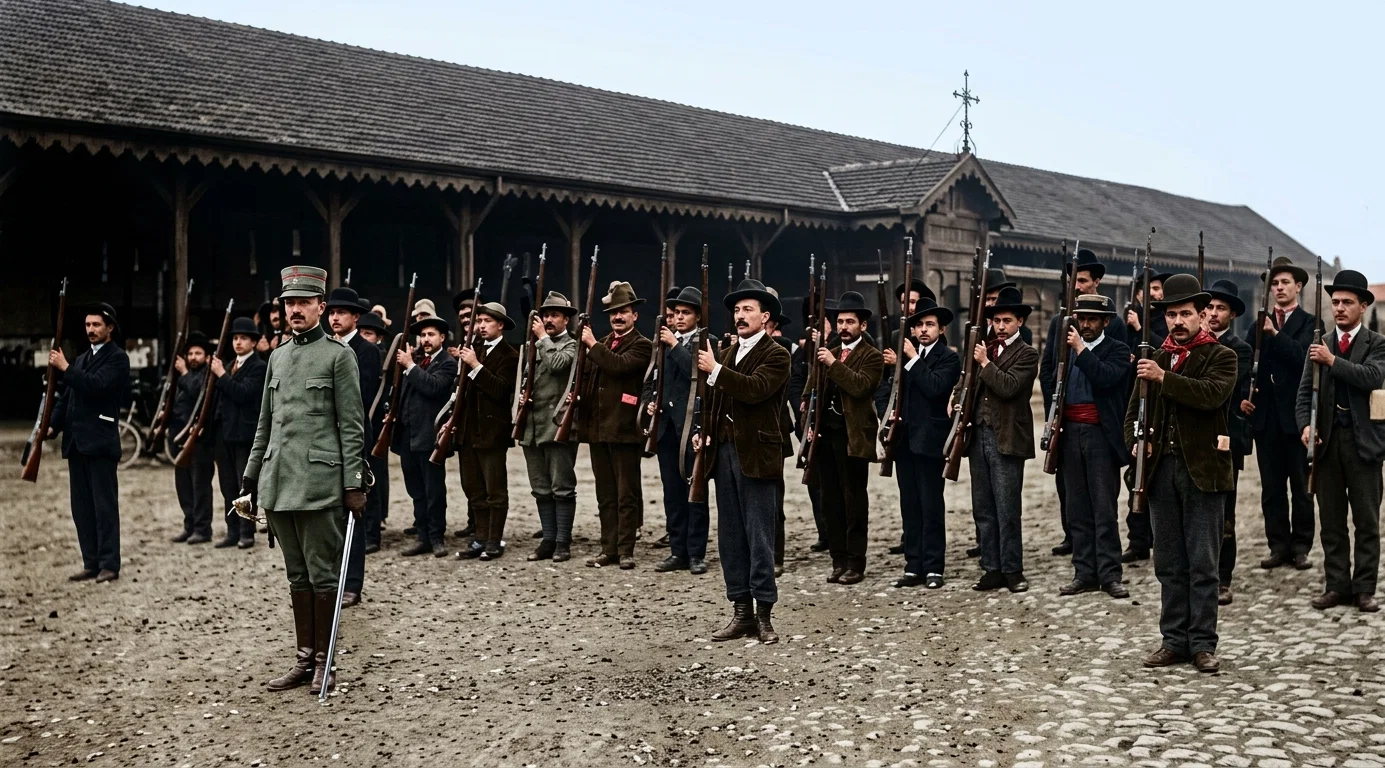
ITALIAN SOCIALISTS DRILLING FOR WAR
In 1730 Russia, with the help of Austria, tried to reach Turkey through the Balkans.
In 1768–1774 Russia invaded Turkey, and destroyed Turkish shipping in the Black Sea. She would then have taken Constantinople, but the fates seemed against her, as the black plague broke out in the Russian army, and Constantinople was again spared.
In 1787 Catherine the Great met Emperor Joseph of Austria in the Crimea, and they agreed on the division of Turkey in Europe, Austria to take the western division, and Russia the eastern, including Constantinople; but their plans failed.
In 1788 Russia attacked Turkey along the Danube, and penetrated as far as the southern boundary of Bulgaria, when Turkey sued for peace.
In 1810 a Russian army invaded Turkey, but had to abandon the campaign on account of disease and a lack of provisions.
In 1828–9 Russia again invaded Turkey, and proclaimed that she was headed for Constantinople. But the plague broke out, and again the Moslem capital was saved.
In the war of the Crimea of 1854–6, Russia again declared her objective to be Constantinople; but she was doomed to disappointment, as England and France and Sardinia came to the rescue of the Turk, and Russia was forced to surrender the territory of Roumania to Austria.
In 1877–8 Russia declared herself to be the champion of Christendom, but again the goal toward which she was headed was Constantinople. She penetrated Turkish territory until it seemed her hopes were to be realized, when England sent a fleet through the Dardanelles to the relief of Constantinople. Disease among the Russian troops, and the threatenings of the English, again saved the capital of Turkey from being seized by the Russians.
In 1908 the minister of foreign affairs of Russia and the minister of foreign affairs of Austria met in a castle in Moravia and agreed on a division of Turkey in Europe, Austria to take the western division, and Russia the eastern, including Constantinople. When other powers were approached, they would not give their consent to such a plan, and again the much coveted city escaped.
Russia Now Confident
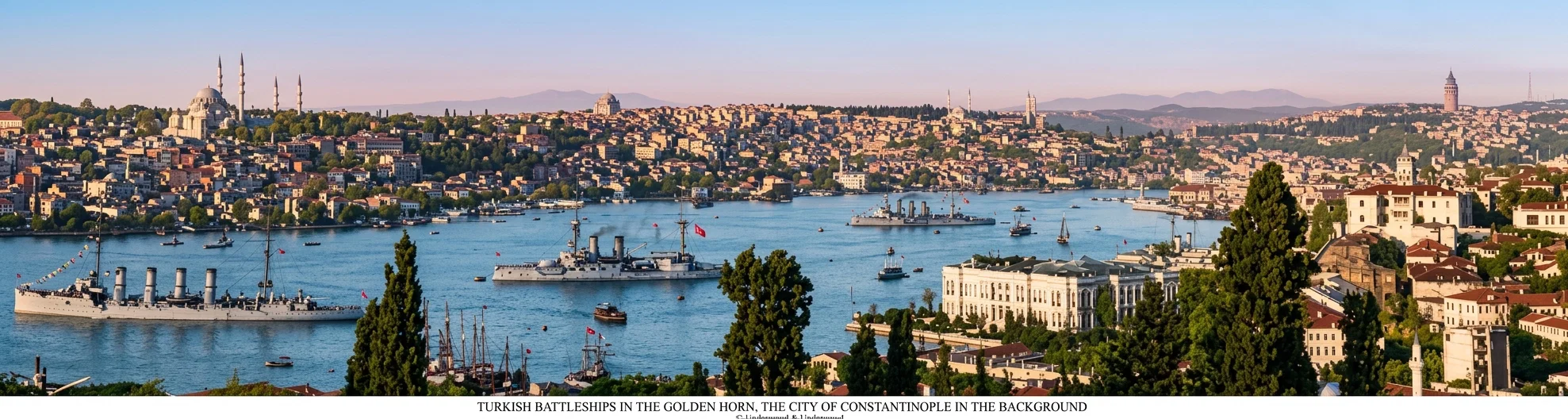
Russia is now pressing on to the goal, and the allied powers are helping her, as their fleets are now hammering the fortifications of the Dardanelles. The Russian Black Sea fleet is also approaching Constantinople from the east, and the sultan is taking up temporary quarters at Brusa, south of Constantinople, in Asiatic Turkey. Russia is certain that the city of Constantinople is to be her portion.
Great Britain, which has often opposed Russia in her desire to gain control of Constantinople, is now “in entire accord with her doing so.” Sir Edward Grey, in addressing the British Parliament, said that England was “in sympathy” with Russia’s gaining access “to the sea.”
So confident is Czar Nicholas of success in gaining the coveted prize, that he has already named Constantinople Czargrad—Czar’s City. In a manifesto to his people, the czar stated, “We believe, and the whole Russian people believe, that the ill-advised interference of Turkey in the present struggle will not only hasten the progress of events that for her will be fatal, but will open for us a way to the solution of the historic problems connected with the Black Sea, which we inherited from our ancestors.” The present sentiment in Russia is, “On to Czargrad.” Many view the final solution of the struggle for Constantinople optimistically, and have visions of a “syndicate of nations” and “the federation of the world.”
The Picture of the Future
The prophet presents no flattering picture of the future so far as this wicked world is concerned. After the capital of the Turk is planted in the “holy mountain” at Jerusalem, the time will come when without help “he shall come to his end.” “And at that time shall Michael stand up; . . . and there shall be a time of trouble, such as never was since there was a nation.” Then God’s people “shall be delivered,” and the resurrection of the dead take place. See Dan. 11:45; 12:1, 2.
With Holy Writ agree the words of Louis Kossuth, who said, “In Turkey will be decided the fate of the world.” Turkey also realizes that her stay in Europe is about ended, and that she will soon have to return to Asia. Sir Winifred Blunt, in “Future of Islam,” page 95, says: “Ancient prophecy and modern superstition alike point to the return of the Turks into Asia as an event at hand. . . . The feeling of a coming catastrophe is so deeply rooted and so universal.”
Turkish Capital Must Be Moved
Dr. Jesperson, for some years a missionary in Palestine, said: “During the Balkan war, I talked with different Turkish officers stationed at Jerusalem; and they were free to state that the capital of Turkey would have to be moved from Constantinople, and in event that it should be, it would no doubt be located in Jerusalem.”
How remarkably the words of Dr. Martin Luther agree with the declaration of the prophet: “If you beat back the Turk, the prophecy of Daniel will be fulfilled and the end at hand. Then the day of Judgment is surely at our doors.”
Albert Bushnell Hart, professor of history, Harvard University, makes the following statement: “In case of victory, the Russians will certainly demand Constantinople, which means that the Turk would be finally shoved out of Europe.”
Truly we are living in a history-making age, and in the most solemn period of the world’s history. We are standing face to face, as it were, with the solemn realities of the Judgment. Therefore, now is the most opportune time we will ever have to bring our lives into harmony with the divine will.