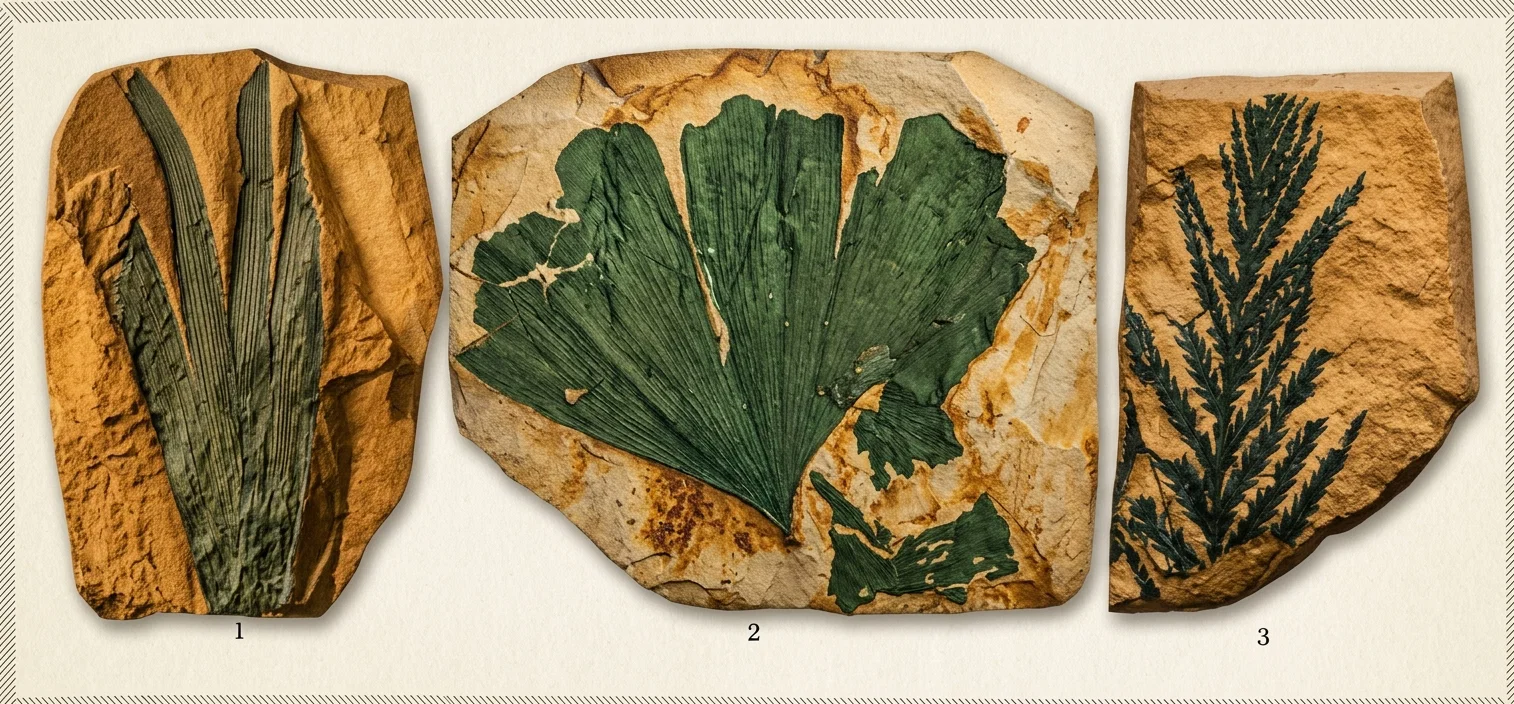
These cuts from U. S. Geol. Survey, professional paper No. 85
Voice of the Plants in the Coal Beds
By George McCready Price
Remains of Tropical Plants in the Frozen North—Evidences of a One-Time Luxuriant Vegetation—How Did It Get There?
By GEORGE McCREADY PRICE
If you take your map of Alaska, you will find a point one hundred sixty miles north of the Arctic Circle, and about three hundred miles directly north of Nome, which is called Cape Lisburne. This cold, desolate region, where the soil is frozen hundreds of feet deep and only thaws out a little on top in the short summer sufficiently to support a few stunted plants, is extremely interesting because of its coal beds and the facts they tell us. Coal, as we know, was made from immense quantities of vegetable matter covered up in the earth and partly oxidized. Here at Cape Lisburne there are forty or fifty successive beds of coal, ten of them being four feet thick each, and one over thirty feet.
When It Was Perpetual Springtime
The plants that contributed to the formation of this coal are largely ferns, palms, equisetums (horsetails), lycopods (club mosses), cycads, and ginkgoes, some of them much larger than the living representatives of the same families. But the chief interest centers in the proof they give of a climate of perpetual spring that must have prevailed there within what are now called the Arctic regions. “A mild and probably frostless climate” is what the Bulletin of the Geological Survey says about it; while F. H. Knowlton, the well-known botanist, says that “the presence of large and luxuriant ferns, many of them tree ferns, and cycads, and of very abundant and large sized leaves of ginkgo,” etc., . . . indicates a moist, warm, possibly subtropical climate.” (Professional Paper 85, page 46.) And that it must have been a profusely abundant and luxuriant vegetation, is attested by the quantity of the coal; for it takes several feet—five to ten—of pressed vegetable matter to produce one foot of coal, and here we have a total of one hundred fifty feet of coal beds.
Has the Earth Shifted?
Some people, on learning of such conditions in the Arctic, immediately think that the earth’s axis must have shifted, and that what are now the Arctic regions were once the tropics, and vice versa. But of this there is no evidence whatever. On the contrary, there is every evidence that at the time indicated here, a mild, equable climate covered the entire globe. Plants even identical in species with these found here have been reported from the Antarctic, as well as various other parts of the Arctic regions, Siberia, China, Japan, Germany, France, England, Oregon, and now here in Alaska. As the Geological Survey Bulletin expresses it, a large percentage of the whole Jurassic flora “was practically world-wide in its range.”
It Was Done Suddenly
But the change from that Eden-like condition of universal loveliness to our present conditions of violent extremes, was no gradual process, as the followers of Lyell would like to have us believe, but a sudden, violent change, an accompaniment of the Deluge. The huge animals—elephants, rhinoceroses, etc.—still preserved in the ice of Siberia and Alaska, are incontestable proof of this, even apart from the evidence in the coal beds themselves that they were buried by a sudden and awful catastrophe.
But though all these things are proofs of that world disaster called the Flood, I always like to look upon them more as relics of that Eden world upon which the Creator looked in its finished perfection and which He pronounced “very good,” and also as pledges of that happy coming time when He will again “make all things new.”
And how appropriate that the Lord is now uncovering these buried witnesses to refute the theories of the present generation, who have so completely explained away creation and the Creator! Surely the facts above enumerated have a large part in swelling that message which calls upon this age of evolutionists to “worship Him that made heaven, and earth, and the sea, and the fountains of waters.” Rev. 14:7.