WONDERFULLY beautiful to him who hungers and thirsts for the knowledge of God, is the story of the Christ as told in the types and symbols of the earthly sanctuary. In the record of the shadowy service of the long ago, the seeker after truth finds a vivid pen-picture of both the person and work of the Lord Jesus—of Jesus the Sin-bearer, of Jesus our great High Priest. Evidently the writer of the epistle to the Hebrews so regarded the matter; for, after reviewing the work of the past, he said: “Now of the things which we have spoken this is the sum: We have such an High Priest, who is set on the right hand of the throne of the Majesty in the heavens; a Minister of the sanctuary, and of the true tabernacle, which the Lord pitched, and not4man. For every high priest is ordained to offer gifts and sacrifices; wherefore it is of necessity that this Man have somewhat also to offer.” Heb. 8:1-3.
God’s Word is sure. “The Scriptures can not be broken.” Just so truly as on earth there were typical offerings for sin, and priests to minister, so truly in heaven there are both Offering and Priest for the sons of men.
Jesus Our Sacrifice
From the day that sin first entered this fair world of ours until now, our heavenly Father has been striving to lead men to look upon Jesus as their sacrificial Substitute. “Blessed be the Lord God of Israel; for He hath visited and redeemed His people, and hath raised up an horn of salvation for us in the house of His servant David; as He spake by the mouth of His holy prophets, which have been since the world began.” Luke 1: 68-70. Jesus is the “Lamb slain from the foundation of the world.” Rev. 13: 8. In the ecstasy of divine assurance, John the Baptist cried out, “Behold the Lamb of God, which taketh away the sin of the world.” John 1: 29.
The story of Jesus, our Sacrifice, is so blessedly simple that even a child can understand. In that terrible day when sin first intruded itself into man’s life, the Son of God looked down from His holy habitation and saw that “there was none to help,” and “wondered that there was no intercessor; therefore His arm brought salvation unto him.” Isa. 63: 5; 59: 16. That day He gave Himself up in man’s behalf; the iniquity of all was laid upon Him (Isa. 53: 6), and all heaven’s agencies were at once set in operation for the accomplishment of His will. By patriarch, priest, and prophet, man was instructed concerning the Lamb that was to come; and “when the fulness of time was come, God sent forth His Son, made of a woman, made under the law, to redeem them that were under the law.” Gal. 4: 4, 5.
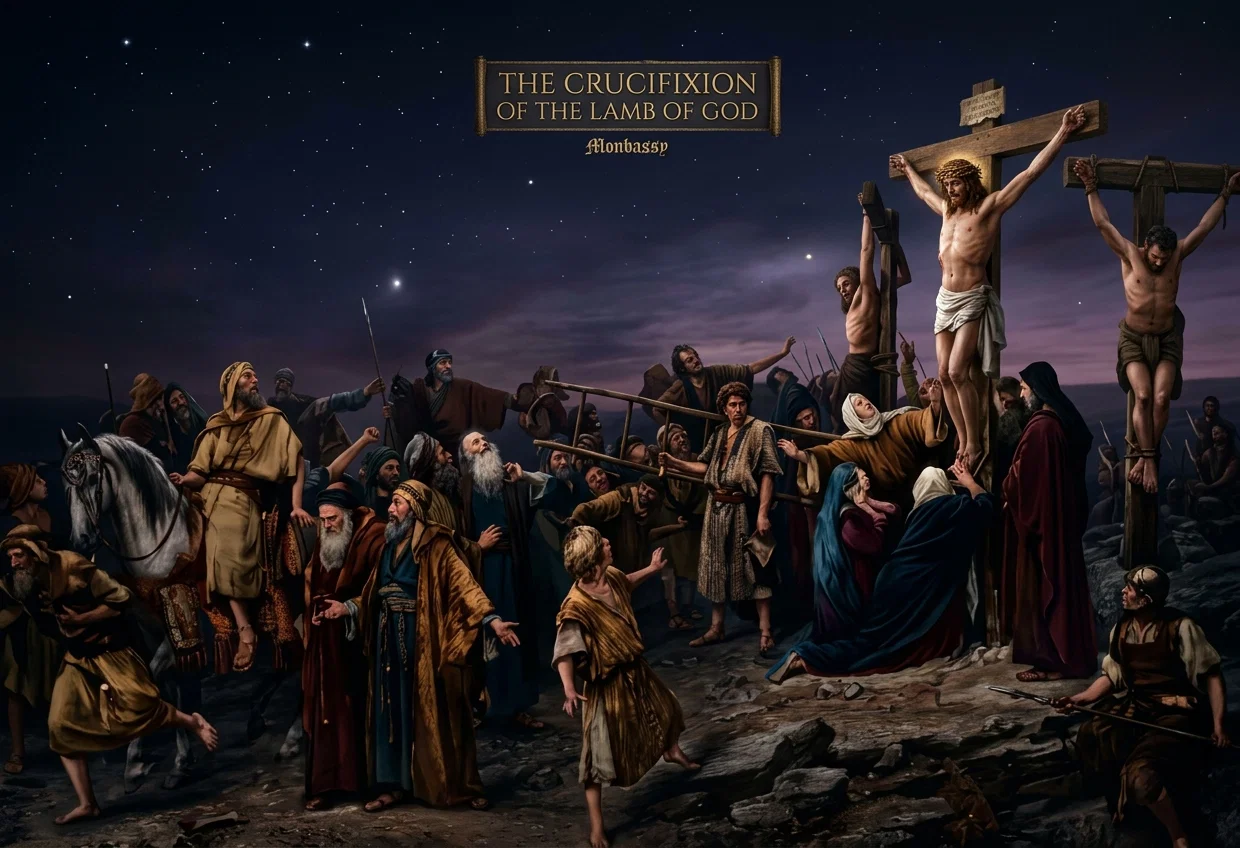
Calvary came. In harmony with that which was “determined before to be done” (Acts 4: 28)—namely, “that He by the grace of God should taste death for every man” (Heb. 2: 9)—Jesus was there “brought as a lamb to the slaughter” (Isa. 53: 7). He “who knew no sin” (2 Cor. 5: 21), the “Lamb without blemish and without spot” (1 Peter 1: 19), there “offered up Himself” (Heb. 7: 27).
But Why Must He Die?
Ah, it was that God “might be just,” and yet “the Justifier of him which believeth.” Rom. 3: 26. All had sinned (Rom. 3: 23); “sin is the transgression of the law” (1 John 3: 4); and “the wages of sin is death” (Rom. 6: 23). That God’s holy law might be satisfied and upheld, and still sinful man be saved, Jesus, the Author of the law, threw Himself into the breach. He put Himself into man’s place, taking all that man deserved, that the man might have all Christ deserved. He took man’s death, that man might have His life. “Who His own self bare our sins in His own body on the tree, that we . . . . should live unto righteousness.” 1 Peter 2: 24. “He hath made Him to be sin; . . . that we might be made the righteousness of God.” 2 Cor. 5: 21.
By His death the Son of God made possible reconciliation between God and man. Rom. 5: 10. He “abolished in His flesh the enmity . . . to make in Himself of twain one new man.” Eph. 2: 15. By the gift of Himself, He broke down the wall of sin which shut man away from heaven.
But this is not all. The Scripture says (Heb. 9: 22), “Without shedding of blood is no remission.” As in the type, so here, the blood is the medium by which sin is transferred to the sanctuary on high, the channel through which, by prayer, man can find access to Jehovah’s throne. Heb. 10: 19. The blood of the cross makes peace. Col. 1: 20. And blessed indeed is the glorious truth that “the God of peace . . . through the blood of the everlasting covenant,” makes man “perfect in every good work to do His will.” Heb. 13: 20, 21.
Jesus Our High Priest
“Seeing then that we have a great High Priest, that is passed into the heavens, Jesus the Son of God, let us hold fast our profession.” Heb. 4: 14. Having completed His earthly ministrations, our Lord took His departure to the courts above, there to “appear in the presence of God for us.” Heb. 9: 24. He is there as our Advocate (1 John 2: 1), seated with the eternal Father upon the throne of mercy and grace. Heb. 4: 15, 16. Surrounded and assisted by those who ascended with Him to heaven (Matt. 27: 52, 53; Rev. 5: 6), He there, by a specific and a well-defined service, completes what Calvary had begun.
And let all remember that our High Priest in the heavenly temple must “have somewhat . . . to offer” for sin, even as did the priests on earth. Heb. 8: 1-4. Of the earthly service the Scripture says, “For if the blood of bulls and of goats, and the ashes of an heifer sprinkling the unclean, sanctifieth to the purifying of the flesh; how much more shall the blood of Christ . . . purge your conscience from dead works to serve the living God?” Heb. 9: 13, 14. And this makes the story plain. To-day Jesus Christ pleads His own “precious blood.” In behalf of His lost ones on earth, He stretches forth His hand to the Father, and asks that for His own blood’s sake the Father have mercy upon those who by the broken law are condemned to death. His constant word is, “Father, remember the blood, remember the blood!” And as the prayers and confessions of His believing children come up before God, He mingles with them the fragrant incense of His righteousness (Rev. 8: 3, 4), the merits of His own blood. This is a glorious truth; and thus the Master graciously reminds us that, “having an High Priest over the house of God, let us draw near with a true heart in full assurance of faith, having our hearts sprinkled from an evil conscience.” Heb. 10: 21, 22.
“The sprinkled blood is speaking.” Does it speak for you and for me?—It does, if we have chosen that it shall. The work of the atoning sacrifice can be wrought out in us only by our cooperation. Man must yield his will in order that God may work. Man’s part is to make the offering of Jesus Christ his own personal offering. Says the Lord, “Thou shalt make His soul an offering for [thy] sin.” Isa. 53: 10.
Jesus is our Priest forever (Heb. 5: 10); His priesthood changes not (Heb. 7: 24); and because of this, “He is able also to save them to the uttermost that come unto God by Him, seeing He ever liveth to make intercession for them.” Verse 25. Blessed hope! And this hope “we have as an anchor of the soul, both sure and steadfast, and which entereth into that within the veil; whither the Forerunner is for us entered, even Jesus, made an High Priest forever after the order of Melchizedek.” Heb. 6: 19, 20.