Our London Letter

3%

Pacific Press Publishing Association · Mountain View, California · Jun 16, 1909

FromSigns of the Times, Vol. 36, No. 23.

Read the full edition

Our London Letter

(From Our Own Correspondent)
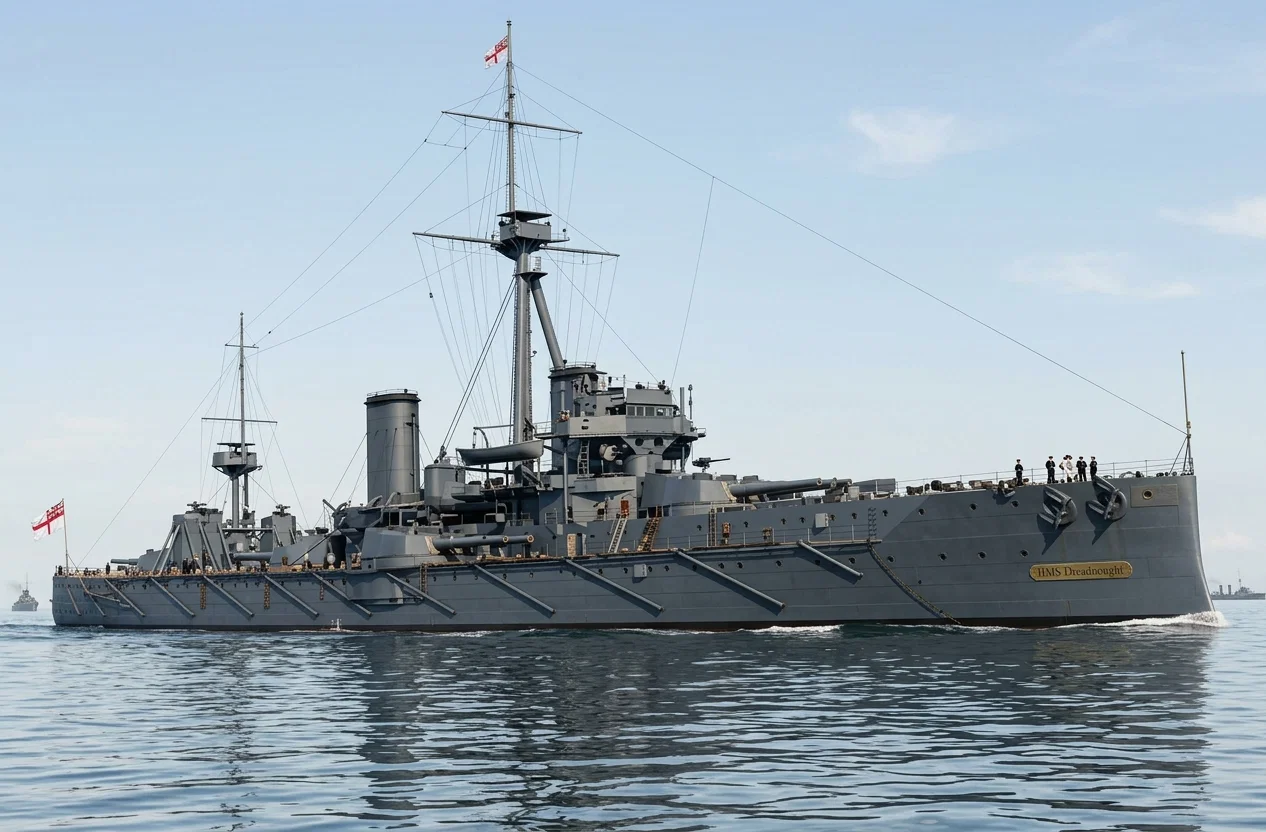
H. M. S. "Dreadnought." The vessel marked the new type of battle-ship.
[Prof. M. E. Olsen has connected with the Foreign Mission Seminary in Washington, D. C., and we have lost a valuable correspondent. But we have asked Mr. W. T. Bartlett, editor of the Present Truth, London, Eng., to furnish us a quarterly review of the field from the great London watch-tower, and he has kindly consented. This is his first contribution.—EDITOR.]

The Clouds of War

THERE has come home to the heart of England during the last few weeks a new and unwonted realization of the meaning of the struggle for armed supremacy among the nations. The shadows of Armageddon have grown distinctly darker and more threatening. Hitherto the possibility of war with other Powers has been discussed with comparative complacency, because no matter what their advantages might be in military strength, England’s unapproached naval armament guaranteed the security of her coasts and the maintenance of her commerce; but now the future wears another aspect. England’s place of pride on the seas is to be disputed by the greatest military power on the continent of Europe.
A few weeks ago, Mr. Asquith, the Prime Minister, announced to the House of Commons that by an unlooked-for acceleration of her ship-building program, and a rapid multiplication of her dockyard facilities, Germany had made such a spurt in the race that in the course of another three years her force of “Dreadnoughts” would be practically equal to our own. In order to meet this danger, Mr. Asquith asked that another four “Dreadnoughts” be added to our program. His demand was acceded to without hesitation, and he was urgently pressed by the opposition party to double the number. Had the government called for a vote authorizing them to build eight or even more, there is no doubt that the permission would have been given by an overwhelming majority. It is long since England was so deeply stirred.

Deemed a Necessity

The advocates of peace and disarmament strove to stem the current, but without avail. Everybody united in deploring the foolish extravagance of spending such vast sums of money on preparation for war, when the means were needed so badly for other pressing purposes, but everybody declared that the fleet must be strengthened at any cost, in order that England might preserve her present place among the nations.

Conscription Inevitable

It is beginning to dawn upon England that her comparative freedom from the fear of invasion will soon be a thing of the past. There has been an almost entire change of tone during the last few weeks on the subject of conscription. For years there had been a steady and continuous effort to accustom the public mind to the idea of compulsory military service, but with small success. Now people seem to recognize that conscription is inevitable.
In his speech to the House, Mr. Asquith declared his own abhorrence of the idea of spending so much additional money on “Dreadnoughts”—but at the same time declared his helplessness. He said: “No set of men here are more anxious to save money for social reform and to get rid of this horrible, devastating, sterilizing expenditure, but this is the least we can demand from the House of Commons.”

Public Sentiment

There was a scene of deep, suppressed excitement in Parliament when Mr. Asquith made his statement concerning the enormous developments that had taken place in Germany’s preparations. The “Daily News” said: “That last ten minutes when Mr. Balfour and Mr. Arthur Lee on the one hand, and Mr. Asquith and Mr. MacKenna on the other hand, compared month by month, their estimates of the respective naval strengths of Great Britain and her mighty rival, while the House sat mute with sudden excitement, overshadowed every secondary thought. There was no eloquence; it was like a council of war; but the thought which sprang to the imagination was the fact of force—brute, barbarian force, shattering ideals, obliterating distinctions of party, mentioned with a certain terrible calmness, just as the scientist in measured tones diagnoses an earthquake which has destroyed a nation.”

The Former Standard Impossible

Hitherto it has been the declared aim of English naval policy to maintain a fighting naval force at sea fully equal to the naval strength of the next two strongest powers, but it has now become thoroly apparent that this is impossible. Other nations of great wealth and much greater population have entered the lists, and England can not expect to do more than keep ahead of any one nation. In the course of the discussion in the House of Commons, Mr. John Dillon, one of the Nationalist members for Ireland, asked what England would do to maintain her naval superiority if America should take it into her head to be first in the ranks of the world’s navies. He said: “Supposing that America were to say that, as she had the largest seaboard in the world, and as she had two oceans to protect, she would be mistress of the seas; she would have some excuse.” He noticed that that morning the “Daily News,” the organ of peace, said that if there were war between Japan and America, England might be forced by her treaty to take the side of Japan. “But, supposing America were to say that she would have the biggest navy, are you going to build against America then?” asked Mr. Dillon. “I tell you, and I know what I am talking about, that if she took it into her head, she would break you in ten years. Instead of flourishing these challenges in the face of the world, you ought to use your great power to set an example of moderation and peace.”
No speaker in the whole course of the discussion has been listened to more eagerly than the Foreign Secretary, Sir Edward Grey, who is one of the most respected men in English public life. He sees but one possible end to the unceasing expenditure in which the great Powers are engaging: “The great countries of Europe are raising enormous revenues, and something like one-half of them is being spent on naval and military preparations. You may call it national insurance, that is perfectly true; but it is equally true that one-half of the revenue of the great countries of Europe is being spent on what are, after all, preparations to kill each other. Surely, the extent to which this expenditure has grown really becomes a satire and a reflection upon civilization. Not in our generation, perhaps, but if it goes on at the rate at which it has recently increased, sooner or later I believe it will submerge that civilization.”
These words are no thoughtless utterance of an irresponsible speaker, but the calm, deliberate utterance of a high-principled statesman, who speaks with a full sense of responsibility. At the same time, while Sir Edward Grey recognizes the inevitable end of such a competition, he sees nothing for it but for England to make whatever sacrifice may be demanded to keep her present place of naval preeminence. “If we allow ourselves to fall behind in the race,” he says, “we should be fortunate if our liberty were left and we did not become the conscript appendage of some stronger power. That is a brutal way of stating the case, but it is the truth.”

Position of Germany

Sir Edward Grey is fair-minded enough to recognize the position of Germany. He makes no complaint because they do not show a spirit of willingness to come to an amicable arrangement with England for a mutual suspension of ship-building: “We should be glad if they did, but we have never suggested that it should be a ground for complaint against them if they did not. On whatbasis would any arrangement have to be proposed? Not on the basis of equality. It must be the basis of a superior British navy. No German, so far as I know, disputes that that is the natural point of view for us, but it is another thing to ask the German Government to expose itself before its own public opinion to a charge of having cooperated to make the attainment of our views easier. That is a difficulty which it is only fair to state.”

A Military Scheme for the British Empire
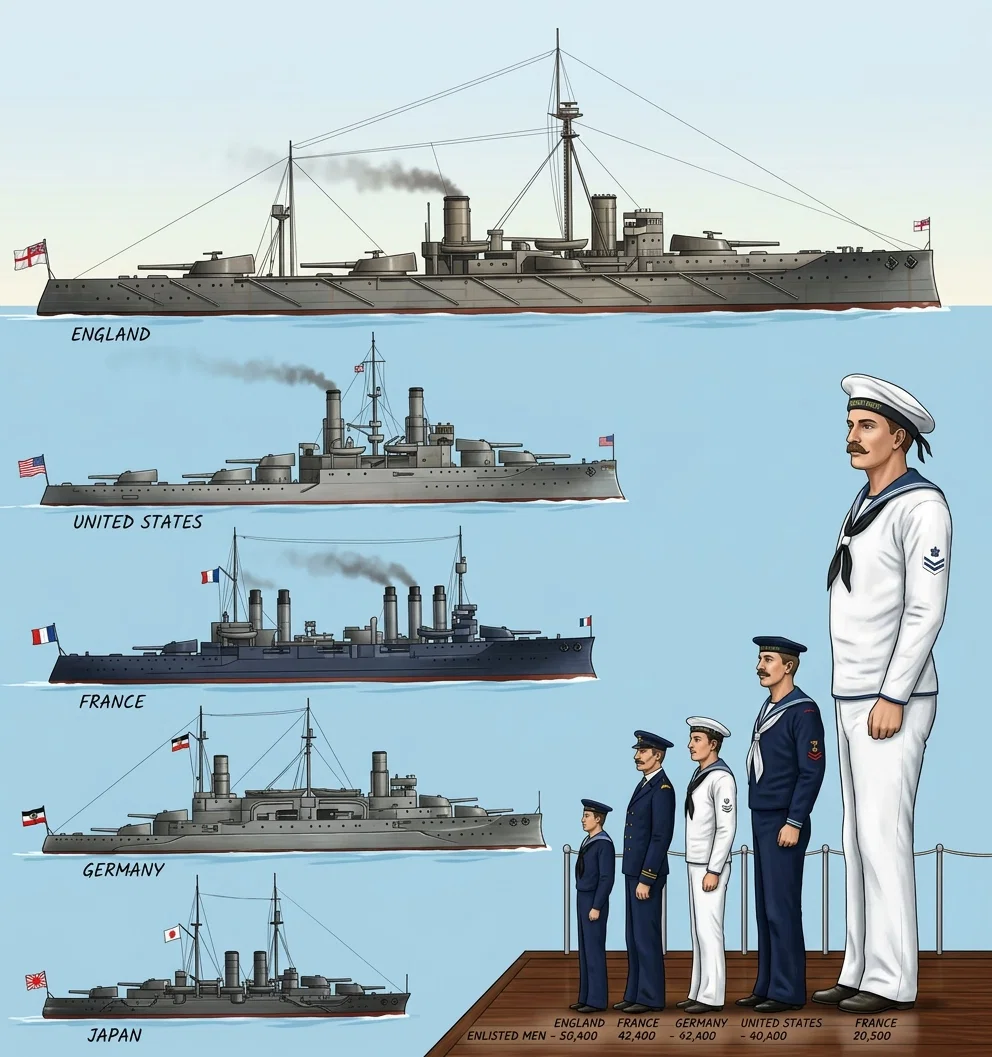
Comparative strength of leading naval powers in ships and enlisted men as it was about a year ago. England had in ships, 1,633,116 tons; while Germany had 529,032 tons. England had 98,973 enlisted men, and Germany 42,400. England wishes to keep more than twice the war strength of Germany. It is fear of Germany's changing this comparative strength that has caused the present agitation in England.
Only a few weeks ago Mr. Haldane, the English Secretary of War, was presenting a scheme by means of which all the Colonies and Possessions of England were to be linked with the mother country in a military system which would give to the Empire a total force of twenty-three army corps, equal to the vast army maintained by the German Empire. Mr. Haldane’s plan was that the garrisons in all the Colonies and Dependencies should be drilled and organized upon the same plan, so that they would form interchangeable units in one military whole. He relied upon England’s naval supremacy to maintain the unity of this force. By her command of the sea, England would be able at any time to transfer parts of this force from one place to another, or concentrate it all at one point. If this scheme were carried out, England’s naval supremacy, joined to the possession of so vast an army, would practically confer upon her military supremacy also. In the presence of such a program as this, no one can wonder that Germany is deeply convinced of the necessity of building a navy that will be able to compete with England on equal terms if she wishes to maintain her military position.

Distrust, Suspicion, and Insecurity

The trouble is that all the nations, while they feel the utmost confidence in their own pacific intentions, place little confidence in the honesty and friendliness of one another. Each feels the necessity of maintaining forces that will make it formidable to its neighbors and protect it from sudden attack, while the other Powers, looking on at these preparations, take it for granted that they are, on the first favorable opportunity, to be aimed at themselves. Thus the uneasy competition proceeds, growing ever keener.
The recent course of Austria in tearing up the Treaty of Berlin has produced a general sense of insecurity in Europe. On this point Mr. A. J. Balfour, the leader of the Conservative party in the House of Commons, spoke of the proved inadequacy of Treaties to restrain an ambitious policy of conquest: “The only security in that case is the security of the law of Europe—the security of those treaties by which less powerful states may feel that, tho they be less powerful, they nevertheless are members of a civilized community of nations to whom they can appeal, and appeal with security, to the law of Europe which is above them all. “Will any man say that that public law has been strengthened in the last few years, the last few months, or even the last few days? I mean to say that, so far as I can observe, the tendency of public affairs, that which is ultimately to be the great basis, tho I am afraid I shall not live to see it, of peace and security among civilized society, the great organization of the public law of Europe, shows signs, not of strengthening and growing, but of weakening and falling away.”
The real difficulty, then, which is involving the Powers of Europe in the present enormous waste of their resources, is the general lack of confidence in one another. Sin has destroyed the very foundation on which mutual respect and confidence are based. Selfishness is the ruling feature in the hearts of statesmen, and they know it. No one expects from another any more consideration than he is able to enforce. In spite of all the advancement in knowledge, and all the experience gleaned from human history, the kingdoms of this world are marching toward a common destruction, because they have rejected the rule of God, and sought to order their course by the corrupt principles of human statecraft. Civilization is demonstrating that it is worthless apart from the Gospel.

A Retrograding Force

Every nation that enters into the mad competition for military and naval preeminence becomes a downward force dragging the other nations with it. Even those nations that in the past, like the United States, have been comparatively free from this curse, and which were designed in God’s providence to be elevating forces, drawing other nations to higher and better things, are now becoming leaders along the downward path, misusing their wealth and opportunities to secure for themselves a foremost place in the mad rush, and setting for their less favored competitors a more rapid and exhausting pace. Among the countries of Europe all kinds of needed reform are clamoring for attention, but these must be put on one side, in order that the demands of armies and navies may not be interfered with.
We have reached a stage of greatly increased intensity in the world-wide preparation for war. The words of the prophet Joel are taking on a new and more thrilling significance: “Prepare war, wake up the mighty men, let all the men of war draw near.” Joel 3:9. We are beginning to feel as tho, under the increased pressure, the fulfilment of the words that follow in the prophecy may not lie very far in the future: “Beat your plowshares into swords, and your pruning-hooks into spears.” Verse 10.
But beyond the noise and tumult of arming nations lies the fulfilment of another feature in the prophetic picture. “Thither cause Thy mighty ones to come down, O Lord.” “The day of the Lord is near in the valley of decision.” Verses 11, 14. Louder than earth’s artillery will be heard the voice of the Lord, as He comes in flaming fire taking vengeance on His enemies: “The Lord also shall roar out of Zion, and utter His voice from Jerusalem; and the heaven and the earth shall shake: but the Lord will be the hope of His people, and the strength of the children of Israel.” Verse 16. That consummation hastens apace. As we stand in the midst of scenes of strife and perplexity and hear the harsh voices calling a world to arms, we know by these tokens that it is time to lift up our heads and rejoice, because the day of redemption also draweth nigh. Luke 21:25-28.
W. T. BARTLETT.