THE General Conference of Seventh-day Adventists now convened in this city has entered upon the second week of its duties. Much instruction has been given, many stirring appeals have been made, many earnest prayers offered for divine guidance and Christian harmony in the deliberations of the Conference. While worldly pastors are discussing the decadence in extemporaneous prayer, it is refreshing to know that, where the whole soul is consecrated to the work of the Lord, mighty prayer is not only a possibility but a glorious reality. On numerous occasions we have listened to such petitions at this conference, petitions which carried the hearts of the hearers in a grand uplift toward the throne of God. It was impossible to listen to them and not be moved by them to a closer walk with God. Out of the mistakes of the past and into the light of the present in unity and power is the burden of the instruction given.
IN the sermons given both by Mrs. White and others no discordant note has been heard. The message in its simplicity and purity, the message shorn of extraneous theories, and clothed with God’s abundant power, has been ringing through the conference from the first meeting to the present time. In the business meetings of the conference some matters relating to the ownership and control of institutions have caused more or less discussion; but it is the belief of the delegates that these matters will be settled in a way that will tell for the unification of the work and the advancement of the cause.
AT the sixth meeting of the session, the chairman, H. W. Cottrell, called for reports from the various Union Conferences, and reports were submitted from the Canadian Union Conference, the Central Union Conference, the Northern Union Conference, and the Pacific Union Conference. Progress in the work was a characteristic of all these reports. All showed an increase in tithes, and offerings for foreign missions. The Canadian Union showed an addition of 65 new members with a prospect of many more in the interested ones who are still investigating. This conference is planning for training schools where workers can be trained for service in their own field.
THE Central Union reports a church membership of 13,200, with isolated Sabbath-keepers numbering 757; 343 organized churches; and 196 laborers on the conference payroll; an increase of over $14,000 in denominational books sold; and a total of tithes for the year amounting to $104,572. This Union Conference has been contributing liberally of both laborers and means to the work in foreign fields.
THE Northern Union Conference, comprising Minnesota, North and South Dakota, the province of Manitoba, and the Canadian territories of Assiniboia, Saskatchewan, and Alberta, reported a church membership of about 4,000 in a population of 3,000,000 souls. Eleven new churches have been organized with an aggregate membership of 268. This Union Conference, while supporting 36 church schools, is planning for the establishment of an industrial school—when the means shall be in hand to pay for the same. The president, in submitting his report, stated that all their workers were subject to the call of the Foreign Mission Board, and their interest in the work was not bounded by the lines of the conference. The Mission Board was invited to call upon this Union Conference for both men and means to help in the foreign fields.
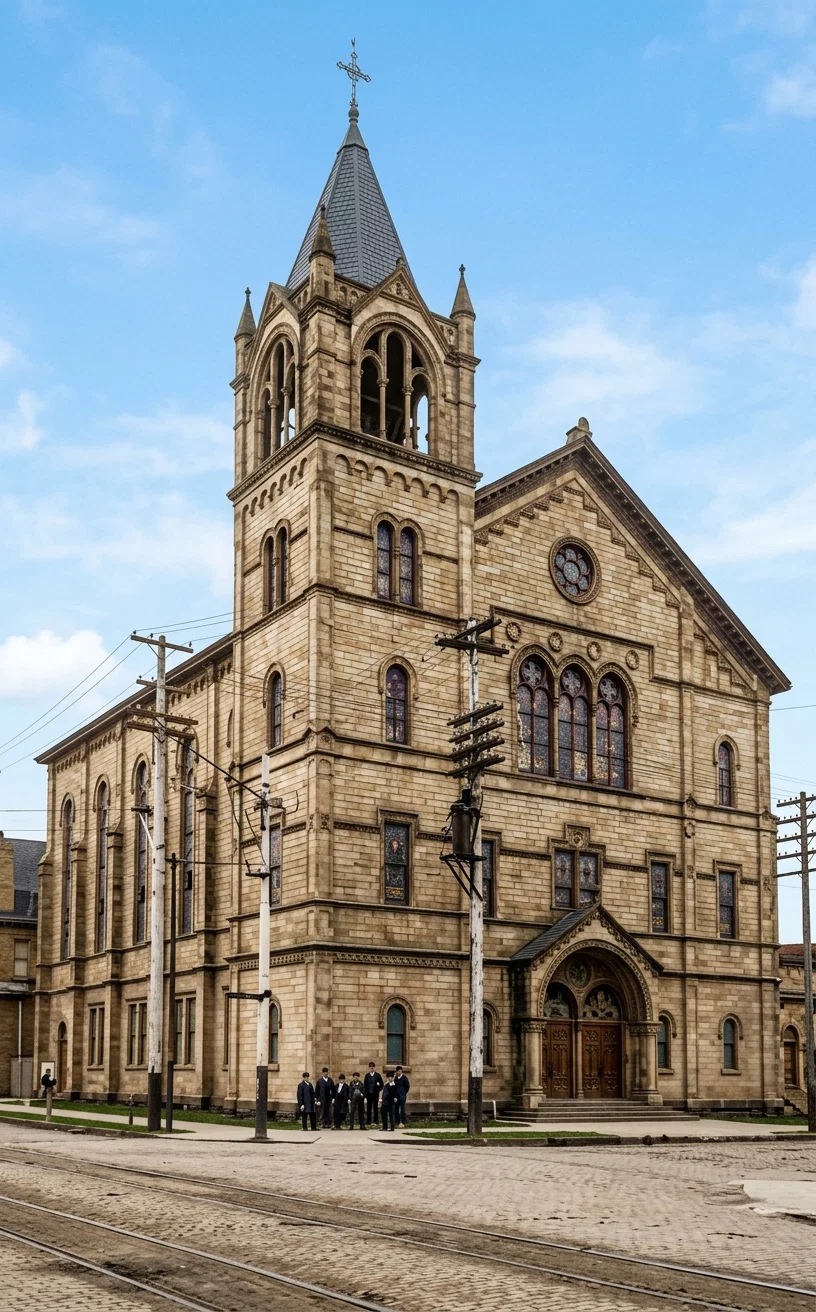
Church Where the General Conference Has Just Closed. Seating Capacity, 1,800.
THE Pacific Union Conference, including the Pacific States, Arizona, Utah, British Columbia, Alaska, and the Hawaiian Islands, reported a membership of 9,845, divided among 212 churches, whose tithe for the past two years amounted to $212,588. This Union Conference also has shown a material gain both in membership and in tithes and offerings, and has added thirty to its list of Conference laborers. The educational work and the medical missionary work are both well established in this Union Conference, and at the schools industrial training is being brought in as fast as proper facilities can be secured.
TUESDAY morning, March 31, Mrs. E. G. White again addressed the congregation, her theme being the manner in which we should receive the blessings of God, the way we should relate ourselves to those blessings, to God, and to one another. She deprecated the hurry of the present day, to which many were yielding to that extent that they had no time to pray or to train their children, and urged all to place themselves in right relation to God and to teach His lessons to their little ones. The address closed with an earnest appeal for thorough repentance which would prepare the way for the reception of the Lord’s blessing. Then all united with the speaker in an earnest prayer for pardon and help. At the morning meeting on April 1 Mrs. White spoke again, taking for her subject unity of effort in the work of the Lord.
ONE of the features of the conference has been the meetings held each day at 1:30 for those specially interested in Sabbath-school work. At these meetings special counsel and instruction is given for the workers in that line of missionary endeavor.
DURING the discussion of the recommendation regarding the support of workers in needy fields, A. G. Daniells read a list of the different conferences that were supporting laborers outside of their own fields. Fifty-two laborers at least, and in all probability sixty, were being supported in needy fields by individual conferences; while there is a probability that this feature of the work will be increased in the future.
THE sermon on Monday evening, by E. J. Waggoner, was an interesting setting forth of “The Gospel of the Kingdom,” showing that growth is the characteristic of truth, and that there was no disloyalty to the fathers in seeing more in the Word than what they saw. Loyalty to the truth meant loyalty to all the truth the Word contained, and to give the message meant to preach the Gospel in its entirety—and not only to preach it in word, but to have it in the heart. He said in brief—
God is light, and we are to walk in the light, in Him, and we ourselves are to be lights in the world. We have not time to do or to think anything that will weaken our testimony to the world. We have all been conscious of a weakening of our testimony because we were not light. We have interposed a veil between our hearts and the glory shining from the face of God, and just to the extent that we did that we were not the witnesses of the Lord. The testimony of Jesus is to be given to the world; but it can be given only as Jesus Himself dwells in us to bear witness of Himself. One thing is sure, and that is that nothing less than the complete fulness of the message, not only as it was proclaimed by the Lord, but as it existed in Him, must be given before the Lord can come. If that message is not carried in the individual as well as by Him, it does not get to the world. We are to look forward, and not backward; and by that I do not mean that we are to repudiate any truth that we once held, but we must understand that the path of the just is as the shining light that shineth more and more unto the perfect day. It is a seed that is sown, and springs up and develops and unfolds. Our fathers preached the truth as it was revealed to them, and that was what gave them the power that accompanied their preaching. Now, when the same truth and the same Spirit shall take hold of us, then the very same power that characterized the preaching of the pioneers of this message will characterize the preaching of those who follow them. And then the end can come. Do not be afraid of the truth. It must develop more and more, or else we will never get the Gospel of the kingdom preached. The greater the light that shines, the easier it is for people to see. So that, as we come nearer to the end, and the truth shines with a broader light, a deeper light, a clearer light, the more easily will it be comprehended; for it is preached with the power of Him who is the Light of the world.
AT the seventh meeting of the conference, G. G. Rupert, president of the Southwestern Union Conference, presented the report from that conference. Here also the doctrine of debt-raising is being promulgated and practised, while earnest efforts are being put forth to carry the Gospel message to those in the conferences included in that union. They have a school and a sanitarium, but feel that their force of laborers is totally inadequate to the demands of the field. This conference raised $20,301 in tithes during the past year, and is supporting a corps of 77 laborers. Elder Rupert stated that they found many difficult problems to solve in carrying on the work in that field. They had a constituency of whites, negroes, Mexicans, and Indians. Something had been done in getting up a literature for the Mexicans, but only a beginning had been made.
THE eighth meeting of the conference convened on April 2, at 10:20 A.M., and the time of the meeting was devoted entirely to the discussion of the recommendations of the committee on plans and resolutions and the partial report of the committee on institutions. The discussion of the recommendations of the first named committee showed that the spirit of sending the message to the regions beyond had taken hold of the conference. At the same time there was a strong sentiment that the needy fields in the home land should not be neglected. The great needs of the work in the foreign fields came in incidentally in the discussions, and it was made evident that this conference meeting would mark a forward step in the prosecution of the work in lands that had not yet been entered, or had been entered in a feeble manner.
THE conference session, evening after the Sabbath, April 4, was given over to a consideration of the work in the European field, L. R. Cottrell finishing the report which he had begun in an earlier meeting. The European General Conference comprises all of Europe, western Asia, and North Africa—an13immense field, and much of it destitute of workers. The general tenor of Elder Conradi’s remarks was “improvement.” There was improvement in the matter of debt-lifting, in the matter of payment of tithes, and in the work done generally. At the same time there were many obstacles to meet in some portions of the field, such as Russia and the Balkan States; but the work was progressing even there, notwithstanding the difficulties encountered.
The sermon on Sabbath forenoon was by Mrs. White. It was a call to repentance and consecration. After setting forth the need for repentance, the need of a preparation for standing before God, she said: “I ask you,—those who realize that you have erred; those who realize what they must be in order to see the King in His beauty, in order to behold the face of God; those who are willing to lay hold of the help that the Lord has given in His Word, and together to wrestle to overcome,—to rise to your feet.” Nearly the whole congregation then arose, and while they were standing, Mrs. White said: “We have made a covenant with God, and now I want to offer a word of prayer. As I pray will you send up your petitions to God? I feel an intense desire that you shall begin to work as you never have worked before to bring to the foundation gold, silver, and precious stones. If you will do this, we shall see the salvation of God revealed in all the churches among us.” Mrs. White then offered a most earnest prayer, and the meeting closed with singing “Jesus, Lover of My Soul.”
SESSIONS 12 and 13 of the General Conference were taken up principally in the discussion of resolutions bearing on the disposition of property belonging to institutions and on the removal of the General Conference headquarters from Battle Creek. The resolution dealing with the latter was passed almost unanimously; but the place to which it should be removed was not decided upon. The dominant sentiment, however, seemed to be that New York City would be the most advantageous place for its location, as this would bring it into touch with the stream of missionary travel.
On Sabbath afternoon, April 4, A. G. Daniells preached a stirring sermon upon the conditions necessary to the finishing of the work. He began with a résumé of some of the discourses already delivered upon the soon coming of Christ and the finishing of the work in this generation, and then asked the question, What is hindering the work to-day? What is the thing to do that will cause our people to rise up and finish the delayed work? He read from the 25th chapter of Isaiah, Rom. 9:28, and Joel 2, to show what was necessary to the prosecution of God’s last great work. He said: “The great need is the reception of the Holy Spirit in its fulness. The one supreme consideration, the one great requirement of the people of God to-day, is the presence, in its fulness, of the Spirit of Jesus Christ. That alone is our sufficiency. That power will fit us for service, fitting us in such a way that we shall finish the service which it qualifies us to perform.” The speaker pleaded for a clear, strong, definite message, and deprecated any manifestation of weakness or tameness, and declared that no finishing power would ever attend this message until it was lifted up and given its supreme place in the hearts of those who were charged with giving it to the world. As showing what might be done if every Sabbath-keeper in the United States was occupying the position which it was his privilege to occupy, the speaker declared that it was possible for this people to give this message to the people of the United States within twelve months, and he prayed for that heavenly endowment which would bring it to pass.
Mrs. F. G. White spoke at the meeting Sunday morning, April 5, upon the great work before this people; the necessity of opening up the work in cities and localities where the truth has not yet been presented; the necessity of a judicious use of means for carrying on the work, the duty of paying a faithful tithe; the necessity of following the leadings of the Lord in the matter of conducting the work and in the establishment of new institutions; and advised a spirit of broad, brotherly, Christian liberality among those who are engaged in different lines of work. Men were not to be condemned because they chose to conduct their work for the Lord in a way that others might not choose to conduct it. She said, “God wants us to have hearts of pity; He wants us to have reason and judgment and the sanctification of His Spirit. He is in earnest with us. We are but His little children, and we should ever be learning of Him. Do not stand in the way of others. You may have much knowledge and much intelligence, but if the love of God is lacking, you are not prepared to enter heaven.”