THE city of Laodicea was but the enlargement of the old city of Diospolis by Seleucus II., and named Laodicea by his wife. It was situated in Asia Minor, on a branch of the Meander River, a few miles distant from Colosse. It became, under Roman rule, a great commercial center. A Christian church was early established here, from the central church Ephesus. (See Col. 4:15, 16.) In the fourth century an important religious council convened in Laodicea. The city was destroyed by the Mohammedans, and it is now a heap of ruins around a poor, miserable village. Thus much for the city.
THE name Laodicea means the judgment or judging of the people. That ancient church stood as a type of a last great, prominent feature of the professed church of Christ. The very language is self-evident in its application to existing conditions in the Christian church. It is the last letter of the great Master, pregnant with pathos and power to arouse a slumbering, backslidden indifferent people. We will make no application of its solemn words to any particular denomination of God's people. He who sends these letters would have the individual take them to heart and be benefited thereby. It is he that hath an ear, whoever he may be, that is admonished to hear what the Spirit saith unto the churches. Suffice to say that the time of its application is in the closing part of the Gospel work, in the time of the judgment. Let us question the letter (Rev. 3:14-21) that it may the better and more in detail disclose its message:
How does our Lord refer to Himself?
“And to the angel of the church in Laodicea write: These things saith the Amen, the faithful and true Witness, the Beginning of the creation of God.”
What does He say of the condition of those in Laodicea?
“I know thy works that thou art neither cold nor hot.”
What would He prefer to their condition?
“I would that thou wert cold or hot.”
What is declared because of their condition?
“So then because thou art lukewarm, and neither hot nor cold, I will spew thee out of My mouth.”
What opinion do the people have of themselves?
“Because thou sayest, I am rich, and have gotten riches, and have need of nothing.”
What is their true condition?
“And knowest not that thou art the wretched one and miserable and poor and blind and naked.”
Because of their poverty what does the True Witness counsel?
“I counsel thee to buy of Me gold refined by fire, that thou mayest become rich.”
What does He counsel for the nakedness?
“And white garments, that thou mayest clothe thyself, and that the shame of thy nakedness be not made manifest.”
What remedy does He offer for blindness?
“And eyesalve to anoint thine eyes, that thou mayest see.”
What evidence does He give of His love?
“As many as I love I reprove and chasten.”
What is the object of His reproof and chastening?
“Be zealous therefore and repent.”
How does He express His readiness to help us?
“Behold, I stand at the door and knock.”
What blessed assurance does He give?
“If any man hear My voice and open the door, I will come in to him, and will sup with him, and he with Me.”
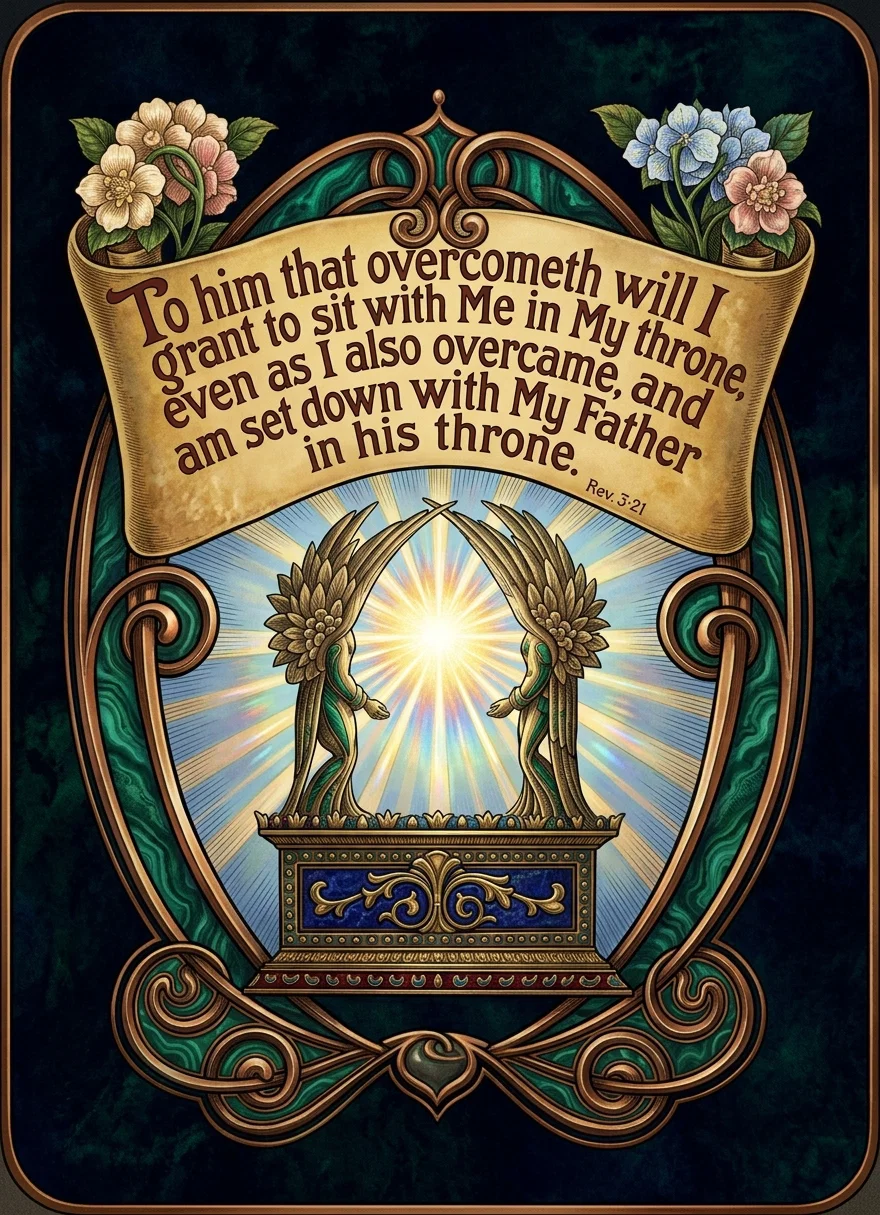
What is His promise to the overcomer?
“He that overcometh, I will give to him to sit
down with Me in My throne, as I also overcame, and sat down with My Father in His throne.”
Exposition and Comment.
1. “The Amen.”—How suggestive is the term! The One who has been with His people all the way, the sure Builder, the Establisher, the Confirmer of all promises, the Amen. How fitting is this title in the close of His sevenfold letter. “The faithful and true Witness,”—the Amen Witness; the One who has truly witnessed in His life and sufferings2and providences of God's wonderful character of love to His people. All others have failed in some respects; He has been faithful in all. And all this not for a little time, but from the beginning of the creation of God. For “without Him was not anything made that hath been made.” “For in Him were all things created, in the heavens and upon the earth, things visible and things invisible, whether thrones or dominions or principalities or powers; all things have been created through Him, and unto Him.” He it is, the Faithful, the True, the Mighty, who thus tenderly comes to those in Laodicea.
2. “Neither cold nor hot.”—How sad is the condition of those in Laodicea. Both hot and cold are conditions of feeling. Hot may well denote warm, earnest zeal (See Hosea 7:7, where it is used of zeal in an evil work); cold, a condition of discouragement in which one feels his distance from God, and longs to better it. (See Job 23:3, 8, 9.) Either of these conditions is infinitely preferable to lukewarmness,—a feeling of utter indifference, of don't care, of ease and satisfaction; and yet most nauseating to others. We can endure hot water, and many like it. Weak indeed the stomach which rejects it. Cold water is always refreshing to a thirsty soul; but lukewarm water is nauseating, and a standard emetic. Sad indeed is the condition of God's professed people when the Christ of infinite love can use such language.
3. “I am rich.”—The lukewarm is drunken in his satisfaction with himself and his times. He is living in a wonderful age of progress and enlightenment, God's Word has been opened as never before, times are good, and he sits down satisfied, contented, feeling rich and increased in goods. How many intoxicated men are rich and strong and great—in their imagination. Spiritual intoxication is worse than this. The stupor is of longer duration. The true Witness reveals the real condition of the lukewarm; of all others he is “the wretched one;” for he is “miserable and poor and blind and naked.” What has any mortal soul on earth that he did not receive? In what can he boast? Not for one hour can he live of himself. For all good things he is dependent upon God. Apart from God he is prolific in all things evil and that result in evil.
4. “I counsel thee.”—Is it not well to take the counsel of the Infinite One, the Faithful and True Witness? His witness of our nothingness is as faithful as His witness of God's goodness. Man does not know himself. “The heart is deceitful above all things, and it is exceedingly corrupt.” God desires that we should learn this lesson by faith, and so learn the Healer. If we will not learn it by faith, He will suffer us to fall and fall, till we learn the lesson or identify ourselves with the sin. He never counsels the latter. “Buy of Me gold.”—He has the only true riches, “the exceeding riches of His grace” (Eph. 2:7), gotten by faith (James 2:5), the “faith which worketh by love” (Gal. 5:6). The faith and love of Christ are true character-builders, the only character-builders. In these the poor may become rich. But never will one boast of these riches in himself. He will not say “I have gotten riches.” Nay, but “I received them ‘without money and without price,’ ‘freely by His grace.’” O wretched, poverty-stricken soul, feeding with swine, far from your Father's house, drunken perhaps, in indifference, rise from your stupor, come home, and partake of the riches of His grace.
5. “White garments,”—await the casting away of the filthy rags of our own righteousness, the white raiment of Christ's own righteousness, without spot or wrinkle, woven in the loom of earth's trials and temptations. He will forgive the sin. He will wash clean the stains in His own blood. He stoops to lift the low and the fallen, and makes them to sit in heavenly places with Himself. Then can we sing, in the language of Inspiration, “I will greatly rejoice in Jehovah, my soul shall be joyful in my God; for He hath clothed me with the garments of salvation, He hath covered me with the robe of righteousness.” Why go naked, soul, when royal garments await thee? No garments of thine own weaving will hide thee, when thou standest before His throne (Isa. 59:5, 6); only the robe of “Jehovah our Righteousness” (Jer. 23:6). “And the work of righteousness shall be peace; and the effect of righteousness quietness and assurance forever.” Isa. 32:17.
6. “Anoint thine eyes.”—What would not a blind man give to have his sight restored! But how much worse is the spiritually blind! Yet there is remedy. When Jesus met the blind of old, He made eyesalve of the clay, and anointed the man's eyes, told him to wash in the pool of Siloam; and the man washed and saw. It was the power of the Spirit of God which wrought the change. So Christ with holy unction would anoint the eyes of the blind in Laodicea, that in the visions—seeings—of God they might see the littleness of little things, and the greatness of God's eternally great things. There are eyes which ought to be seeing in the light of God, but they are blinded by the glare of wealth, by the films which passion spreads, by fame, by the fading glamour of authority. Let Christ heal the vision, that the eternal glories of God may be seen.
7. “I reprove and chasten.”—The wise parent or friend does not always praise us or please us. It is easy for mortals to stray, easy to form wrong habits, easy to make mistakes and perpetuate them, easy to become self-centered, easy to get to seeking the peace instead of the righteousness, easy for the natural heart to sin. O, then, how much we need the wise friend!
“I have learned that a friend that is worth the having
Is a friend that will hurt you now and then;
That will turn to ice at your sickly craving
For sympathy uttered by word or pen,
That will tear you with brave, rough hands away
From the altars you build to your gods of clay,
And break them down, lest you kneel again.”
“Faithful are the wounds of a friend; but the kisses of an enemy are deceitful.” “He is in the way of life that heedeth correction; but he that forsaketh reproof erreth.” Blessed is he who can pray, “Let the righteous smite me, it shall be a kindness; and let him reprove me, it shall be as oil upon the head; let not my head refuse it.” God reproves and chastens, not because He wishes us to suffer, but to save us from greater suffering. He is like the wise surgeon who finds it necessary to set the broken bone, and take the stitches in the wound, even tho it cause pain, in order to save the limb, and better heal the wound. “He doth not willingly afflict nor grieve.” He doth not reprove to free His mind, but to save our soul. He could not be love, if He permitted us unhindered, unreproved, to go on in sin. He will not compel righteousness; it can not be compelled; but He will do all He can to save us from sin. “As I live, saith the Lord Jehovah, I have no pleasure in the death of the wicked; but that the wicked turn from his way and live; turn ye, turn ye from your evil ways; for why will ye die.” This is God's message of love to the sinner. See Prov. 3:11, 12.
8. “Be zealous therefore, and repent.”—It is less difficult to arouse and to help the discouraged and despairing than the indifferent. The stupor of death is upon him. “Awake, thou that sleepest, and arise from the dead, and Christ shall shine upon thee.” No one will do it who has not faith in God,—faith that believes what God says of us, that our condition is what He declares, that the only true riches, and garments, and sight are His, and that it is death, eternal death, to continue in indifference. “Awake, arouse, or be forever fallen.” Be zealous in repenting. Put away all sin by reparation and confession, and seek God earnestly. See Zeph. 2:1-3. Only in this is there safety.
9. “Behold I stand at the door and knock.”—The Faithful One does not wait indifferently (nor anxiously, ever) for us to come to Him. He comes to our dwelling of revelry or slumber, and knocks, knocks, knocks, many times and persistently, to arouse us. He waits for response, and knocks and calls again. Is the ear deafened with the din? O listen. Life, eternal life, depends on your hearing. He knocks, and calls, and waits as long as there is hope. Who knows but that thou art now reaching that limit. Heed now.
10. “If any man hear My voice.”—He does not ask to be received into a marble palace or splendid banqueting room; He does not ask for a splendid company of the great, the learned, the wise, the pious to receive Him; He does not ask for priest or prelate or saint to act as intermediary; He does not ask that the whole church shall bid Him welcome. “If any man.” It takes in the lowest, the poorest, the wickedest in Laodicea. He may listen; he may hear; he may open. “My voice.”—How may we know it among the multitude of voices? Measure it by the law which His voice uttered from Sinai, which He wrote on tables of stone. Take His law, take His Word; learn its teaching; open thy heart to receive it. “If any man willeth to do His will, he shall know of the teaching.” These are Christ's own words. Open the door, let Him in, that He may sup with you. But I have nothing fit to place before Him, you say. Of course you have not. You never can have in yourself. Neither can any one else. Man is poor, and wretched, and miserable, and blind, and naked. He knows it; therefore He comes. Do not strive to hide it from Him who knows your works. Spread your own starvation diet all before Him. Lo, He is partaker of your wretchedness, your misery, your poverty. He is a brother beloved to bear it; and His admitted presence reveals and shines away all the evil, and glorifies our humble board. And then He spreads the table with all the delectable viands of heaven, and we sup with Him. His glorified Word in us becomes righteousness, peace, glory, unutterable. It is the blessing which every one in Laodicea may enjoy, the blessing of the latter rain, which immediately precedes His second coming.
11. “I will give.”—He does not wait in His giving till we overcome. He gives the overcoming. “This is the victory that overcometh the world, even our faith” in Christ Jesus. But at the end of the overcoming lies3the crown, the kingdom, the everlasting reign. Christ overcame as we must overcome. He met the enemy in the weakness of human flesh. He prayed and supplicated “with strong crying and tears unto Him that was able to save;” He learned “obedience by the things which He suffered,” and so earned the power to become an all-effectual, ever-living High Priest for us, in the throne of the Majesty of the heavens. Heb. 5:7-10; Ps. 110:1; Heb. 8:1, 2. He reigns a king-priest, a conquering priest, on the throne of grace. And to every soul who will overcome in Him, He will give a place with Him in His throne, even as He has a place with the Father. This is the glorious climax of this sevenfold promise of this sevenfold letter. Christ reigned with God the Father because the Father's law was in His heart. We will reign with Christ eternally, only when that same law is written in our hearts. It is not enough that we should know of it in His Word. It is not enough that we should possess the veritable ark and tables of stone. “Knowledge puffeth up, but love buildeth up.” That law must be enshrined in the heart, and live in the life, and our God must, by His Spirit, be enthroned there, our King, our everlasting Reward.