CONSIDER HIM

6%

Pacific Press Publishing Company · Oakland, California · Jan 21, 1903

FromSigns of the Times, Vol. 29, No. 3.

Read the full edition

“CONSIDER HIM”

BY PROF. G. W. RINE

“BEHOLD YOUR KING.”

THROUGHOUT the prophecies of the Old Testament is depicted, with vivid portraiture, the visions of a divine Messiah-King. In the promise to our first parents, that the seed of the woman should bruise the serpent’s head, is clearly implied the promise that a divine Ruler would ultimately erect upon the ruins of Satan’s realm an imperishable kingdom. Moved by the Holy Spirit, Jacob declared: “The scepter shall not depart from Judah, nor a lawgiver from between his feet, until Shiloh come; and unto Him shall the gathering of the people be.” Gen. 49:10. The forty-fifth psalm is one of the many Messianic psalms. In the sixth verse the Father is represented as declaring to the Son: “Thy throne, O God, is forever and ever; the scepter of Thy kingdom is a right scepter.” In the seventy-second psalm, also a Messianic psalm, it is prophesied that dominion also from sea to sea, and unto the ends of the earth. “Yea, all kings shall fall down before Him; all nations shall serve Him” (verses 8–11). In vision, Isaiah exclaims: “Behold, a King shall reign in righteousness” (32:1). Jeremiah writes of this prospective King, under the figure of a Branch raised up unto David; as a King who should reign and prosper, and should execute judgment and justice in the earth (23:5). “David shall never want a man,” declares the same prophet, “to sit upon the throne of the house of Israel” (33:17).
The prophets of Israel saw that this Shiloh, this Branch of Righteousness, this Desire of all nations, would be a King of more than human beauty; full of grace were to be His lips; the sword of a world-wide justice should be girded on His thigh; before Him all kings were to fall down, all nations were to do homage at His feet. His throne would rest, not upon the love of power, but upon the power of love. He would be a King whom the daughter of Jerusalem would one day behold coming to her, not through blood and carnage, but in lowly guise, sitting upon an ass—yet a King whose dominion shall be from sea to sea and shall never pass away. Righteousness and peace, salvation and deliverance, judgment and victory—these were to be the “pomp and circumstance” of His empire.
Nor did this hope in Israel wane in the least, even in the years immediately preceding the birth of Jesus. True, the prophetic ideal of a great moral Deliverer and spiritual King had become utterly debased in the popular belief. But still the belief was cherished—the belief in a world-wide Conqueror, some Jewish Cæsar, who was to rescue the nation and fulfil its most glorious political aspirations. Even the Gentiles were yearning for the advent of the long-expected seer and philosopher, who should resolve all the problems of humanity; “a princely infant before whom the rocks should flow with honey and the briars bloom with roses.”
Hence how pertinent was the question of the “wise men from the east,” after the birth of the Saviour: “Where is He that is born KING of the Jews?” How natural therefore that the ministry of Christ was ushered in by the proclamation, “The kingdom of God is at hand.” How wondrously significant, therefore, the words of the angel respecting Jesus, to Mary His mother: “He shall be great, and shall be called the Son of the Highest; and the Lord God shall give unto Him the throne of His father David; and He shall reign over the house of Jacob forever; and of His kingdom there shall be no end.” Luke 1:32, 33. So throughout the entire life of Jesus there is always to be seen a most serene and absolute conviction of His royalty. He repeatedly adverts to Himself as King and Master. Again and again He expressly claims the character and functions of that divine Messiah-King for whom the nation had for ages been wont to look. When Pilate in his judgment hall asked Jesus, “Art Thou a king then?” Jesus answered, “Thou sayest that I am a king. To this end was I born, and for this cause came I into the world, that I should bear witness unto the truth.” John 18:37.
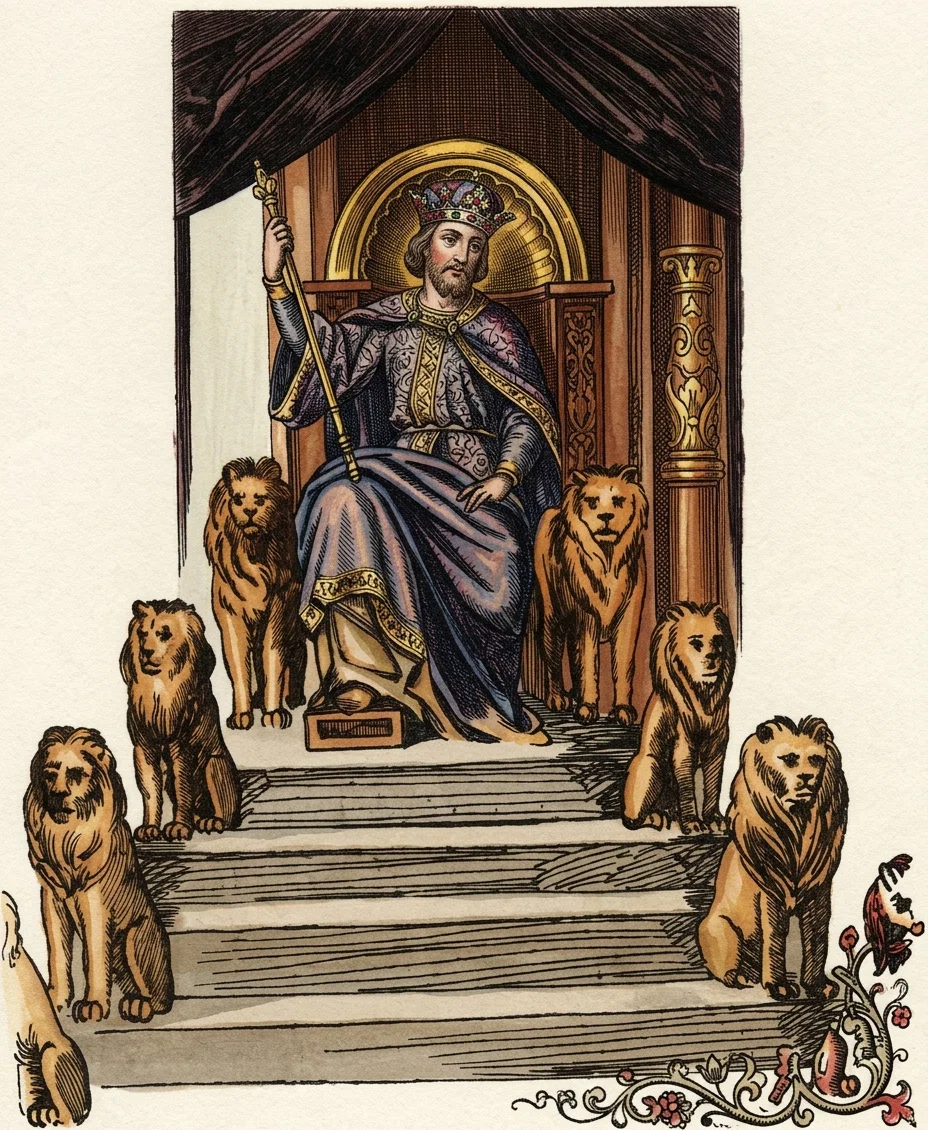
Throne of Solomon.
Throne of Solomon.
And yet He never for a moment allowed Himself to be regarded as an earthly monarch; He persistently repudiated the splendors of an earthly throne. And this was the secret of His ultimate rejection by the Jews. By proclaiming the kingdom of God is at hand He raised their hopes to the highest pitch, only to dash them down before their eyes. The kingdom to which they were looking forward as an earthly kingdom, He revealed as a spiritual kingdom. Against the proud, bigoted exclusiveness of their expectations, He announced a kingdom for all the world. Hence in their blind ambition for carnal power and worldly glory, the Jews were staggered at the paradox of a ruler without a throne, a monarch without tribute money, a sovereign without armies, a king without crown or scepter. They could not reconcile His royal pretensions with the humble, homely tenor of His life. How He could declare Himself a King and yet aver that His kingdom was not of this world, was to these Jews an inexplicable enigma.
It is well known that the Jewish leaders had, in the days of the Son of Man, so far apostatized from the truth of God that they had lost approximately all spiritual discernment. They could not see that the Messiah had never contemplated the assumption of civil rule in “this present evil world.” They knew not that until “the mystery of God should be finished,” (that is, until the Gospel should have completed its mission in the earth) Christ should occupy nothing more than a “throne of grace,” and that as long as He ministered grace to the sinner, by ministering His own blood, as a priest, for the remission of sins, He could not sit upon the throne of David, inasmuch as David could not have been a priest, not being of the tribe of Levi. No; they could not understand the doctrine of rendering to Cæsar the things that are Cæsar’s, and to God the things that are God’s; and that this must be done until, in the Lord’s own good time, the kingdoms of this world should become the kingdoms of our Lord and of His Christ; and that then “He shall reign forever and ever.” Rev. 11:15. By reading the first part of this verse we learn that the “kingdoms” do not become Christ’s until the time of the sounding of the seventh angel. By reference to Rev. 10:7, we read that when the seventh angel begins to sound “the mystery of God should be finished.”
Rom. 16:25 and other scriptures clearly teach that the “mystery of God” is identical with the Gospel. Hence the irresistible conclusion is that Christ takes His kingdom after the work of the Gospel closes. Our Lord Himself declares: “When the Son of Man shall come in His glory, and all the holy angels with Him, THEN shall He sit upon the throne of His glory.” Matt. 25:31. Every one knows that Christ has not yet come in His glory with the holy angels with Him; and that He therefore does not yet sit upon the throne of His glory. Let the reader refer to Dan. 7:9–14, and he will see how explicitly it is there taught that Christ does not assume “dominion, and glory, and a kingdom,” in which “all people, nations, and languages should serve Him” until after the investigative judgment—in which the destiny of all men will be decided—will have closed. None but those who now receive Christ as King in their own hearts, and whose names He confesses in that solemn judgment above, will share in the glory of His kingdom in the world to come. Be not deceived. There is no future age in which the conditions of salvation will be extended to procrastinators. For further corroborative evidence read the parables recorded in Luke 19:11–27 and in Matt. 13:36–43. In the latter parable the Master states that the harvest is the end of the world. THEN “the Son of Man shall send forth His angels, and they shall gather out of His kingdom all things that offend, and them which do iniquity; and shall cast them into a furnace of fire; there shall be wailing and gnashing of teeth. Then shall the righteous shine forth as the sun in the kingdom of their Father.”
Christ’s kingdom now is a spiritual kingdom, but visible in the living exemplification of the Golden Rule; in the loosing of the bands of wickedness, in the undoing of the heavy burdens, in letting the oppressed go free. Jesus is King of Righteousness, Prince of Peace. He reigns in the hearts, in the thoughts and affections of His subjects—of WILLING subjects only. He never appeals to force or to civil authority, in behalf of His own kingdom. Christians, who, in the interests of religion, appeal to secular power, forget that their Master declared, “My kingdom is not of this world.” It is only a willing service, a service incited by love that is acceptable with our King, for He is God, and “God is love.”
Ah, it is only in love that this King commands. Hence “His commandments are not grievous.” His laws are simply indications of where our happiness lies. Obedience to our King means joy, peace, life. His name shall be called Wonderful, Counselor, the mighty God; hence in boundless wisdom does He guide and instruct His loving subjects. There can be no bondage in the service of our King, for He is not only our King, but our Redeemer, our Brother, our spiritual Husband. Hence He makes us sharers with Him in the glories of His royalty; for has He not “made us kings and priests unto God”? Rev. 1:6. Yes, His service is our recreation; His courts ourdelight, His glory our honor, His cross our crown. We bless Thee, our Father, for exalting Jesus to be a Prince and a Saviour to us.
[The next and last article in the series is “Thy Kingdom Come.”]