Mankind is bound to trust in something. The child may learn to leap in the dark into its father’s arms, because it has learned to trust the voice that bids it loose its hold and spring out where it can not see. The farmer plants his seed, and then trusts in the rain and the sunshine to bring him his increase. The speculator invests his money, and trusts in his own sagacity to bring him back his own with much that is not his. The wilful boy trusts in his own wisdom, and makes shipwreck of his soul.
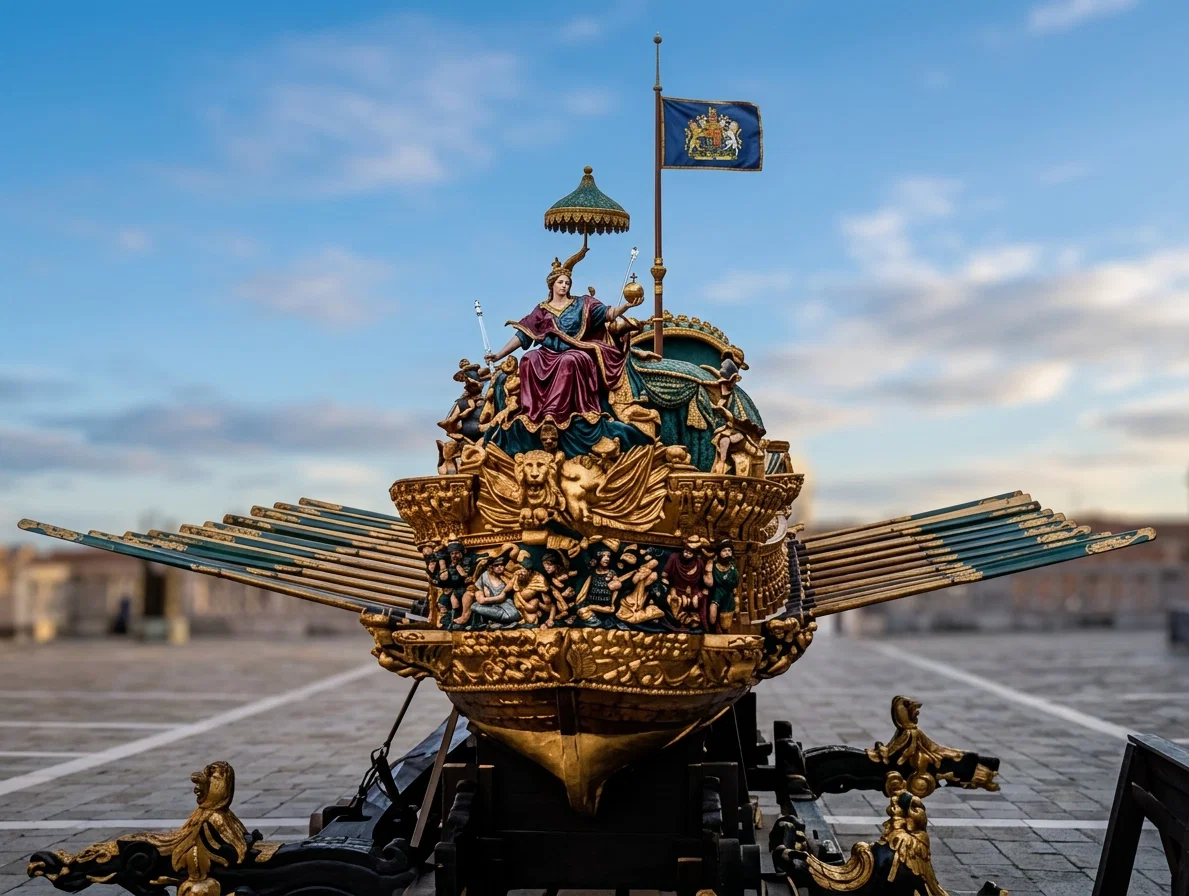
An Ancient Royal Galley.
There are two classes in this world, those who trust in that which is temporal and uncertain, and those who trust in that which is eternal and sure. On every hand are illustrations of the results of the two courses—disappointed hopes, misplaced confidence, sorrows where joys were expected, heartaches where lasting pleasures were thought to be, poverty where opulence was sought, disgrace where admiration was hoped for, defeat instead of victory and success. These have come to them who trusted in the false and uncertain, seeking the pleasures of sense, and trying to satisfy the cravings of the carnal heart.
On the other hand are they who have trusted in that which can not fail, in that which God has pledged Himself to make succeed. In them there is no disappointment, no hopes crushed, no confidence misplaced. There are trials; but they are victors over them. There may be sorrows; but they end in the peace of God. There is lasting pleasure; but it is not in the things of earth. There may be times when there is little to spare; but the blessing of God rests upon that little and multiplies it a hundred fold. They do not look for opulence here; but they know that God has given to them an inheritance in His everlasting kingdom where want can never come. They have not looked for human admiration or adulation; but God has laid up for them a crown of glory which will never fade, and over all that could oppose them in the earth He has made their victory sure. In the place of the ruin which is bound to come to them who trust in self and uncertainty, He has given them the success that can come to those alone who will put their trust in the everlasting God.
The nations of the world to-day are taxing their inhabitants to their utmost ability to pay, in order to form bulwarks of national defense against possible enemies. They are building cannon of the greatest possible range and rapidity of operation. They are building forts to withstand the highest power guns. They are training their millions of armed men to the greatest possible efficiency in the use of their weapons and the mobilization of their companies. They are inventing new kinds of projectiles, and new kinds of powder to drive them on their mission of death—or of protection as they view it. They are filling their ports with the most ingenious ships of war, floating fortresses, powerful enough to skim the seas with the speed of the wind against wind and wave, carrying in their massive magazines tons upon tons of the most concentrated agencies of destruction, their hulls massive shields of the hardest metal man can make, and their decks and sides bristling with the most terrible weapons the world has ever known.
Nations and men are trusting in these agencies of death for the maintenance of their liberty and their rights and their national existence. They are multiplying them as fast as the resources of the people will permit, each seeking to equal or outdo the other, and the achievements of each in these lines inspiring the others to greater exertions. To state that the world has never seen anything like it before is to state that which no one will question for a moment. That is the kind of fruit which trust in such things was bound to bear. Whether that trust was in the slave-driven galleys of Cleopatra, Xerxes, Alexander, and Nero, with their javelins and arrows, or whether it be in the modern steam-driven, cannon-bristling, torpedo-shooting cruisers and battle-ships which the nations are trusting in to-day, the fruit of that trust is distrust, taxation, oppression, defiance, variance, and a fearful looking for of the consequences of such terrible combat as such engines of destruction have made possible.
Spain trusted in her Armada, and the waves of the Channel have long since ground their sunken hulks out of all semblance of ships of war. She put her trust in ships of war again, and to-day the tongue of the salt sea waves is licking up the rusting iron of their sides and the guns that went down with her trust in the crash of war.
That day is fast approaching that will try the trust of the people that have not made God their trust, the people that have put the arm of flesh and the sword of steel in the place of the arm of the Most High and the sword of the Spirit. Millions of men to-day are turned from the pursuits of peace to man the ships of war and drive the plow of ruin through the world. In them the nations are trusting, but their trust is vain. Such trust is folly; such hopes are built on sand. They can not bring peace nor assurance; they can not bring happiness to a single heart. All the navies of the world can not build up one single character that will stand the test of God’s searching judgment.
Solomon had two navies of ships. They brought him the wealth of Tarshish and Ophir; but they did not fortify him against the influences that were working for his ruin. He trusted in his wealth, his wisdom, and his strange wives, and God took from his posterity the kingdom that would have been theirs. Xerxes trusted in his galleys of war, and his2 (642)hosts of fighting men, and his heart and hopes went down in the swift destruction that fell upon them at Salamis and Plataea. Just so will it be with those who are trusting to-day in the weapons that give death instead of life, and in the arm whose only service is to smite and bruise and kill.
There is a better trust; there is a more enduring hope; there is a higher aim; there is a truer life. The admonition of the Almighty to every intelligent creature on the earth is this: “Put not your trust in princes, nor in the son of man, in whom there is no help.” Ps. 146:3. “It is better to trust in the Lord than to put confidence in princes.” Ps. 118:9. The Lord will punish the wicked prince as He does the wicked peasant. He tells us that in the day of His sacrifice He “will punish the princes and the king’s children.” Zeph. 1:8.
The man who puts his trust in man has passed judgment on himself already, and the man who trusts in treasure has likewise built his hope upon the moving quicksands. “Because thou hast trusted in thy works and in thy treasures, thou shalt also be taken.” The Lord declares that upon those who put their trust in treasure He will bring a fear (Jer. 49:4, 5); but “they that trust in the Lord shall be as Mount Zion, which can not be removed, but abideth forever. As the mountains are round about Jerusalem, so the Lord is round about His people from henceforth even forever.” Ps. 125:1, 2. In place of the fear that comes with a trust in things of earth the Lord gives peace to them that trust in Him, not such as the world gives; but “Thou wilt keep him in perfect peace, whose mind is stayed on Thee; because he trusteth in Thee.” Therefore, “trust ye in the Lord forever; for in the Lord Jehovah is everlasting strength.” Isa. 26:3, 4. “Thus saith the Lord, Cursed be the man that trusteth in man, and maketh flesh his arm.” On the other hand, “Blessed is the man that trusteth in the Lord, and whose hope the Lord is.” Jer. 17:5, 7. Putting our trust in weapons of war and ships of war is putting our trust in man, for those are man’s provisions for the safety of them that trust in him. Upon such a course there is no safety, no salvation, no blessing pronounced.
It is better to say with the psalmist, “My times are in Thy hand;” to leave it all with God, and then have the blessed peace that comes with such confiding, the everlasting protection that no dart can pierce, no fire consume, no flood o’erwhelm. That trust was never yet betrayed; that shelter is a shelter to all eternity. Ships may go down, armies may crumble into dust; but the ark of God’s abiding protection will anchor inside the eternal harbor with all who have made it their refuge from the storms of life. C. M. Snow.