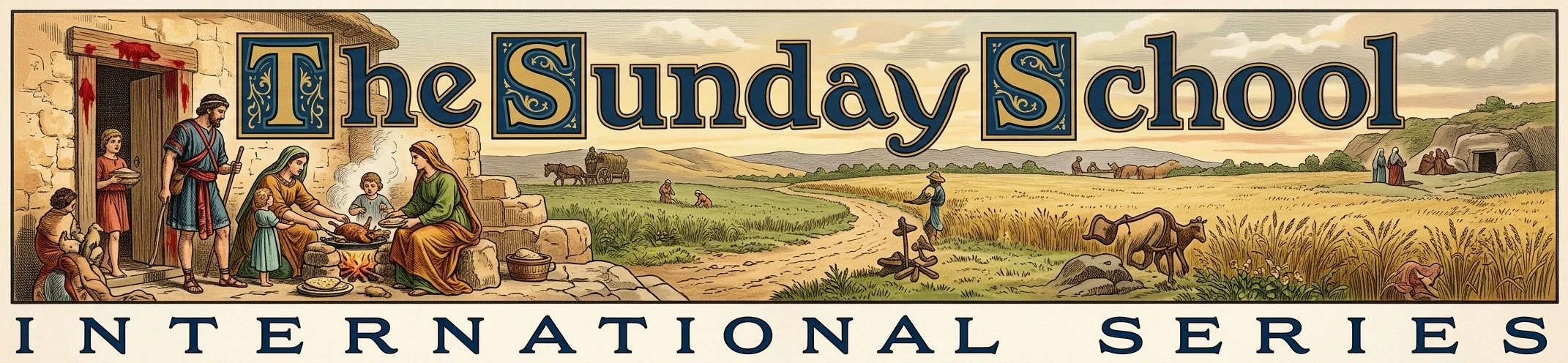
3 “Speak ye unto all the congregation of Israel, saying, In the tenth day of this month they shall take to them every man a lamb, according to their fathers’ houses, a lamb for an household; 4 and if the household be too little for a lamb, then shall he and his neighbor next unto his house take one according to the number of the souls; according to every man’s eating ye shall make your count for the lamb. 5 Your lamb shall be without blemish, a male of the first year: ye shall take it from the sheep, or from the goats; and ye shall keep it up until the fourteenth day of the same month: and the whole assembly of the congregation of Israel shall kill it at even. And they shall take of the blood, and put it on the two side posts and on the lintel, upon the houses wherein they shall eat it. And they shall eat the flesh in that night, roast with fire, and unleavened bread; with bitter herbs they shall eat it. 6 Eat not of it raw, nor sodden at all with water, but roast with fire; its head with its legs and with the inwards thereof. And ye shall let nothing of it remain until the morning; but that which remaineth of it until the morning ye shall burn with fire. 7 And thus shall ye eat it: with your loins girded, your shoes on your feet, and your staff in your hand; and ye shall eat it in haste: it is the Lord’s passover. For I will go through the land of Egypt in that night, and will smite all the first-born in the land of Egypt, both man and beast; and against all the gods of Egypt I will execute judgments: I am the Lord. 8 And the blood shall be to you for a token upon the houses where ye are: and when I see the blood, I will pass over you, and there shall no plague be upon you to destroy you, when I smite the land of Egypt. 9 And this day shall be unto you for a memorial, and ye shall keep it a feast to the Lord; throughout your generations ye shall keep it a feast by an ordinance forever.”
Golden Text.—“Christ our Passover is sacrificed for us.” 1 Cor. 5:7.
SUGGESTIVE QUESTIONS.
(1) After Pharaoh had disregarded the warning of the ninth plague, what did the Lord say to Moses? Verse 3. (2) What arrangement was to be made for eating the lamb? Verse 4. (3) What kind of lamb was it to be? Verse 5. Note 1. (4) On what day of the month should the lamb be killed? How many of the Israelites were to observe this feast? Verse 6. (5) What was to be done with the blood? Verse 7. Note 2. (6) What direction was given about eating the lamb? Verse 8. (7) How was it to be cooked? Verse 9. (8) What was to be done with any part of the lamb that might be left? Verse 10. (9) How were the people to be prepared for eating the Passover? Verse 11. Note 3. (10) What did the Lord say He would do that night? Verse 12. Note 4. (11) What would the blood be to them? Verse 13. Note 5. (12) What was the day of the Passover to be to the Israelites? How long were they to observe it? Verse 14. Notes 6 and 7.
NOTES.
1. “Without Blemish.”—This lamb was the type of Christ, therefore any deformity would have rendered it unfit to represent the perfect Son of God. We are redeemed with “the precious blood of Christ, as of a lamb without blemish and without spot.” 1 Peter 1:19. He was “the Lamb of God, which taketh away the sin of the world.” John 1:29. “For even Christ our Passover is sacrificed for us.” 1 Cor. 5:7.
2. The blood must be on every house. There was no idea of national salvation there. Blood on the doorposts of the elders was not enough. No one would have been spared from the scourge threatened upon Egypt by virtue of his being an Israelite. Every dwelling must show the blood, and every individual must eat of the Passover lamb. The blood on the doorpost was the sign of faith in the Word of God, and the name of Israel was of no consequence without the obedience of faith.
3. All ready to depart must be the attitude of those who were willing to go, and who believed that God was able to deliver them. Thus again was the manifestation of faith called for. Every soul that was not ready that night when the word was given to go, would have been left to the doom of the Egyptians. So Christ warns us in these days: “Let your loins be girded about, and your lights burning; and ye yourselves like unto men that wait for their lord, when he shall return from the wedding; that when he cometh and knocketh, they may open unto him immediately.” Luke 12:35, 36.
4. “This Night.”—Egypt had dallied away her last day of grace. The day of reckoning had come. And in Israel the time was at hand when the decision must be made, once for all, “Who is on the Lord’s side?” “This night” comes to every individual, sooner or later. To the man engrossed in the affairs of this world, there comes the sudden announcement, “Thou fool, this night thy soul shall be required of thee.” To the spiritual seed to-day the Master is saying, “Be ye also ready; for in such an hour as ye think not the Son of man cometh.”
5. The Lord requires outward tokens of inward15faith. Not that He does not know the heart, but His people are to be witnesses unto Him before the world. While the Christian walks by faith in God’s Word, the world walks by sight. Having no faith, the people of the world must have ocular demonstration of the truth. All the ordinances of the Lord’s house are tokens of faith, and their neglect shows to all, believers as well as unbelievers, a lack of faith in Him who has ordained these testing tokens. To those who are faithful in all things, the Lord has promised that no plague shall come nigh their dwelling. Ps. 91:10.
6. A Memorial.—The day of the Passover was to be a memorial, an object-lesson, by which they should remember the grace of God in sparing them in the day of judgment upon unbelieving Egypt. The two objects linked together, the day and the feast, were a double test of faith and gratitude.
7. “Forever,” in connection with any object or institution, would be during its existence. Keeping the Passover “forever” could only mean as long as that feast could have any force as a type, and that would be until the type met the antitype.