OUR STRONG TOWER

9%

Pacific Press Publishing Company · Oakland, California · Feb 13, 1901

FromSigns of the Times, Vol. 27, No. 7.

Read the full edition

OUR STRONG TOWER.

IN ancient times the tower was a conspicuous and important feature in both public and private improvement. Towers were used as places of defense and refuge, as garrisons for soldiers, and as outlook stations. They were always connected with, usually incorporated in, the walls of “fenced cities.” King Uzziah “strengthened himself exceedingly” by building towers in Jerusalem and in the desert. 2 Chron. 26:8–10. It is said that there were 250 towers on the walls of Babylon. The great wall of China, much of which is yet intact, is surrounded with towers at intervals convenient for communication. There are many towers and ruins of towers of ancient character yet to be seen in the Old World, especially in Asia. Over the gates of walled cities there were always the watch-towers. And every well-ordered vineyard had its watch-tower, from which watchmen could look out for persons or animals that would commit depredations. See Isa. 5:2; Matt. 21:33. These are still common in Palestine.
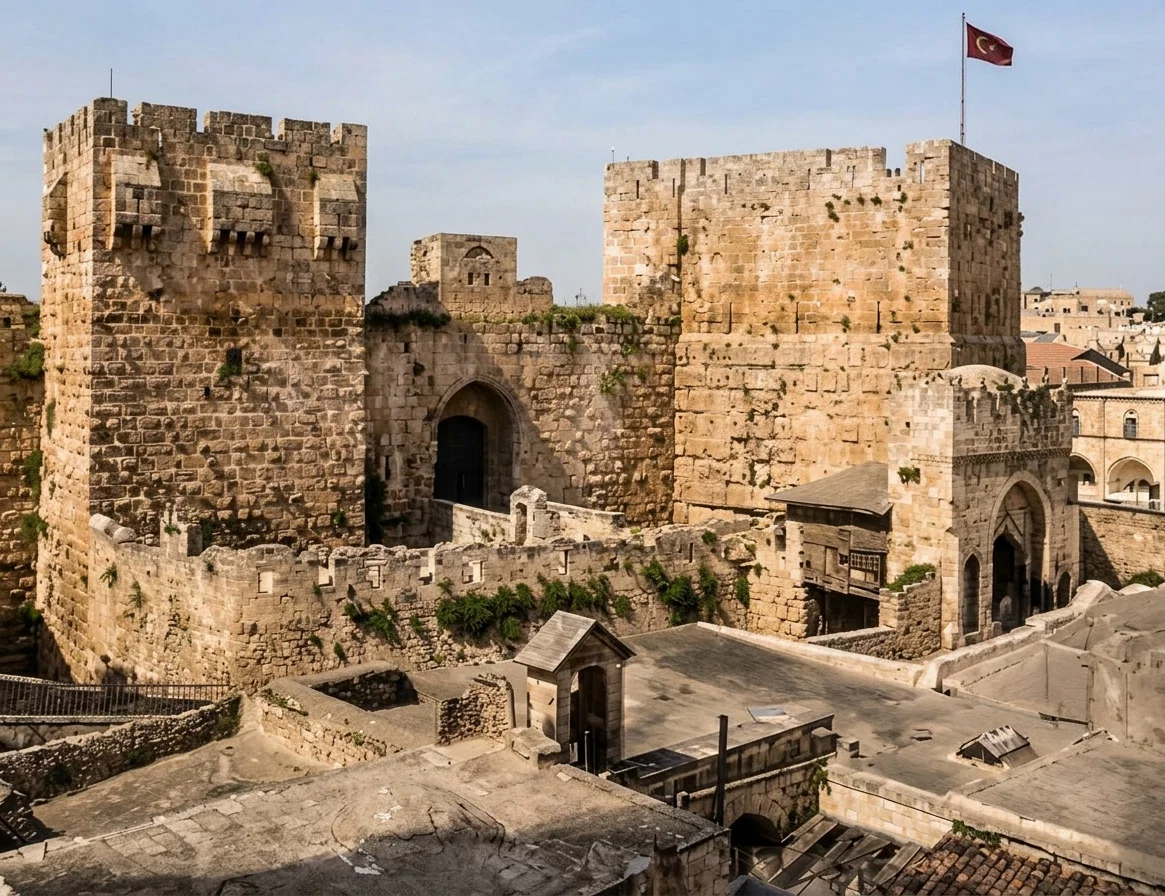
TOWER OF DAVID—JERUSALEM.
THE first tower mentioned in the Scriptures is that of Babel. The proposition of the builders was to build “a city and a tower” whose top would “reach unto heaven,” the purpose being to make for themselves a name. It was because of this act of presumption that the world is afflicted with such an inconvenient multiplicity of languages. The world was then more than two thousand years old, yet “the whole earth was of one language, and of one speech.” After the confounding of their speech, the people scattered abroad, as the Lord had originally designed. Jewish tradition tells of many remains of towers discovered during the captivity in Chaldea, some of them very large.
OTHER prominent towers are noted in the Scriptures. The tower of Edar is mentioned in Gen. 35:21 as one of the stopping-places of Jacob on his return from Padan-aram. Gideon beat down the tower of Penuel. Judges 8:17. Abimelech destroyed about a thousand men in the tower of Shechem. Chapter 9:41–49. Mount Hermon is called “the tower of Lebanon which looketh toward Damascus.” Song of Solomon 7:4. Several towers are spoken of in Jerusalem, such as Hananeel (Neh. 3:1; 12:39; Jer. 31:38, and Zech. 14:10), the tower of the furnaces, the tower of Siloam, etc. The following from the Schaff-Herzog “Encyclopedia of Religious Knowledge” is of interest in connection with the accompanying illustration:—
“The walls were almost entirely destroyed, along with the city, by Titus, A.D. 70, but rebuilt by Hadrian, A.D. 132–136, who probablyrestored the old citadel built by Herod; for in 1099 the Crusaders found at the spot a fortress which long resisted their attacks. They called it the Tower of David, and this name it has retained until the present day. It is now the most prominent object as one enters the Jaffa gate, and consists of five square towers originally surrounded by a ditch. The foundations of the towers are manifestly ancient. It is probably the tower of Phasaelus. The present walls are of Arabic construction, and date from Sultan Soleyman I. (1536–39).”
THE prominence and importance of the tower make it a fitting symbol of our Lord, so He is frequently spoken of as a tower. “The Lord is my rock, and my fortress, and my deliverer; the God of my rock; in Him will I trust; He is my shield, and the horn of my salvation, my high tower, and my refuge, my Saviour; Thou savest me from violence.” 2 Sam. 22:2, 3; also Ps. 18:2, and 144:2. The tower implies strength of resistance against attack, hence a safe place of refuge for the weak. It also implies height, or eminence from which may be foreseen the approach of danger, from whatever source. “The eyes of the Lord run to and fro throughout the whole earth, to show Himself strong in the behalf of them whose heart is perfect toward Him.” 2 Chron. 16:9.
TO THE suggestion of a Saviour is added the idea of a present Saviour—immediate help. “God is our refuge and strength, a very present help in trouble.” Ps. 46:1. This is a most encouraging assurance. “Therefore will not we fear, tho the earth be removed, and tho the mountains be carried into the midst of the sea; tho the waters thereof roar and be troubled, tho the mountains shake with the swelling thereof.” Verses 2, 3. In the strength of this assurance the Christian may unhesitatingly adopt this further language of the psalmist: “From the end of the earth will I cry unto Thee, when my heart is overwhelmed; lead me to the rock that is higher than I. For thou hast been a shelter for me, and a strong tower from the enemy.” Ps. 61:2, 3.
THERE are power and salvation even in the name of our Redeemer. “The name of the Lord is a strong tower; the righteous runneth into it, and is safe.” Prov. 18:10. The power that is in this tower was illustrated in the wonderful works done in the name of Jesus of Nazareth. The seventy disciples whom He sent out during His ministry in Judea, “returned again with joy, saying, Lord, even the devils are subject unto us thru Thy name.” Luke 10:17. And He gave them this further assurance, “Behold, I give unto you power to tread on serpents and scorpions, and over all the power of the enemy.” Verse 19. After His resurrection and departure from earth, the power of His name remained, with the assurance that it should continue to the end. Matt. 28:18–20. The lifelong cripple whom Peter and John found at the gate of the temple, was healed thru the power of His name. Acts 4:5–10. And in giving testimony to this fact, Peter added, “Neither is there salvation in any other; for there is none other name under heaven given among men, whereby we must be saved.” Verse 12. This is the name that is “above every name.” See Phil. 2:9–11; Eph. 1:21.
PERSONATING the church, Solomon sings of Christ, the “beloved:” “Thy neck is like the Tower of David builded for an armory, whereon there hang a thousand bucklers, all shields of mighty men.” Song of Solomon 4:4. He is indeed the Tower of David; for David trusted in Him, saying: “In Thee, O Lord, do I put my trust; let me never be ashamed; deliver me in Thy righteousness. Bow down Thine ear to me; deliver me speedily; be Thou my strong rock, for an house of defense to save me.” Ps. 31:1, 2. He is also to sit upon the throne of David, “and He shall reign over the house of Jacob forever; and of His kingdom there shall be no end.” Luke 1:33.
CHRIST, our strong Tower, is prominent over all, both in this world and the world to come. God “hath put all things under His feet, and gave Him to be the head over all things to the church; which is His body, the fulness of Him that filleth all in all.” Eph. 1:22, 23. And the complete restoration is thus foretold in prophecy: “And Thou, O Tower of the flock, the stronghold of the daughter of Zion, unto Thee shall it come, even the first dominion; the kingdom shall come to the daughter of Jerusalem.” Micah 4:8. The “first dominion” is the dominion that was given to the first Adam at the creation, and which he lost when he by transgression fell. All this is soon to be restored by and for Christ, and for all who, thru the obedience of faith, make Him their strong Tower. The full consummation will be enjoyed by the “Tower” and by the “flock” in the “new earth, wherein dwelleth righteousness.” 2 Peter 3:13. G.