Jenin to Samaria

7%

Pacific Press Publishing Company · Oakland, California · Aug 25, 1898

FromSigns of the Times, Vol. 24, No. 33.

Read the full edition

Jenin to Samaria

JOTTINGS FROM PALESTINE. No. 8.

Jenin to Samaria.
AFTER an hour’s halt for lunch in the vicinity of Jenin, we continued our journey southwards toward Samaria. Soon after leaving Jenin, we have on our right a fine valley, at the head of which lies Dothan. When Joseph came to Shechem to visit his brethren with their flocks, he learned that they had gone to Dothan; he followed them to this place, and was here sold and taken to Egypt. The Arabs still call the place “Joseph’s Pit.” The valley of Dothan is a fine place for grazing; and being quite extensive, Joseph’s brethren could well have seen him “afar off, even before he came near unto them.” Dothan is in the caravan line from Gilead to Egypt. It was doubtless in this same valley that they “lifted up their eyes and looked, and, behold, a company of Ishmaelites came from Gilead with their camels bearing spicery and balm and myrrh, going to carry it down to Egypt.” One still meets an occasional band with camels bearing burdens of merchandise, so that it is quite easy to fill out the rest of the scene enacted in selling Joseph.
Turning our eyes from the valley to the east of Dothan, we look to the hills round about, and remember that once they were filled with “horses and chariots of fire round about Elisha.” It was here the grand truth, which has ever since echoed in the heart of Christians, was declared and so impressively emphasized: “Fear not; for they that be with us are more than they that be with them.” 2 Kings 6:16. It was here that the Syrian host was smitten with blindness and led into Samaria, which is about three hours distant.
About an hour after passing Dothan, the setting sun reminded us that we must seek quarters for the night. Travelers usually stop overnight at Nablous or Jenin, as there is no place affording accommodations between. But not wishing to stop where we would be treated as tourists, as nearly as possible in European style, we planned our journey to leave the beaten track, and stop in some Arab village, to get a peep at their home life. The hotel-keeper at Nazareth assured me that I could not do this with any degree of comfort; and my Arab companion thought I could not put up with the accommodations which I would find in a village; yet at my special request, he finally consented to leave the usual course.
As we entered the Arab villages among the hills of Samaria, we were reminded of the mud villages which we had made in childhood. The huts and walls inclosing the court of the house were made of mud; in the place of streets were crooked passages so narrow as to be almost impassable to one on horseback. My Arab companion soon found a house where they were willing to receive us for the night. The entrance to the little court in front of the house was so small that we had to dismount and remove the saddle before the horses could enter. But, one may ask, were the horses taken into the house?—Certainly. The Arab seems to think that if the horse is good enough to ride on all day, he is good enough to lodge with at night.
While dismounting, a small company gathered about to see the strangers; for such travelers were rarely seen in their village. On entering the house, we found that it had but one room. At the right was a place for the animals, and at the left the kitchen, the principal furniture of which was a fireplace; above was a floor like a scaffold in a barn, reached by a ladder, for the accommodation of the family and the guests. After bringing in water for the horses, and grape-vines and dried brush for the fire, the women brought to the scaffold a “fire of coals” in a brazier to prepare some supper for us. It was difficult to make the hostess understand that I would take nothing; for the evening meal seems to be the principal one with the Arab. My companion gave his horses nothing to eat all day, and took but little dinner himself; but in the evening, he took a hearty meal, consisting chiefly of eggs fried in olive oil, and bread.
In this Arab home, the women seemed to bear the burden of everything; they were like servants, while the husband and father was the lord. They were all barefoot, the hair was sadly neglected, and in most cases the face, especially the chin, was tattooed. We were kindly treated and permitted to go in peace.
In the light of another fair morning, we continued to wind our way over the hills and through the valleys towards Samaria, the ancient capital of Israel. Sometimes for several miles we would pick our way among the stones, and over bare, unbroken rocks; and again we would wind through an olive grove. The olive trees here are the finest I have seen; the trees are twice as large as those in southern France and Greece. How they must have flourished when this land was in its prime!
Occasionally we would pass over a ridge, or the summit of a hill, from which we had an extensive view. At each rise we scanned the land before us to catch our first glance of the hill which Omri, king of Israel, bought of Shemer for two talents of silver, and built on it a capital for his kingdom, and called the city Samaria. Fully an hour before reaching it, from a summit to the northwest, we had a clear view of this hill and extensive valleys surrounding it. Omri made an excellent choice. The hill of Samaria is terraced and planted with vines and olive trees nearly to the top. It is five miles in circumference and nearly five hundred feet higher than the surrounding plain. From the summit is a charmingview of the undulating hills and valleys round about; to the north rises the snowy peak of Mount Hermon; to the southeast, six miles distant, rise Mounts Ebal and Gerizim; and to the west, in the vicinity of Cæsarea, is the wide expanse of the blue Mediterranean.
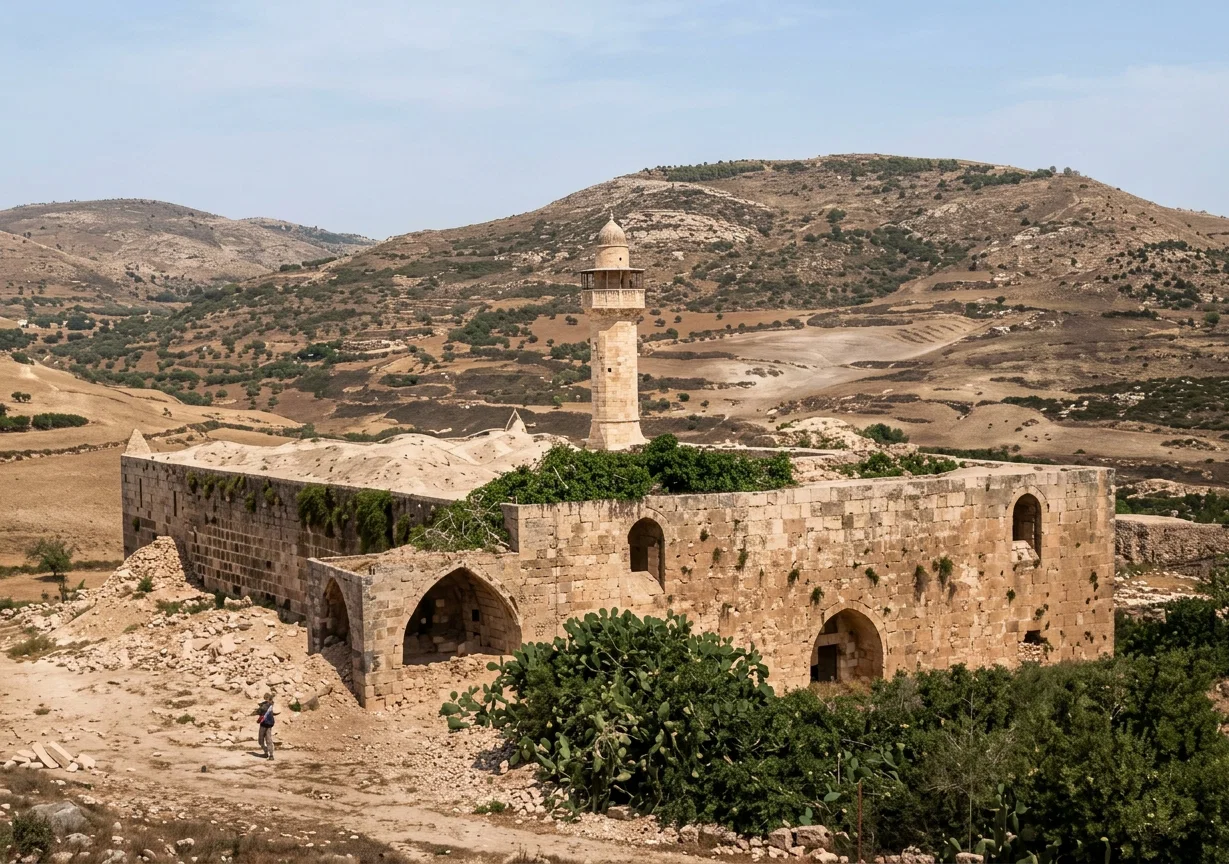
About half way up the eastern slope is an Arab village of some sixty houses, and in one corner of it the ruins of a church of the Crusaders, which is claimed to stand over the tomb of John the Baptist. The top of the hill is now barren, except a few columns dating from the time of Herod the Great, who did much to restore Samaria. He gave it a new name, by which it is still known,—Sebaste, the Greek of Augusta. After having stood as capital of Israel for two hundred years, Samaria was totally destroyed by the Assyrians, and the people carried into exile, and their places filled with heathen from the vicinity of Babylon.
THE HILL ON WHICH SAMARIA STOOD.
The most interesting part of the history of Samaria was in the days of Ahab, during the time of Elijah and Elisha. Twice Ben-hadad of Syria while besieging Samaria with an immense host was put to flight in great confusion, once by the sound of an approaching host which the Lord caused him to hear, and once by a small band of Israel. Evidently the prophet Elisha spent considerable time here.
When Philip preached the Gospel in Samaria, “the people with one accord gave heed.” Many were healed, “and there was great joy in that city.” It was on this occasion that Peter and John came here, and Simon, who “used sorcery, and bewitched the people of Samaria,” tried to purchase the gift of God with money. As we stood on this hill, once the center of natural life, adorned with royal palaces, and then looked upon its present desolations, we were forcibly reminded of how literally the words of the Lord have been fulfilled which were spoken by Micah: “Therefore I will make Samaria as an heap of the field, and as plantings of a vineyard; and I will pour down the stone thereof into the valley, and I will discover the foundations thereof. And all the graven images thereof shall be beaten to pieces.” Micah 1:6, 7. H. P. H.