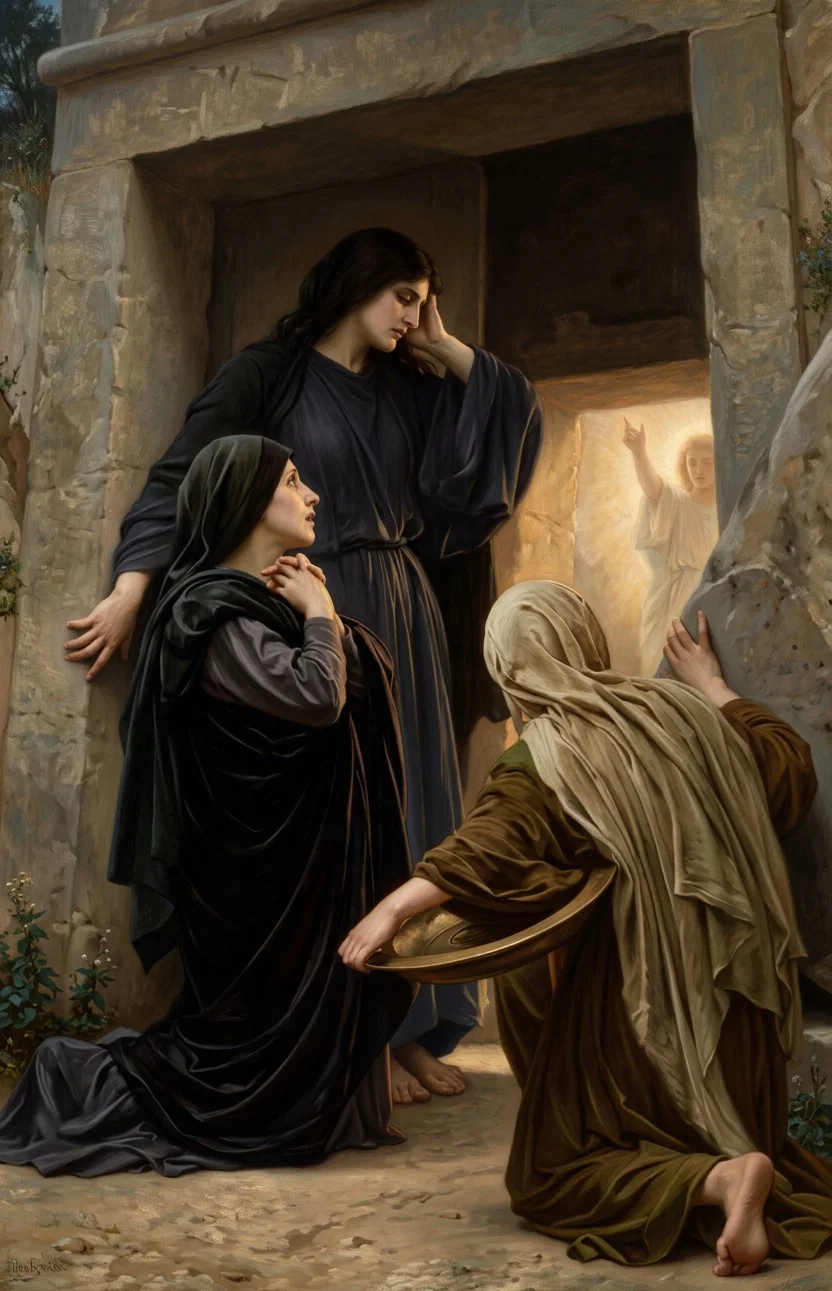
THE RISEN CHRIST

6%

Pacific Press Publishing Company · Oakland, California · Jun 9, 1898

FromSigns of the Times, Vol. 24, No. 23.

Read the full edition

THE RISEN CHRIST.

“He is not here; He is risen.”
When our Saviour yielded up His life and was laid in Joseph’s new tomb, was His work of redemption defeated? Was the one perfect life on earth to close in the reproach of the cross and the darkness of the grave? The sad and bewildered disciples seem to have thought thus. They had believed that Jesus was the Christ, the Anointed of God, yet they had not grasped the truth that His kingdom was not of this world. They still cherished the idea of a temporal king under whose glorious reign Israel should throw off the hated Roman yoke and be again, and in a greater degree, the favored nation of God. Now indeed it seemed that all was lost. The “Hope of Israel” had suffered an ignominious death, and lay shrouded in the gloomy sepulcher.
The sorrowful women had prepared spices and ointments for the embalming of the sacred body. They “rested on the Sabbath day according to the commandment” (Luke 23:56), and upon the first day of the week they arose and came very early in the morning to the sepulcher, bringing the spices they had prepared, intending to perform the last sad office for the Lord they loved. Evidently not one of the disciples remembered their Lord’s often reiterated promise that on the third day He would rise again; yet His enemies remembered it well, and besought Pilate to secure the sepulcher, “lest His disciples come by night, and steal Him away, and say unto the people, He is risen from the dead.” Matt. 27:64. So by Pilate’s command the great stone at the entrance of the rock-hewn tomb was sealed with the imperial seal of Rome, which it was death to touch, and a guard of soldiers was appointed to watch the place.
As the two Marys went sadly forth in the gray dawn of that memorable first-day morning, their hearts were oppressed with grief. They sought only a dead Christ. Intent upon their purpose, they questioned, “Who shall roll us away the stone from the door of the sepulcher?” Mark 16:3. Needless anxiety! for already had the angel of the Lord appeared and rolled back the stone. So overpowering was the resplendent glory of his presence that the Roman guard fell back as dead; and as the women approached, they too were amazed and terrified, when the angel addressed to them the startling words, “He is risen; He is not here;” “He goeth before you into Galilee.” Verses 6, 7. They fled, speechless with fear and trembling; for as yet they, in common with all the disciples, understood not the Scriptures, and believed not the words of the Lord that “He must rise again from the dead.” John 20:9.
Peter and John came also and found the empty tomb; there lay the linen grave-clothes and the napkin which bound the head was folded and placed by itself. They returned, wondering, to their homes; but the weeping Mary still lingered, and to her was given the first appearance of the risen Christ. He stood unknown beside her till the well-known voice spoke the familiar name Mary. Verse 16. With eager haste she bore this message to the disciples: “Go to My brethren, and say unto them, I ascend unto My Father, and your Father; and to My God, and your God.” Verse 17.
But when the women told these things to the sad eleven, their words seemed to the disciples like “idle tales;” for they believed not. The evening following the same day, as they were seated at their evening repast, being assembled together for fear of the Jews, the Lord appeared among them, and they were frightened, thinking they saw a spirit. They were not convinced till the Lord had shown them His hands and His side. Thomas was absent on that occasion, and he stilldoubted. He said to the disciples, “I never will believe unless I see the print of the nails and thrust my hand into the wounded side.” But when after eight days the Lord was again with the eleven in their common abode, and called Thomas to His side, and gave him the desired proof, he exclaimed, “My Lord and my God.” Verse 28.
We wonder at the incredulity of these men of Galilee, but at the same time it adds force to their testimony. These men were expecting no miracles; they were not in a state of mind to be deceived by a false appearance. Yet to them did Christ establish the fact of a bodily resurrection. It was necessary that the glorious fact of the resurrection be established beyond a doubt; for unto these eleven apostles did our Lord commit the sacred trust. “And ye are witnesses of these things.” Luke 24:48.
Under the Levitical law the testimony of two or three witnesses established a matter beyond doubt. How ample, then, is the proof of the resurrection! These eleven apostles proclaimed the truth to the known world, and, with perhaps a single exception, sealed their testimony with their blood. The four evangelists recorded it for future generations, and Paul, writing a quarter of a century later, says: “He [Jesus] was seen of above five hundred brethren at once; of whom the greater part remain unto this present, but some are fallen asleep.” “And last of all He was seen of me also, as of one born out of due time.” 1 Cor. 15:6, 8.
The Lord Jesus was seen of His disciples during forty days after His passion, convincing them “by many infallible proofs” (Acts 1:3) of His identity, and taught them concerning the things of the kingdom of God, then ascended, a risen, living Saviour (Luke 24:51).
The part and power of His resurrection is the foundation of our faith. “If Christ be not raised, your faith is vain; ye are yet in your sins. Then they also which are fallen asleep in Christ are perished.” 1 Cor. 15:17, 18.
What a terrible picture is here presented of a world without a Redeemer! All in vain the faith of patriarchs and prophets who trusted in the Hope of Israel! Every living soul bound in chains of sin, with no door of mercy! Death would end all. Our dear ones who now sleep in Jesus would never wake again, but, locked in the prison-house of the last cruel enemy, they, together with all the countless generations of men, would sleep in the dust of the earth through endless ages of eternity. But, thank God! we have a living Saviour. “But now is Christ risen from the dead, and become the first-fruits of them that slept.” Verse 20.
What is the grand import of Christ’s resurrection to us?—It is to the living the fact of Christ’s power over sin, and the same power in us, if we will but believe, and let Him dwell in us. See Eph. 1:18–22; Col. 1:9–13; Phil. 3:10, 11. It is concerning the dead the truth contained in these precious words, “Because I live, ye shall live also.” John 14:19. There is in this promise a twofold meaning. Christ has opened the portals of the grave, and thus gained “the keys of hell and of death.” Through Him all who have ever lived, or shall live and die in this earth, will live again. All who sleep in the dust will awake at the “voice of the Archangel,” when the “trump of God” shall sound; “but the dead in Christ shall rise first.” 1 Thess. 4:16.
In a higher and ever-abiding sense is the promise given to all who, living or dying, have, through faith in the risen Christ, lived His life. Gal. 2:20. To all such the death and resurrection of our Lord secure a blessed and never-ending existence in the Paradise of God. “I give unto them eternal life; and they shall never perish, neither shall any man pluck them out of My hand.” John 10:28.
May you and I, dear reader, have a blessed part in the first resurrection.
AUGUSTA W. HEALD.
Windham, Vt.