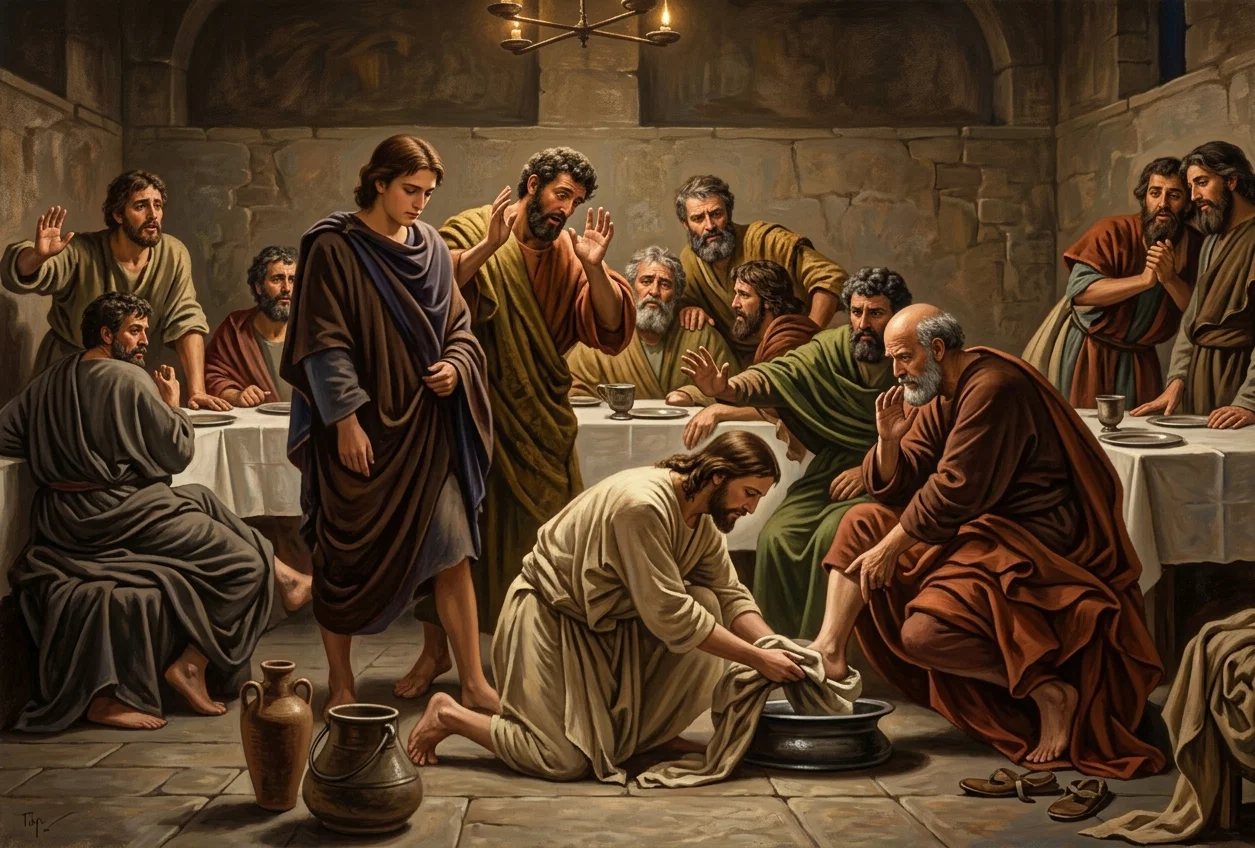
17 “Now on the first day of unleavened bread the disciples came to Jesus, saying, Where wilt Thou that we make ready for Thee to eat the Passover? And He said, Go into the city to such a man, and say unto him, The Master saith, My time is at hand; I keep the Passover at thy house with My disciples. 19 And the disciples did as Jesus appointed them; and they made ready the Passover. Now when even was come, He was sitting at meat with the twelve disciples; and as they were eating, He said, Verily I say unto you, that one of you shall betray Me. And they were exceeding sorrowful, and began to say unto Him every one, Is it I, Lord? And He answered and said, He that dipped his hand with Me in the dish, the same shall betray Me.
24 The Son of man goeth, even as it is written of Him; but woe unto that man through whom the Son of man is betrayed! Good were it for that man if he had not been born. And Judas, which betrayed Him, answered and said, Is it I, Rabbi? He saith unto him, Thou hast said. And as they were eating, Jesus took bread, and blessed, and brake it; and He gave to the disciples, and said, Take, eat; this is My body. 27 And He took a cup, and gave thanks, and gave to them, saying, Drink ye all of it; for this is My blood of the covenant, which is shed for many unto remission of sins. 29 But I say unto you, I will not drink henceforth of this fruit of the vine, until that day when I drink it new with you in My Father's kingdom. 30 “And when they had sung a hymn, they went out unto the Mount of Olives. 31 “Then saith Jesus unto them, All ye shall be offended in Me this night; for it is written, I will smite the shepherd, and the sheep of the flock
32 shall be scattered abroad. But after I am raised up, I will go before you into Galilee. But Peter answered and said unto Him, If all shall be offended in Thee, I will never be offended. Jesus said unto him, Verily I say unto thee, that this night, before the cock crow, thou shalt deny Me thrice. Peter saith unto Him, Even if I must die with Thee, yet will I not deny Thee. Likewise also said all the disciples. 36 “Then cometh Jesus with them unto a place called Gethsemane, and saith unto His disciples, Sit ye here, while I go yonder and pray. And He took with Him Peter and the two sons of Zebedee, and began to be sorrowful and sore troubled. 38 Then saith He unto them, My soul is exceeding sorrowful, even unto death; abide ye here, and watch with Me.”
Golden Text: “As often as ye eat this bread, and drink this cup, ye do show the Lord’s death till He come.” 1 Cor. 11:26.
SUGGESTIVE QUESTIONS.
(1) As the feast of unleavened bread drew near, what inquiry did the disciples make? V. 17. Note 1. (2) What was the significance of this feast? Note 2. (3) What kind of bread was used during the week of this feast? Note 3. (4) Then what kind of bread must have been used at the Lord’s supper? Same note. (5) What directions did Jesus give in reply to the question of His disciples? V. 18. (6) How did the disciples respond to His directions? V. 19. (7) What preparation was necessary? Note 4. (8) What two disciples were intrusted with this work? Same note. (9) What did Jesus do when even was come? V. 20. (10) What startling announcement did He make as they were eating? V. 21. (11) What effect did this have upon the disciples? V. 22. (12) What did they say in reply? Same v. Note 5. (13) What was the answer of Jesus to their anxious queries? Vs. 22, 23, 24. (14) Then what question did Judas ask? V. 25. (15) What answer did he receive? Same v. (16) While they were still at the table, what did Jesus do and say? V. 26. Note 6. (17) What next did He do and say? Vs. 27-29. Note 7. (18) How was the service closed? V. 30.
NOTES.
1. The feast of unleavened bread, or the Passover, began on the fifteenth day of Abib, the first month of the Jewish religious year, and the seventh month of the civil year. It began with the first new moon after the spring equinox. The preparation for the feast was made on the fourteenth day of the month; the paschal lamb was slain in the evening of that day, and was eaten in the night or forepart of the fifteenth, the days being reckoned from evening to evening. The Hebrew months were lunar months, and were therefore variable, so that feasts set for certain days of the month could have no reference to the days of the week. The feast of the Passover continued seven days, and the first and seventh days of the feast were special Sabbath days, whether they fell on the weekly Sabbath or not. This feast is mentioned in detail in Exodus 12 and in Deuteronomy 16.
2. The Passover was the memorial of the angel’s passing over the houses of the Israelites in Egypt on the night when all the first-born of the Egyptians were slain. The time of the feast was the anniversary of Israel’s departure from Egypt. The lamb slain at each annual feast by each family was a type of Christ, the Lamb of God, our true Passover. 1 Cor. 5:7. The occasion mentioned in this lesson was the last legitimate typical Passover that could be celebrated, as the Antitype was to be slain the next day, or rather on the same day on which that typical lamb was eaten. As Christ’s death could no longer be celebrated in type, the Lord’s supper was instituted to commemorate the important event thereafter in memorial.
3. Unleavened bread was used throughout the Passover week. Leavened bread was not even permitted to be kept in the house (Deut. 16:4), so it must have been unleavened bread that was used in the institution of the Lord’s supper. There were significant reasons for its use in both cases. (1) It was a reminder of the haste with which they prepared to leave Egypt; it was also called the “bread of affliction.” Verse 3. (2) Bread is leavened by fermentation, which is incipient putrefaction; hence leavened bread could not fitly represent the pure life and consequent sinless body of Christ.
4. The preparation.—It was necessary to have a room with accommodations for cooking and eating; also unleavened bread, bitter herbs, grape juice, and a lamb. It was required that the lamb be slain at the temple (Deut. 16:2), but it had to be cooked at the house where it was to be eaten. Peter and John were the two disciples sent to make the preparation. Luke 22:8.
5. “Lord, is it I?”—This earnest question indicates a serious self-examination appropriate on all such occasions. See 1 Cor. 11:27-29.
6. Eating of Christ’s body.—We eat food for the purpose of sustaining life. All proper food, all real food, nourishes the body and enters into the life. So in eating the body of Christ by faith, His life enters into our life. Eating of Christ’s body can not be confined to partaking of the emblems on communion occasions; it is more than such occasional eating could possibly be. Nor can that occasion impart its full benefit unless there be the daily partaking; for this alone can impart healthful spiritual life. Christ is the Word of God: “The Word was made flesh, and dwelt among us.” John 1:14. And in chapter 6:54 Jesus says, “Whoso eateth My flesh, and drinketh My blood, hath eternal life, and I will raise him up at the last day.” Again, in verse 56, He says, “He that eateth My flesh, and drinketh My blood, dwelleth in Me, and I in him.” He thus explains His meaning more fully: “It is the spirit that quickeneth; the flesh profiteth nothing; the words that I speak unto you, they are spirit, and they are life.” Verse 63. He had on a former occasion said, “Man shall not live by bread alone, but by every word that proceedeth out of the mouth of God.” Matt. 4:4. It is by faithful study of His Word, and obedience to its requirements, that we truly feed on Christ, and are enabled to discern His body and blood in the Lord’s supper.
7. THE word “wine” is not used in any of the accounts of the institution of this ordinance. It is the “cup,” or the “fruit of the vine.” This vitiates the argument of many persons that strong wine should be used. The same prohibition would lie against the presence of fermented wine in the house at all, that lay against the presence of leavened, or fermented, bread. The “cup” represented the blood, or life, of One who “saw no corruption.” Acts 13:37. The old covenant, or testament, was ratified, or sealed, with the corruptible blood of animals (Ex. 24:3-8; Heb. 9:18-20); but that covenant decayed (Heb. 8:13). On the contrary, the new covenant was ratified by the “blood of Christ, who through the eternal Spirit offered Himself without spot to God.” Heb. 9:14. This new covenant being everlasting, it can not decay; therefore the blood by which it is ratified can not be represented by an element that is decayed, as all fermented substances are to the extent of their fermentation.