The Intense War Spirit

5%

Pacific Press Publishing Company · Oakland, California · May 12, 1898

FromSigns of the Times, Vol. 24, No. 19.

Read the full edition

The Intense War Spirit.

We have had the promise from many pulpits and platforms, and from the press, both secular and religious, that the nineteenth century would close with the dove of peace hovering over the entire world. But it would seem very clear now that these predictions are the very farthest from any possible fulfilment. The last century closed with the whole of Europe engaged in war; it looks quite possible now that this century may close, not with Europe, merely, in arms, but with the whole world marshaled for a terrible conflict. There can be no disguising the fact that the spirit of militarism has completely taken possession of the people of this age. And there is an intensity and almost maddened frenzy that characterizes this war spirit that is simply inhuman.
At no previous period of the world’s history have there been so many men engaged in military and naval preparations as to-day, nor has there ever existed a body of men so well clad, equipped, and armed, so thoroughly schooled, disciplined, and prepared for war. There are now on the continent of Europe nearly four million men whose lives are devoted to military preparations. At least one hundred thousand of these are employing all the modern appliances of machinery, steam power, and electricity in the construction of the latest military implements, ranging from the enormous armor-piercing, high-power cannon, which throw a distance of twelve miles a projectile weighing 2,000 pounds, capable of puncturing twenty inches of solid steel, down to the rifle of smallest caliber, throwing a bullet with suchenergy as to penetrate six feet of solid wood.—General Nelson A. Miles, in April Forum.
General Miles is a scholar as well as a soldier. And when he says that “at no previous period of the world’s history have there been so many men engaged in military and naval preparations as to-day,” he speaks from the standpoint of a man who has had every opportunity of knowing what he is talking about.
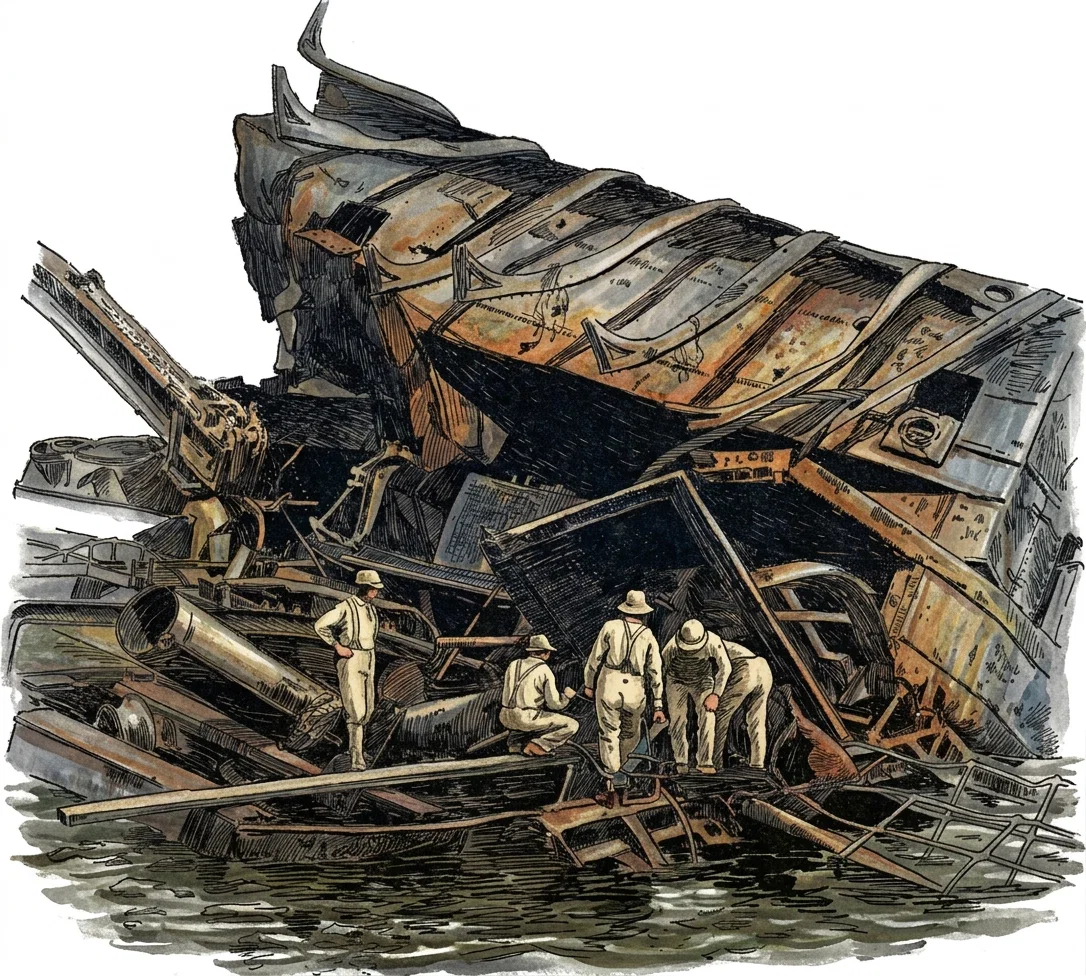
VIEW OF THE WRECK OF THE BATTLE-SHIP MAINE, AMIDSHIPS.
Just consider for a moment what is comprehended in the fact that “there are now on the continent of Europe nearly four million men whose lives are devoted to military preparations.” And, further, that “at least one hundred thousand of these are employing all the modern appliances of machinery, steam power, and electricity in the construction of the latest military implements.” Think of it! Four million men on the continent of Europe alone whose lives are devoted to military preparation. And is it any wonder that four million men are required to devote their lives to “military and naval preparations,” when we take into account the great battleships, armored cruisers, monitors, torpedo-boats, torpedo-boat destroyers, etc., that all the nations are building for their navies, and the guns and other accoutrements needed for their armies?
England alone has sixty-six battle-ships, one hundred and two cruisers, sixty-seven armored vessels, and two hundred and seventy-eight smaller fighting craft. On the occasion of the queen’s jubilee last year she had thirty miles of war ships in her naval parade. And France, Russia, Germany, and Japan have each their large and expensive navies. All of these nations, as well as the weaker ones in both Europe and Asia, are putting forth every effort to build and equip more and still more vessels that they hope will enable them to assist in “disputing the supremacy of the seas,” and protecting their coasts.
The average cost of a battle-ship is about $3,000,000; an armored cruiser costs about $1,000,000, while the smaller boats cost from $800,000 on down. The largest cannon, together with their emplacements, cost as high as $500,000. And it takes the strongest and best of machinery and the most skilful men to construct them. And then there are all the smaller guns, torpedoes, military mines, etc., that have to be manufactured. And with Europe’s 25,000,000 men in her armies and navies, is it any surprise that another 4,000,000 would have to devote their lives to the one work of building the necessary ships and guns? And certainly 100,000 of these would need “all the modern appliances of machinery, steam power, and electricity” to assist them in their colossal task.
And not only do we have the greatest armies and navies, as well as the greatest guns and battle-ships that the world has ever seen, but the most wonderful explosives have been invented. The artist furnishes us a section of the battle-ship Maine as she appeared after she was blown up in Havana Harbor. When we consider that this now world-famed ship was built of the best of steel, and that her steel armor was 12 inches thick; that she was 318 feet long and 57 feet beam; that her mean draft was 21 feet, and that her displacement was 6,682 tons—well may we be astonished at the terrific force that had to be exerted to rend and twist this great floating fortress into a mass of tangled débris.
Out of this “Maine disaster,” combined with the “Cuban question,” has grown the war between the United States and Spain. Men have told us in the past that modern fighting implements had become so terrible that nations would be held back from war, because they would fear to risk the appalling slaughter. But the facts do not fulfil this prediction. With a full knowledge of what modern warfare means, the United States finds no difficulty in securing all the men she wants. Indeed, there is an eagerness to enlist in the army and navy that, to say the least, is fully equal to anything that the past can produce. The press, and the pulpit as well, is resounding with the call to arms. And not only men are pressing into the service, but women also are urging that they be allowed to shoulder the gun and march to the field as soldiers.
Why all this military spirit at a time when we have been so assuringly promised that war was vanishing before the on-coming columns of diplomacy and universal peace? The roar of the cannon amid the world-wide battle cries and the tread of colossal armies, makes the hollow nothingness of this boasted freedom from war all the more apparent. The Saviour says that “ye shall hear of wars and rumors of wars,” and that “nation shall rise against nation, and kingdom against kingdom.” Matt. 24:6, 7.
There is no promise in the Word of God that the carnally ambitious natures of men in this world will ever become so pacific as to bury out of sight the instincts of war. But we are told that—
“They have healed also the hurt of the daughter of My people slightly, saying, Peace, peace; when there is no peace.” Jer. 6:14.
And again:—
“Then said I, Ah, Lord God! behold, the prophets say unto them, Ye shall not see the sword, neither shall ye have famine; but I will give you assured peace in this place. Then the Lord said unto me, The prophets prophesy lies in My name; I sent them not, neither have I commanded them, neither spake unto them; they prophesy unto you a false vision and divination, and a thing of naught, and the deceit of their heart.” Jer. 14:13, 14.
These plain words of Scripture need no interpretation. Study them carefully and see how plainly they tell that the prophecies of peace are a “false vision,” and that “wars and rumors of wars” are to continue. God has spoken on the one side and man on the other. You can readily see who is correct.
There is another most solemnly important prophecy that we desire to leave with the reader. It is as follows, and we ask you to think of it candidly:—
“And the nations were angry, and Thy wrath is come, and the time of the dead, that they should be judged, and that Thou shouldest give reward unto Thy servants the prophets, and to the saints and them that fear Thy name, small and great; and shouldest destroy them which destroy the earth.” Rev. 11:18.
It seems hardly necessary to call attention to the fact that the foregoing scripture most vividly brings to view the great judgment day. And how clearly does this Word show that one of the things that enables us to know when the judgment day is near is the fact that “the nations were angry.” The nations of earth present a warlike attitude to-day which is without a parallel in history. Are not these shouts of the warrior the fulfilment of this prophecy? And do we not see before us to-day in these fearful armies and navies one of the unmistakable signs that the judgment day is almost here?
Consider the matter well. We will have more to say on the subject next week.
T.