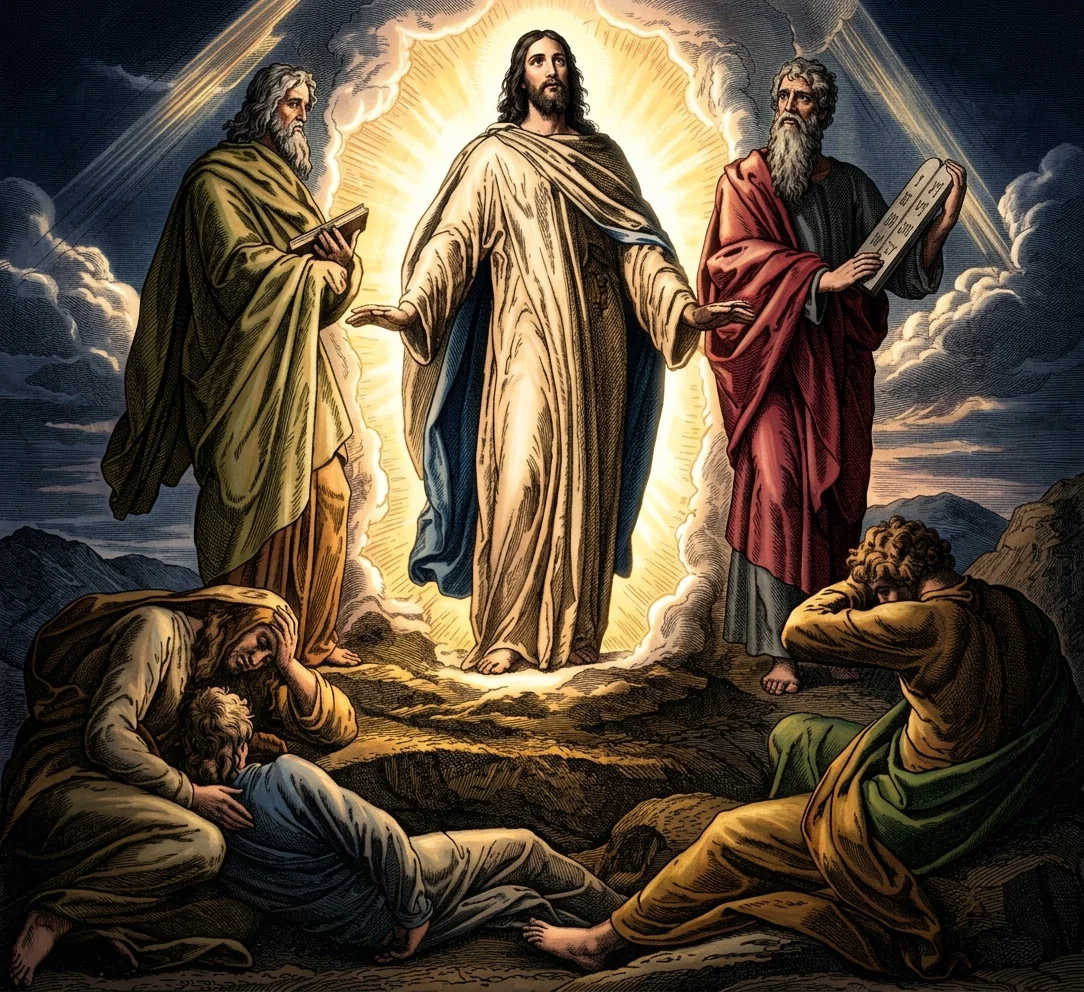
In speaking with people who believe that all mankind go to their place of punishment or reward at death, I often find them using as an illustration the scene on the mount of transfiguration. They say, “Here was Moses, who was buried, safe in the kingdom, and Elias, a translated man, with him, rejoicing in the glories which we expect to receive as soon as the Lord sees fit to place the finger of death upon us.”
How often I have said, and more often thought, What an awful door you have by which to enter heaven! Then you make no distinction between the door to heaven and the door to hell. Christ says plainly, “I am the Door of the sheep.” John 10:7. Christ is not death, but life; for in him was life, and his life was the light of men. John 1:4; 8:12. Peter, one of the witnesses, says: “For we have not followed cunningly devised fables, when we made known unto you the power and coming of our Lord Jesus Christ, but were eyewitnesses of his majesty.” 2 Peter 1:16. What did Christ receive when in the mount at this time?—“For he received from God the Father honor and glory.” Verse 17. By what declaration was this honor and glory made known?—There came a voice from the excellent glory, “This is my beloved Son, in whom I am well pleased.”
It is very evident that Peter had reference to the honor and glory shown Christ by the voice; for he says in verse 18, “And this voice which came from heaven we heard, when we were with him in the holy mount.” “We were eyewitnesses of his majesty”—power of authority. What power of authority had they seen?—His power over the works of Satan.
Christ came to destroy the works of the devil. 1 John 3:8; Heb. 2:14. Argument is hardly necessary to show that sin is the work of Satan. “The wages of sin is death.” Rom. 6:23. Death, then, being part of Satan’s work, Christ came to destroy it. Would it not be a strange destruction of death if his stronghold were not broken open and the captives set at liberty? The grave, we have every reason to believe, is the prison-house of death; and we find that Christ came to open the prison-house. Isa. 61:1; 42:7.
Did he do it?—His own words declare that he did. Rev. 1:18; John 5:28, 29. How was Christ’s majesty (power) made manifest in the mount? We find here a man who had died and was buried, and another who had been caught up into the skies without dying. Let me ask those who would have all go to heaven or hell at death, If both of these were worthy of heaven, why did one have to die first, and be buried? Is God a respecter of persons? Elias was a man subject to death, since he was of the offspring of Adam. It was therefore, undoubtedly, by the virtue vested in Christ that Elias was present.
But how did Moses get there, since we know he was buried? Ah, here is where the power of Christ is manifested to open the prison-house of death! We read of no trouble with reference to Elias. He never had been in the prison-house of death, and therefore could be removed from this earth without any trouble, for those who are of faith, as faithful Abraham, are pilgrims and strangers. Moses, however, had been overcome by death, and we read that there was a dispute over the body of Moses (Jude 9), and why?—For the reason that in God’s purpose he was to represent the power of Christ in the resurrection, when an exposition of the kingdom of Christ was to be given to Peter, James, and John. Matt. 16:28. The same exposition of Christ’s kingdom will meet our eyes at the coming of Christ, only on a larger scale. Paul describes it in the following language: “Behold, I show you a mystery; we shall not all sleep, but we shall all be changed, . . . for the trumpet shall sound, and the dead shall be raised incorruptible, and we shall be changed.” Many texts might be given to show that those of the past are waiting the resurrection, but let these suffice: Job. 19:25-27; Ps. 17:15; 2 Tim. 6-8.
Brethren, let us be “strangers and pilgrims” on the earth, “sanctified wholly” to the Lord; that should we enter this prison-house of death, it may be with a “full assurance of faith” and hope in the first resurrection. Remember our Lord will call all such forth unto the resurrection of life. John 5:29.