DANIEL'S PROPHECY

5%

Pacific Press Publishing Company · Oakland, California · Jun 11, 1896

FromSigns of the Times, Vol. 22, No. 23.

Read the full edition

DANIEL'S PROPHECY.

BY W. L. ILES.

Great World Empires.

THERE is a most remarkable line of prophecy found in the eighth chapter of the book of Daniel. The all-wise God has declared “the end from the beginning” (Isa. 46:10), and here, in the eighth chapter of Daniel, the world's history is foretold by means of symbols.
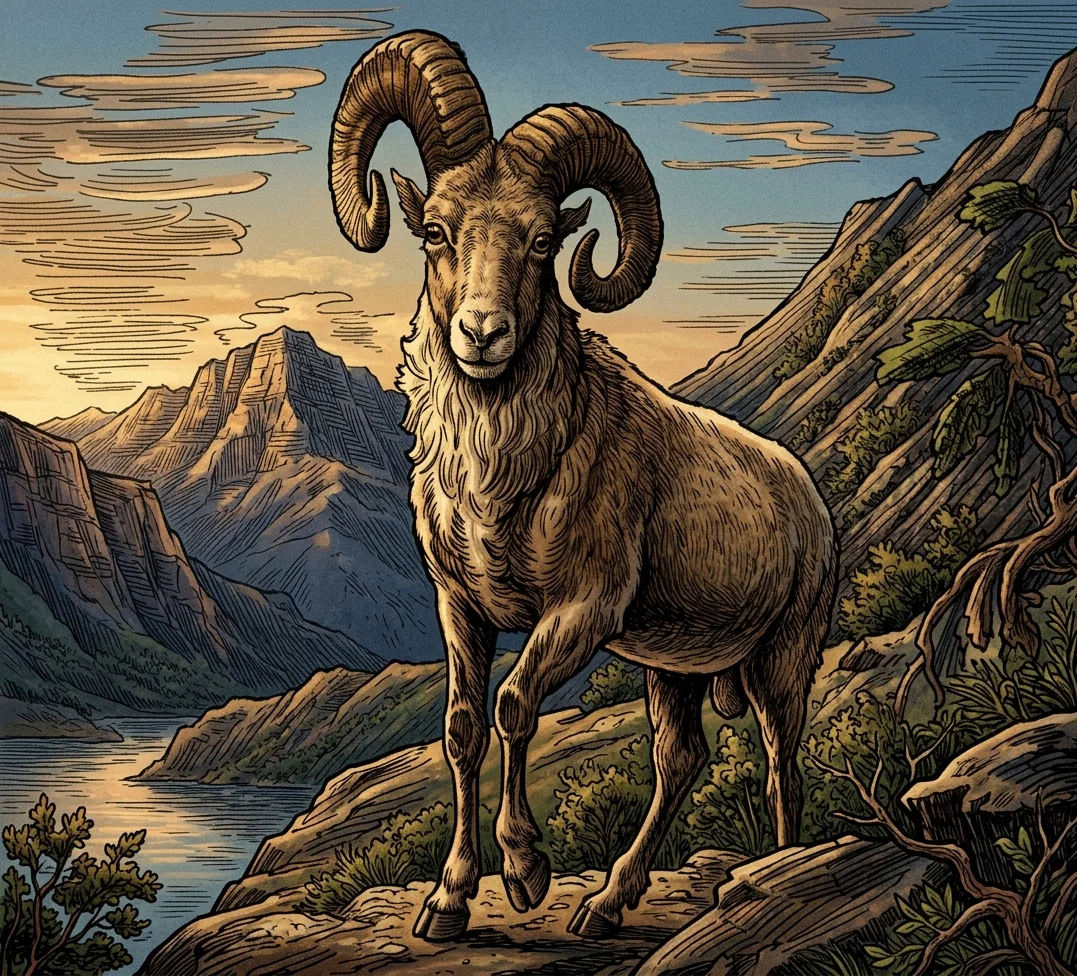
Daniel was at Shushan in the palace when God gave him this vision. Dan. 8:2. He thus states the matter: “Then I lifted up mine eyes, and saw, and, behold, there stood before the river a ram which had two horns; and the two horns were high; but one was higher than the other, and the higher came up last.”
In verses 15 and 16 the angel Gabriel, who “stands in the presence of God” (Luke 1:19), was commissioned to make Daniel understand the vision. We do not need, therefore, to accept of man's interpretation, but listen to the words of the angel: “The ram which thou sawest having two horns are the kings of Media and Persia.” Dan. 8:20. The Medo-Persian Kingdom existed from B.C. 538 to B.C. 331. This kingdom was composed of two nationalities, the Medes and the Persians, symbolized by the two horns. One of the horns preceded the other; and so the Medes first ruled in the kingdom, and then the Persians. The latter horn was higher, and the Persians were the stronger element.
The ram (Medo-Persia) was seen “pushing westward, and northward, and southward.” Verse 4.
The Persians extended their conquests to the west, to the north, and to the south, conquering all held by Babylonia. Daniel continues:—
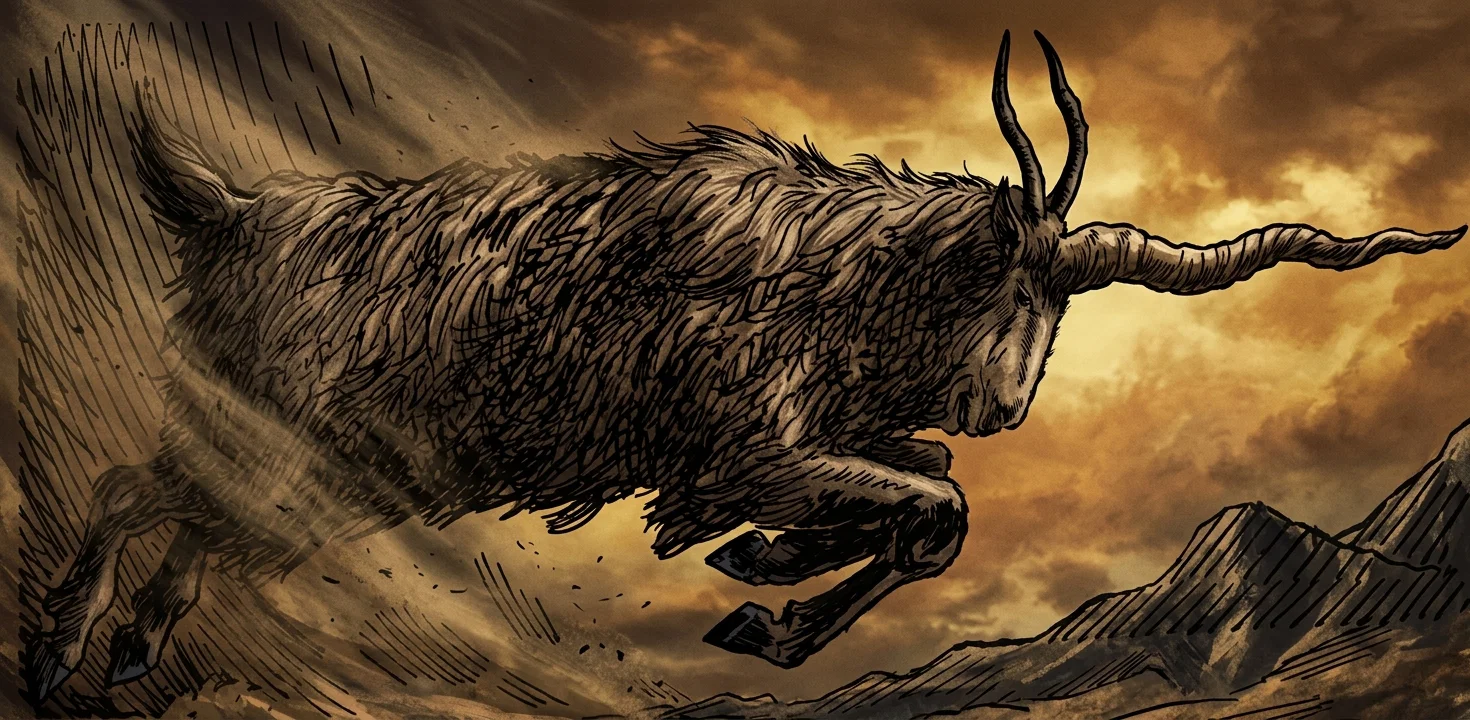
“And as I was considering, behold, a he goat came from the west on the face of the whole earth, and touched not the ground; and the goat had a notable horn between his eyes.” Verse 5.
What is the meaning of this symbol? The angel answers, “And the rough goat is the king of Grecia.” Verse 21. The goat had a “notable horn between his eyes,” and the angel continues, saying, “and the great horn that is between his eyes is the first king.” Grecia, under Alexander the Great, overthrew the Medo-Persian power in B.C. 331, and thus became a universal kingdom. The first king, represented by the “notable horn,” was Alexander the Great, who, in eight years, conquered the world, and wept that there were not other worlds to conquer.

The Conflict.

The battle which took place between the Grecians, symbolized by the goat, and the Medo-Persians, by the ram, is well represented in this prophecy.
“And he [the goat, or Grecia] came to the ram [Medo-Persia] that had two horns, which I had seen standing before the river, and ran unto him in the fury of his power. And I saw him [Grecia] come close unto the ram [Medo-Persia], and he [Grecia] was moved with choler against him [Medo-Persia], and smote the ram [Medo-Persia], and brake his two horns; and there was no power in the ram [Medo-Persia] to stand before him [Grecia], but he [Grecia] cast him [Medo-Persia] down to the ground, and stamped upon him [Medo-Persia]; and there was none that could deliver the ram [Medo-Persia] out of his [Grecia's] hand. Therefore the he goat [Grecia] waxed very great; and when he was strong, the great horn [Alexander the Great] was broken [Alexander died]; and for it came up four notable ones toward the four winds of heaven.”
The Grecian army, under Alexander, completely overthrew the kingdom of Medo-Persia at the battle of Arbela, as history records. The kingdom of Grecia became strong with Alexander at its head, but, after his death, the kingdom of Grecia was divided into four divisions. Let the angel Gabriel tell us what the four horns, which came up in the place of the great one, which was broken, represent.
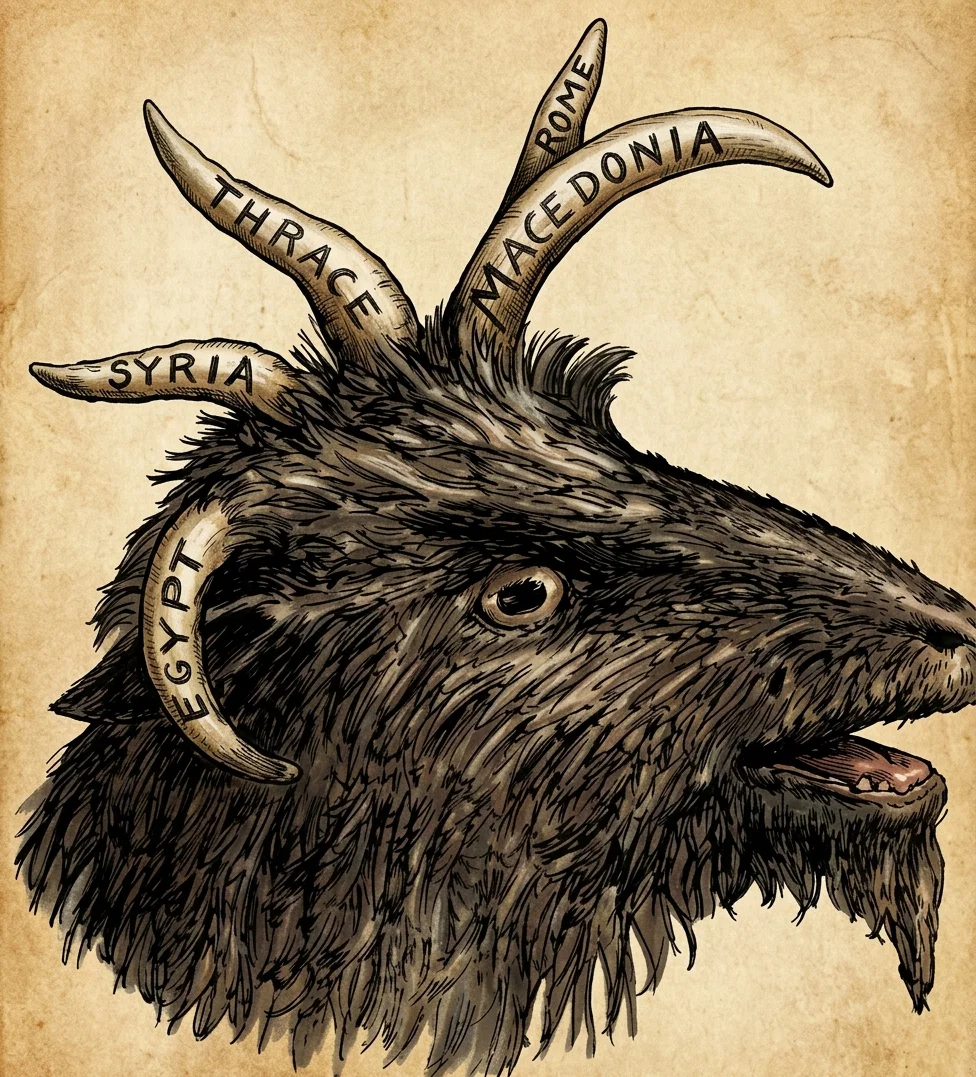
“Now that being broken, whereas four stood up for it, four kingdoms shall stand up out of the nation, but not in his [Alexander's] power.” Verse 22.
After the death of Alexander, his four leading generals, Casander, Lysimachus, Seleucus, and Ptolemy, divided the Grecian Empire between themselves. These divisions were known as Macedonia, Thrace, Syria, and Egypt.
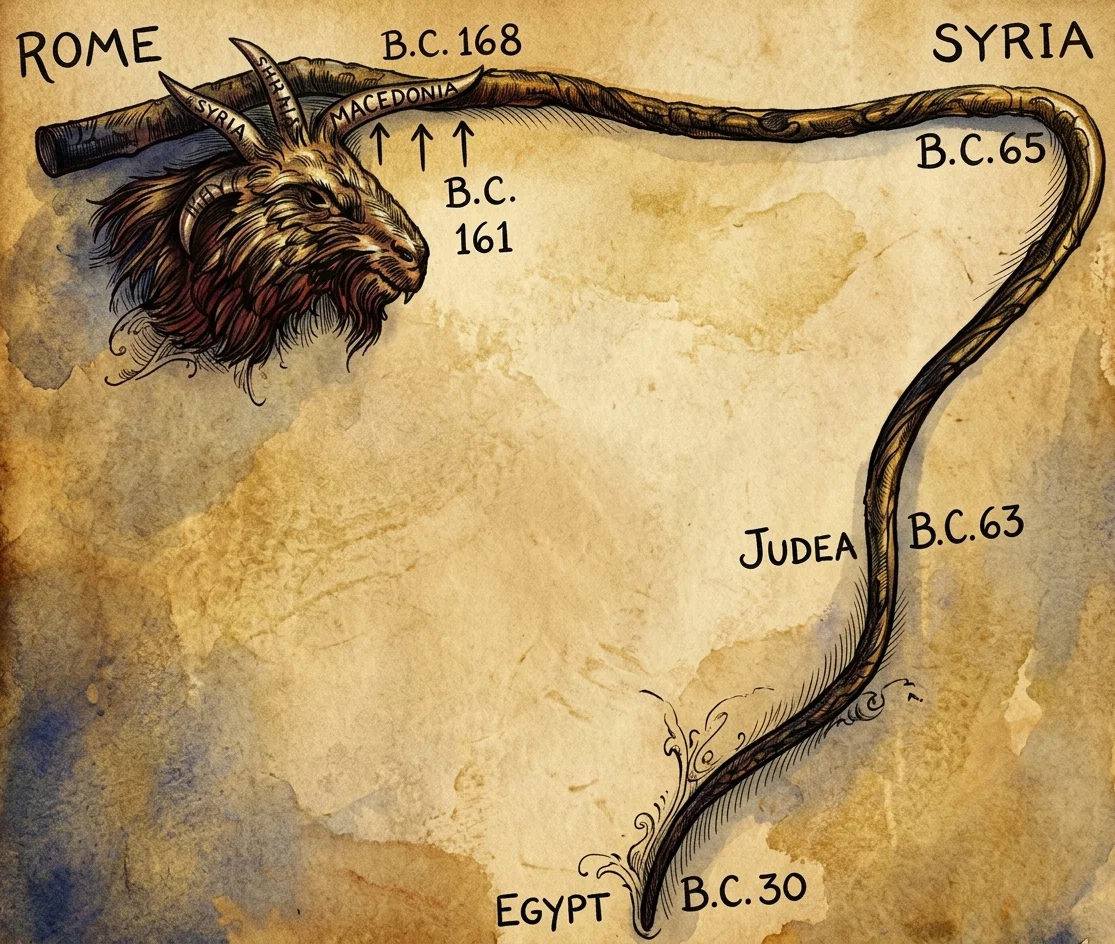
The vision of Daniel continues: “And out of one of them [the horns, or kingdoms into which Grecia was divided] came forth a little horn, which waxed exceeding great, toward the south [Egypt], and toward the east [Syria], and toward the pleasant land [Palestine].” Verse 9.
This important prophecy will be considered further in our next number.