In the reply which Job made to the Lord (Job 42:5, 6), he said: “I have heard of thee by the hearing of the ear; but now mine eye seeth thee. Wherefore I abhor myself, and repent in dust and ashes.” Evidently there is a vast difference between hearing of God,—hearing about God,—and seeing God for one’s self. And there is also a vast difference in the results upon one’s own life. In seeing God as Job saw him is life. But in the hearing of God with the hearing of the ear, unless it leads to something more, there is only death.
There are very many who have heard of God, and heard about God; yet they do not know God, and that because they have never seen him for themselves. There is salvation in seeing God and knowing him for one’s self. There is salvation in it because it leads to a proper estimate of self, that of utter abhorrence of self, and repentance. But salvation is not found in hearsay,—hearing about God.
God’s Testimony about Job.—The Lord’s testimony concerning Job was “that there is none like him in the earth, a perfect and an upright man, one that feareth God, and escheweth evil.” Job 2:3. And yet this uprightness of character was not enough. There was something more for the patriarch. Let us learn the lesson. It is evident that Job was trusting in his own uprightness of life, in his own righteousness, which could only bring ruin to him, or to any one who trusts in that kind of righteousness. That this was the case is evident from the answer that he gave to his friends. “Till I die,” said Job, “I will not remove mine integrity from me. My righteousness I hold fast, and will not let it go; my heart shall not reproach me so long as I live.” Job 27:5, 6. Such was his testimony of confidence in himself. But every one who enters the kingdom of Christ must let go of self. Having heard something about God and his requirements, and being convinced of the justice of these requirements, Job was led to resolve to lead an upright life. And to this end he had made a covenant with his eyes (Job 31:1) that he would not do evil. Evidently Job had raised himself up to quite a degree of success. But he needed more. Like many a person to-day, he needed to know God for himself.
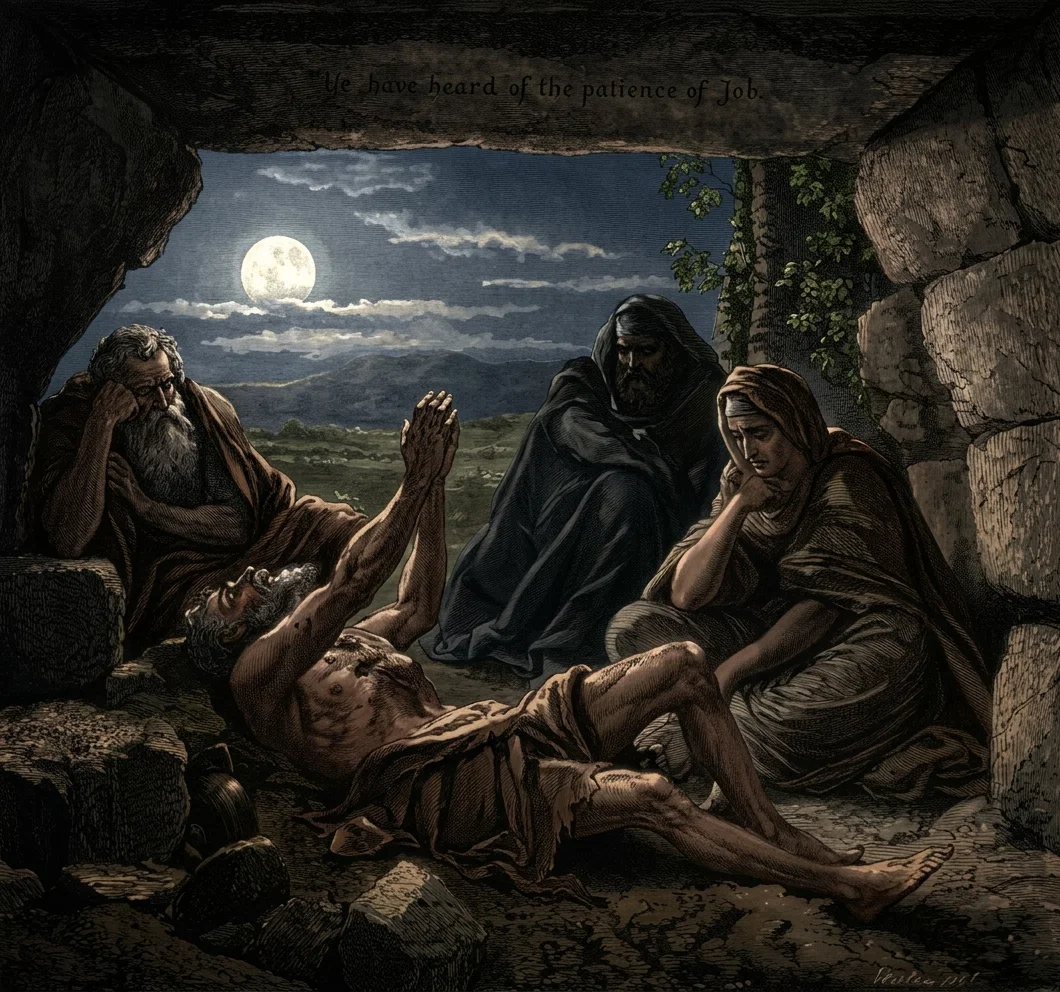
A Severe Lesson Well Learned.—It was because of Job’s self-righteousness that the hedge that God had built about him (Job 1:10, Ps. 34:7) was withdrawn, and sudden calamities and afflictions followed, which is always the case when God withdraws his protecting care. So terrible were these afflictions that Job sat down among the ashes,—a symbol of the deepest sorrow, and grief, and mourning.
The Three Friends.—When Job’s three friends heard thereof (Job 2:11–13), they came to see him, “to mourn with him, and to comfort him.” And such was their utter consternation that they lifted up their voices and wept, and rent their garments, and sprinkled dust upon their heads toward heaven, and sat seven days and seven nights without speaking a word to him, “for they saw that his grief was very great.” But when at last they did speak, such was their comfort, conveyed in words that were as an arrow to the wounded soul, that Job declared them to be miserable comforters. And, indeed, it is not calculated to assuage grief to be assured by a friend that one’s sufferings are because of sins, and that any certain sufferings are because of God’s displeasure. This is just what the three friends did, trying to convince Job that he was unrighteous.
Job’s Defense.—The defense that Job made for himself, as against the charges of his friends, was a most complete justification of self, and a vindication of his own self-righteousness. No doubt, in all his dealing with others, he had been upright, for God had said that he was upright. And so certain was Job that even God would find no fault in him, that he exclaimed: “O that I knew where I might find him! that I might come even to his seat! I would order my cause before him, and fill my mouth with arguments. I would know the words which he would answer me, and understand what he would say unto me. Will he plead against me with his great power? No; but he would put strength in me.” Job 23:3–6.
Inasmuch as Job could not find God, that he might see him face to face and plead his cause before him, he proceeds to plead it before his friends, and declares: “Neither have I gone back from the commandment of his lips; I have esteemed the words of his mouth more than my necessary food.” Job 23:12. And in chapter 24 he contrasts the lives of those who “remove the landmarks,” and “violently take away flocks, and feed thereof,” who “drive away the ass of the fatherless,” who “take the widow’s ox for a pledge,” and “turn the needy out of the way,” with his own life. With himself it had not been so, “Because,” said he, “I delivered the poor that cried, and the fatherless, and him that had none to help him. . . . And I caused the widow’s heart to sing for joy. . . . I was eyes to the blind, and feet was I to the lame. I was a father to the poor.” Job 29:12–16. What more could Job have done? Indeed, what more can any man do? Does not James call such works “pure religion and undefiled”? James 1:27.
One Thing More Is Necessary.—There was yet one thing more needed in Job’s life to make it a perfect life. He needed to see God’s righteousness, and to take it. Is that one thing needed by the reader and the writer? It is for all. All of Job’s afflictions were that he might see the one thing lacking, and take it for himself. That necessary thing was a personal acquaintance with God. Hearing about God was not enough for Job. Neither is it enough for us to-day. Hearing about God, and seeing the reasonableness of his requirements, sometimes leads men to do these works of goodness. Especially is this so when, like Job, we have enough and to spare, and when the doing of these things leads to the honors that men can give, which Job also once enjoyed. Chapter 29. And when this is the case, how human like to look at these good works as evidence of our righteousness, and so, robing one’s self in it, to be satisfied with that which is only filthy rags! Isa. 64:6. No greater mistake could ever be made by any as to their acceptance with God, and as evidence of a righteous character. There is no salvation in it, but, rather, death. This would be going about to establish our own righteousness, not having submitted ourselves to the righteousness of God. Rom. 10:3. This is just what Job did, and this is what made necessary his afflictions. At last the lesson was seen by Job, and it is written for our learning. Then may we also learn the precious lesson.
As the reality of his own condition began to dawn on the mind of the patriarch, he heard the Lord speaking to him in all his experiences. He saw God for himself, with his own eyes. His faith had once led him to declare that he knew that he should see his Redeemer at the latter day. Job 19:23–27. But this is not enough. In order to see the Redeemer at the latter day, and see him in peace, it is necessary that we see him now, and know him. We must see God nigh at hand. It is even Christ within, the hope of glory. Col. 1:27. Job saw God for himself at that time, and when he saw God, his confidence in himself was all gone. This was what he needed. It is just what is needed in the experience of many at this day. It is just what is necessary in order to meet Christ when he comes. When Job saw God, then it was that he said, “I have heard of thee by the hearing of the ear; but now mine eye seeth thee.”
The Blessed Result.—The result was just what might have been expected,—utter abhorrence of self, followed by repentance. “Wherefore,” said Job, “I abhor myself, and repent in dust and ashes.” Job 42:6. It was like coming forth to the light of day all besmeared, and bespattered, and covered with the smut and dust and drippings of a coal mine. The contrast of the light and the darkness, and the contrast of one’s appearance as seen by one’s self in the darkness and the broad light of day, is immensely great. This, however, is but a faint comparison. When a person walks in the light of his own righteousness, which is but intense darkness itself and no light at all, he enjoys a sense of satisfaction in himself that will end only in bitter disappointment at the last day. But8coming to see God, coming to the light of God’s presence, the contrast is immensely greater. The first impulse may be discouragement, but the better thought is that of self-abnegation and repentance. And, thank the Lord, who meets us more than half way with forgiveness, and receives us all as his own. Then it is that God can safely increase our blessings, as with Job; and with these blessings our usefulness may be increased.
The Moral.—From all this we may learn that, however much temporal blessings may be enjoyed, they may not be entirely for our good, and that something more is needed in order that we may see ourselves as the needy beings that we really are, and that we may let go of self as we should, for there is no salvation in self. When Job saw himself as he truly was, a poor mortal and a vile sinner, one to be utterly abhorred, with no virtue in himself, wretched, miserable, blind, and naked, when he saw God in all his fullness and blessedness, what more did he need of self? Then God removed his distresses and greatly increased his blessings. This could now be done with safety to Job himself. He now had no love for self, hence all love for God.
It was not a matter of discouragement when Job began to open his eyes to see God, even tho it revealed himself the worthless creature that he was. But it was altogether the opposite,—a matter for encouragement and rejoicing, even an evidence that God had not left him in his own self-righteousness, but that he was even nigh at hand, and loved him still. The danger was when Job could not see his true condition, and trusted in his own righteousness for salvation. It is just so with us. The seeing of our sins, our failures, our weaknesses, our errors, our backslidings, even all the blackness of darkness of our own hearts, is not a cause of discouragement, but of encouragement; for God is near, and has not departed from us forever. Seeing this as we should, we turn to Him who is our righteousness, our strength, our holiness, our goodness, our faithfulness, and we are led to accept him for all that he is and may ever be to us. We give up all, and take all. It is then that we may say, “Mine eye seeth thee,” and exclaim that, In him is my holiness, my righteousness, my faithfulness, my all and in all. Self is given up for Christ. “I am crucified with Christ; nevertheless I live; yet not I, but Christ liveth in me; and the life which I now live in the flesh I live by the faith of the Son of God.” May we live this life.