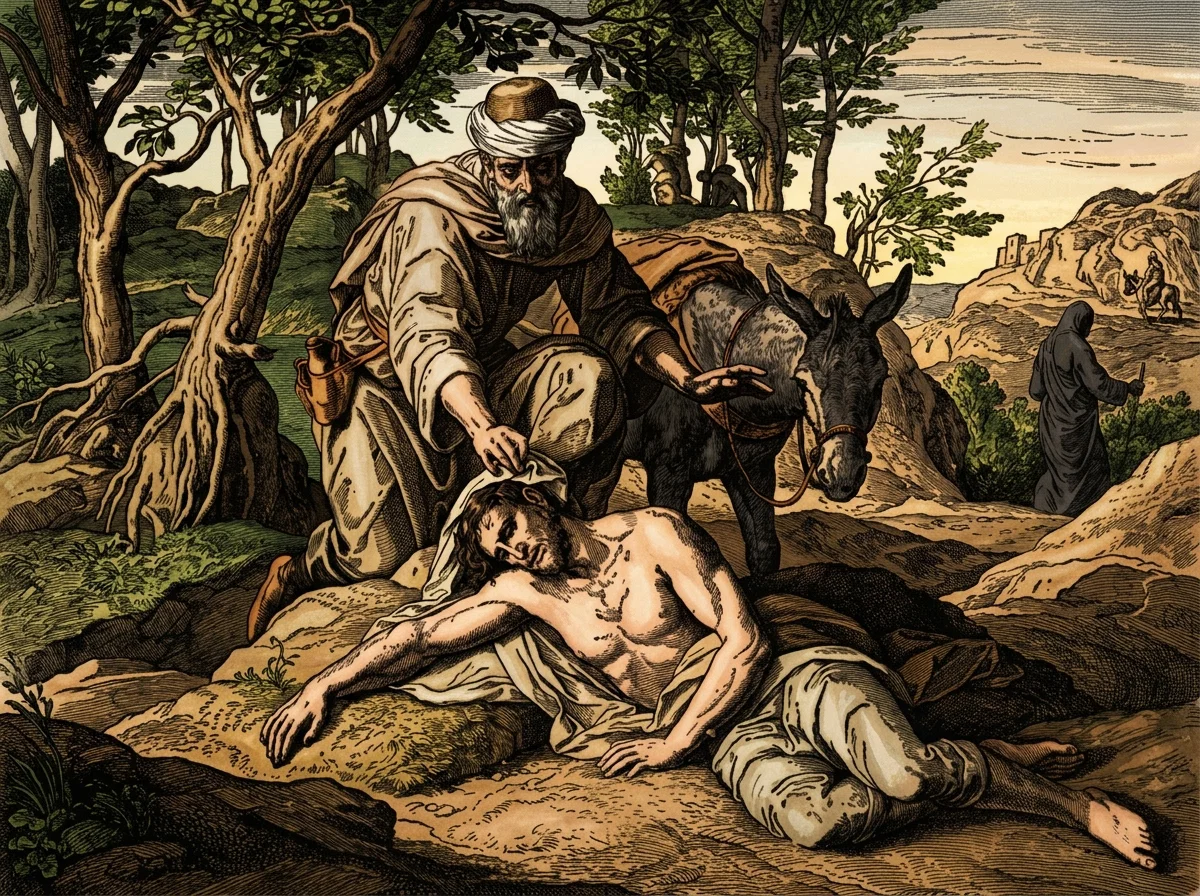
25. And, behold, a certain lawyer stood up, and tempted him, saying, Master, what shall I do to inherit eternal life? 26. He said unto him, What is written in the law? how readest thou? 27. And he answering said, Thou shalt love the Lord thy God with all thy heart, and with all thy soul, and with all thy strength, and with all thy mind; and thy neighbor as thyself. 28. And he said unto him, Thou hast answered right; this do, and thou shalt live. 29. But he, willing to justify himself, said unto Jesus, And who is my neighbor? 30. And Jesus answering said, A certain man went down from Jerusalem to Jericho, and fell among thieves, which stripped him of his raiment, and wounded him, and departed, leaving him half dead. 31. And by chance there came down a certain priest that way; and when he saw him, he passed by on the other side. 32. And likewise a Levite, when he was at the place, came and looked on him, and passed by on the other side. 33. But a certain Samaritan, as he journeyed, came where he was; and when he saw him, he had compassion on him. 34. And went to him, and bound up his wounds, pouring in oil and wine, and set him on his own beast, and brought him to an inn, and took care of him. 35. And on the morrow when he departed, he took out two pence, and gave them to the host, and said unto him, Take care of him; and whatsoever thou spendest more, when I come again, I will repay thee. 36. Which now of these three, thinkest thou, was neighbor unto him that fell among the thieves? 37. And he said, He that showed mercy on him. Then said Jesus unto him, Go, and do thou likewise.
(Memorize verses 25–27.)
Golden Text: “Thou shalt love the Lord thy God with all thy heart, and with all thy soul, and with all thy strength, and with all thy mind; and thy neighbor as thyself.” Verse 27.
NOTE.—The meeting with the lawyer occurred after the transfiguration on the mount, and the sending out and return of the seventy. Jesus was on his way to Jerusalem, passing through Perea,14the country east of the Jordan. Study the whole chapter.
SUGGESTIVE QUESTIONS.
(1) Who tempted Jesus on one occasion? Verse 25. Note 1. (2) What question did the lawyer ask? Same verse. (3) How did Jesus reply? Verse 26. (4) What answer did the lawyer make? Verse 27. Note 2. (5) What did Jesus reply to this? Verse 28. See note 2. (6) For what reason did the lawyer wish to prolong the discussion, and what words did he use? Verse 29. (7) How did Jesus introduce his reply? Verse 30. Note 3. (8) Who passed that way, and what did he do? Verse 31. (9) Who else had occasion to traverse the road, and what did he do? Verse 32. (10) Who finally had compassion on the man? Verse 33. Note 4. (11) How did he care for the wants of the unfortunate one? Verses 34, 35. (12) What question did Jesus then ask? Verse 36. (13) How did the lawyer answer? Verse 37. (14) With what instruction did Jesus round off the discussion? Verse 37. Note 5.
NOTES.
1. A certain lawyer . . . tempted him.—The word signifies, to test, to put to trial, to tempt. Jesus came preaching the Gospel of the kingdom, and offering eternal life to all. He came to save men, and it is probable that the lawyer desired to dispute some portion of his doctrine. His question was not sincere, that is, he implied by his manner that he disbelieved. The question was no doubt designed, as were many that were put to Jesus, to provoke controversy and a show of feeling which would frustrate the work the Lord was doing. How often this is the experience of the servant of God now! And not infrequently strife and vain disputations carry the day. Here is the practical value of Christ’s attitude. Here he was tempted, even as we are. His work was doubted, even as is the mission of his followers. But while he drove home the truth, it was in love, and showed forth true meekness.
2. Thou shalt love the Lord, etc.—This was a well-known point of the law, and was familiar to the lawyer,—the man skilled in the law. In the reply is combined what Jesus himself defined as the basic principles upon which rested all the law and prophets. Matt. 22: 37-40. The law in its full form was the Ten Commandments,—the law of God,—and it was also a favorite word with the Jews, from the instruction of God himself, that the man who should do these commandments, should live in them. Lev. 18: 5. So Jesus here answered the lawyer with what was doubtless to him a familiar saying, as well, “This do, and thou shalt live.” And that is what the Jews had been trying to do, and had failed, for the reason that the work was attempted in their own strength. Here is where many fail now. Whoever believes he can escape sin by doing the works of the law, will be woefully disappointed, for the work of the law in sinful man is to reveal sin and death. “Knowing that a man is not justified by the works of the law, but by the faith of Jesus Christ.” Gal. 2: 16. “The just shall live by faith.” Gal. 3: 11. That is, faith of Jesus Christ, who, being without sin, was able to keep the law perfectly. We are therefore “justified by faith” in him. Rom. 5: 1. Without Jesus Christ no man can be saved, and to this conclusion the Saviour wished to draw the lawyer. For in Christ is life, and whosoever believeth on him hath eternal life. It can be obtained in no other way.
3. From Jerusalem to Jericho.—This was a portion of country well chosen by Jesus for the setting of his parable. “The road, or path—for there was no such road as is familiar to us—from Jerusalem went down literally, to Jericho, the descent in less than twenty miles being about 3,500 feet. It was also a very dangerous road, lying much of the way in a deep ravine through soft rocks in which caves and chambers abounded, affording shelter to miscreants, who from them sallied forth to prey upon travelers. It is still necessary to have an escort in passing over that road.”—Bliss. It was notorious for harboring robbers and brigands, and one portion was protected in ancient times by a fort and Roman garrison.
4. A certain Samaritan.—The introduction of this character into the parable in such a role required boldness and fearlessness in relating the incident to a Jew, for of all people the Samaritans were the most despised and hated by the Jews. Here the priest and the Levite, classes high in authority among the Jews, were placed in a decidedly unenviable light, while the decision of approbation could not help being given to one who was esteemed so low that to touch him meant defilement. But the incident was shaped in precisely this form in order that the lesson might be of the utmost weight.
5. Go, and do thou likewise.—The parable was told, the query was propounded as to who the neighbor was, and the lawyer himself immediately answered, “He that showed mercy on him.” Here, then, with the words, “Go, and do thou likewise,” was the full reply, driven home, to his first question, “What shall I do to inherit eternal life?” The Lord desires mercy, rather than sacrifice (Micah 6:6-8), and in the manifestation of this quality there will be no questioning as to who is our neighbor, for every one in need is such, without reference to age, social condition, or color. True and unfeigned love for the needy—the neighbor—must necessarily be accompanied by love to God, for God himself is love, and the God of mercy. The manifestation of these principles in the works which they bespeak, must therefore be that which leads to inheriting eternal life, for it is the keeping of the commandments of God, and the justification of the man, all through the faith of Jesus Christ, through whom alone is the knowledge of God and his righteousness. With this way the lawyer was unacquainted. The pertinent question now is, Am I acquainted with my neighbor?