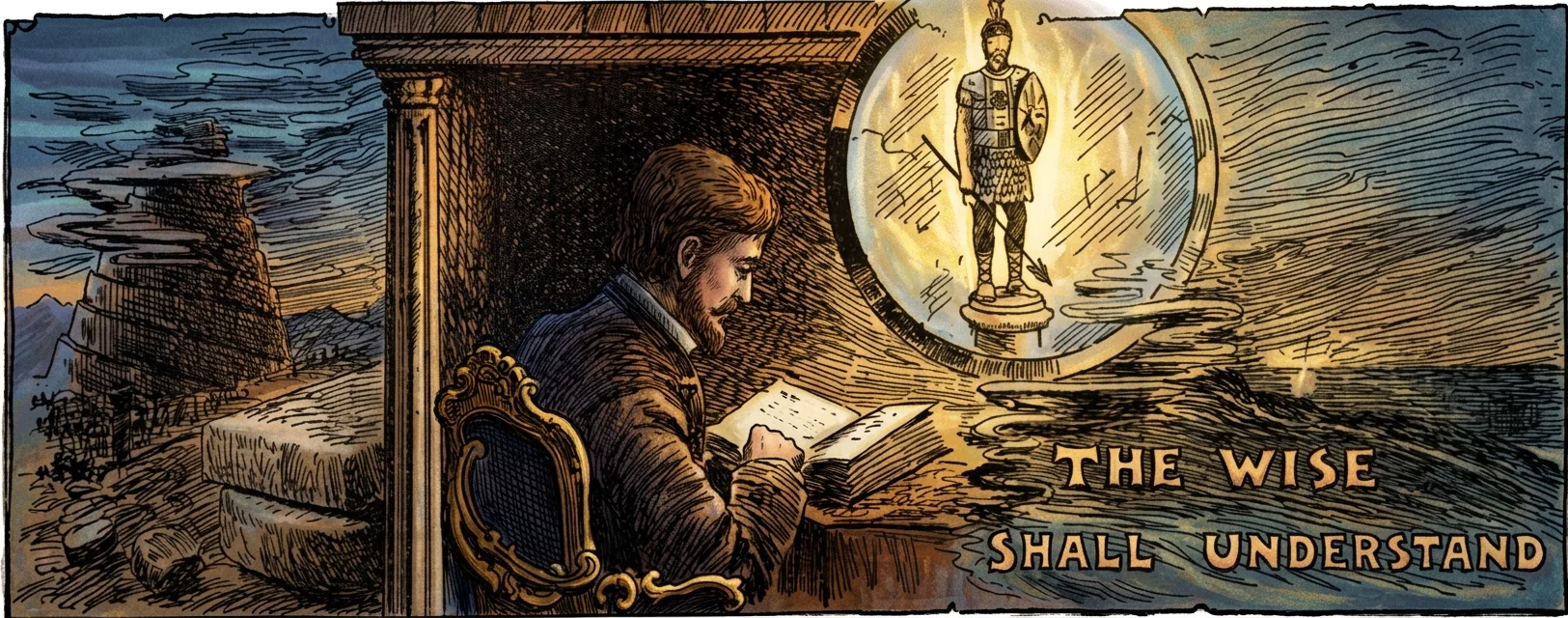
There are evidences of facts stronger than that of the senses. In 2 Peter 1:16–19 we are told that “more sure” than the hearing of God's voice and the seeing of Christ's glory is the “word of prophecy; whereunto ye do well that ye take heed, as unto a light that shineth in a dark place, until the day dawn, and the day-star arise in your hearts.” The world is now passing through the long, dark night of sin; the eternal day of righteousness lies on before; and the “more sure word of prophecy” is given as God's light to reveal the snares and pitfalls of the way, and to guide the pilgrim feet to the better land. By that light we may now see that “the night is far spent, the day is at hand.” Rom. 13:12.
Daniel's Prophecies.
That these predictions are given for the people of God, and may be understood, we are expressly told by our Lord: “Whoso readeth, let him understand.” Note also what we are told in the book itself:—
“He that revealeth secrets maketh known to thee what shall come to pass. But as for me, this secret is not revealed to me for any wisdom that I have more than any living, but for their sakes that shall make known the interpretation to the king, and that thou mightest know the thoughts of thy heart.” Chapter 2:29, 30.
“But thou, O Daniel, shut up the words, and seal the book, even to the time of the end; many shall run to and fro, and knowledge shall be increased.” Chapter 12:4.
“And he said, Go thy way, Daniel; for the words are closed up and sealed till the time of the end. Many shall be purified, and made white, and tried; but the wicked shall do wickedly; and none of the wicked shall understand; but the wise shall understand.” Verses 9, 10.
We have reached the time of the end; many have been running to and fro in the treasure house of God's word, and knowledge has been increased. Let us briefly survey in the light of prophetic truth the rise and fall of empires, the waymarks to the kingdom of God.
Three Lines of Prophecy.
There are three symbolic lines of prophecy, to which we will largely confine this paper, given in the second, seventh, eighth, and ninth chapters. The general outline of these prophecies are the same. In the first chapter we have a great metallic image, composed of five different materials, representing the various changes to take place in the great world empires, or ruling dynasties of earth, especially those having a molding influence on the religion and civilization of the world. These empires are shown to Nebuchadnezzar, an idolater, in the form of a great image, as being more likely to impress him. The same are shown to Daniel, the prophet of God and the representative of his people, in the form of cruel and rapacious beasts, devouring and breaking in pieces. These latter symbols are found in chapters 7, 8 and 9.
The First Empire.
The first symbol of the image is “the head of gold,” which we are expressly told represents the Babylonian dynasty, of which Nebuchadnezzar, the greatest of all its rulers, was the head. Chapter 2:38. Here was represented its character as compared with succeeding empires. This empire was founded on the ruins of the old Assyrian Empire. Its seat of government was the renowned city of Babylon, greatly enhanced and beautified by Nebuchadnezzar. It was dowered with both riches and splendor, and its city is called by inspiration “the glory of kingdoms, the beauty of the Chaldees' excellency.”
In chapter 7 Babylon is represented in moral character and its attitude as respects the people of God. Its symbol is that of a lion with eagle's wings (Jer. 4:7, 13), indicating power, strength, and occasional ferocity, combined with soaring pride. These traits were marked in Babylon's conquests over other nations (Jer. 25:9; 27:6–8), in its persecution of the people of God (Dan. 3:1–22), and in the self-exaltation of Nebuchadnezzar (chapter 4:30). But proud Babylon was forced to succumb. The gold was to yield to a baser metal, the lion to an ignoble brute.
The Second Empire.
Babylon fell in B.C. 538 before the Medes and Persians under Cyrus. The Medo-Persian Empire is represented in the image by the breast and arms of silver (chapter 2:32, 39), among the beasts by a bear (chapter 7:5), and by a two-horned ram (chapter 8:3, 4, 20). Concerning the application of the second symbol we need have no doubt; it is definitely settled by the facts of history, in the reference last given. There is no symbol given of Babylon in chapter 8, because that empire was just passing under the control of Medo-Persia. The two horns of the ram, the bear raising itself up upon one side, are met in the union of the two powers, Media and Persia. “The higher came up last,” refers to Persia, which soon became the dominant power in the empire. Medo-Persia was supreme until B.C. 331, when, at the battle of Arbela, at the river Granicus, the empire was overthrown by
The Third Empire, Grecia.
To the silver of the image succeeded brass (chapter 2:39), a metal stronger and more brilliant, but less valuable; to the bear succeeded the winged leopard (chapter 7:6); to the ram, the rough goat (chapter 8:5–8), symbolizing Grecia (verse 21). The notable first horn of the goat symbolized Alexander the Great, the first Grecian king of universal conquest (verse 21; chapter 11:3); and the four heads, and the four horns, the four divisions of Grecia shortly after Alexander's death (chapter 8:22; 11:4). These divisions were as follows, Syria, Thrace, Egypt, and Macedon, and were ruled respectively by leading officers in the Grecian Empire, Seleucus, Lysimachus, Ptolemy, and Cassander. The independence of these did not long continue.
The Fourth Empire.
The brass of the image was broken by the stronger iron (chapter 2:40); after the leopard came a great, cruel, nondescript beast (chapter 7:7), symbolized in chapter 8 by a little horn which came out of one of the four horns of the goat, and waxed exceeding great (chapter 8:9–12, 23–25). The world empire which succeeded to the dismembered Grecian dynasty was, as all know, Rome. In the year B.C. 168 Rome conquered the Macedonian horn of the goat, demonstrating her superiority in the contest for world empire, and stimulating to further conquest. Hence she is represented to the prophet as coming out of one of the horns of the goat. Chapter 8:9, 23. Seven years later (B.C. 161) Rome came into connection with the people of God. Shortly after this Syria and Egypt fell, and at the time of our Lord's first advent the Roman Empire filled the known civilized world. At this time she was Satan's agent, through both Herod and Pilate, against the Son of God.
A Divided Empire.
Rome remained a united government till the fourth century, when, through the incursions of the northern barbarians, the empire was broken to pieces, symbolized by the clay mixed with iron. Chapter 2:41. The strength of the imperial iron was broken. Between the years A.D. 351 and 476 just ten kingdoms were evolved out of the broken empire, as follows: Franks, Alemanni, Burgundians, Vandals, Suevi, Visigoths, Anglo-Saxons, Ostrogoths, Lombards, Heruli. Chapter 7:7. These continued intact till A.D. 493. Previous to this period of seventeen years another power, religious, ecclesiastical, clamoring for political power, had been pushing itself up among the ten kingdoms. This power is symbolized by the little horn of Dan. 7:8, 11, 20–26. Concerning this little horn the prophecy gives not less than ten specifications, all of which have been fulfilled in one power, and but one power, of all the earth, namely, the Papacy, which religiously dominated the powers of Europe for 1,260 long years (time, and times, and the dividing of time, verse 25), from A.D. 538, when, by a decree of Justinian and the overthrow of the Heruli, Vandals, and Ostrogoths, the Papacy was set up, to 1798, when under the French the spiritual domination of the Papacy was destroyed. The rise of the little horn, the blasphemous, assuming, persecuting character, the work it was to do, the time of its continuance, are all met in the system of the Papacy.
The Next Great Empire.
All of these things have been fulfilled, and, according to these three lines of prophecy, the next great event is the destruction of all earthly kingdoms, broken by the stone “cut out without hands (chapter 2:35), “broken without hand” (chapter 8:25), “given to the burning flame” (chapter 7:11). Then “shall the God of heaven set up a kingdom, which shall never be destroyed; and the kingdom shall not be left to other people” (chapter 2:44); when “the kingdom and dominion, and the740greatness of the kingdom under the whole heaven, shall be given to the people of the saints of the Most High, whose kingdom is an everlasting kingdom, and all dominions shall serve and obey him” (chapter 7:27). This, according to Daniel's prophecies, is the next great event to dawn upon the world. Soon will it come. Oppression and persecution and conflict and death will yield before the reign of peace, rest, and life.
Prophetic Periods
There are important prophetic periods in the book of Daniel. One—the 1,260 years of persecution—we have already referred to. This brought us to 1798, the beginning of the time of the end. Chapter 11:35. Then began the opening of these prophecies to the world, in a fuller sense than ever before, when the great prophetic periods culminated (chapter 12:4), and the sealed book in God's providence was opened, as shown in Rev. 10:2, 6, 7.
Space will permit the consideration of but one other prophetic period of the book of Daniel, namely, the 2,300 days of chapter 8:14; other publications will more clearly reveal the great truths involved in this scripture. Upon this only the briefest outline can be given. In Dan. 8:13 is the following question, asked of the angel: “How long shall be the vision concerning the daily [or continual desolation], and the transgression of desolation, to give both the sanctuary and the host to be trodden underfoot?” The reply is addressed to Daniel and the church: “Unto two thousand and three hundred days; then shall the sanctuary be cleansed.” Verse 14.
The question pertained to the people of God and the persecution from the two great phases of oppressive powers,—the “daily” (“sacrifice” is a supplied word), or continual desolation—paganism—and the transgression of desolation—the Papacy. By these two the work of God for fallen man (represented by the sanctuary), and the people (by the host who there worship) have been trodden down. How long shall the truth and people of God be subject to earthly powers? The answer is that in 2,300 days the sanctuary would be cleansed. Does this answer the question? Let us see.
The beast symbols, representing persecuting powers, every one, reach from Daniel's day to the great day of God's reckoning. The period concerning this persecution must be also a long period of time. The divine rule in prophecy is a day for a year. Eze. 4:6. The 2,300 days therefore represent 2,300 literal years.
Explanation of the Time
The ninth chapter, recording a vision a few months later, is the key to chapter 8. To Daniel was explained the vision of chapter 8 excepting the time. When the angel returns, he begins by referring Daniel to the vision of the previous chapter, and immediately begins upon the explanation of the time. See chapter 9:21–27.
Briefly stated, the days begin with the going forth of the commandment to restore and build Jerusalem. This went forth in B.C. 457, in the seventh year of Artaxerxes Longimanus. Ezra 7. Seven weeks, or forty-nine full years, reach to the restoration of the wall under Nehemiah—B.C. 408. See Prideaux. Sixty-two weeks more, or 434 full years, in all 483 full years, beginning in the autumn of B.C. 457, reach to Messiah the Prince, in A.D. 27. Luke 4:18. The fulfillment of this time was proclaimed by John the Baptist. Mark 1:15. Three and one-half years more reach to the cutting off of Messiah the Prince (Dan. 9:26), and the last half of the seventh week of years, making in all 490, closes with the cutting off of the Jewish nation as the special people of God, and the giving of the Gospel to the gentiles, A.D. 34. See Acts 8 and 9. From 2,300 years subtract 490, and there remains 1,810, which, added to A.D. 34, brings us to 1844. Or, 2,300 full years from the autumn of B.C. 457 reach to the autumn of A.D. 1844, when the 2,300 years ended.
Then Shall the Sanctuary Be Cleansed.
The sanctuary of the Levitical dispensation was that built by Moses in the wilderness, later giving way to the temple. That sanctuary in its building appointments, priesthood, and service was typical of Christ and his priesthood in the heavenly sanctuary. See Heb. 4:14; 8:1–5; 9:1–12. Jesus began that priesthood when he ascended on high.
In the typical sanctuary there was a complete round of service every year (Lev. 1–16; Heb. 9:6, 7), typifying in each year the service of Christ, which was once for all (Heb. 9:12). The last day in the year the typical priest entered upon the cleansing of the sanctuary, the blotting out of sin, which was a judgment work. See Lev. 16:7–21; 23:26–32. In the close of Christ's ministry the heavenly sanctuary is cleansed from all remembrance of sins, the mystery of God is finished, and the judgment work begins with the investigation of the names of those in the book of life. See Heb. 9:22, 23; Rev. 10:6, 7; 14:6, 7. That the investigative judgment precedes the coming of Christ, the resurrection of the just, and their reward, is shown by Luke 20:35; 1 Cor. 15:51, 52. They are “accounted worthy” before they are raised immortal.
This judgment work began in 1844. In the type it was comparatively brief. How long it may now last we can not tell. Suffice to say that it will close with the last generation to which its warning message comes, “The hour of his judgment is come.” Rev. 14:7. The next event is the coming of Christ to reward the faithful. We know not the day or the hour, but we do know that the coming of the Lord is near, “even at the doors.”
Thus briefly is merely sketched the outlines of the Gospel of prophecy in Daniel. Let the reader study the outline, fill it up with the facts of history and the word of God, and he will “know” that the Lord cometh quickly. “The wise shall understand.”