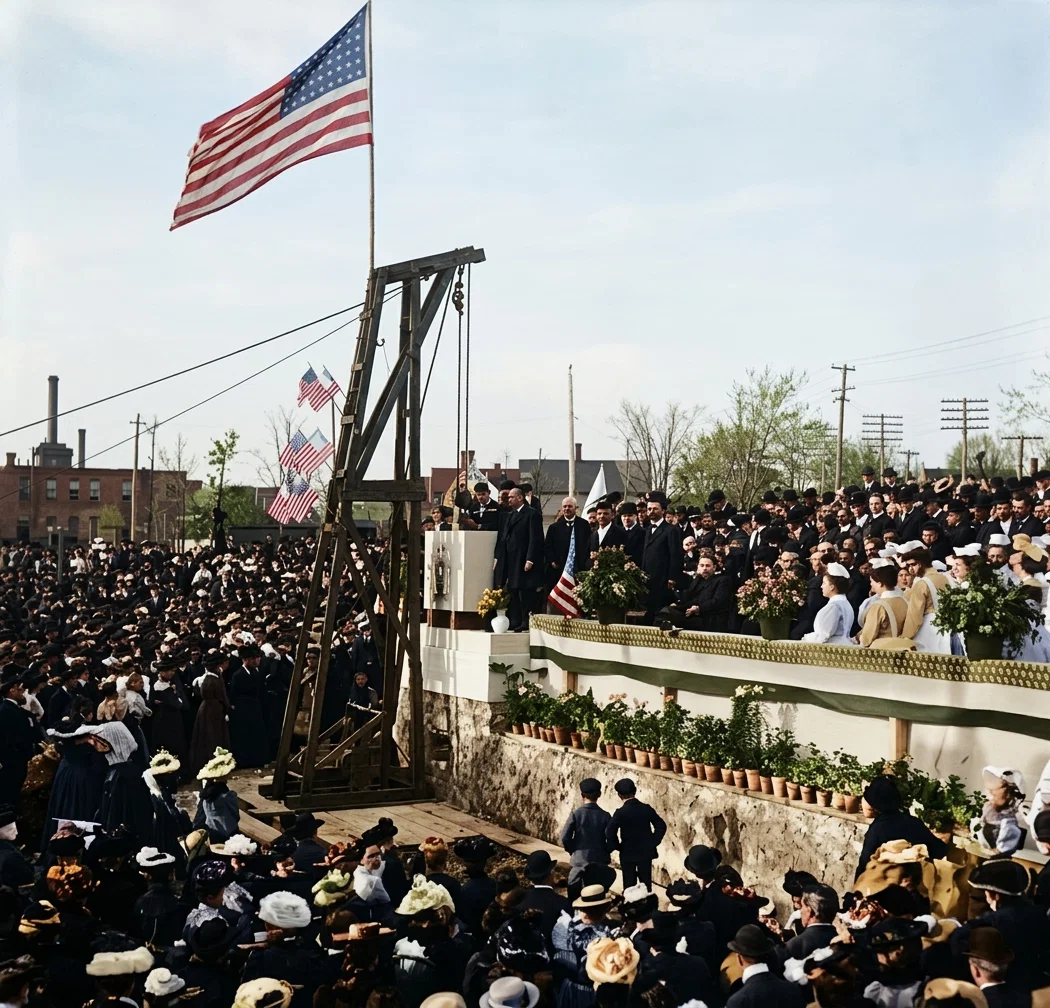
The Laying of the Corner Stone of the New Sanitarium
By L. A. S.
FEBRUARY 18 and May 11, 1902, are contrasted and eventful days in the history of the Battle Creek Sanitarium. On the former date a large number of citizens gathered upon the grounds about the institution, called thither by the alarm of fire, to witness a scene as unexpected as it was depressing. They gathered to look upon what almost seemed at the time to be the blotting out of the institution. On the latter date an even larger concourse of people gathered upon the same spot to join in an occasion of rejoicing, which, but for that former date, would not have been possible. The lesson darkly written by the finger of God in smoke and ruins, and which at first seemed hard to be understood, had been made clear, and with renewed confidence in the high purpose of God for the institution of his planting, its many friends, from far and near, assembled to participate in a ceremony prophetic of the glory of the latter house which was rising from the ruins of the first.
At 3:30 P.M., the appointed hour, began the ceremony of laying the corner stone of the new structure. Upon an elevated stage erected for the occasion over a part of the rising foundation, were seated the physicians and leading officials of the Sanitarium, clergymen of the leading churches in the city, the mayor of Battle Creek, several State officials, and a number of leading citizens who had done much by their means and influence to make the occasion possible. Another portion of the platform was occupied by the nurses and medical students, in uniform. Next to these was the leading orchestra of the city, and on the rear of the platform was a chorus of several hundred trained singers. In front of the stage below were seated the patients, and beyond these, spreading out in a vast semicircle, were the thousands who had come from their homes and from other cities to witness the scene.
The exercises were opened by the anthem, “Praise Ye the Father,” rendered by the orchestra and chorus, under the direction of Prof. Edwin Barnes. Elder L. McCoy, chaplain of the Sanitarium, then read from the Scripture, beginning with Neh. 2:17, 18: “Then said I unto them, Ye see the distress that we are in, how Jerusalem lieth waste, and the gates thereof are burned with fire: come, and let us build up the wall of Jerusalem, that we be no more a reproach. Then I told them of the hand of my God which was good upon me; as also the king’s words that he had spoken unto me. And they said, Let us rise up and build. So they strengthened their hands for this good work.” The reading included also 1 Kings 6:11, 12; 1 Chron. 22:11–13; Ezra 3:10, 11; Psalm 67.
Following the Scripture reading, prayer was offered by the rector of the Episcopal church, the vast audience standing with uncovered heads. The anthem, “Send Forth Thy Light,” was then rendered by the orchestra and chorus, after which W. W. Prescott, who acted as chairman, briefly addressed the audience, as follows:—
These exercises mean more than mere sentiment or ceremony. The true meaning of the laying of a corner stone has been taught in the Scriptures: “Behold, I lay in Zion for a foundation a stone, a tried stone, a precious corner stone, a sure foundation; and he that believeth shall not make haste.” The Master also said, referring to this principle, “Upon this rock will I build my church; and the gates of hell shall not prevail against it.” This building is simply a18means through which may be revealed principles of divine truth, and hence, a living exponent of divine truth.
We are gathered here to emphasize anew the principles which have been represented by this institution for more than a quarter of a century, and this ceremony marks the progress which has been made in the erection of a suitable home for the promulgation of these principles.
We have not space to give in full the addresses of the various speakers, but only the substance of each one. Rev. D. D. Martin spoke in behalf of the clergymen of Battle Creek. He said:—
There is, in this occasion, an expression on the part of this multitude, of appreciation of the place this institution fills in our community. We are proud of the records of this institution which we have met to honor to-day. In the hour of sorrow and distress and the devastation of the devouring flame, some of us had hope that a re-erection of the Sanitarium was sure to come. But there have been days of careful planning and nights of unremitting toil to bring about what has already been accomplished.
I speak in a representative way of the moral forces of the city about us when I say that we recognize the fact that this is more than simply an institution of gain, in a material sense. This and its branch institutions stand under the shadow of the cross, and carry with them the influence of the sufferings of the Son of God. In all the strength of its service, we may recognize the principles of this institution in their application to humanity’s need, as they are constantly held before us. The physical gospel which is here preached, is essential to the domestic, the political, and the social life of our commonwealth. Such an institution as this, which stands for cleanliness and purity in this age of vice, is an institution of moral power in any community in which it stands. . . .
I am sure that I speak the spirit of those who think and act in moral channels, seeking to mold the moral life of this community, when I say to the worthy man who is at the head of this institution, and to his co-workers in their noble work. We bid you Godspeed in your work, and we wish for this institution an unprecedented prosperity in all its work for humanity’s good.
Hon. E. C. Nichols, of Battle Creek, was next introduced, and said:—
This is something more than a mere gathering of people to lay a corner stone. That is done almost every day in the year, and ordinarily such occasions are matters of little consequence. But this institution is carried on upon a basis which has hitherto been unknown, and without precedent. Its very foundation was practically unknown to its own people when this institution was dedicated. It was a surprise to them as well as to the outside world that this great institution should be carried on without profits or dividends. Here, it seems to me, is ample ground for a distinction between the significance of the dedication of this building and that of any other building in the land. And I am very glad that the people of our city have arisen to a sense of the importance and understanding of the true aim and object and work of this great institution.
I hope that the completion of this splendid building will not be long delayed, and that this institution will soon be carrying on its work as before. Never in the history of this town has there been anything that came so close home to us all as did the thought that through some possible stress of circumstances, this institution might leave this city.
From Governor Bliss, who was detained at the capital by the pressure of official duties, came this message, sent by his private secretary:—
I wish you would carry to the people at Battle Creek who are building the new Sanitarium, my message of kindly feeling and of congratulation. I am so glad that what seemed to be a disaster, has proved to be, perhaps, a blessing in disguise, and may God prosper and bless them in their work.
The auditor-general of Michigan, Hon. Perry F. Powers, was introduced, and said that he brought greetings in the name of the people of the State, and that Michigan was proud of the sentiments represented by the occasion. Following him Mayor Webb spoke of the name and fame of the institution, which has become known throughout the world, and of the better knowledge of its beneficent work which had been one result of the fire. “I have,” he said, “watched the growth of this great institution from boyhood, from the time when it occupied the small building known as the Water Cure, until the present, but never until recently had I a faint conception of the work done by it for the poor and needy.”
Dr. Paulson, the director of the Chicago Branch Sanitarium, spoke for the many branch institutions located in this country; and Elder W. A. Spicer, who returned to this country from India one year ago, spoke for the regions beyond, the dark portions of the earth filled with a vast human constituency which says little and suffers much. From personal experience he knew of the appreciation felt by those in such lands for the work of those who came to minister to their physical and spiritual needs.
The chairman then rose and said: “It seems very fitting that the man whose life has been wrapped up in the growth and development of this institution, who has stood with it from the very first, who is to-day standing with all these fellow workers as a leader in this great work, and I may say, in some degree at least, as a personal tribute to whom there is this large gathering to-day,—I say it is very fitting that his hand should be the one to lay the corner stone of the new institution.” He then introduced Dr. J. H. Kellogg, who addressed the audience, as follows:—
Some buildings are constructed as monuments of great men, or deeds considered great, or great achievements in art, science, invention, and discovery. The structure which we have begun to build, and the corner stone which we are here to-day gathered to lay, is not a monument. The purpose of the multitude of the public-spirited, large-hearted men and women who have contributed their money, thought, and sympathy in the planning and erecting of this structure, is to build a temple to be dedicated to mercy and truth, an institution the spirit of which shall be all that is noble, sweet, pure, and true; a practical illustration of good will, beneficence, kindliness, fraternity, and brotherly helpfulness toward all men, irrespective of creed, caste, or condition; an institution which, though enjoying the advantages of denominational affiliations, remains unbound by creed or sectarian shackles. There is a religion greater, broader, and deeper than that of any sect which recognizes any formula as its creed, any synod, sanhedrin, or hierarchy as its custodians or almoners; which claims as its members all men and women who love God and their fellow men; whose ministers require no other credentials than the possession of the spirit of the good Samaritan, impelling them to acts of kindly human helpfulness, following in the footsteps of the divine Teacher, the history of whose life is recorded in the simple words, He “went about doing good.”
Organized as a self-supporting, philanthropic enterprise, the beneficent work of this institution will be confined to no community, State, or country. Already it has planted daughter institutions on every continent, being represented by nearly one hundred branch enterprises in different parts of the world. The principles for which this institution stands to-day, and for which it has been standing for more than a third of a century, cannot be easily formulated in a verbal statement; for, like a vigorous, growing tree, they are continually putting forth new branches and leaves, and unfolding new blossoms of truth. The central thought in the philosophy of this institution, which has sometimes been designated as “The Battle Creek Idea,” is one in which science, philosophy, and the inspired Scriptures agree; namely, that man is a temple, controlled physically, mentally, and morally, if he will, by an indwelling intelligence, infinitely superior to him, yet serving him beneficently, guiding, instructing, aiding him by subtle promptings and leadings,—sometimes called instinct,—silent, but yet appealing voices, saying to man in all his wanderings and perversions, “This is the way, walk ye in it.”
“Truth owes its high prerogatives to none.
It shines for all, as shines the blessed sun;
It shines in all who do not shut it out
By dungeon doors of unbelief and doubt.
To shine, it does not ask, O, far from it,
For hierarchal privilege and permit.”
“The power to bind and loose to Truth is given;
The mouth that speaks it, is the mouth of Heaven.”
Out of this basic thought grow all the rules, customs, and practices peculiar to this institution. Man has fallen from his original high estate,—once a royal personage, a king and ruler of the earth, made a little lower than God, his representative in the world. He has wandered away from the divine way of life marked out for him by his Creator, and has become addicted to practices in eating and in dressing, in his home life, his business life, his social life, which are incompatible with his own best good as an individual, and destructive to the welfare of the race. These have led to degeneracy of mind and body and the development of a thousand maladies, and have become a veritable Pandora’s box of physical, mental, moral, and social ills.
Against all these perversions and deviations from the natural order of life, this institution raises an earnest protest; and its work from its inception to the present moment has been, and for all future time must be, to hold up before the world the eternal immutability of law, the unerring certainty of penalty following the violation of law, and to win men from transgression to obedience, to lift them from disease to health, through the promulgation of the principles of righteousness in all that pertains to human nature, physically, mentally, and morally, and the demonstration of the glory and the beauty and the sweetness of the natural order, the divine order of life.
As a medical enterprise, this institution stands for and must ever be made to represent the highest attainment and the farthest advance in the healing art, recognizing that the healing power which operates in the restoration of the sick is within the sick man, not external to him, that every act of the healing is an evidence of divine beneficence and power; and utilizing as the best, most potent, and most genuinely curative measures those powerful natural agencies whereby life and health are maintained under ordinary conditions, especially light, air, water, food, exercise, electricity, mechanical applications, and every other measure which can aid the healing powers of the body in their restorative work.
As a benevolent enterprise, this institution must forever devote all its earnings, after expenses have been paid, to the treatment of the sick poor, through the organization of dispensaries and clinics in various cities, as well as the treatment of those who may visit the institution here, and such other work of beneficence as may be germane to its principles.
As an educational enterprise, this institution has founded and will maintain a training school for missionary nurses, in which hundreds of self-sacrificing men and women, who have laid down their lives upon the altar of sacrifice for humanity, have been and will be trained for service in mission fields at19home and abroad. It has also organized and equipped, and for many years maintained, a medical college, in which one hundred or more students receive a thorough medical education, recognized as equal, and in many respects superior, to that of other first-class medical colleges, in which young men and women who have resolved to devote their lives to the promotion of the principles and work here represented may receive the preparation necessary for their life work.
As a reformatory enterprise, this institution stands for total abstinence and utter abolition of the manufacture and traffic in intoxicating beverages; for the prohibition of the culture, manufacture, and public use of tobacco. It protests against the habitual use of tea and coffee, and all other drugs capable of injuring the body-temple; it protests against the wholesale, useless slaughter of innocent, inoffensive animals to satisfy the unnatural thirst for blood which men, the Anglo-Saxon race in particular, have inherited from their cannibalistic ancestors; and urges a return to natural simplicity and purity in diet as necessary for the reclamation of the race from degeneracy, disease, vice, and carnality; and demanded by a just recognition of the rights of lower animals, and the high code of ethics, purity of life, physically, mentally, and morally. A recognition of all the demands of truth and all the demands of mercy must be the aim of every man and woman connected with this enterprise, and to bring others to a like recognition is the grand and inviting task, extending out through coming years to those who join hands for the promotion and carrying forward of this work.
It is certainly no discredit to those who founded this institution thirty-six years ago that, in this new founding, this corner stone laying, marking the beginning of a new era in the history of this work, it is not necessary to introduce any new principle nor to discard or repudiate any principle which has been heretofore recognized. Every essential principle implanted at the beginning of this work is here to-day, and comes forward for recognition, not tarnished by the lapse of time, nor shattered by the shafts of criticism, but tried, burnished, and intact. The little light kindled here on this hilltop a third of a century ago has never gone out, but has burned brightly, and yet more brightly, as the years have passed, and this day shines out even from the midst of these shapeless piles of brick and stone with a brighter luster than ever before, and not from here only, but from a hundred hilltops scattered throughout the civilized world.
In behalf of the board of management and my medical colleagues, physicians and nurses, who are gathered here to-day, and who, from near and distant parts, are to-day looking up to this place with interest and sympathy and love almost like that which kindled in the heart of the ancient Israelite when he turned his face toward his temple-city, Jerusalem, I am glad to be able to express a universal sentiment of accord and confidence in relation to the sacred principles upon which this work rests, and to say that the experience of the past and the promise of the future justify us in feeling that the standards set for us have been none too high; that not one principle can be abandoned, not one truth surrendered; that, instead, the standard must year by year be raised a little higher, and higher still; that the blazing light of truth must be made year by year to shine out a little brighter; that in the years to come, the noblest principles of human love and sympathy and divine truth which Providence has made to emanate from this place must call forth from those who have stood here as the representatives and the instruments in this work in years past, and who may stand in the years to come, nobler efforts, deeds of greater sacrifice, greater faithfulness, more unswerving loyalty to truth, and uncompromising opposition to error.
This corner stone which we are about to lay here is not the real foundation of this building. We have only chosen it to be a visible symbol of those great, heaven-born truths of which this building is to be the home, the vehicle of dissemination to the world. Time may crumble these stones to dust, winds may scatter them far and wide, but the principles which have been growing here these many years, and are now replanted for a still larger growth, are indestructible, and will live after these visible tokens may have disappeared, in the human hearts and lives which have been made sweeter and better and happier by being brought into greater harmony with God.
The speaker then held up to view a copper box in which had been placed copies of the daily papers of Battle Creek, published the day of the fire, the Articles of Incorporation of the Michigan Sanitarium and Benevolent Association, copies of the medical journals published under the direction of this society, a report of the citizens’ committee appointed to investigate the management of the institution, photographs of nurses’ classes, and a number of coins. A workman with a soldering outfit came forward, and sealed the box, which was then placed by Dr. Kellogg in a receptacle prepared for it in the foundation just underneath the corner stone. He was then handed a mason’s trowel, and with this he filled the space around the box with mortar, so that it was firmly imbedded in its place. Mortar was then spread upon the foundation, the wooden blocks upon which the corner stone rested were removed, and the latter was lowered to its place, and pronounced true, level, and square.
Rev. W. S. Potter, pastor of the Presbyterian church, then offered the dedicatory prayer, and the impressive service was concluded by singing the doxology, in which the audience joined with the choir. The weight of the corner stone is three thousand pounds.
A pleasing feature of the ceremony was the presentation to Dr. Kellogg of a solid silver trowel with an ivory handle, by members of the building committee, the superintendent of construction, and other friends. Upon one side of it was the inscription: “Presented to J. H. Kellogg, M. D., by a few friends on the occasion of the laying of the corner stone of the new Battle Creek Sanitarium, May 11, 1902, A. D.” Upon the reverse side was inscribed this sentiment:—
“Build as man may, time gnaws and peers
Through marble fissures, granite rents;
’Tis only principle that rears
Imperishable monuments.”
The weather was very favorable for the occasion, and the vast audience listened with evident interest throughout the whole of the exercises.