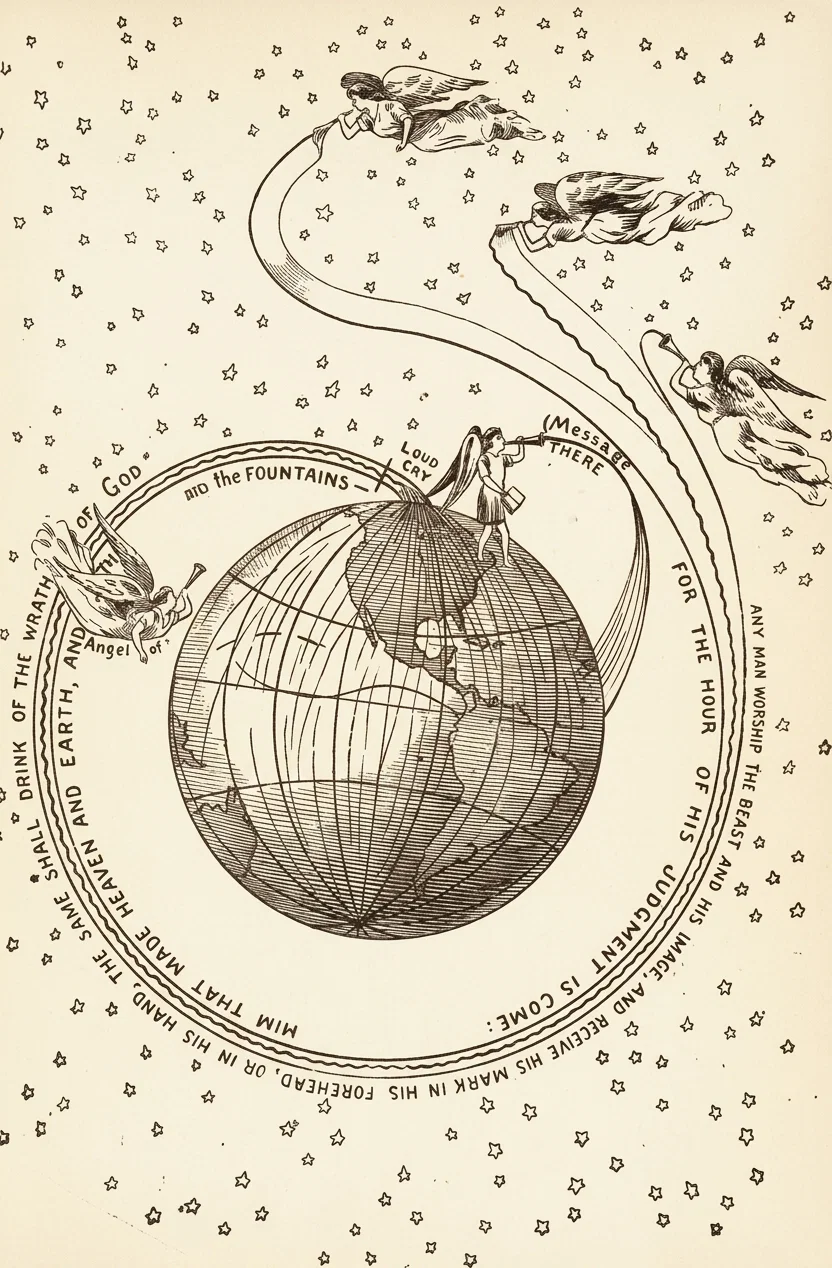
"And I saw another angel fly in the midst of heaven, having the everlasting gospel to preach unto them that dwell on the earth, and to every nation, and kindred, and tongue, and people, saying with a loud voice, Fear God, and give glory to him; for the hour of his judgment is come; and worship him that made heaven, and earth, and the sea, and the fountains of waters. And there followed another angel, saying, Babylon is fallen, is fallen, that great city, because she made all nations drink of the wine of the wrath of her fornication. And the third angel followed them, saying with a loud voice, If any man worship the beast and his image, and receive his mark in his forehead, or in his hand, the same shall drink of the wine of the wrath of God, which is poured out without mixture into the cup of his indignation; and he shall be tormented with fire and brimstone in the presence of the holy angels, and in the presence of the Lamb; and the smoke of their torment ascendeth up forever and ever; and they have no rest day nor night, who worship the beast and his image, and whosoever receiveth the mark of his name. Here is the patience of the saints; here are they that keep the commandments of God, and the faith of Jesus." Rev. 14: 6-12.
NONE who love the word of God, and desire to understand it, can read thoughtfully this scripture without becoming interested to know its meaning and application. Were the book in which it is found, as is so often inconsistently affirmed, "a sealed book," the case would be different. But when the angel who presents these things to John, says at the beginning, "Blessed is he that readeth, and they that hear the words of this prophecy, and keep those things which are written therein; for the time is at hand" (chapter 1: 3), and when he says again at the close, speaking as the representative of Christ, whose angel he was (see chapter 1, verse 1), "Behold, I come quickly; blessed is he that keepeth the sayings of the prophecy of this book," repeating, "for the time is at hand" (chapter 22: 7, 10), the searcher for light has the fullest warrant for studying, and the blessed assurance that he may understand and obey.
The portion under consideration in these articles embraces what is frequently called "The Three Angels' Messages," from the fact that, as John saw three angels flying "in the midst of heaven," of the last one he says, "And the third angel followed them," which implies that only two others preceded this one connected with this series, or with his then present vision.
The first is represented as preaching the gospel to dwellers upon the earth; but we know that the preaching of the gospel "to every creature" "in all the world" was committed by Christ himself to men. Mark 16:15. Angels, it is true, as direct messengers from God (Heb. 1:14), assist men, and by their influence over those who desire and yield to it, may be said to direct in the work; yet they operate through human agents in accomplishing it. So while actual angels may have charge of the work symbolized by these messages, yet the work itself must be one in which men are the active agents. The importance of the work is, however, more strikingly presented by the selection of angels as bearers of the message.
Three angels appear; each proclaims a distinct message; yet, carefully studied, these messages are found to be really but one, rather, a leading, principal message, followed or joined by two others contingent upon, and made necessary by, the rejection of the first.
THREE MESSAGES.
NOTES UPON THE ILLUSTRATION.
in its nature, embracing as it does, considering the terms employed, a complete system of truth, and a perfect worship, added to which, as an incentive to heed the message, the announcement that the "hour of God's judgment is come." The acceptance of the "everlasting gospel," and the true worship of "him that made heaven and earth, and the sea, and the fountains of waters," must embrace every moral and Christian duty, and secure every Christian privilege and blessing; in short, must fit the recipient perfectly for the judgment.
The second message is a statement of a single fact, with the reason for it: "Babylon is fallen, is fallen, that great city, because she made all nations drink of the wine of the wrath of her fornication." All that need be said in this connection concerning it is that the term "Babylon," used here symbolically, is the same as that found in chapter 18, from which it is evident that whatever it symbolizes, it is that in which at the time of its fall God's people are found; and further, that the fall is a moral one through sin, for "Babylon the great is fallen, is fallen, and is become the habitation of devils, and the hold of every foul spirit, and a cage of every unclean and hateful bird," therefore, "come out of her, my people, that ye be not partakers of her sins, and that ye receive not of her plagues. For her sins have reached unto heaven, and God hath remembered her iniquities." Rev. 18:2, 4, 5. It is because of her sins that God calls his people out of her, in order that they receive not of her plagues.
The third message is remarkable. It is spoken with a loud voice, as is the first. The first calls upon all to worship the Creator—the true God. This warns every man, in most striking language, against the worship of powers evidently opposed to God, but which demand worship due alone to him. This warning is emphasized by the most fearful threatening of punishment upon those who do not heed it, to be found in all the Bible, the "wrath of God" "without mixture." The only modifying element ever mixed with wrath is mercy. This, then, will be wrath without any mercy. In chapter 15, verse 7, we read of seven angels, having "seven golden vials full of the wrath of God." With the commonly accepted idea that, in Scripture, the number seven denotes completeness, we have in this an expression of God's unmixed wrath—evidently God's wrath after the period of mercy is forever past. From chapter 16, verse 19, we learn that this wrath comes upon Babylon, for "great Babylon came in remembrance before God, to give unto her the cup of the wine of the fierceness of his wrath." It comes upon Babylon after God's people have left her; for the announcement is first made, "Babylon is fallen, is fallen" (chapter 14:8 and 18:2); and then the call is given, "Come out of her, my people," and lastly the statement and command concerning her: "God hath remembered her iniquities. Reward her even as she rewarded you, and double unto her double according to her works." By this it is seen that the punishment threatened in the third message comes upon Babylon, whose fall is announced by the second angel, thus connecting these two messages directly.
The result of the third message is to develop a people of whom it is said, "Here is the patience of the saints, here are they that keep the commandments of God, and the faith of Jesus." Rev. 14:12. These were ones in Babylon, but accepted the call to come out, and rejected the false worship of which the message warns. The fall of Babylon is not announced until after the proclamation of the world-wide gospel message of the first angel, from which it may be reasonably concluded that her fall, being a spiritual one, is consequent, in a measure, at least, upon the rejection of light and truth which that message brought to her. Had that light been received as it might have been, the two succeeding messages would not have been necessary. This will more fully appear from further presentation of the subject in future articles.4One more consideration may be noticed, showing the connected nature of the three messages. The first embraces, as already stated, the preaching of all Bible truth connected with the worship of the true God and the gospel of Christ. It is entirely free from warnings, threatenings, or condemnation expressed or implied. The others are essentially different in these respects. They neither present nor embrace any direct position of truth, except as involved in the statements of condemnation, warning, threatening, or approval. It is therefore plain that the company referred to above, as being developed by the third message, should more properly be regarded a development of the three messages combined. For it is said that they "keep the commandments of God, and the faith of Jesus," which is in reality the same thing as accepting the "everlasting gospel" and worshiping "him that made heaven and earth." These expressions are synonymous. "Keeping the commandments of God"—true worship—and "the faith of Jesus"—the gospel. In other words, those referred to under the third message are really doing what the first message calls upon all to do, having rejected the worship against which the third message warns. Thus, properly understood, the three constitute one message consisting of three parts, the first being the primary and important one, while the others are secondary, and important only in connection with the first and related to it.
From the foregoing we conclude that John, instead of seeing these angels give independent messages in consecutive order, sees the first giving the leading message, and while he continues, he is joined by the second, and while the two continue in unison, they are also joined by the third, the message of the first never ceasing to constitute the basis, or keynote (so to speak), of the two following. This leads to another conclusion, that they are given to the same generation. The generation living when the first begins to be given will hear the third; for it would not be just to punish one generation for the neglect and sin of some generation preceding it.