FOR ages, in deadly antagonism to each other, two great principles have existed in the earth, molding the characters of men. Between these principles there is irrepressible conflict, and will be until the existence of one is forever ended. Of vital importance—and it should be of vital interest—is this conflict to the children of men; for they are factors in the great problem that is being worked out in the universe, and upon its solution depends their eternal weal or wo. There is no neutral grounds. There is no escape from the inevitable result on one side or the other.
On one side of this conflict is the principle of Love, or Good, or Truth, or Light, or Righteousness, or Life, for they are all of One. Opposed to these are Hatred, or Selfishness, Evil, Error, Darkness, Sin, Death, and these are all of one.
The former of these principles is of God, the center and circumference of all goodness, truth, light, righteousness, and life; for "God is love." That is his character; and love unperverted is light and life.
The latter principle, Selfishness, is of the great adversary of God. In selfishness is found hatred, evil, error, sin, darkness, death.
Love is diffusive, seeking others' good. Hatred or selfishness is self-centered, seeking the good of one at the expense of all others and all else. The one seeks to build up all, and is itself built up as a consequence; the other seeks to build up self at the expense of any and all, hence it is destructive. Love asks what is right, what is for the best good of one and all. Evil asks what is expedient? what will benefit me?
Embodied in Law.
For the benefit of his creatures God has embodied his righteousness in his law of love, unchangeable and eternal as his throne. Theology has divided the history of God's dealings with sinners into three great dispensations according to priesthoods, namely, Patriarchal, Levitical, Christian, and out of this division men have tried to build different systems of morality and plans of salvation. But it is only by perverting God's word that such things may be made to appear. The following scriptures, condensed to save space, spoken to or of men in the various "dispensations," conclusively show that God's requirements of men are and always have been the same, and that what he requires is nothing less than the perfection and holiness which he himself possesses:—
"An Enoch walked with God [by faith, Heb. 11:5]; and he was not; for God took him." Gen. 5:24.
How "can two walk together, except they be agree?" Amos 3:3.
"Noah found grace in the eyes of the Lord. . . . Noah was a just man and perfect in his generations, and Noah walked with God." Gen. 6:8, 9.
"And the Lord said unto Noah, . . . . These have I seen righteous before me in this generation." Gen. 7:1.
"God . . . . saved Noah, . . . . a preacher of righteousness." 2 Peter 2:4, 5.3"By faith Noah . . . became heir of the righteousness which is by faith." Heb. 11:7.
"The Lord . . . said unto him [Abraham], I am the Almighty God; walk before me, and be thou perfect." Gen. 17:1.
"And he [Abraham] believed in the Lord; and he [God] counted it to him for righteousness." Gen. 15:6.
"Abraham obeyed My voice, and kept My charge, My commandments, My statutes, and My laws." Gen. 26:5.
"Know ye therefore that they which are of faith, the same are the children of Abraham?" Gal. 3:7.
"For in Jesus Christ neither circumcision availeth anything, nor uncircumcision; but faith which worketh by love." Gal. 5:6.
"This is the love of God, that we keep his commandments." 1 John 5:3.
"If ye were Abraham's children, ye would do the works of Abraham." John 8:39.
"He hath showed thee, O man, what is good; and what doth the Lord require of thee, but to do justly, and to love mercy, and to walk humbly with thy God." Micah 6:8.
THE PROOF OF GOD'S LOVE TO MAN.
"Ye shall be holy; for I the Lord your God am holy." Lev. 19:2.
"As He which hath called you is holy, so be ye holy in all manner of conversation [conduct]; because it is written, Be ye holy; for I am holy." 1 Peter 1:15, 16.
"Let us hear the conclusion of the whole matter: Fear God, and keep his commandments; for this is the whole duty of man. For God shall bring every work into judgment, with every secret thing, whether it be good, or whether it be evil." Eccl. 12:13, 14.
"For whosoever shall keep the whole law ["the royal law"], and yet offend in one point, he is guilty of all. For He that said ["that law which said," margin], Do not commit adultery, said also, Do not kill. Now if thou commit no adultery, yet if thou kill, thou art become a transgressor of the law. So speak ye, and so do as they that shall be judged by the law of liberty." James 2:10-12.
"I delight to do thy will, O My God; yea, thy law is within My heart." (Prophetic of Christ at his first advent.) Ps. 40:8.
"My meat is to do the will of Him that sent Me, and to finish His work." John 4:34.
"I have kept My Father's commandments, and abide in his love." John 15:10.
"He that saith he abideth in Him ought himself also so to walk, even as He walked." 1 John 2:6.
"Blessed are they that do His commandments, that they may have right to the tree of life, and may enter in through the gates into the city." Rev. 22:14.
Such scriptures might be multiplied indefinitely, but it will not be needful for the candid Bible student. The great facts that the injunctions to be perfect, to be holy, to walk with God, implying agreement; the doing of his will; the keeping of his commandments; the exercise of the same faith, resulting in obedience to the same holy law; the injunction to keep the law in view of the judgment, of which the law is the rule; the obedience of Christ, and the duty to walk as he walked; the blessing pronounced upon the keeper of God's commandments, and much more which might be cited, show unmistakably that God's requirements are always the same, and, in the very nature of things, can no more change than his character can change.
The love which Christ enjoins is the love enjoined through Moses. (Deut. 6:5; Lev. 19:18; Matt. 22:27-40.) The Scriptures and the morality to which the New Testament writers continually appeal are the Scriptures and morality of the Old Testament. God and his law are eternal, unchangeable (Ps. 111:7, 8; Isa. 51:6, 7; Matt. 6:17-19); and that law which reveals sin, is embodied in the Decalogue (1 John 3:4; Rom. 7:7).
Two Masterpieces.
These opposing principles in the great conflict are not purely abstract. Both are personified. Each principle is represented by a person in whose character the principle is wrought out or developed. These the word of God, the Gospel of Christ, holds out before us, that we may see the principle in the character, and so accept the good and refuse the evil. Love—unselfishness—finds its personification in
The Son of God, Our Saviour.
Thus is his character portrayed:—
"Have this mind in you, which was also in Christ Jesus: who, being originally in the form of God, counted it not a prize [a thing to be grasped] to be on an equality with God, but emptied himself, taking the form of a servant, becoming in the likeness of men; and being found in fashion as a man, he humbled himself, becoming obedient even unto death, yea, the death of the cross." Phil. 2:5-8; see R. V., margin.
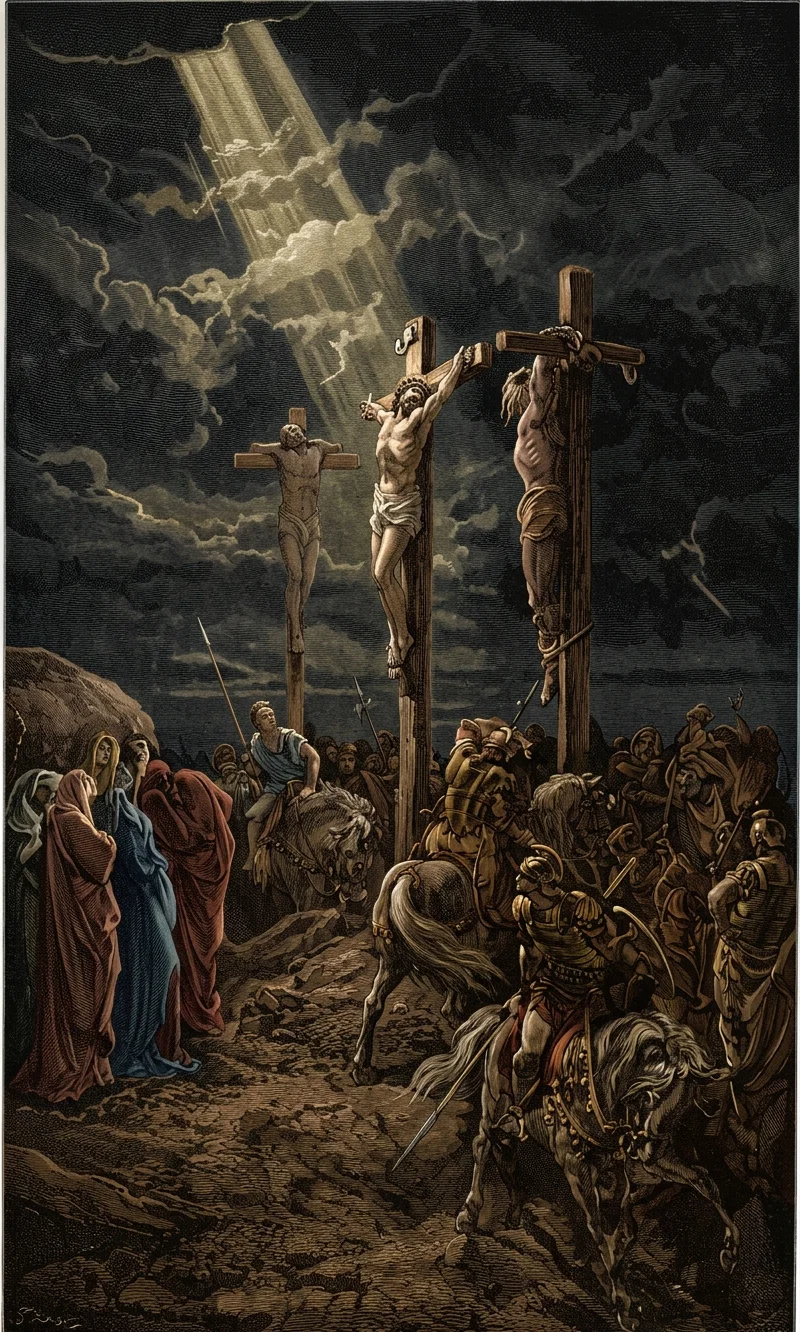
This is love. If any being in the universe had a right to aspire to the throne of the Eternal, it was his divine Son, but he did not count it a prize, "did not meditate a usurpation" (as some translate), did not seek to advantage self, as long as other lives were in jeopardy. So he stepped down to an angelic messenger, and lower still, to man, and even to the lowest, death, or sin full-grown, and did all this that man might be saved, that man might possess the same character. He emptied himself of himself, and God filled him. Christ therefore revealed not himself to the world, but the Father. (See John 14:6-10; Matt. 11:27.) The sacrifice, the suffering, the sympathy, the love, the yearning tenderness for lost humanity seen in the life of Christ, were but the manifestations of the love of God that filled him; and when at last the climax was reached by his death upon the cross, that said to the world, This is love, this is God's love even to the sinner.
Selfishness, or sin, finds its personification in him who was once Lucifer, the Daystar, now known as
Diabolus and Satan,
And here is the record of the mind that was in him:—
"How art thou fallen from heaven, O Lucifer, son of the morning! . . . For thou hast said in thine heart, I will ascend into heaven, I will exalt my throne above the stars of God; I will sit also upon the mount of the congregation, in the sides of the north; I will ascend above the heights of the clouds; I will be like the Most High." Isa. 14:12-14.
Here is self salvation, self exaltation. He that is of like nature is of Satan. He that is of love, of unselfishness, is, through Jesus Christ our Lord, born of God. (See 1 John 3:8-14; 4:7, 8.)
It is the purpose of God to gather out of this earth a company which shall bear his name and character, a part of the great family of God. For that purpose he in love gave them his holy law, "ordained unto life," (Rom. 7:10.) But through Satan, man sinned, perverted God's law to the law of death, came short of God's glory (Rom. 3:23), and was doomed to die (Rom. 6:23). But Christ gave himself, that man might live, and that through Christ the law might work out in sinful flesh what God designed it should do in sinless flesh in the beginning. The law was "ordained to life," but sin found it to be unto death. Sin perverted that law, turned its life power into an unlawful channel, and it worked out wrath, and became "the law of sin and death." (See Rom. 7:10, 23; 4:15.) The law of gravitation is a beneficent and life-sustaining law; it preserves in equilibrium the things of earth; but let man cast himself from a tower or precipice, and the same law proves his destruction. The law in itself is good, but it is perverted and used unlawfully; and thus the law of life becomes a law of death. It is even so that the carnal heart has perverted the beneficent and life-giving power of God's law; and it becomes a law of sin and death to the sinner.
In Christ, however, the Spiritual-hearted, who did no sin, the law is normal in its workings, "the law of the Spirit of life;" and4he who by faith receives Christ, receives in Christ the law in its normal condition—righteousness and life. (Rom. 8:1-4, 9, 10.)
Always Faith.
But righteousness and life are always by faith. "Without faith it is impossible to please Him" (Heb. 11:6), not on the part of the sinner alone, but the righteous as well; for there is no true righteousness but by faith in God. A righteousness without faith in the Supreme is self-centered, and has within it the root of all sin, selfishness. But he who has faith in Almighty Power, Eternal Goodness, and Infinite Wisdom will be ever led and drawn out of self and toward the Great Center of light and love.
In faith, therefore, there is union and strength. It brings one into union with the Eternal Spirit and make him a partaker of its life. It does the same with each and all of the children of faith, and thus it unites by the bond of that Spirit and Life all the children of faith, all who are submitted to God's holy law, who receive in God's own appointed way—Christ Jesus—the riches of his grace. But self, howsoever righteous it may seem, is weak and divisive. It has as many separate centers as there are minds controlled by its influence. These may unite in groups on some common idea or plan or conception, but the union is essentially selfish, lasting only so long as selfish interests seem to be served. This was true from the beginning; it is true now. True faith among men will issue in the prayer of Christ recorded in John 17. It seeks God's glory and the good of all; eventually it will reap God's glory in its fulness and be served by all the saints in light. So it will be in the glad day of universal restoration, when all of sin is destroyed. Each will by love serve God and one another, and each will be served by all. Glad, happy service! Come, thou glad day!