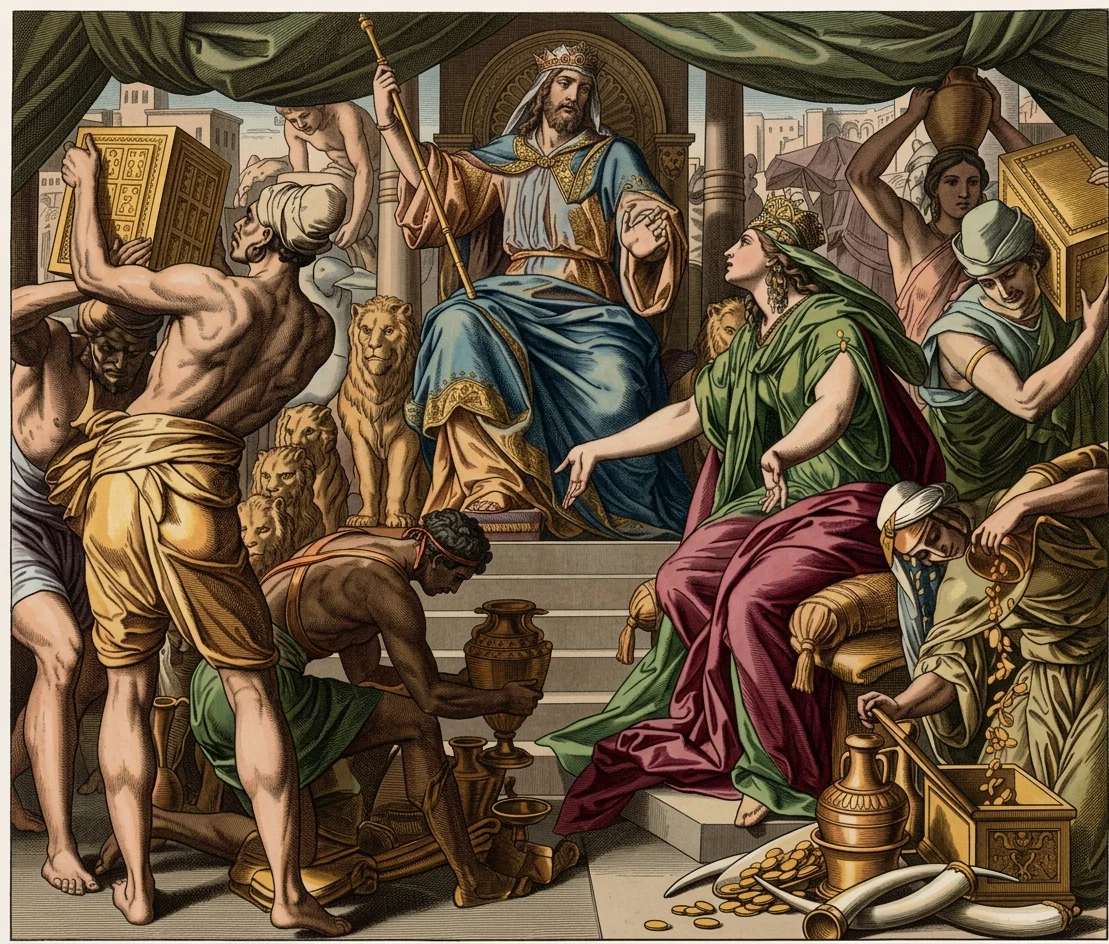
1. AND when the queen of Sheba heard of the fame of Solomon concerning the name of the Lord, she came to prove him with hard questions.
2. And she came to Jerusalem with a very great train, with camels that bare spices, and very much gold, and precious stones; and when she was come to Solomon, she communed with him of all that was in her heart.
3. And Solomon told her all her questions; there was not anything hid from the king, which he told her not.
4. And when the queen of Sheba had seen all Solomon's wisdom, and the house that he had built,
5. And the meat of his table, and the sitting of his servants, and the attendance of his ministers, and their apparel, and his cupbearers, and his ascent by which he went up unto the house of the Lord, there was no more spirit in her.
6. And she said to the king, It was a true report that I heard in mine own land of thy acts and of thy wisdom.
7. Howbeit I believed not the words, until I came, and mine eyes had seen it; and, behold, the half was not told me; thy wisdom and prosperity exceedeth the fame which I heard.
8. Happy are thy men, happy are these thy servants, which stand continually before thee, and that hear thy wisdom.
9. Blessed be the Lord thy God, which delighted in thee, to set thee on the throne of Israel; because the Lord loved Israel forever, therefore made he thee king, to do judgment and justice.
10. And she gave the king an hundred and twenty talents of gold, and of spices very great store, and precious stones; there came no more such abundance of spices as these which the queen of Sheba gave to king Solomon.
13. And king Solomon gave unto the queen of Sheba all her desire, whatsoever she asked, besides that which Solomon gave her of his royal bounty. So she turned and went to her own country, she and her servants.
Golden Text: "Behold a greater than Solomon is here." Matt. 12:42.
NOTE.—The parallel account is 2 Chron. 9:1-12. The title of this lesson requires for its full answer a review of Solomon's career up to the time of the present lesson, and the further recital of his acts in the chapters above named. Read the entire chapters.
SUGGESTIVE QUESTIONS.
(1) Who came to visit Solomon, and for what purpose? Verse 1. Note 1. (2) In what manner did the queen of Sheba come to Jerusalem? What is said of her conversation with Solomon? Verse 2. (3) How complete were his replies? Verse 3. (4) What were some of the principal things of interest shown the queen? Verse 4, 5. What effect did this have upon her? Note 2. (5) What did she say concerning the report of his greatness? Verse 6. (6) Yet how had she regarded the report before she came? Verse 7, first part. (7) What did she now acknowledge? Verse 7, last part. (8) How did the queen regard the condition of Solomon's servants and of the nation at large? Verse 8. (9) After all, to whom did she attribute praise? Verse 9. Note 3. (10) What present did she make the king? Verse 10. Note 4. (11) What did Solomon give to her? Verse 13. Note 5.
NOTES.
1. Sheba.—Sheba was a country in Arabia Felix, now called Yemen, on the east of the Red Sea. It was famous for its traffic in gold, frankincense, and precious stones. This journey was no light undertaking. The distance was about fifteen hundred miles, and the route lay through the great desert or wilderness, a place infested by robbers. At an ordinary caravan rate, something like seventy-five days would be necessary to complete the journey one way. This was undertaken because of Solomon's fame. This was not alone his personal greatness, but was concerning the name of the Lord; in fact, this feature seems to have been the first to connect itself with his fame. This was right; for he could have had none of his remarkable wisdom without it had been given him of the Lord. But popularity is dangerous; for it is a principle always true on this sin-cursed earth that the world loves with a constant love only its own. Sooner or later, there will come a change, either on the part of the world, or on the part of the one who is at present popular. The hard questions might include the riddles and puzzles of the east, or intricate or deep questions upon any topic. That they were upon various subjects is very evident from verse 3.
2. Had seen all Solomon's wisdom.—That is, when she had seen all that he had wrought by his wisdom, and had heard his words. On the ascent see 2 Chron. 9:11. This stairway must have been magnificent to warrant the words in the text referred to, and to awaken the wonder of the queen. In addition were his commerce, public works, aqueducts and pools, his gardens, singers, and army. No more spirit, or breath, remained in her. Her amazement was so great that, as we would say, it took away her breath; she was lost in admiration.
3. Blessed be the Lord.—This acknowledgment was the best of all. So long as Solomon's greatness and wisdom led those who knew Him not to the knowledge of God, he was accomplishing God's purpose in placing him in such an exalted position. Yet such a position as Solomon occupied is not necessary to the spreading of God's truth. Jesus Christ, in whom are hid all the treasures of wisdom and knowledge, came as a humble man, with none of the world's riches or greatness. He himself said, "Behold, a greater than Solomon is here," teaching this principle by contrast. Pomp, display, and riches, which are so frequently seen nowadays, are not necessary. On the contrary, such are dangerous possessions to the majority. Let no one despair because he is poor in this world's goods. The reward of doing is in the motive, and the Lord has for you all you can possible do. Be faithful to him, and let your glory be his glory.
4. Gold.—An 120 talents, at $26,250 a talent, is over $3,000,000. Josephus states that among the spices was some of the Arabian balsam, and that in consequence of her visit, this plant was naturalized in the famous gardens of Jericho.
5. Her desire.—The "royal bounty" of Solomon covers the present, whatever it may have been, that he gave to the queen. Besides this, there were other gifts, according to oriental custom between equals. Here the queen is told to ask what she will, and for her to have hesitated to ask would have been, according to the ideas of the east, to admit an inferiority of position. We may learn, too, a lesson from this. The greatest gift we can make to God is ourselves, consecrated to his service; but he has already made the inestimable gift of his Son to be life for you and me, and for the whole world. And with him he freely gives us all things, whatsoever we may ask, and infinitely more besides. Rom. 8:32; John 14:13. We are called joint-heirs with Christ, who calls us brethren. Shall we learn to ask?
CHRIST AND THE SABBATH: Or Christ in the Old Testament and the Sabbath in the New, by Elder James White. Paper covers, fifty-six pages, sent post-paid for ten cents. Address. PACIFIC PRESS, Oakland, Cal.