When Israel was a child, then I loved him, and called My son out of Egypt. Hosea 11:1.
The Lord's portion is His people; Jacob is the lot of His inheritance. He found him in a desert land, and in the waste howling wilderness; He led him about, He instructed him, He kept him as the apple of His eye. Deut. 32:9, 10.
AND to this people God committed His law, and the sacred truths concerning the plan of salvation; not alone for their benefit, but also to give to a world lying dead in trespasses and sins. On their way from Egypt to the land of Canaan, as they were encamped at Mount Sinai, the Lord called Moses up into the Mount, and there gave to him what is called the ceremonial law, and also instruction in reference to building a sanctuary through which He might make known to them by object-lessons the wonderful plan of salvation.
The psalmist says, "Thy way, O God, is in the sanctuary." Ps. 77:13. We can best learn a person's ways by being brought in close contact with him; hence God said to Moses, "Let them make Me a sanctuary; that I may dwell among them." Ex. 25:8. This has always been God's desire, and He never will be satisfied until that voice is heard from heaven saying, "Behold, the tabernacle of God is with men, and He will dwell with them, and they shall be His people, and God Himself shall be with them, and be their God." Rev. 21:3.
Very minute details were given in reference to building the earthly sanctuary. "According to all that I show thee, after the pattern of the tabernacle, and the pattern of all the instruments thereof, even so shall ye make it," were God's words to Moses. Ex. 25:9.
In Heb. 8:1, 2 we find that Christ is seated "on the right hand of the throne of the Majesty in the heavens; a minister of the sanctuary, and of the true tabernacle, which the Lord pitched, and not man." If then the earthly sanctuary was built after the pattern of "the tabernacle," it must have been fashioned after the heavenly sanctuary, as that is spoken of as the true one. Verse 5 makes this plain. Speaking of the service of the earthly priests, it says that they served "unto the example and shadow of heavenly things, as Moses was admonished of God when he was about to make the tabernacle: for, See, saith He, that thou make all things according to the pattern showed to thee in the mount." Then the4pattern showed to him in the mount must have been of "heavenly things;" namely, the heavenly sanctuary.
Again Heb. 9: 24 says, "Christ is not entered into the holy places made with hands, which are the figures of the true; but into heaven itself."
Then the sanctuary on earth was a "pattern," "figure," "example," and "shadow" of the heavenly.
Another Temple
But let us not forget that God has another sanctuary or temple, without which the other two would never have been brought into existence, and for which all their services are performed.
Thus saith the Lord, The heaven is My throne, and the earth is My footstool: where is the house that ye build unto Me? and where is the place of My rest? For all those things hath Mine hand made: . . . but to this man will I look, even to him that is poor and of a contrite spirit, and trembleth at My Word. Isa. 66:1, 2.
Can not God be satisfied with all heaven and the earth? O no. All those things His hand has made; and His loving heart will not be satisfied till we build Him a house, till we find Him a place. "To this man will I look."
"For thus saith the high and lofty One that inhabiteth eternity, . . . I dwell in the high and holy place, with him also that is of a contrite and humble spirit." Isa. 57: 15. Reference is made to this same fact where it is said, "But—Christ as a son over His own house; whose house are we." Heb. 3: 6. Again, "Ye are the temple of the living God; as God hath said, I will dwell in them, and walk in them." 2 Cor. 6: 16.
Both the earthly and heavenly sanctuaries, with all their furniture and services, are not only object-lessons of how we are to build, but to assist us in building a temple that is holy and undefiled, a fit dwelling-place for the Most High.
In the book entitled "Education," page 36, the writer sets forth this thought in the following beautiful language:
Through Christ was to be fulfilled the purpose of which the tabernacle was a symbol,—that glorious building, its walls of glistening gold reflecting in rainbow hues the curtains inwrought with cherubim, the fragrance of ever-burning incense pervading all, the priests robed in spotless white, and in the deep mystery of the inner place, above the mercy-seat, between the figures of the bowed, worshiping angels, the glory of the Holiest. In all, God desired His people to read His purpose for the human soul.
It was the same purpose long afterwards set forth by the apostle Paul speaking by the Holy Spirit: "Know ye not that ye are the temple of God, and that the Spirit of God dwelleth in you? If any man defile the temple of God, him shall God destroy; for the temple of God is holy, which temple ye are." 1 Cor. 3: 16, 17. "In the preparation of the sanctuary and in its furnishing, all the people were to coöperate. . . . And they were to coöperate also in the preparation of the spiritual building—God's temple in the soul."
The Earthly Sanctuary
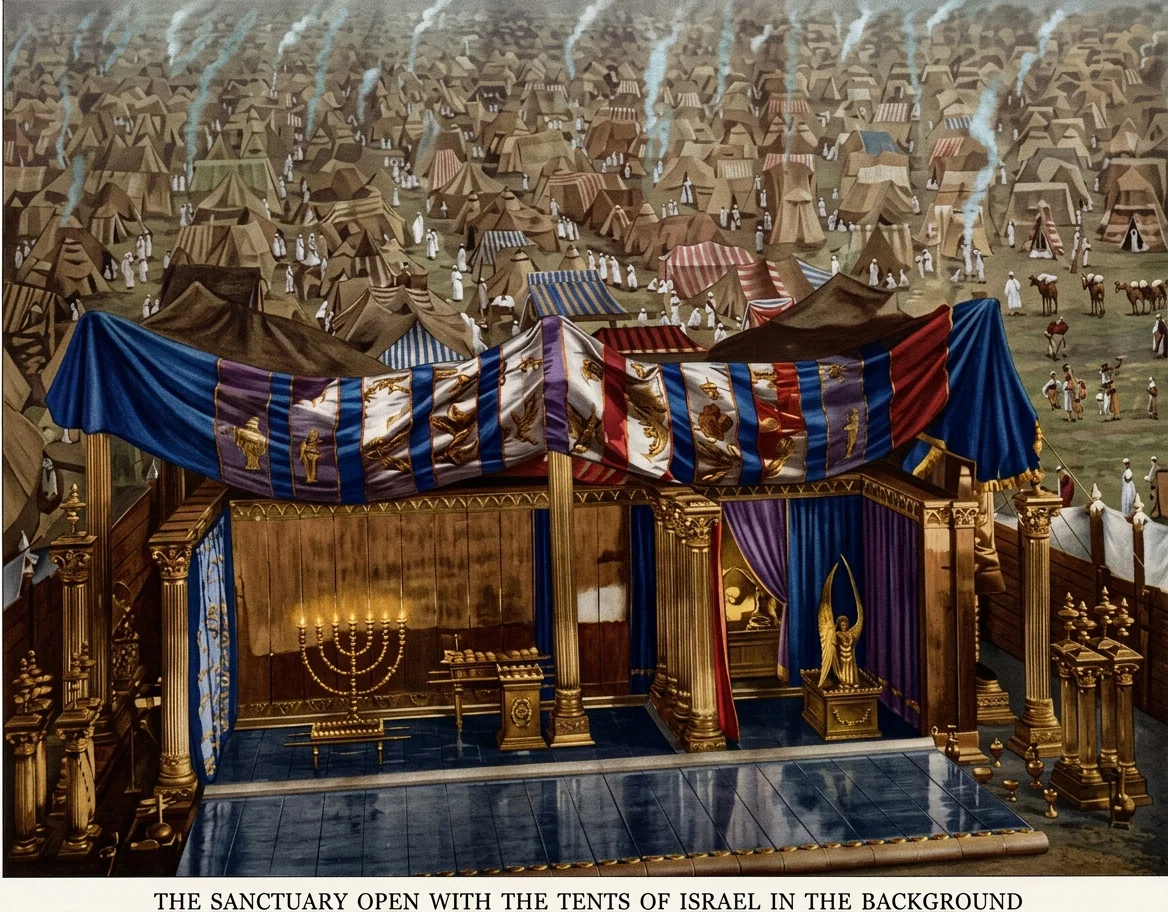
The earthly sanctuary was a small building not more than fifty-five feet in length and eighteen in breadth and height. The walls consisted of upright boards set in silver sockets and held firm by pillars and connecting bars. And all, being overlaid with gold, had the appearance of solid gold.
The building was divided into two apartments by a beautiful curtain or veil, suspended from gold plated pillars; and a similar veil closed the entrance of the first apartment.
The tabernacle was enclosed in an open space called the court, and was surrounded with hangings of fine linen, suspended from pillars of brass. The entrance to the enclosure was at the east end.
In the court, near the entrance, stood the brazen altar of burnt offerings. Between the altar and the door of the tabernacle was the laver, at which the priests were to wash their hands and their feet before going into the sanctuary. As we enter the door, or veil, of the first apartment, we see on the north side the table of showbread, and standing over against it on the south side the seven-branched candlestick with its seven lamps. Just before the veil separating the holy from the most holy, stood the golden altar of incense. Beyond the veil in the most holy place, stood the ark that contained the tables of stone, on which God Himself had inscribed the Ten Commandments. Heb. 9: 2-5.
As has been stated, the earthly sanctuary was a pattern of the heavenly; and as to John in vision was shown the temple of God in heaven, he beheld "seven lamps of fire burning before the throne, which are the seven Spirits of God." Rev. 4: 5. He also saw an angel offering up the prayers of saints at the golden altar of incense. Rev. 8: 3, 4. Hence he must have been permitted a view of the first apartment of the heavenly sanctuary.
Again, "the temple of God was opened in heaven," and there he saw the "ark of His testament," the copy of which was in the most holy place of the sanctuary on earth. Rev. 11: 19.
Thus we must conclude that not only the building but "the pattern of all the instruments thereof" was but a shadow of heavenly things.
As God could not take all His people to heaven to view the place where Jesus ministers for us, and it being essential that our faith should grasp the reality of it, He brought as much of heaven down to us as humanity could bear, in the earthly sanctuary and its services.
Even the furniture was an object-lesson of the spiritual things we must have in our temple, the body, to make it a fit dwelling-place for God.
The Heavenly Light
There was no window in the sanctuary—no natural light ever penetrated there. Its light came from the golden candlestick with its seven lamps of fire, which the Word says represent the seven Spirits of God, or the Spirit of God with its diversity of operations. So with man, all was darkness and sin until "God, who commanded the light to shine out of darkness, shined into our hearts" by His Holy Spirit, until, as the seven lamps lighted up the sanctuary, so we are to become the light of the world.
The candlestick faced the table of showbread, which pointed to Christ, the living bread, who is ever in the presence of God for us. Christ, the food for the spiritual life, is found in the Word of God. John 6: 48, 53, 63.
The table is prepared, the food is there; but without the light of the Spirit we shall never find it.
This bread was removed every Sabbath, and fresh hot bread put in its place. Lev. 24: 8; 1 Sam. 21: 6. So every Sabbath we may expect new supplies of grace fresh from the Father's hand.
As we draw near the veil that separates between the holy and the most holy place, we find the altar of incense, or altar of prayer. No temple for the Lord can be complete without communion with Him. As the stated hour for prayer draws near, how often we hear His voice, as did Adam, calling, "Where art thou?" O, let us not disappoint the yearning heart of our loving Father, who seeks communion with His child, by allowing trivial things to keep us away from this altar, fragrant with the incense of the merits and intercession of Christ, which alone can make our worship acceptable to God.
Christ the Way
The only way into the court was by the gate; the one way into the holy place was by the door; and the way into the holiest of all was by the veil. That gate, door, and veil represented Jesus Christ, the only divinely appointed entrance into the kingdom of God; and yet many people are trying to get to heaven by the door of legal righteousness—by their own personal obedience to the law of God. Man may seek long and earnestly by the way of legal righteousness, but he can never, never find it. But God has provided another way, which He calls a new and living way, into the holiest of all.
This way is consecrated—new-made—for us through the veil, that is to say, His flesh. Heb. 10: 19, 20.
What was it that came in between us and God, and cut us off from communion with Him? The prophet Isaiah says, "The Lord's hand is not shortened, that it can not save; . . . but your iniquities have separated between you and your God, and your sins have hid His face from you." Isa. 59: 1, 2.
So Christ gathered up all our sins into5Himself, He became the veil, the sin that separated us from God. “He was made to be sin,” and bore the fearful separation from His Father until His heart broke; and when He thus died, “the veil of the earthly sanctuary was rent in twain,” not only to show that that sanctuary was no longer sacred, but that there was now nothing between the sinner and God, but Christ, and He is there as the open door, the rent veil, the new-made way to God.
The following quotation from “Christ’s Object Lessons,” page 386, makes plain Christ’s purpose in dying: “Christ came to demolish every wall of partition, to throw open every compartment of the temple, that every soul may have free access to God.” This places poor souls “within reach of the throne of God, the throne encircled by the rainbow of promise.”
The way is now open to the altar of burnt offering, where justification can be had; to the laver, where purity can be obtained; to the holy place, where both light and food are to be enjoyed; and to the throne, where mercy is obtained, and where grace is found. Heb. 4:16.
“Whosoever will, let him come” and take every blessing freely.
[The next article in this series is “The Earthly Priesthood and Its Services.”]
THE SANCTUARY OPEN WITH THE TENTS OF ISRAEL IN THE BACKGROUND