EDITORIAL

4%

Pacific Press Publishing Association · Mountain View, California · Oct 29, 1912

FromSigns of the Times, Vol. 39, No. 42.

Read the full edition

EDITORIAL

The Temptation of Jesus

THE rite of baptism had been administered to the Man of Nazareth by John the baptizer. The prayer for divine help and fitting for service had been offered. The response of high heaven had been manifest in the visible descent of the Spirit, and the assurance which would ever abide, "Thou art My beloved Son; in Thee I am well pleased." The anointing of the Prophet of the ages had taken place, and Jesus of Nazareth was fitted for entrance upon His divine mission for man.
YET not wholly fitted. The enduement of the Holy Spirit is not enough. There must be a negative fitting also, a resistance of evil, a mighty duel with the enemy of all good; and the sword of the Spirit the only weapon against him, faith the only panoply. "Then was Jesus led up of the Spirit into the wilderness to be tempted of the devil." It was no uncertain leading. "The Spirit driveth Him forth into the wilderness. And He was in the wilderness forty days tempted of Satan; and He was with the wild beasts." Impelled by divine impulse, He, our Redeemer, went forth to battle for the salvation of men.
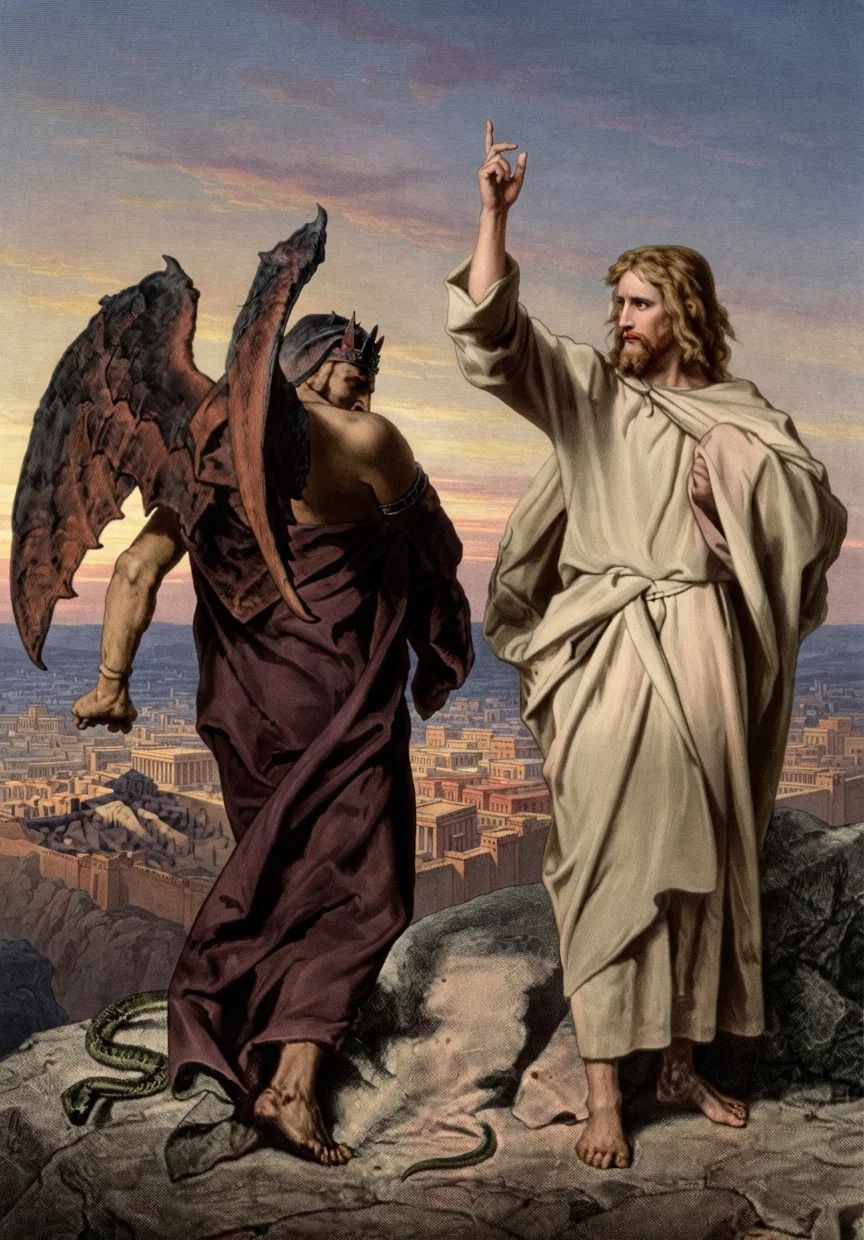
The last of the three temptations. Satan has offered the kingdoms of the world. Jesus has responded, "Get thee behind Me." The serpent in the picture is suggestive of the first temptation in Eden.
INTO three parts His temptation falls, the instances given being typical of all temptation,—in appetite, or the ministering to the flesh; the glory of life, or power and wealth; and the adulation, or worship, of men. In and among these three are summed up the traps which ensnare mankind. John sums them up as "the lust of the flesh, and the lust of the eyes, and the pride of life," which are not of the Father, but of the world. 1 John 2:16. Let us study them a little more fully.
THE forty days' fast is no longer questioned. Dr. Tanner and others have demonstrated its physical possibility. Jesus did not fast for show, or to demonstrate a physical possibility, or to earn righteousness thereby. It was a divine agony of soul which drove Him into the wilderness. The weight of a world of sinners was upon Him, of a world which from the beginning had gone down before the lusts of the flesh. From the time that Eve saw and ate the desirable, forbidden fruit, to licentious Sodom, with their "fulness of bread, and abundance of idleness," their disregard of "the poor and needy," and their filthy abominations before God which constituted them a type of the last days, and from that down to the present time, the millions have fallen before the power of appetite. Alexander could conquer a world, but he could not subdue his beastly appetite. The bloated and porcine epicures caring for nothing but indulgence, the millions that go down to drunkards' graves, the mighty numbers which are afflicted and die of nameless diseases from the lusts and appetites of the flesh, demonstrate the power of this temptation. Jesus saw it all,—saw the young, the strong, the beautiful, the bright, falling before its demoralizing and degrading sins, and in His union with humanity felt it all. Its power must be broken in the flesh, and for this the Man of Galilee struggled during those fearful forty days of temptation, surrounded by the howling, hungry hordes of the wild beasts of the wilderness. But all these things He forgot in His struggle for human victory. "For their sakes I sanctify Myself," was His motto. "Who gave Himself," was the great fact. When the days of struggle were ended, when victory was won, and exhausted nature demanded food, the tempter came as an angel of light, came with his devilish suggestion of doubt, "IF"—"If Thou"—poor, weak, emaciated Thou—"If Thou be the Son of God, command that these stones be made bread." It was not alone a challenge to miracle working for self-gratification, but a temptation to doubt the voice from heaven forty days before, "Thou art My beloved Son."
BUT the Man did not yield. Spirit-brought came the heart-hidden words given for victory fifteen hundred years before, but then lost to nearly all,—"It is written, Man shall not live by bread alone, but by every word that proceedeth out of the mouth of God." The life is more than food, God's power and presence and victory are more than the bread which perishes, the fitting of the spiritual life is more important than that of the physical. Not that God wants starved fanatics, but He would have us place the heavenly things above the earthly. Jesus demonstrated that the mighty Word of the Spirit can meet temptation to self-indulgence without or within. He met it for us, He met it for every appetite-enthralled soul who will yield to Him.
"THEN the devil taketh Him into the holy city; and he set Him on the pinnacle of the temple, and saith unto Him, If Thou art the Son of God, cast Thyself down: for it is written, He shall give His angels charge concerning Thee: and, On their hands they shall bear Thee up, lest haply Thou dash Thy foot against a stone. Jesus said unto him, Again it is written, Thou shalt not make trial of the Lord thy God." How many times, after the young convert has successfully met one temptation, does he think himself strong to venture on the devil's ground! He has met the enemy in one temptation and conquered, why should he not seek him in another? But such a spirit is born of presumption, and places the soul on the devil's ground. God comes to the needy soul. He often leaves the presumptuous soul to himself, and then comes failure. Satan would lead Jesus into the sin of presumption by tempting Him to work a miracle for His own worship and exaltation. Surely the people would worship one who would cast himself from the great wing of the temple to the earth unharmed. Surely, says the devil to the young Christian, you have resisted the gaming-table, but you can take one glass of beer. But the glass of beer is on the way to the gambling-hell, and the end is drunkenness and death, degradation, and disgrace, and eternal loss; and so it is with every sin. Satan quoted Scripture to Jesus to enforce his temptation, but it was not appropriate. It was given of God as an assurance to His children when, in doing duty, all earthly help fails them, and even the very elements are threatening destruction. God's assurances are not to stimulate to selfishness, nor to foster bravado, nor are they given to lead the soul to presume upon the undeserved mercies of God. Jesus saw through all the suggested doubt and temptation to evil, and met the tempter again with a word from a Book practically set aside by the "higher critics,"—"It is written again, Thou shalt not tempt the Lord thy God." And the heart-enshrined, living Word conquered. The devil will often come to us with Scripture in his mouth falsely and devilishly applied. Our hope is always to have God's Word hidden in our heart, that we may say to him, "It is written again."
ONCE again the enemy comes, but this time not in the form of an angel of light. He throws off all disguise. He takes the Tempted One upon an exceedingly high mountain, and shows Him in panoramic view all the kingdoms of earth, and the glory of them. He reminds the second Adam that he won them from the first, and that they were delivered to him, and to whom he would he gave them. He doubtless pointed out to the suffering Jesus the way of toil and pain He had chosen to win back the lost world, and in this way of toil and pain He might fail at last. Satan offered Him the easier way,—offered Him all, all the dominion and glory, as he had offered it to Nimrod and Alexander and Cæsar, as he offered it to Napoleon, as he offers it still to men in high position, who yield to his temptation. He offered all to Christ,—all should be His if He would fall down and worship the usurper, the deceiver. "All these things will I give Thee, if Thou wilt fall down and worship me." And again the heart which throbbed instinctive with the will of God saw the deception, saw the sin, knew that everlasting might was only with everlasting right, and responded, "Get thee hence, Satan: for it is written, Thou shalt worship the Lord thy God, and Him only shalt thou serve. Then the devil leaveth Him; and behold, angels came and ministered unto Him." Then He was in need, then He was dependent upon God, and then God sent His ministers to supply the need.
WE may meet the temptations by the same power, the mighty Word in Jesus. In Christ we may tread under the foot of noble resolve and holy deed the lusts of the flesh. We may in the fear of God submit to suffering and scorn and ignominy, rather than to exalt ourselves and make God a partner in selfish seeking and daring presumption. We may in our blessed Lord cast in the dust all the baubles of earthly glory, and while we walk in God's way, wait God's time for the giving of the kingdom and the eternal glory. Soul, there is grace in Christ Jesus our Lord for every temptation, victory for every conflict with sin and Satan.

The Sabbath in Apostolic Times

AS Christ was leaving this earth, He said to His disciples, "Go ye therefore, and teach all nations, baptizing them in the name of the Father, and of the Son, and of the Holy Ghost: teaching them to observe all things whatsoever I have commanded you: and, lo, I am with you alway, even unto the end of the world." Matt. 28:19, 20.
The commission, according to these words, is to teach all nations "to observe all things whatsoever I have commanded you." There is no authority in that commission for either the apostles, or the Christian church that they were to raise up through the preaching of the gospel, to teach anything other than what the Master Himself had commanded. This forever shuts off the idea that the apostles could have changed the Sabbath law, or any other precept of Jehovah; for they are commissioned to teach only the things that the Lord had commanded them.
In harmony with that instruction, we would naturally expect that the apostles would be found teaching people to walk in the old paths, to observe the truth which they had learned from the beginning. And accordingly we find the apostle John writing in the year 90, something more than sixty years after the crucifixion: "That which was from the beginning, which we have heard, which we have seen with our eyes, which we have looked upon, and our hands have handled, of the Word of life; (for the life was manifested, and we have seen it, and bear witness, and show unto you that eternal life, which was with the Father, and was manifested unto us;) that which we have seen and heard declare we unto you, that ye also may have fellowship with us: and truly our fellowship is with the Father, and with His Son Jesus Christ. And these things write we unto you, that your joy may be full. This then is the message which we have heard of Him, and declare unto you, that God is light, and in Him is no darkness at all." 1 John 1:1-5. In these words the apostle who had leaned on Jesus' bosom, is declaring what he had heard from the beginning.
The same epistle says, in another chapter, "Whosoever committeth sin transgresseth also the law: for sin is the transgression of the law." 1 John 3:4. Here he refers to a law as something that was well understood. He does not speak of it as a new law, or something that is strange and that needs an explanation. He simply calls it "the law."
In harmony with the foregoing words by John concerning the law are the following from the apostle Paul: "Now we know that what things soever the law saith, it saith to them who are under the law: that every mouth may be stopped, and all the world may become guilty before God. Therefore by the deeds of the law there shall no flesh be justified in His sight: for by the law is the knowledge of sin. But now the righteousness of God without the law is manifested, being witnessed by the law and the prophets." Rom. 3:19-21.
Here the law is spoken of in the same matter-of-fact way, as something that is so well understood that it needs only to be mentioned. "By the law is the knowledge of sin," says Paul; "Sin is the transgression of the law," says John. The expressions mean one and the same thing; and in these words, both of the apostles show that they are teaching the things that were before commanded them by the Lord.
There is no intimation whatever that Christ ever said anything, during His whole earthly ministry, either to apostle or to any one else, concerning any divinely proposed change of the Sabbath; and one of the strongest evidences that the apostles never thought of such a thing as teaching the obligation to observe some other day as the Sabbath, is found in the fact that there was no controversy over the Sabbath question in the apostolic church. The Jews were great sticklers for the outward observance of the law. If Paul, or John, or Luke, or Barnabas, or any one else connected with the early church, had taught that the seventh day was set aside and the first day was to be observed in its stead, there would have been a mighty uproar from the Jews. If Christ had ever taught any such thing, the Jews would have brought that forward as a reason for His crucifixion. But there is no intimation anywhere of anything of the sort.
The apostle James speaks of the Ten Commandments as "the royal law," for he says: "If ye fulfil the royal law according to the Scripture, Thou shalt love thy neighbor as thyself, ye do well: but if ye have respect to persons, ye commit sin, and are convinced of the law as transgressors. For whosoever shall keep the whole law, and yet offend in one point, he is guilty of all. For He that said, Do not commit adultery, said also, Do not kill. Now if thou commit no adultery, yet if thou kill, thou art become a transgressor of the law. So speak ye, and so do, as they that shall be judged by the law of liberty." James 2:8-12.
If we ask James what, through the foregoing text, he understands the "royal law" to mean, he will tell us that it means the Ten Commandments, for he specifically quotes the sixth and seventh commandments of the ten. Now this same James who speaks thus so respectfully of the "royal law," and who tells us that if we offend in one point we are guilty of all, was the chairman of the first general conference that was called by the early church. The record of this conference is found in the fifteenth chapter of the book of Acts. This conference, as the first verse shows, was called for the purpose of considering a difference that had arisen in the early church over the question of circumcision and the ceremonial law in general. The apostles were teaching that "circumcision is nothing, and uncircumcision is nothing." 1 Cor. 7:19. And again: "For in Jesus Christ neither circumcision availeth anything, nor uncircumcision; but faith which worketh by love." Gal. 5:6.
This teaching, which showed that the old ceremonial law had fulfilled its purpose, and had expired by limitation and annulment at the cross, had stirred up the Jewish people, and there were converts from Judaism to the Christian faith who would not accept this teaching. This fact shows conclusively that they were jealous to maintain the established customs of the Jews as taught in the Old Testament Scriptures; and this being the case, why is the Bible, and all of the history of the early church, absolutely silent concerning any controversy over the Sabbath? The only answer is that there was no controversy over the Sabbath. All were agreed in regard to it.
The Sabbath was in mind, and was actually spoken of, in that first general conference; for when James, who presided at the conference, was summing up the decisions reached by their deliberations, he stated, "Moses of old time hath in every city them that preach him, being read in the synagogues every Sabbath day." Acts 15:21. So the Sabbath day was mentioned; and incidentally, this mention shows that the Sabbath was regularly observed, and that the people had an opportunity, in these meetings, to become familiar with the teachings of the Old Testament Scriptures.
Christ made a positive provision by which the Sabbath should be constantly kept in mind by the apostolic church; for in foretelling the destruction of Jerusalem, He said, "Pray ye that your flight be not in the winter, neither on the Sabbath day." Matt. 24:20. That was a prayer that was enjoined upon them to be continually uttered, and therefore it kept the Sabbath continually before them. The destruction of Jerusalem did not occur until A.D. 70; and thus for nearly forty years of the very first part of the history of the Christian church, the Lord had that church praying that they should not be driven out of Jerusalem on the Sabbath day. And with all of this solicitation for the day, there is not a single hint that the day was ever changed.
Such evidence as this — and there is much more that might be given — should be conclusive to any one, that neither Christ nor the apostles ever made any change in His Sabbath law. The seventh-day Sabbath is the only Bible Sabbath, and there is not a breath of evidence to the contrary.
T.