EDITORIAL

8%

Pacific Press Publishing Association · Mountain View, California · Jul 30, 1912

FromSigns of the Times, Vol. 39, No. 29.

Read the full edition

EDITORIAL

The Homage of the Great

"GOD is no respecter of persons." He reveals Himself to the meek and to the lowly, to those who are willing to be taught and led, regardless of their station in life. There are more of the poor in the world than there are of the rich. There are more of the meek and humble and lowly among the poor. Their condition in this world fosters the humble spirit. Even so it was with the shepherds of Bethlehem to whom God's angels brought the blessed evangel.
BUT as readily God reveals His truth to earth's great men if they are equally humble and teachable. This, too, is illustrated at the very beginning of the gospel narrative by the visit of the wise men to Bethlehem, as recorded in the second chapter of Matthew's Gospel: "Now when Jesus was born in Bethlehem of Judea in the days of Herod the king, behold, wise men from the East came to Jerusalem, saying, Where is He that is born King of the Jews? for we saw His star in the east, and are come to worship Him."
THESE wise men, or Magi, have ever had hung around them various and sundry traditions. They have been represented as kings from Asia, Africa, and Europe, and Ps. 72:10 is used in support of the tradition. Even their names are given in the traditionary romance. But it is more consonant with the Sacred Record to take them as Magi from the East, that is, from Persia, members of a very ancient religious cult dating back to Abraham, or even before that. The word "magi" signifies in Persian "the diviners." They were the established priesthood of the Persian, or Parthian, empire, in historical times, and were persons of the highest rank and consequence in the state. Their origin is attributed to Zardusht, or Zoroaster, but not Zoroaster the Second, the great reformer who flourished in the time of Darius Hystaspes.
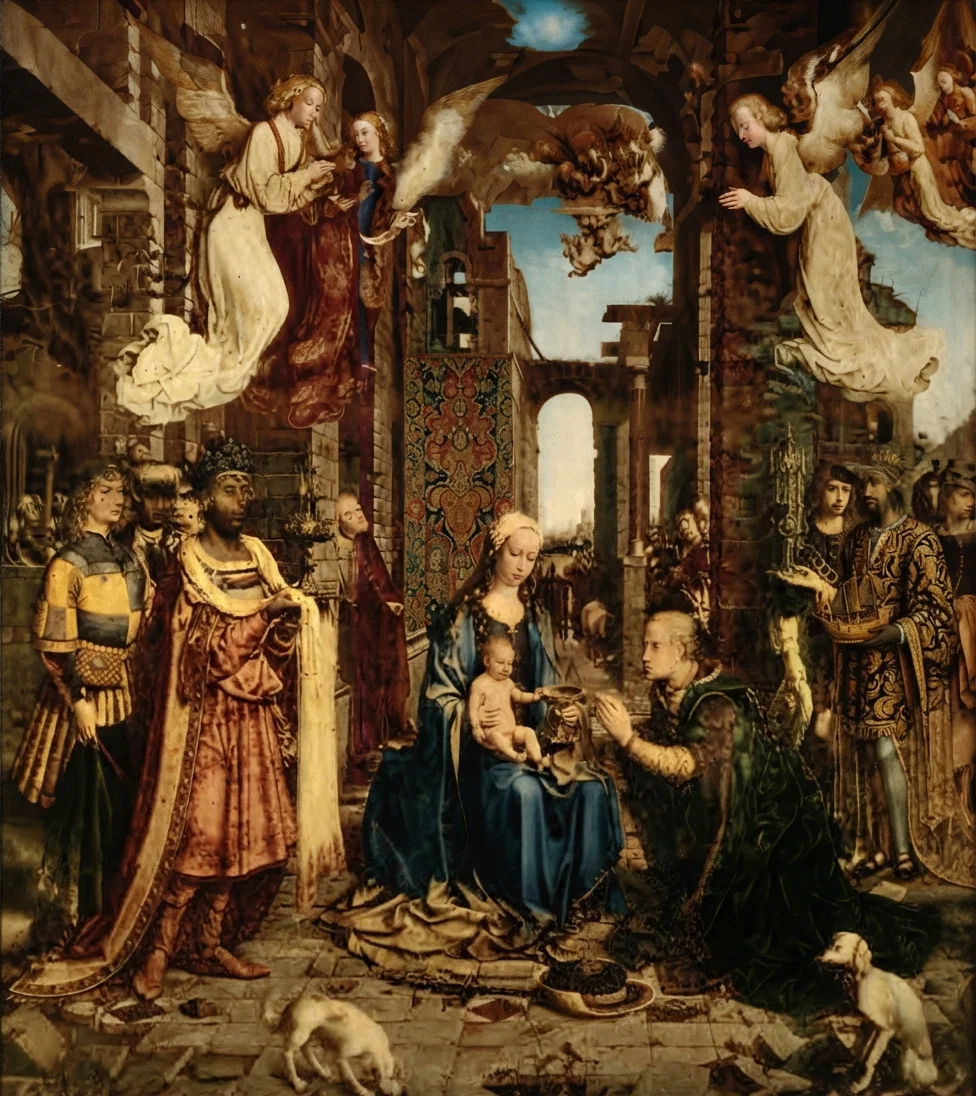
ADORATION OF THE KINGS
THE earliest Magian religion seems not to have been idolatrous. The first eminent teacher, Zoroaster, consecrated in the mountains of Bactria a natural cave to Mithras, "the maker and father of all things." This Mithras the ancient Magi called "the hidden god," represented by the darkness of the cave. There are expressions in the Psalms which express the same thought. Mithras therefore originally had naught to do with sun-worship. In this cave was a sacred fire which was never allowed to go out, similar to that in the Jewish sanctuary. If it should go out it must not be rekindled by strange fire, nor was any other to be used in the sacrifices. They represented God as "the First, the Incorruptible, Eternal, Unmade, Indivisible, most unlike everything, the Leader or Author of all good, Uncribable, the Best of the good, the Wisest of the wise: He is also the Father of equitable law and justice, self-taught, perfect, and the only Inventor of the natural holy." See "Hales's Chronology," volume 4, pages 37, 38. They held that there was one eternal being, Yezdan, or, as sometimes stated, Ormuzd, the creator of light and darkness, and that he is alone, and has no associate. They believe in a malign deity called Arhiman, denoting the devil. These two powers will exist to the time of the consummation of all things. See Isa. 45:5-7, and the parable of the wheat and tares in Matthew 13.
IN view of these and other great truths held by them, in part at least, the Magian religion has been characterized as the oldest and noblest of all the ancient religions apart from the Bible. Balaam the ancient prophet was doubtless of the Magi, and at one time in his experience had living connection with the God of heaven and earth, the Jehovah of the Old Testament. See Num. 22:8-13, 18, 19. Balaam prophesied Israel's triumph in the defeat of her foes. He evidently refers to our Lord in the following (Num. 24:17-19): "I see Him, but not now; I behold Him, but not nigh: There shall come forth a star out of Jacob, And a scepter shall rise out of Israel, And out of Jacob shall one have dominion." It is a pity that the great Magian prophet yielded to his lust for gold, and perished among those he led astray. It is said of the second Zoroaster that he was taught by a Jewish prophet claimed to be Elijah, but more likely it was the prophet Daniel, who taught him the nature of the times of which he prophesied.
THE time when the Magi visited Jerusalem was subsequent to the birth of Jesus, as will be seen by comparing Matthew and Luke. It was after the occurrences connected with His presentation in the temple. Evidently Jesus did not remain long in the stable where He was born, for He was found in a house by the Magi. The star was not a sidereal body, nor a combinationof planets, as some would teach at the present time. It went before them, "it came and stood over where the young Child was." Matt. 2:9, 10. Hales thinks it was a meteor supernaturally guided and controlled. But what seems more and preeminently fitting is that it was the same company of angels, God's messengers, that appeared to the shepherds, shining with the glory of heaven, seeming to the Magi a low and brilliant star, the star that should "rise out of Jacob" prophesied of by one of their own number, and they followed it, and it led them to the "Word made flesh."
SEEKING the truth, instructed by the Jewish Scriptures, they first go to Jerusalem, the center of Jewish worship, and there inquire, but none know of the object of their inquiry. Their inquiries, however, stir the people, and the base and ambitious king calls an ecclesiastical council, but learns nothing save that the King is to be born in Bethlehem. He then inquires of the Magi, sends them to Bethlehem, and charges them to bring him word when the Child is found, that he may join with them in the worship. They pass on, and the star appears and leads them to the house. Devoutly humble, they are divinely illuminated. They have no doubt of God's leading, and they pour out their souls in adoration and truest worship, and lavish their largesses and costly, princely gifts upon the little Babe, gold and frankincense and myrrh. They have found Him, the eternal Logos, in the likeness of the flesh, they hail Him as the Saviour and King of the world, and they return to worship and to serve.
WARNED of God, the Magi did not return to the base and deceptive king. Herod's subsequent course showed that his expressed desire to worship was a wicked ruse. But it is worthy of note that among the converts on the Day of Pentecost were some, first mentioned, from the land of the Magi, Parthians, Medes, Elamites, and dwellers in Mesopotamia. Acts 2:9. The wise men had been missionaries. W.