(Concluded.)
Permissive Diet—The Promise Sure—"The Second Time"—The Highway of Holiness—The Diet of Eden—Present Truth—A Safe, Economical, Simple, Moral Dietary.
THUS much for the ages past. During this time the people of God have lived upon the permissive diet, which ever spoke of death, and they have died. In the one time when God would have redeemed His people to eternal life and an eternal kingdom, in their unbelief they would not enter into His rest. But "what if some did not believe? shall their unbelief make the faith of God without effect? God forbid: yea, let God be true, but every man a liar."
The promise given them of entering into God's rest they would not accept; and now the "promise is being left us of entering into His rest," "Seeing therefore it remaineth that some must enter therein, and they to whom it was first preached entered not in because of unbelief," "there remaineth therefore a rest to the people of God." Heb. 4:1, 6, 9.
We have reached that time when the rest of God is opening to His children again, of which the renewed Sabbath is a pledge of God's power to perform His promise of old. Line after line of prophecy, and a multitude of signs in earth, sea, and sky, proclaim that Christ's coming is near; that He will soon take to Himself His great power and reign; and that His people shall enter the eternal rest of God. The promise still holds. The rest still remains; and its proclamation to the world is a part of the proclamation of the truth of the "everlasting Gospel" for this generation. It is "present truth."
But what does this mean?—It means that God will again set before His people His rest, and will gather them to it, as truly as He set it before Israel of old; for thus saith the prophet:—
"And in that day [now, in this day] there shall be a root of Jesse, which shall stand for an ensign of the people; to it shall the Gentiles seek; and His rest shall be glorious. And it shall come to pass in that day [in this day], that the Lord shall set [has set] His hand again the second time to recover the remnant of His people, which shall be left, from Assyria [Babylon], and from Egypt, and from Patmos, and from Cush, and from Elam, and from Shinar, and from Hamath, and from the islands of the sea. And He shall set up [has set up] an ensign for the nations, and shall assemble the outcasts of Israel, and gather together the dispersed of Judah from the four corners of the earth. And the Lord shall utterly destroy the tongue of the Egyptian Sea; and with His mighty wind shall He shake His hand over the river, and shall smite it in the seven streams, and make men go over dry shod. And there shall be an highway for the remnant of His people, which shall be left, from Assyria; like as it was to Israel in the day that he came up out of the land of Egypt." Isa. 11:10-16.
For the sin of unbelief the plagues of wrath fell upon Egypt of old. For the same sins the seven last plagues will fall upon a sinful, unbelieving world. Revelation 16. But from their power God will save His people. See Ps. 91:3-10.
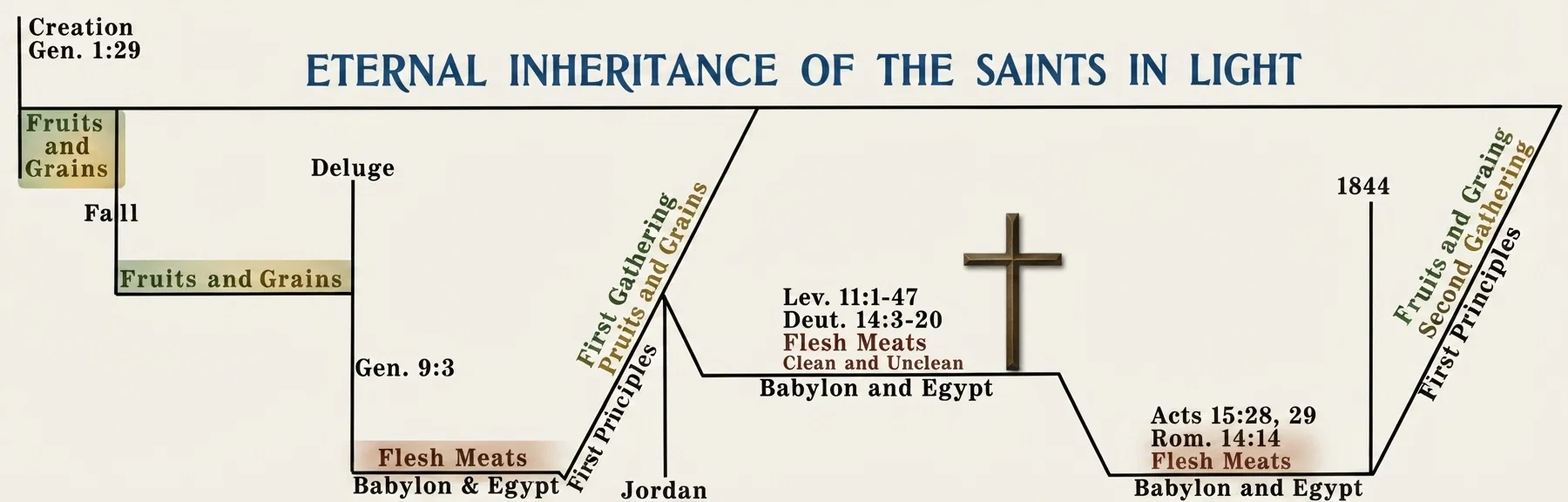
When the Lord sets His hand to gather His people the second time, He will lead them over the same "highway" of holiness. Christ and His wonderfully-developed truth will be a pillar of cloud and fire to go before them all the way.
He will take them from this mortal, sinful world to an immortal, righteous one; from the imperfections of humanity, to the perfections of divinity; from the powerlessness of human striving, to the mighty working of His creative power through the outpouring of His Holy Spirit; from a land of death, to a land of life; and from a diet of death, to the diet of life, God-given "in the beginning."
But will the diet question be a test, as to Israel of old? Why will it not? Is not the rest to which God is leading us the same? Is not His standard of holiness the same? Is He not just as anxious that we shall have the very best now as then? Surely we can answer these questions only in the affirmative. He will lead His people now as then by the same "highway." Isa. 11:16. The stumbling-blocks will be gathered out. Isa. 57:14; 62:10. He will turn them back to the better diet of the beginning,—fruits and grains. And He points us back to Egypt, that we may be warned by unbelieving Israel's sad fate not to despise the straitness of the way, nor the goodness of God.
"Let us therefore fear, lest, a promise being left us of entering into His rest, any of you should seem to come short of it. For unto us was the Gospel preached, as well as unto them; but the word preached did not profit them, not being mixed with faith in them that heard it." Heb. 4:1, 2.
"Take heed, brethren, lest there be in any of you an evil heart of unbelief, in departing from the living God." Heb. 3:12.
ETERNAL INHERITANCE OF THE SAINTS IN LIGHT
"Moreover, brethren, I would not that ye should be ignorant, how that all our fathers were under the cloud, and all passed through the sea; and were all baptized unto Moses in the cloud and in the sea; and did all eat the same spiritual meat; and did all drink the same spiritual drink; for they drank of that spiritual Rock that followed them; and that Rock was Christ. But with many of them God was not well pleased; for they were overthrown in the wilderness. Now these things were our examples, to the intent we should not lust after evil things, as they also lusted [they lusted for flesh]. . . . Now all these things happened unto them for ensamples; and they are written for our admonition, upon whom the ends of the world are come. Wherefore let him that thinketh he standeth take heed lest he fall." 1 Cor. 10:1-12.
Shall more be said? Is not the Biblical argument enough? It matters not what diet God's people have eaten in the past, or what He has in His mercy for their ignorance permitted; these are not the questions for those to ask who are looking for Christ's coming. Rather, What is present truth—God's truth for this generation—God's truth for me? If we desire to fall in the wilderness, we may give way to the longings of an appetite yet in Egypt. We may place ourselves in "the devil's debating chair," if we will; we may ask about Moses and Elijah and Paul; we may excuse ourselves by the example of Abraham, even as men seek to do over irregular marriages; but still the present truth of God for this generation rings in our ears, "This is the way, walk ye in it." In this present truth He refers us to only one time in earth's sad history, and that is when He sought to lead Israel to life forevermore. What did He then ask of them? If we desire to enter alive the eternal rest of the earth made new, we will anxiously, gladly, go back to the diet of the beginning.
Other Considerations.
1. Safety.
In the fall of sin the curse rests most heavily upon the most highly-organized and responsible creatures. In a sinless state man was king over all creatures; now he has fallen so low that he is a prey to the infinitesimal bacillus. Next to him in weakness, deterioration, disease, and death are the domestic animals, with whom he has most to do. In many of the tuberculin tests of dairy herds the majority of the herd have been found affected with the dread disease tuberculosis, now sweeping off one-seventh of the people of earth. Cholera, anthrax, and other diseases, affect animals the flesh of which is used for food. Ptomain poisoning, almost wholly from flesh foods, is a very common thing. It is almost impossible to find a perfectly healthy beef. Thousands are discarding flesh foods for personal safety, and almost invariably, if wisely, with beneficial results. Thousands have tested the better fleshless diet for years, and are hearty advocates of its benefits.
2. Economy.
A vegetarian diet is an economical diet. There is much more food at less cost in such a diet than in that of flesh foods. It would be a great blessing to the poor of our teeming cities if they knew this. The wholesome, unstimulating diet of fruits and grains and legumes would be a mighty agent in overcoming the drink habit. The matter of economy will be demonstrated by putting into practise the principles herein advocated.
3. Simplicity.
In stomach troubles one of the most cogent factors is too great a variety of foods, and foods in wrong combinations; but man's primitive diet of fruits and grains offers no trouble on that score. Fruits and grains and nuts may safely be eaten together always; and no trouble will come by the combination.
4. The Moral aspect.
There is one further consideration which we lay before the sincere reader in the matter of diet, and that is the spiritual or moral aspect of food.
The nature of the brute is inherently selfish. His desire is to get and gorge, even to gluttony. He delights to take of nature's sweetest and best, and transmutes it into greedy brute. He is at times beautiful, graceful, faithful, and we admire him. He occupies a more intelligent plane than the vegetable, but not a more refined one. While he devours all he can, he willingly gives up nothing to humanity. All his exhalations, all that his system in its various functions throws off, is offensive to refined and sensitive eyes and delicate nostrils. And when the brute dies of himself, he is still more offensive. If slain in the prime of life, his flesh keeps "sweet" but a few hours at most in the ordinary climate. Unless artificially preserved, it soon becomes offensive to smell and taste, and poisonous for food. "Like produces like." Will not the love for and the continual5partaking of such food, change man to the same nature?
A different picture is presented in the creatures given of God in the beginning for food. In the vegetable world God has written the Gospel of unselfishness. The seeds are planted in the earth, oftentimes in decaying, offensive soil. They take of the base soil, and, by the power of God, through sunlight and moisture, transmute it into the cleanest fiber, flower, and fruit, pleasing to the eye, fragrant to the smell, delicious to the taste, and wholesome to the entire man. If allowed to mature, the grain is reaped, threshed, ground, or in various ways converted into palatable, nutritious food. In ordinary climates it may be preserved for years. If the fruit be allowed to ripen, it falls, or is plucked, and is at its very prime. The tree or vine has gathered from the basest and given to man the best. The tree is not injured by the plucking of the fruit. No life was taken by its transmutation into food.
Living is giving, and giving is living. The tree, the vine, the grain stalk gathered to give. Even so did Christ.
Reader, which is the better food to prepare us for unselfish service for the Master, for glorious translation into the kingdom of God, that which takes of the sweetest and most fragrant of earth and transmutes it into offensive, malodorous flesh, decaying in its living, filled with disease and death, or that which takes from the lowest of earth, the inert, decaying soil, and transforms it into beautiful blade and stalk and ear and kernel, or tree and leaf and flower and fruit, giving its fragrance and beauty during its growing, and at its maturity furnishing a store of clean, wholesome food?
It seems to the writer that but one answer can be given. Of himself he can say that since he adopted the latter diet, after years of the other, he has found less anxiety as to what he should eat, a keener relish, a better appetite, a clearer brain, a greater sustaining power in labor, a quicker recovery from weariness, a heart more responsive to the things of the Spirit, and purer delight in the things of God. O, there is life and health and blessing in God's way! "If any man willeth to do His will, he shall know of the teaching."
In conclusion, reader, take these things to yourself. "Hast thou faith? have it to thyself before God." As every one of us "shall give an account of himself to God, let us not therefore judge one another any more; but judge this rather, that no man put a stumbling-block or an occasion to fall in his brother's way."
Beyond, just beyond, lie the verdant shores of the promised land, which knows no pain nor death nor sorrow. The "highway of holiness," over which "the remnant" shall pass, leads from Egyptian darkness and Babylonian tradition through the wilderness, through the Jordan, into the eternal rest. God's promise is: "I will be as the dew unto Israel; he shall grow as the lily, and cast forth his roots as Lebanon. His branches shall spread, and his beauty shall be as the olive tree, and his smell as Lebanon. They that dwell under his shadow shall return; they shall revive as the corn, and grow as the vine." And as "the days of thy coming forth out of the land of Egypt will I show unto him marvelous things." And now the remnant may feed of the corn and fruit of the land, yet when passing through the desert of earth's last agonies of sin, when unrestrained wrath shall wreak its vengeance upon a shelterless world, the herd be cut off from the stall, the flock from the fold, the fruit from the vine, and the grain from the field, God will, if needful, give again to His people waters from the flinty rock, and the corn of heaven
for food; for has He not promised in that time that his "bread shall be given him; his waters shall be sure"?
"Who is wise, and he shall understand these things? prudent, and he shall know them? for the ways of the Lord are right, and the just shall walk in them; but the transgressors shall fall therein." "The wise shall understand."
MILTON C. WILCOX.