OUR studies have brought us to the last recorded vision of the “man greatly beloved,” a vision given in the third year of Cyrus the Great, two years after the Medo-Persia dynasty had succeeded that of Babylon, and was well launched upon the great political world-sea. Daniel was now an old man. He had seen and had known, and had had great part in shaping, under God, the great career of Nebuchadnezzar. With that king’s death, B.C. 561, began the decline of Babylon’s glory. His successors in the “golden monarchy” were as follows: Evil-Merodach, two years; Neriglissor, three years; Laboros-oarchod, less than one year; Nabonidus, seventeen years; Belshazzar conjointly with his father Nabonidus, during his last three years; bringing us to B.C. 538, the fall of Babylon, and the beginning of the reign of Darius the Mede. At this time Daniel records his experiences previous to his last vision, as recorded in chapter 10. This chapter opens the last great line of prophecy.
The first was given nearly seventy years before, in chapter 2; the second, three years before Medo-Persia succeeded to Babylon; the third, just before Babylon met her doom in B.C. 538. And this, probably B.C. 536. When Cyrus conquered Babylon, he was the real monarch of Persia, and Darius the Mede reigned by courtesy. If this conception be true, Cyrus issued his decree for the return of the Jews and the rebuilding of the temple as recorded in Ezra 1: 1-4, this very year. This was also the last year of Darius the Mede, now sixty-four years old. Cyrus was but twenty-five years of age. He may not yet have issued his decree for the return of the Jews, and Daniel was pleading for his people, praying for their return to the home land, and the fulfilment of Jeremiah’s prediction of that event. He must have felt even more solicitous for God’s people after the vision of chapters 8 and 9. He did not yet know all that was comprehended in the vision; the explanation in chapter 9: 24-27 had not left him hopeful, with the holy city destroyed and the Prince of the host cut off. Therefore the comfort of God sent by the angel again. Let us—
Question the Text of Chapter 10
1. What came to Daniel in the third year of Cyrus?
In the third year of Cyrus king of Persia a thing was revealed unto Daniel, whose name was called Belteshazzar; and the thing was true, even a great warfare: and he understood the thing, and had understanding of the vision. Verse 1. Note 1.
2. In response to what experiences of Daniel was this vision given?
In those days I, Daniel, was mourning three whole weeks. I ate no pleasant bread, neither came flesh nor wine into my mouth, neither did I anoint myself at all, till three whole weeks were fulfilled. Verses 2, 3. Note 2.
3. Who appeared before him?
And in the four and twentieth day of the first month, as I was by the side of the great river, which is Hiddekel, I lifted up mine eyes, and looked, and, behold, a man clothed in linen, whose loins were girded with pure gold of Uphaz: his body also was like the beryl, and his face as the appearance of lightning, and his eyes as flaming torches, and his arms and his feet like unto burnished brass, and the voice of his words like the voice of a multitude. Verses 4-6. Note 3.
4. How were he and the men with him affected?
And I, Daniel, alone saw the vision; for the men that were with me saw not the vision; but a great quaking fell upon them, and they fled to hide themselves. So I was left alone, and saw this great vision, and there remained no strength in me; for my comeliness was turned in me into corruption, and I retained no strength. Yet heard I the voice of his words; and when I heard the voice of his words, then was I fallen into a deep sleep on my face, with my face toward the ground. Verses 7-9. Note 3.
5. How is he comforted?
And, behold, a hand touched me, which set me upon my knees and upon the palms of my hands. And he said unto me, O Daniel, thou man greatly beloved, understand the words that I speak unto thee, and stand upright; for unto thee am I now sent. And when he had spoken this word unto me, I stood trembling. Then said he unto me, Fear not, Daniel; for from the first day that thou didst set thy heart to understand, and to humble thyself before thy God, thy words were heard: and I am come for thy words’ sake. Verses 10-12.
6. What hindered Gabriel’s coming, and what help was given him?
But the prince of the kingdom of Persia withstood me one and twenty days; but, lo, Michael, one of the chief princes, came to help me: and I remained there with the kings of Persia. Verse 13. Note 4.
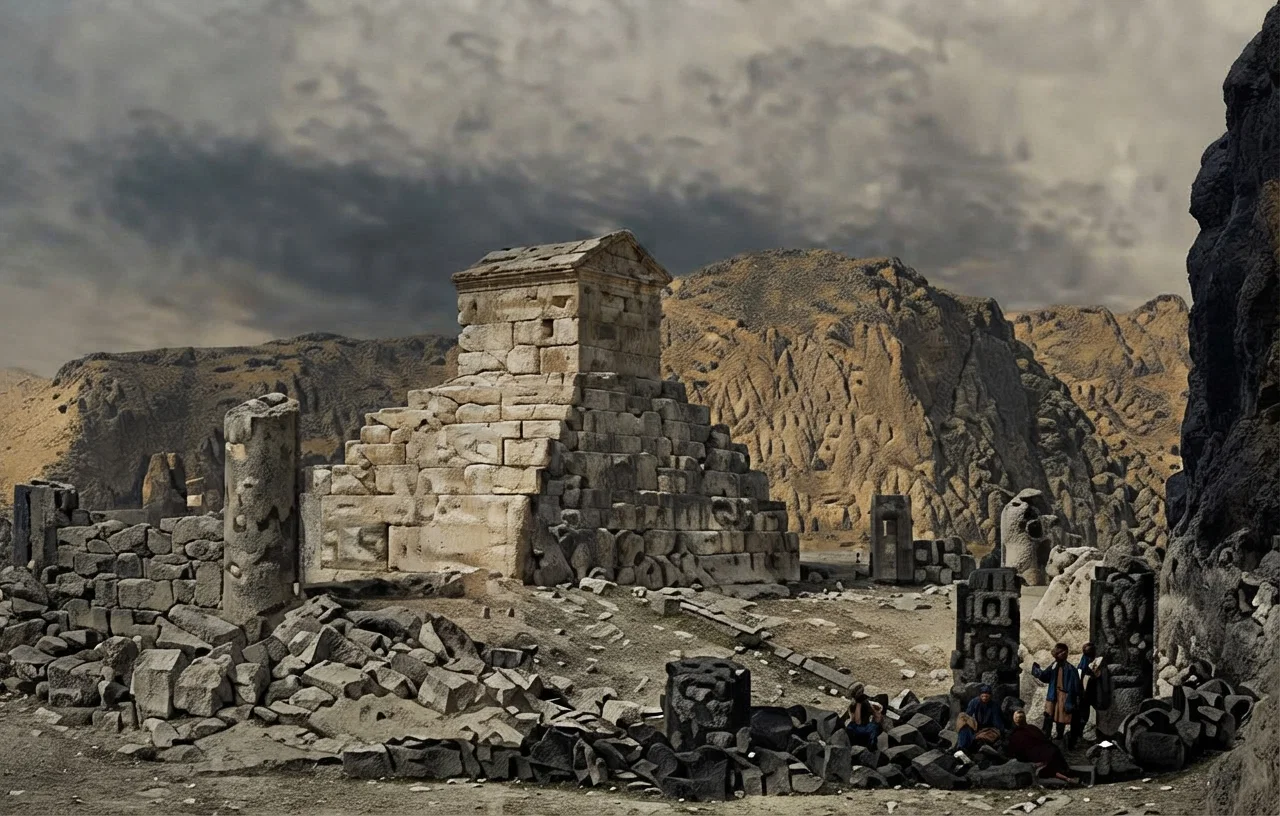
Tomb of Cyrus
7. What had he come to make the prophet understand?
Now I am come to make thee understand what shall befall thy people in the latter days; for the vision is yet for many days. Verse 14. Note 5.
8. How was the aged prophet again affected?
And when he had spoken unto me according to these words, I set my face toward the ground, and was dumb. And, behold, one in the likeness of the sons of men touched my lips: then I opened my mouth, and spake and said unto him that stood before me, O my lord, by reason of the vision my sorrows are turned upon me, and I retain no strength. For how can the servant of this my lord talk with this my lord? for as for me, straightway there remained no strength in me, neither was there breath left in me. Then there touched me again one like the appearance of a man, and he strengthened me. And he said, O man greatly beloved, fear not: peace be unto thee, be strong, yea, be strong. And when he spake unto me, I was strengthened, and said, Let my lord speak; for thou hast strengthened me. Verses 15-19.
9. What did he say of this revelation?
Then said he, Knowest thou wherefore I am come unto thee? and now will I return to fight with the prince of Persia: and when I go forth, lo, the prince of Greece shall come. But I will tell thee that which is inscribed in the writing of truth: and there is none that holdeth with me against these, but Michael your
Prince. And as for me, in the first year of Darius the Mede, I stood up to confirm and strengthen him. Verses 20, 21; 11: 1. Note 6.
Note and Comment
1. THIRD YEAR OF CYRUS.—Dating from the fall of Babylon, B.C. 538, this would be the year 536. Darius the aged reigned by courtesy of Cyrus the conqueror.
2. THREE WHOLE WEEKS.—The earnest prayer of faith will always be heard. Daniel was whole-souled. All his interests were with God; all his burden, for his people. The time had come, according to Jeremiah, for a return to Jerusalem. What was hindering? Daniel wished to know; therefore the earnest pleading. For three full weeks he sought God with special humiliation; no sumptuous fare, no pleasing food or drink, passed his lips. All minor things were forgotten in his agony of soul for more light, for God’s deliverance of His people.
3. FIRST MONTH.—Presumably the Jewish first month of Nisan. Daniel’s pleading, therefore, was begun in connection with the time of the Passover, which recorded the deliverance of God’s people from Egypt; and now Daniel was pleading for their deliverance from Babylon. HIDDEKEL.—Margin of the Revised Version reads “the Tigris.” Some versions read “the Euphrates,” which leads to the conjecture that it was at the confluence of these two rivers where Daniel was. A MAN CLOTHED IN LINEN.—Was it not our blessed Lord? See the description given of Him in Revelation 1. Great was His glory. To comfort Daniel, He sends Gabriel, whom the prophet had met before (8: 16; 9: 21). Daniel’s companions flee in terror; the aged prophet is strengthened to bear the splendor. He is assured that he is “greatly beloved,” and is told to “fear not,” for unto him God had sent yet another message.
4. WITHSTOOD ME.—God had heard the earnest prayer at first, at the very beginning of the three weeks, but there were hindrances; the Persian king must help to fulfil the prayer; God would convince him of his duty. So for twenty-one days Gabriel used such means as angels know, to induce the king to act. If this was relative to the decree, we can see light in both the earnest prayer and in God’s efforts for its fulfilment; but Gabriel was not sufficient, opposed as he must have been by all the influences of the demons of darkness, and help was sent him. Michael, the Prince of Daniel’s people, was sent to his aid. The meaning of the name is “who is like God.” He is the Archangel, chief of all the angels (Jude 9). It is His voice which wakes the dead (1 Thess. 4: 16; compare with John 5: 28, 29.) He is the “great Prince” who stands for the children of God’s people, Daniel tells us. All these scriptures clearly identify Michael with Christ, the Son of God, who afterward became Jesus of Nazareth. He stayed with Cyrus while Gabriel was sent to Daniel.
5. WHAT SHALL BEFALL.—It is ever His people God keeps in mind, ever His people He would forewarn, and that not for the present alone, but His people for all the future, that when the unrolling future shall become present, they may heed the warnings. In this case it was emphatically a prophecy for the latter days (see later comments).
6. KNOWEST THOU?—Gabriel came to Daniel to give him light and comfort, and to make him a channel of light and comfort for the people of God in the latter days; but the other side must not be neglected. The prince of Persia, whoever he might be, must co-operate with God. “The Most High ruleth in the kingdom of men.” And after Persia comes Grecia, and so on to the end. But in all these7things Gabriel had, in the revelation and in the power of accomplishing, the aid of “Michael your Prince.” Gabriel would have Daniel—and more than Daniel, all who came after—know that God moves upon the hearts of men. AGAINST THESE.—The margin seems better, “concerning these things.” God reveals through Christ, to His angel, the angel to the prophet, the prophet to the people. See Rev. 1: 1. DARIUS THE MEDE.—The Septuagint reads, instead of “the first year of Darius the Mede,” “the first year of Cyrus,” and Wright says that this “reading is endorsed by many critics.” Cyrus was strengthened in his mighty warfare against Babylon by God’s angel. Before him were opened the gates of brass, according to Isaiah, in chapter 45; and now the king must set God’s people free.
Important Considerations
There are several important considerations which should be regarded in the study of this prophecy, which we wish to note before we proceed with the study of chapter 11. These will greatly help in the understanding of the vision. There are curious things in prophecy, striking features, appealing features, which may impress, enlighten, encourage every devout reader, but which may add little, if anything, to the understanding of the great object in giving the prophecy. It is an impressive record of Daniel’s devotions; the visit of the angel was wonderful; but the great import of the prophecy ought to be more impressive, more wonderful, because more important.
This vision of chapters 10-12 should be considered in its relation to the previous vision. Neither that vision nor its explanation could have left Daniel otherwise than sad and perplexed. True it is that in the 8th chapter the great apostate power was to be “broken without hand;” but only by a far-fetched implication was the prophet assured of the eventual triumph of the Prince and the host, utterly unlike the vision of chapter 7 (see verse 27). In the supplementary chapter, of Daniel 9, the prophet finds no comfort save in God’s great power to foretell. There is revealed a cutting off of Messiah without justice, and the destruction of Jerusalem, and the chapter closes. There is reason why Daniel should pray for more light. He wishes to know the ultimate issue; therefore his prayer, and therefore the visit of the angel. And we are not alone in this view. Read the following:
There was then still something which Daniel did not understand, but in reference to which he earnestly desired light. What was it?—It was undoubtedly some part of his last preceding vision; namely, the vision of chapter 9, and through that of the vision of chapter 8, of which chapter 9 was but a further explanation. And as the result of his supplication, he now receives more minute information respecting the events included in the great outlines of his former visions.—“Daniel and the Revelation,” page 214.
We learn from chapter 10 that there were some points still unexplained to the prophet; and he set his heart again, with fasting and supplication, to understand the matter.—Id., pages 215, 216.
Once, already, he [Gabriel] had made a special visit to Daniel to give him additional information when he sought it with prayer and fasting. Now, when he is prepared for further instruction, and again seeks it in the same manner in reference to the same subject, can it for a moment be supposed that Gabriel disregarded his instruction?—Id., page 216.
This prophecy, says Bishop Newton, may not improperly be said to be a comment and explanation of the vision of chapter 8; a statement showing how clearly he perceived the connection between that vision and the remainder of the book.—Id., page 222.
“Old as he was, ‘he set his heart to understand’ the former revelations which had been made to him, and particularly the vision of the ram and he goat, as may be collected from the sequel; and for this purpose he prayed and fasted three weeks. His fasting and prayers had the desired effect, for an angel was sent to unfold to him those mysteries.”—Id., page 217.
Chapters 10-12 form a section of themselves. They occupy the position naturally assigned to them by their date (10:1) and by their contents; in the latter point, being a development of the prophecies contained in chapters 8 and 9.—“Bible Commentary,” in loco.
It [the vision of chapter eleven] contains a further filling up of the outline of the four great empires already given in the visions of the great image, and the four beasts (chapters 2 and 7), as well as that of the third monarchy and the little horn in the vision of the ram and he goat (chapter 8).—Homiletic Com.
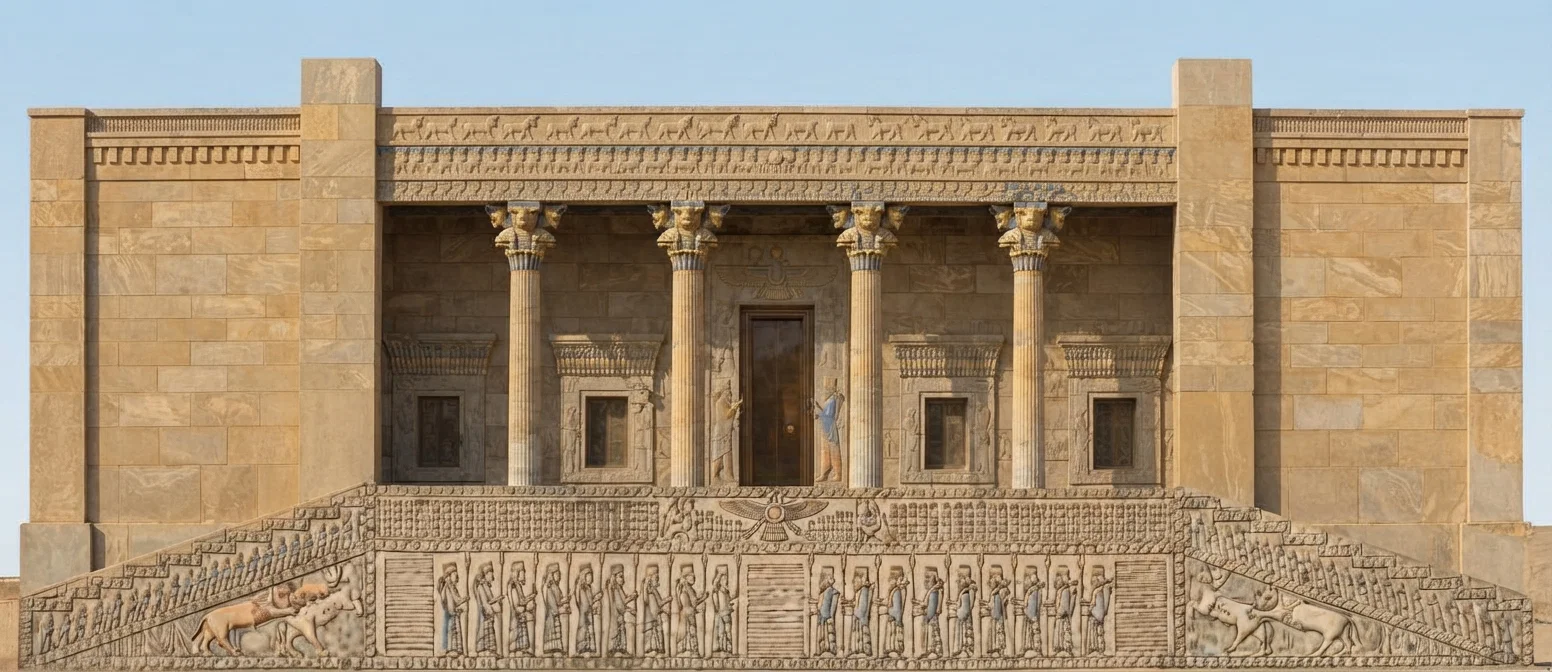
South front of the palace of Darius, Persepolis, restored (after Flandin)
We need cite no more; it is clearly evident to the devout and careful student. But this being true, the prophecy of chapter 11 must cover the same ground, deal with the same powers, and reach the same end as the vision of chapter 8.
2. Parallelism
The time emphasis of the vision, evidences also that the vision of chapters 10 to 12 is parallel with and supplementary to the vision of chapters 8 and 9; in fact, there is a decided parallelism in all the four visions of Daniel, each supplementary to the other, as the following will show. We number these four lines of prophecy:
The four great world beast powers and the little horn of Daniel 7.
The vision of Medo-Persia, Grecia, the little-horn power, and the two thousand three hundred days of Daniel 8 and 9.
The vision of the kings of the north and south, and the reign of Michael. Daniel 10-12.
Prophecies 1 and 2 begin with Babylon, prophecies 3 and 4 with Medo-Persia, after the passing of Babylon as a world power. Their parallels:
(a) Prophecies 1, 3, and 4 were given for the latter days (2: 28; 8: 19; 10: 14).
(b) Prophecies 3 and 4 both belong to the time of the end (8: 17, 19; 10: 14; 11: 35; 12: 4, 9, 10).
(c) Both 3 and 4 have to do with the “indignation” (8: 19; 11: 36).
(d) The final apostasy comes to the same violent end, smitten by the stone cut out without hands (2: 45); “broken without hand” (8: 25); “come to his end” with no human help (11: 45).
(e) 2,300 days—“many days” (8: 14, 26; 12: 1-4).
(f) In the regular course of the prophecies they cover the same ground.
This parallelism is not new; it has been seen by others, one writer of whom we quote. Said James White, in the “Signs of the Times” for July 22, 1880:
The field of Daniel’s prophecy embraces five universal kingdoms. These are Babylon, Media and Persia, Grecia, Rome, and the eternal kingdom of God. The ground of the four perishable kingdoms, reaching to and introducing the immortal kingdom, is covered by four distinct lines of prophecy. These are given in chapters two, seven, eight, and eleven. The eleventh chapter of Daniel closes with the close of the fourth monarchy, with these words:
“And he shall plant the tabernacles of his palace between the seas in the glorious holy mountain [“mountain of delight of holiness,” Heb., margin]; yet he shall come to his end, and none shall help him.” The twelfth chapter continues:
And at that time shall Michael [Christ] stand up [reign], the great Prince which standeth for the children of thy people: and there shall be a time of trouble, such as never was since there was a nation even to that same time: and at that time thy people shall be delivered, every one that shall be found written in the book. And many of them that sleep in the dust of the earth shall awake, some to everlasting life, and some to shame and everlasting contempt. And they that be wise shall shine as the brightness of the firmament; and they that turn many to righteousness as the stars forever and ever.
The student of prophecy is thus borne down the stream of time from Babylon in the height of the glory of that kingdom, past Media and Persia, the kingdom of Grecia, and the Roman Empire, which comes to its end at the second coming of Christ and the resurrection of the dead, out into the ocean of eternity, when the truly wise “shine as the brightness of the firmament; and they that turn many to righteousness as the stars forever and ever.”
It will mightily help us in the understanding of the prophecy if we will bear in mind that these four lines of prophecy cover the same great field, closing at the same time.
3. For the Latter Days
This prophecy of Daniel 10-12 is not a prophecy of middle times, but emphatically for “the latter days.” That is, it is a prophecy of the ages, laying special stress upon the “latter days” and “many days.” The “many days” of the vision are evidently the two thousand three hundred days of Dan. 8: 14, which culminate big with important events in “the time of the end.” And Daniel is especially told that the thing is true, and the warfare great, or, as in the Common Version, “the time appointed was long.”
The expression “yet the vision is for many days,” reaching far into the future, and embracing what should befall the people of God even in the latter days, shows conclusively that the days given in that vision, namely the 2,300, can not mean literal days, but must be days of years.—“Daniel and the Revelation” on chapter 10: 14, pages 219, 220, edition of 1906.
Once more we call attention to the matter of the time in Daniel 8. The only time there mentioned, brought out in answer to a vitally important question, is the 2,300 days. Then shall the sanctuary be cleansed; then shall culminate the long agony of the ages. And when Gabriel was commanded to8make this plain, he said, “Understand, O son of man; for the vision belongeth to THE TIME OF THE END.” Verse 17. The end of what? — Manifestly of the period of time given. Again as Daniel arouses: “Behold, I will make thee know what shall be in the latter time of the indignation; for it belongeth TO THE APPOINTED TIME OF THE END.” Verse 19. But “the appointed time of the end” is marked in this prophecy by the 2,300 days. Again: “The vision of the EVENINGS AND MORNINGS [the 2,300] which hath been told is true: but shut thou up the vision; for it belongeth to many days [the 2,300].” Verse 26. “The time of the end” is elsewhere found only in the last vision, at present under consideration (11: 35, 40; 12: 4, 9). And as in chapter 8 the vision, the book, is SHUT UP and SEALED to the TIME OF THE END, then the wise shall understand, the sanctuary shall be cleansed, the mystery of God finished, the book opened. Compare Rev. 10: 2-7. We shall see more of this as we proceed.
4. The Great Mountains of Prophecy
There are in the prophecies of God’s Word great mountain ranges, or peaks, so to speak, similar in some one or more characteristics, which appear at times like one, as they are blended together by long distance, but which separate oftentimes by vast plains, or valleys, of centuries, as we reach and pass them in the course of time.
There are two such great mountain peaks in this last prophecy, similar in character in that they are against the government, covenant, and people of God; while beyond these, rising in mighty contrast, is the mountain of light of Christ’s kingdom, to which tend the feet of the faithful. These two are the persecutions of Antiochus Epiphanes, of Rome, pagan and papal; and lying beyond, and in contrast, is the glorious reign of Christ, the great Prince.
5. God’s People
The host, the people of Daniel, etc., etc., it is well to remember, were centered in the Jews, down to the end of the 490 years. After that they include all in covenant relation with Christ, whether of Jews or Gentiles. A failure to discern this has led able men astray, and led them to place the vision all upon the Jewish people.
6. Successive Empires
When a power becomes no longer world-molding or controlling, especially in relation to God’s people, it is set aside, and the dominant, on-coming power takes its place, tho there may be many rulers yet remaining in the former. This we will learn in our study of the prophecy.
Keeping the above in mind, we can better proceed to the very clear study of Daniel 11 in our next.