THE reader is earnestly requested to bear in mind the suggestions, facts, and principles set forth in previous studies, especially the last. By all means, read that before this. It is as important as it is to read Daniel 10 before Daniel 11 and 12. The three chapters are parts of one vision, and these are a further explanation of Daniel 8. The last article is a part of the attempted explanation of this great prophecy. In the present chapter the story is ever straightforward. Sometimes it lingers, sometimes there are great leaps, but there is no breaking up, telescoping, or overlapping.
The scripture considered in this article is as follows:
(2) And now will I show thee the truth. Behold, there shall stand up yet three kings in Persia; and the fourth shall be far richer than they all; and when he is waxed strong through his riches, he shall stir up all against the realm of Greece. (3) And a mighty king shall stand up, that shall rule with great dominion, and do according to his will. (4) And when he shall stand up, his kingdom shall be broken, and shall be divided toward the four winds of heaven, but not to his posterity, nor according to his dominion wherewith he ruled; for his kingdom shall be plucked up, even for others besides these.
(5) And the king of the south shall be strong, and one of his princes; and he shall be strong above him, and have dominion; his dominion shall be a great dominion. (6) And at the end of years they shall join themselves together; and the daughter of the king of the south shall come to the king of the north to make an agreement: but she shall not retain the strength of her arm; neither shall he stand, nor his arm; but she shall be given up, and they that brought her, and he that begat her, and he that strengthened her in those times.
(7) But out of a shoot from her roots shall one stand up in his place, who shall come unto the army, and shall enter into the fortress of the king of the north, and shall deal against them, and shall prevail. (8) And also their gods, with their molten images [margin, "princes"], and with their goodly vessels of silver and of gold, shall he carry captive into Egypt; and he shall refrain some years from the king of the north. (9) And he shall come into the realm of the king of the south, but he shall return into his own land.
(10) And his sons shall war, and shall assemble a multitude of great forces, which shall come on, and overflow, and pass through; and they shall return and war, even to his fortress. (11) And the king of the south shall be moved with anger, and shall come forth and fight with him, even with the king of the north; and he shall set forth a great multitude, and the multitude shall be given into his hand. (12) And the multitude shall be lifted up, and his heart shall be exalted; and he shall cast down tens of thousands, but he shall not prevail. (13) And the king of the north shall return, and shall set forth a multitude greater than the former; and he shall come on at the end of the times, even of years, with a great army and with much substance. (14) And in those times there shall many stand up against the king of the south; also the children of the violent among thy people shall lift themselves up to establish the vision; but they shall fall. (15) So the king of the north shall come, and cast up a mound, and take a well-fortified city: and the forces of the south shall not stand, neither his chosen people, neither shall there be any strength to stand. (16) But he that cometh against him shall do according to his own will, and none shall stand before him; and he shall stand in the glorious land, and in his hand shall be destruction. (17) And he shall set his face to come with the strength of his whole kingdom, and with him equitable conditions; and he shall perform them: and he shall give him the daughter of women, to corrupt her; but she shall not stand, neither be for him. (18) After this shall he turn his face unto the isles, and shall take many: but a prince shall cause the reproach offered by him to cease; yea, moreover, he shall cause his reproach to turn upon him. (19) Then he shall turn his face toward the fortresses of his own land; but he shall stumble and fall, and shall not be found.
Note and Comment
Verse 2—Kingdom of Persia
After announcing his work in the beginning of the Medo-Persian kingdom, the angel proceeds, keeping to the fore all that affects world empire and its connection with the people of God, especially touching upon portions omitted in the last vision, not yet explained to Daniel. Remember that this vision was given in the third year of Cyrus. He is not therefore counted among the kings to come. The expression "stand up," so frequently occurring in the chapter, means to reign.
Following Cyrus came Cambyses, his son, who lacked the wisdom and moderation of his father. He was passionate and cruel in disposition, tyrannous in his rule. He conquered Egypt, which was already planned at the death of Cyrus. He ordered secretly the death of his young brother Bardes, called by Herodotus "Smerdis," and in a fit of passion slew his sister Merve, whom he had, after Egyptian custom, made his wife. Remaining long in Egypt, two brothers of the Magi formed a conspiracy against him. One of them, Gomates,
bearing also the name Smerdis, and greatly resembling the murdered Smerdis, whose death had been kept secret, was placed upon the throne by his brother, and the people and army were ordered to obey him rather than Cambyses. Cambyses, hastening to suppress the revolt, died by an accidental self-inflicted wound in Ecbatana in Syria.
The second reign was that of the pseudo Smerdis, of less than a year—seven months, in fact—and therefore not mentioned in the canon of Ptolemy. He it was who issued the decree against the Jews as recorded in Ezra 4: 7-22, where he is called Artaxerxes, a name which he may have borne. Doubtless because of this action he is noted in the prophecy.
In the eighth month of Smerdis' reign the fraud he perpetrated was discovered, and he and his brother were slain by the Persian nobles, and Darius the son of Hystaspes was placed on the throne B.C. 521. He is called "the second founder of the Persian empire." He extended the great empire both east and west. Under him tributes from every nation became regular. He was therefore called by his people a "tradesman," while Cambyses was called a "master," and Cyrus a "father." Babylon, which had revolted, was deprived, under his reign, of her walls and gates. Also under this king the decree of Cyrus for the rebuilding of Jerusalem was renewed. He was
a great king. He died B.C. 486, and was succeeded by his son, Xerxes.
Morally and politically, Xerxes was a very weak king; but he was noted for his wealth, and the great army which he sent against Greece, nearly six millions, according to Herodotus,—a fearfully exaggerated number. This expedition was the beginning of the downfall of the Persian empire. He gathered his forces from every part of his vast realm. We are told that seven days and nights were spent in crossing the Hellespont; and Herodotus describes the divisions of the army and the various armor and dress of its divisions in wearisome detail. Xerxes was utterly defeated; and abandoning all thoughts of conquering Greece, he gave himself up to luxury and ease. This king was the Ahasuerus of the book of Esther, who held the first great world's fair. He was slain by Artabanus, the captain of his guard, B.C. 465, and was succeeded by Artaxerxes I, his youngest son, who reigned for nearly forty years, and who is mentioned in Ezra and Nehemiah. The decline of the empire, however, begun under Xerxes, continued rapidly under his successors. Therefore, tho it was yet to persist for more than a century, it had lost its power as a universal empire, a world-molding dynasty, and is not counted as worthy of note by the angel.
Verse 3—Alexander the Great
A new power was rising in the west, and the declining empire of Persia, rent, torn, broken in power, is set aside in the prophecy. More than one hundred years is passed over without a line from the time of Persia's disastrous defeat by Greece until that little European power furnishes the conqueror of the world, who wipes from the face of the earth the great Persian empire. Alexander began his remarkable career in B.C. 336. Three battles gave him the rulership of the world,—Granicus, Issus, and Arbela. The decisive battle for world empire was fought at Arbela in 331. When his deeds exceeded those of the deified heroes like Hercules, Achilles, and Theseus, why should he not think himself divine? Poor mortal! He was worshiped as a god, but died of fever after a drunken debauch in B.C. 323, at the age of thirty-two.
Verse 4—The "Diadochi"
There were a score or more of Alexander's chief satraps and generals left after his death, and the map of the empire was constantly changing from that time to the battle of Ipsus (B.C. 301), and even later. In the first division the various parts were satrapies only, not kingdoms, held ostensibly loyal to the seed of Alexander the son of Roxane, born three months after Alexander's death, and called Alexander Aegus, or Alexander IV. After referring to the heir by Roxane, A. H. L. Heeren, "Manual of Ancient History" (quoted in "Larned's History of Ready Reference"), says:
He left likewise an illegitimate son, Hercules; a bastard half-brother, Arrhidæus; his mother, the haughty and cruel Olympias, and a sister, Cleopatra, both widows; the artful Eurydice (daughter to Cyane, one of Philip's sisters), subsequently married to the king, Arrhidæus; and Thessalonica, Philip's daughter, afterwards united to Cassander of Macedonia. The weak Arrhidæus, under the name of Philip, and the infant Alexander, were at last proclaimed kings, the regency being placed in the hands of Perdiccas, Leonnatus, and Meleager; the last of whom was quickly cut off at the instigation of Perdiccas. The provinces of the empire which Alexander had conquered were now divided between the generals of his army, who are known in history as the "Diadochi," that is, the Successors. The division was as follows: Ptolemy, son of Lagus, received Egypt; Leonnatus, Mysia; Antigonus, Phrygia, Lycia, and Pamphylia; Lysimachus, Macedonian7Thrace; Antipater and Craterus remained in possession of Macedonia. . . . The remaining provinces either did not come under the new division, or else their governors are unworthy of notice.—Page 2060.
It is not a pleasant study, that of the kings and their relationships among the successors of Alexander, and among the rulers of the kingdoms which grew out of the great Macedonian's empire. There are Seleucuses, and Antiochuses, and Ptolemies, and Cleopatras galore, and the multiplication of many other names. There were also multiplied and much mixed marriages. Take for instance the following, copied from "Alexander's Empire," by Mahaffy (page 71):
Ptolemy I (Soter) born 367, king 306, died 283MARRIED —
Eurydice, sister of Cassander.
HER CHILDREN —
Ptolemy Ceraunus.
Ptolemais, married King Demetrius.
Lysandra, married — (1) Alexander (son of Cassander); (2) Agathocles (son of Lysimachus).
MARRIED —
Berenice, daughter of Magas (prince of Cyrene).
HER CHILDREN —
Arsinoe, married — (1) King Lysimachus; (2) her half brother (Ptolemy Ceraunus); (3) her full brother (Ptolemy Philadelphus).
Ptolemy II (Philadelphus, born 309, king 285, died 246) married — (1) Arsinoe (daughter of Lysimachus); (2) Arsinoe, his own full sister.
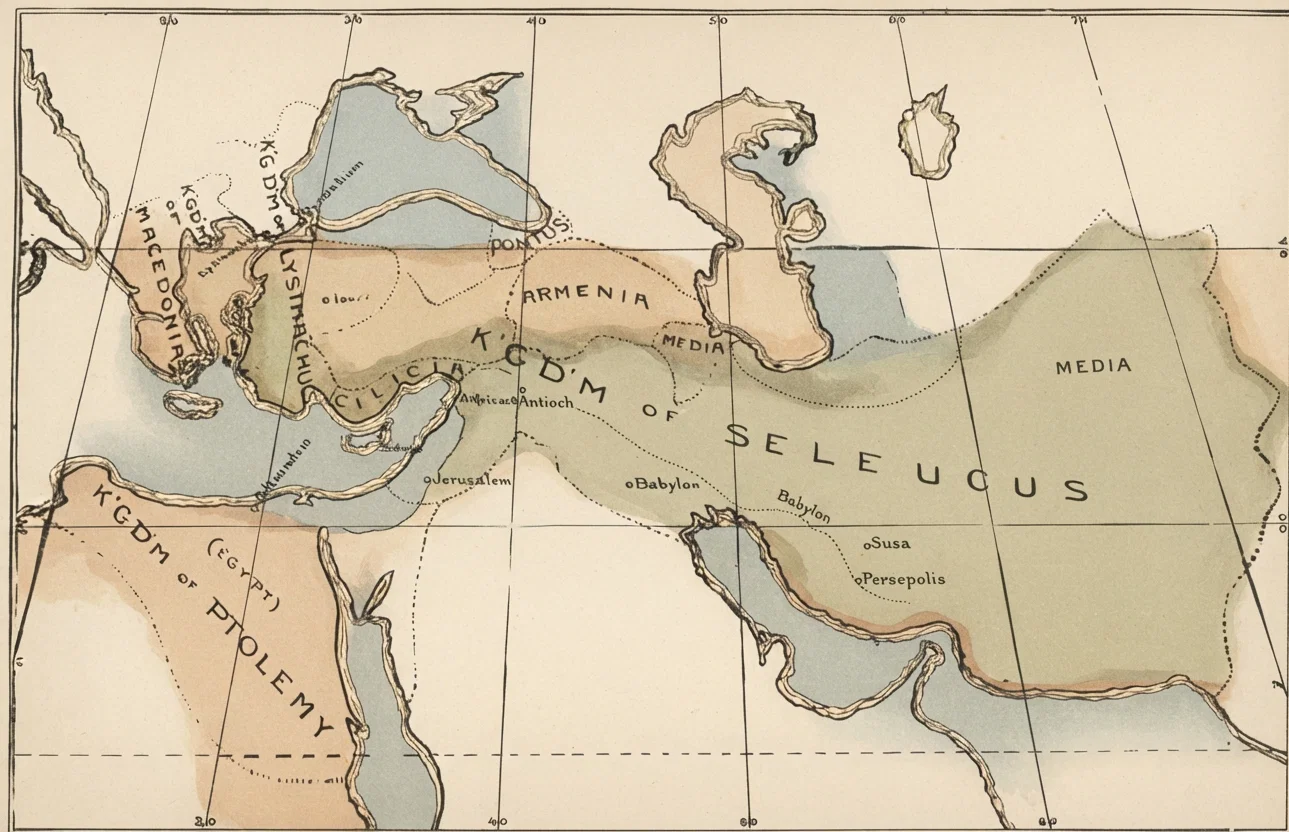
Arrhidæus reigned in all under regents a little more than six years, and was slain with his queen Eurydice by the command of Olympias, mother of Alexander the Great. The most powerful of Alexander's successors was Antigonus. He had for his associate his son Demetrius, an able general. After the death of Antipater the regent, Cassander the son of Polysperchon, who married Thessalonica, the youngest daughter of Alexander the Great, became satrap of Macedonia. By Cassander, largely, the legitimate successors to the throne of Alexander perished. There were at this time (B.C. 306) five divisions of the empire, under Seleucus, Antigonus, Ptolemy, Cassander, Lysimachus. The power of Antigonus, and his son Demetrius, increasing so rapidly, the other four joined in a league against him, executed by Seleucus and Lysimachus, who met Antigonus at the battle of Ipsus, B.C. 301, completely conquered him, and divided his dominion between themselves. The four, Seleucus, Lysimachus, Cassander, and Ptolemy, assumed the title of kings, and from this date (B.C. 301) the fourfold division must begin. The division (see map from Larned) is as follows: Seleucus possessed all the eastern part of the empire and Syria on the Mediterranean, with capital finally fixed at Antioch; Ptolemy had Egypt; Cassander possessed Macedon in Greece, and Cilicia in Asia Minor. Lysimachus ruled over lower, or Macedonian Thrace, and a large part of Asia Minor. His seat of authority was never, even as a satrap, at Byzantium, or Constantinople; but first at Lysimachia, west of Byzantium, and afterward, it is thought, at Ephesus; for his Asia Minor possessions were the larger and more important part of his dominion.
Division of Alexander's empire in four parts, B.C. 301. Seleucus had the largest part, including old Assyria and Chaldea, and a portion of Asia Minor; Ptolemy had Egypt; Cassander, Macedonia, and Cilicia in Asia Minor; Lysimachus had a part of Thrace and the west parts of Asia Minor. This map is from "Larned's History of Ready Reference," volume 3.
But this division, the first real independent political division, lasted but a short time. Cassander died of disease in 297 B.C., "a rare end," as Mahaffy remarks, "among this seed of dragons' teeth." His kingdom was divided between his two sons. Various intrigues, plots, counterplots, and wars followed, resulting in Macedon's finally coming under the rule of Lysimachus. Lysimachus possessed a very able, and for those times a righteous son, Agathocles; but Lysimachus had married Arsinoe, the daughter of Ptolemy. "To seal the alliance after Ipsus, old King Ptolemy sent his daughter Arsinoe to marry his rival and friend, Lysimachus, who on his side had sent his daughter, another Arsinoe, in marriage to the younger Ptolemy (Philadelphus). This was the second son of the great Ptolemy, who had chosen him for the throne in preference to his oldest son, Ceraunus ["The Thunderbolt"], a man of violent and reckless character, who accordingly left the country and went to seek his fortune at foreign courts." The old Ptolemy abdicated the throne of Egypt at the age of eighty-three (B.C. 283), and placed thereon Ptolemy Philadelphus. Ceraunus visited, first of all, the court of Lysimachus, where his half-sister Arsinoe was queen, but where his full sister, Lysandra, was married to the crown prince, the deservedly popular Agathocles; but Ceraunus and the queen conspired against the prince, persuaded Lysimachus that his son was a traitor, and Ceraunus was directed to put him to death. This so enraged the people of the country that Seleucus was called on to avenge him, and so another battle (Corpudion) for world empire was fought not far from the field of Ipsus, on the plain of Coron, B.C. 281, where Lysimachus was killed at the age of eighty, and his dominion passed to Seleucus. This king having given all of his Asiatic possessions east of the Euphrates to his son, Antiochus (B.C. 293), designed to spend his last days in Macedonia, the home of his fathers. He was murdered on the way, at Lysimachia, by the unholy Ceraunus, son of Ptolemy, who was with him (B.C. 280), and who for a little time came to the throne of Macedonia. This change left Antiochus king of the north parts of Alexander's empire in Asia; the Ptolemies rulers of the south, all of the European possessions having passed away from the house of the Seleucids.
We wish the reader especially to mark that there is no king of the north noted in the prophecy until we reach Antiochus, the son of the great Seleucus. But Antiochus held no dominion in Europe. There was no king of the south noted until we reach the reign of Ptolemy Philadelphus, the second son of the great Ptolemy. The holy land becomes a battle-ground between these forces,
Verse 5—A Conflict of Kings
Ptolemy Philadelphus, the second son of Ptolemy Soter, seems to be this king of the south. He was indeed a great king, with a great dominion. But Antiochus Soter, the son and successor of Seleucus Nicator, was a stronger king, with greater dominion. The kingdom of the Seleucids was stronger than that of the Ptolemies. But if it be contended that Ptolemy Soter (or Lagus), the founder of the Egyptian dynasty, is this king of the south, and Seleucus Nicator, the founder of the Seleucid monarchy, is this king of the north, who was "strong above him," it is well to remember that Ptolemy Soter died in B.C. 283. Seleucus did not conquer Lysimachus, and so become possessed of his dominions in Asia Minor and Thrace and Macedonia, until B.C. 281, two years later. Yet he did not even then enter upon this immense possession as ruler. It is well expressed in the chronicle of Little's "Cyclopedia of Classified Dates," under "Greece," 281 B.C.: "The empire of Alexander for a few weeks SEEMS about to unite again under Seleucus after the battle of Corpudion" (in the plain of Coron, near Ipsus), but the next chronicle, 281 B.C., is, "Seleucus is assassinated by Ptolemy Ceraunus, who thereby gains Thrace and Macedonia." And European territory is never again possessed by the successors of Seleucus. He, its conqueror, expected to spend his last days in Macedonia, the land of his youth, but he never entered upon the fruits of his conquest. Therefore, while nominally holding it for a few months, Seleucus was never in real possession, and NOT ONE OF HIS SUCCESSORS AMONG THE SELEUCIDS EVER RULED IN THRACE, OR WHAT IS NOW TURKEY. Antiochus Magnus claimed territory there, and thought to rebuild Lysimachia, but never did. Therefore, the possession of Thrace, or what is now Turkey in Europe, as an identification of the king of the north, has no bearing upon the prophecy. For if so, Ceraunus should be the next king of the north after Lysimachus, or following Seleucus Nicator, instead of Antiochus Soter, for CERAUNUS WAS RULER OF THRACE, followed by others, until the Roman conquest of B.C. 168; but no one argues that Ceraunus became king of the north. The great fact is that the king of the north in this prophecy is the great dominant power, whatever its nation or king, north of Palestine, successors to Babylon, of the "north country," and so prophecy regards it. See Jer. 1: 14; 10: 22; 46: 6, 10, 20, 24; 51: 48; 50: 9, 41; Eze. 38: 6, et al.
Verse 6
An interval of time passes since the two figures of the kings of the north and south step out so prominently on the world stage. Ptolemy Philadelphus is still king of Egypt; Antiochus Theos, son of Antiochus Soter, is king of the north. After years of warring, Ptolemy, to end the trouble, concluded a treaty of peace on the following terms:
That Antiochus should divorce his former wife Laodice, who was his own sister by the father, marry Berenice, the daughter of Ptolemy, and settle the crown upon the male issue of that marriage. Two years after this marriage Ptolemy Philadelphus8died—an event which Antiochus Theos, his son-in-law, no sooner understood than he removed Berenice from his bed, and recalled Laodice, with her children Seleucus Callinicus, and Antiochus Hierax; but Laodice, being well acquainted with his fickle temper, and fearing lest he might again abandon her and receive Berenice, resolved to improve the present opportunity and secure the succession to her son, for by the late treaty with Ptolemy, her children were disinherited and the crown settled on the son of Berenice. To effect this design, she caused Antiochus to be poisoned; when she saw him expiring, she ordered him to be privately conveyed away, and one Artemon, who greatly resembled him, as well in features as in the tone of his voice, to be placed in his bed. Artemon acted his part with great dexterity, and personating Antiochus, tenderly recommended his dear Laodice and her children to the lords that visited him. In the name of Antiochus, whom the people believed still alive, orders were issued, enjoining all his subjects to obey his beloved son Seleucus Callinicus, and acknowledge him for their lawful sovereign. The crown being by this infamous contrivance secured to Callinicus, the death of the king was publicly declared, and Callinicus without any opposition ascended the throne.—"Historians' History of the World," volume 4, page 557.
"He that begat her" may refer to the death of her father. "He whom she brought forth," as in the margin of our Common Version, would refer to her son promised the throne, who was also slain; "they that brought her," to her Egyptian attendants who sought to defend her; and "he that strengthened her," Antiochus.
Verses 7-9—A War of Revenge
"A shoot from her roots," a brother of Berenice, Ptolemy Euergetes (the Benefactor), who made energetic war to avenge his sister. He marched in triumph even to the Euphrates, and prevailed. If he had not been recalled, he would have taken the whole of Syria. He brought back captives, great treasures of gold and silver, and a multitude of gods, some of which had been taken from Egypt. It was for this reason he was called "the Benefactor." At Jerusalem he thanked the God of Israel for his victories, and made gifts. "Shall refrain some years;" margin, "continue more years than the king of the north." He survived Seleucus Callinicus about four years.
The best versions of verse 9 read as does the American Revised Version. The Common Version adds no fact, but is a general statement covering all the career of Euergetes; but the Revised Version states that Callinicus sought to retrieve his fortunes, and this seems to be the case.
According to Justin (Lib. XXVII. 2), Seleucus II, after Ptolemy's return to Egypt, collected a large fleet to subdue the cities which had joined the Egyptians. The fleet, however, was utterly destroyed by a tempest, and the king himself escaped with only a few followers. The disaster, however, proved beneficial to the Syrian monarch, for it aroused popular sympathy, which owing to his former crimes, had been sorely lacking. Hence he was able in a short time after his catastrophe to collect a large army for the invasion of Egypt. That army was, however, totally defeated in the first engagement, and Seleucus again escaped with a few adherents.—"Daniel and His Prophecies," by Wright, page 256.
Verses 10-12—The Last Great King of Syria
Seleucus Callinicus had two sons, Seleucus Ceraunus ("the Thunderbolt") and Antiochus Magnus (the Great), known also as Antiochus III. Ceraunus reigned but three years. He may have had strong designs against Egypt, as the prophecy implies, but he was largely employed in war with Attalus, king of Pergamon. In this war he was slain by one of his own officers, and the army made Antiochus king, at the age of fifteen years. He came to the throne, subdued insurrections in Media and Persia, added a new province in the Far East, and turned his attention to Egypt, now ruled
by Ptolemy IV. Antiochus declared war in B.C. 218, gaining in the beginning some victories of worth. Seleucia, on the Orontes, Tyre, Ptolemais, and other cities were captured. Like a mighty flood he swept on over Phenice and Southern Palestine, but for some reason he ceased operations. Internal troubles may have persuaded him to wait. But the next year he marched forth with a great army against Egypt.
Succeeding Ptolemy Euergetes was his son, Ptolemy Philopator ("Father-lover"). As a demonstration of the unfitness of names, it may be remarked, by the way, that he was suspected of poisoning his father. He was cruelly wicked, licentious, ease-loving. But the victory of Antiochus Magnus and his second march against Egypt aroused Philopator to great fury, and he joined issue with Antiochus at Raphia, near Gaza, and utterly defeated him; and the multitude of the king of the north was given into the hand of the king of the south. Cœle-Syria and Palestine were confirmed to Egypt. On his return to Egypt he visited Jerusalem, but, prevented from entering the holy of holies, he vowed vengeance. This vengeance was carried out in excluding the Jews from the gate of his palace, because they did not sacrifice to his gods, thus depriving them of sueing for justice, or claiming his protection. By another decree he reduced them from the first rank as citizens, where Alexander had placed them, to the third rank, and in the end his vengeance resulted in the massacre, Jerome declares, of sixty thousand Jews; but he was not by this strengthened, nor did he by this prevail.
Verses 13 to 19 continue the history of Antiochus Magnus. Having put an end to eastern wars (B.C. 212-205), he turns again to Egypt, against its infant king Ptolemy Epiphanes, now upon the throne. Where he ought to have sustained the weak king, he, with Philip of Macedon, plotted to divide his dominions. "Many" of the violent men among the Jews joined the "many" of Antiochus and Philip against the king of the south. "The robbers of thy people" in our Common Version, is "the children of the violent among thy people," A.R.V.; "the sons of the violent of thy people," Wright; "the perverse sons of thy people," Wintle and Boothroyd; "the children of prevaricators of thy people," Douay Version. Wright says:
By the "sons of violent men" may be understood the more disaffected or turbulent part of the people. The Jews at that crisis were in subjection under the yoke of their old oppressors, and that subjection was peculiarly galling. The Hebrew prophets, like Haggai, Zechariah, and even Daniel, had all predicted their deliverance, and the advent of a day when the yoke of the stranger should be broken from off their shoulders. Hence the text may mean that certain violent persons, filled with patriotic zeal, would at such a crisis take up arms for the purpose of regaining national liberty, and of fulfilling the vision or prophecy of the seers of old, altho they were destined to fail in their attempt. This view of the passage has been adopted by divers commentators. It is the most natural interpretation of the expression "to establish the vision."—"Daniel and His Prophecies," pages 262, 263.
On the fullest study, we see no reason why it should be applied to the Romans, and every reason why it should be a part of a direct, consecutive narrative. In Egypt, in Macedon, in Syria, and among the Jews were many standing up against the king of the south. Antiochus, after settling matters in other parts of his empire, returns to war against Ptolemy. He defeats the Egyptian general Scopas, shuts him up in Sidon, casts up a mound, and besieges the city. Four chosen Egyptian generals were sent out to raise the siege, but could not, and Scopas surrendered with a large army. Antiochus did according to his will, and no power could withstand him. He entered into the "glorious land," or as rendered by Wintle, "he shall stand in
the land of glory which shall be finished by his hand." In his note he says: "The words may rather be rendered, 'And there shall be a completion by his hand,' that is, the troubles of Judea should for a time at least have an end, and the land be restored to a more flourishing estate by his favor. And Josephus informs us that Antiochus made a decree that the Jews should enjoy many immunities, should live according to their own rites and laws, and that the work of the temple should be finished."—"Wintle on Daniel."
Professor Birks, on "The Two Later Visions of Daniel," page 102, says, "The word 'kalah' translated here 'to consume' is very often used in the sense, to finish, or complete. This appears to be its constant meaning in connection with the tabernacle or temple of God, the completion of which is almost always described by this term. The following passages are examples of this usage: Ex. 39: 32; 40: 33; Num. 7: 1; 1 Kings 6: 9, 14, 38; 9: 1; 1 Chron. 28: 20; 2 Chron. 7: 11; 8: 16; 24: 14; 31: 1." And then he cites history showing how Antiochus endeavored to help the Jews. "Some of them he moved to Mesopotamia and Babylon, counting them 'well-disposed guardians of our possessions from their piety towards God.'" He recompensed them for damages, gave them a pension for their sacrifice, for cattle and wine and oil and incense, twenty thousand pieces of silver, fine flour and wheat in abundance, in order "that the work about the temple SHOULD BE FINISHED, both the pillars and whatsoever else needs to be built." "Also in all the other things in which the furniture of the temple needs to be made more glorious." He frees them from poll-tax and crown imposts and other tribute, also releases them from the third part of the tribute, so that their losses would be repaired. And therefore Birks renders it, "He shall stand in the country of the goodly ornament, and it shall be perfected by his hand."
In the meantime, Rome crushes the ally of Antiochus, Philip of Macedon, in fact in B.C. 197, the very year Antiochus defeated the Egyptian general, Scopas. Antiochus gains some success in Europe. But when he thought of seizing Egypt he was told by Rome to desist, as Egypt was under Roman protection. Antiochus haughtily replied, told the Romans to attend to Europe, but not to inquire what Antiochus did in Asia. As to Ptolemy, he was friendly with him, and soon would be joined in affinity with him. B.C. 195 he gave his beautiful daughter Cleopatra to Ptolemy in marriage, with a dowry of Cœle-Syria, Samaria, Judea, and Phenice, the tribute to be divided between the two kings, "the conditions of equity" noted in the Scripture. It was no act of beneficence on the part of Antiochus, however. He thought through his daughter that he would gain Egypt, but she had ambitions also, and would not stand for her father's devices. After this Antiochus turned his face to the isles, or coast lands. Wright says:
After concluding the alliance with Egypt, Antiochus turned his attention to the coast lands of Asia Minor. The Egyptian possessions along that coast had been by mutual agreement divided between Philip of Macedon and Antiochus. But the Romans, having overcome Philip, declared all the Greek cities of Asia Minor, which had belonged to that monarch, free. The Romans further require Antiochus not only to acknowledge the freedom of those cities, but also to surrender all his possessions in Europe. In the war which ensued Antiochus, through neglect of the advice given by Hannibal, was, after some successes in Asia Minor and in Greece, severely defeated on land at Thermopylæ (B.C. 192), as well as in several naval engagements, especially in that at Ephesus, and after his return into Asia, in the decisive battle of Magnesia (B.C. 190), soon after which event he perished in an attempt to plunder the temple of Bel at Elymais.
These latter events are generally supposed to be glanced at in verse 19: "And he shall turn his9face toward the fortresses of his own land; and shall stumble and fall, and shall not be found."
The sketch of the history of Antiochus the Great given in Daniel 11 closes with verse 19. The tremendous defeat which the Romans inflicted on that monarch at Magnesia, towards the close of the year B.C. 190, is but slightly alluded to. In consequence, however, of that defeat, Antiochus was obliged to relinquish all his conquests in Greece, and a considerable part of his possessions in Asia Minor. He was further compelled to surrender his fleet to the Romans, to pay within twelve years 15,000 talents as an indemnity for the costs of the war, and to send twenty hostages to Rome, among whom was his younger son, who became afterwards notorious as Antiochus Epiphanes. Arrangements were also made for such an exchange of hostages as might from time to time seem desirable.—"Daniel and His Prophecies," pages 271, 272.
It [the battle of Magnesia] sealed the fate of the last of the great Oriental empires.—P. Smith, in "Larned's History of Ready Reference."
Thus faithfully has the pen of inspiration outlined the history of three and a half centuries. During this time God was caring for His people, who were still too far from Him. His care is shown in the decrees of the Persian monarchs for the building of the temple, and of the city of Jerusalem, and the rebuilding and repairing of the city. Punishment came upon them through the severity of Ptolemy Soter, who sent 100,000 of them captive into Africa, but afterward showed them many favors. Antigonus, one of the regents of Alexander, also behaved with intolerant cruelty toward the Jews. Ptolemy Philadelphus, however, was very favorable toward the people of God, and it was under his reign that the Septuagint translation was effected, and from this time on the Jewish Sanhedrin was formed, and out of these times came the Gemara and Talmuds, and the various sects of the Jews, —Sadducees, Pharisees, and Essenes.
The greatest suffering of the Jews noted in this prophecy still lies before us, and will be considered in our next article. To help the general reader, we append a liberal paraphrase of verses 2 to 19, embodying what we have just passed over:
2. And now I will show thee the truth. Behold, there shall reign yet three kings in Persia, Cambyses (B.C. 529-522), false Smerdis (521), and Darius Hystaspes (521-486); and the fourth, Xerxes (485-465), shall be far richer than all; and when he is waxed strong through his riches, he shall stir up all against the realm of Grecia.
3. And a mighty king, Alexander the Great, shall reign (336-323), that shall rule with great dominion, and do according to his will.
4. And when he shall stand up, that is, at the close of that reign, his kingdom shall be divided eventually (B.C. 301) into four parts, Syria, Egypt, Macedonia, Thrace and Asia Minor, but not to his posterity, Alexander IV or his descendants, nor will the divisions be according to his dominion wherewith he ruled; for his kingdom shall be plucked up for Seleucus, Ptolemy, Cassander, Lysimachus, and others besides his posterity.
5. And the king of the south, Ptolemy Philadelphus (285-247), son of Ptolemy Lagus, shall be strong, and of his princes, and Antiochus Soter (280-261), son of Seleucus Nicator, shall be strong above him, and have dominion; and his dominion shall be a great dominion.
6. And after a time Ptolemy Philadelphus and Antiochus Theos (261-246), son of Antiochus Soter, shall join themselves together, and the daughter of Ptolemy Philadelphus, Berenice, shall come to Antiochus Theos to make an agreement, or marry him, with the understanding that her issue shall be heir of the throne: but she shall not retain the support of her husband; neither shall he stand by her, nor his power; but she shall be given up, and her personal attendants from Egypt shall be slain, and her father shall die, and her husband Antiochus Theos also.
7. But Ptolemy Euergetes (247-222), brother of Berenice, and son of Ptolemy Philadelphus, shall stand up in his father's office, who shall come against the army, and enter into the fortress of Seleucus Callinicus, the king of the north, and shall deal against them (perhaps including Callinicus and his mother Laodice, who slew Berenice, but more likely the whole host of the Syrians), and shall prevail.
8. And Ptolemy Euergetes shall carry captive into Egypt many gods, with them molten images ("princes," margin), and goodly vessels of silver and gold, and shall continue more years than the king of the north, Seleucus Callinicus.
9. And Seleucus Callinicus (246-226) shall come into the realm of the king of the south, Ptolemy Euergetes, but he shall return into his own land.
10. And the sons of Seleucus Callinicus, Seleucus Ceraunus (226-223) and Antiochus Magnus (223-187), shall assemble a great multitude of forces, which shall come on, and overflow, and pass through; and they, the multitude (or "he," margin, Antiochus Magnus) shall return and war, even to his fortress.
11. And Ptolemy Philopator (222-205), son of Euergetes, shall be moved with anger, and shall come forth and fight with him, even with Antiochus Magnus, the king of the north; and Antiochus Magnus shall set forth a great multitude, but the multitude shall be given into the hand of Ptolemy Philopator.
12. And the multitude shall be carried away (margin), and Philopator's heart shall be exalted with pride, and he shall cast down tens of thousands of the Jews, but he shall not prevail.
13. And Antiochus Magnus shall return, and shall come with an army stronger than before; and he shall come at the end of times, even of years, with a great army and much substance.
14. And in those times there shall many (in Macedonia and Syria) stand up against the king of the south, Ptolemy Epiphanes (204-181) (infant son of Philopator;) also the children of the violent among thy people (the Jews) shall lift themselves up to establish the vision; but they shall fall.
15. So Antiochus Magnus shall come and cast up a mound, and take the well-fortified city of Sidon; and the forces of Ptolemy Epiphanes shall not stand, neither his general Scopas, nor those who endeavor to help him, neither shall there be any strength to stand.
16. But Antiochus Magnus, that cometh against Scopas, shall do according to his own will, and none shall stand before him; and he shall stand in the glorious land, and in his end shall be destruction (see note above).
17. And Antiochus Magnus shall set his face to come with the strength of his whole kingdom, and with him equitable conditions; and he shall give to Ptolemy to wife his daughter Cleopatra, to further his corrupt designs; but she shall not stand for such things, neither be for him.
18. After this Antiochus Magnus shall turn his face toward the coast lands, and shall take many; but a captain (margin) of the Romans shall cause the reproach offered to Ptolemy Epiphanes to cease (battle of Magnesia, B.C. 190); yea, moreover, he shall cause his reproach to turn upon him.
19. Then Antiochus Magnus shall turn his face toward the fortresses of his own land, but he shall stumble and fall, and not be found.