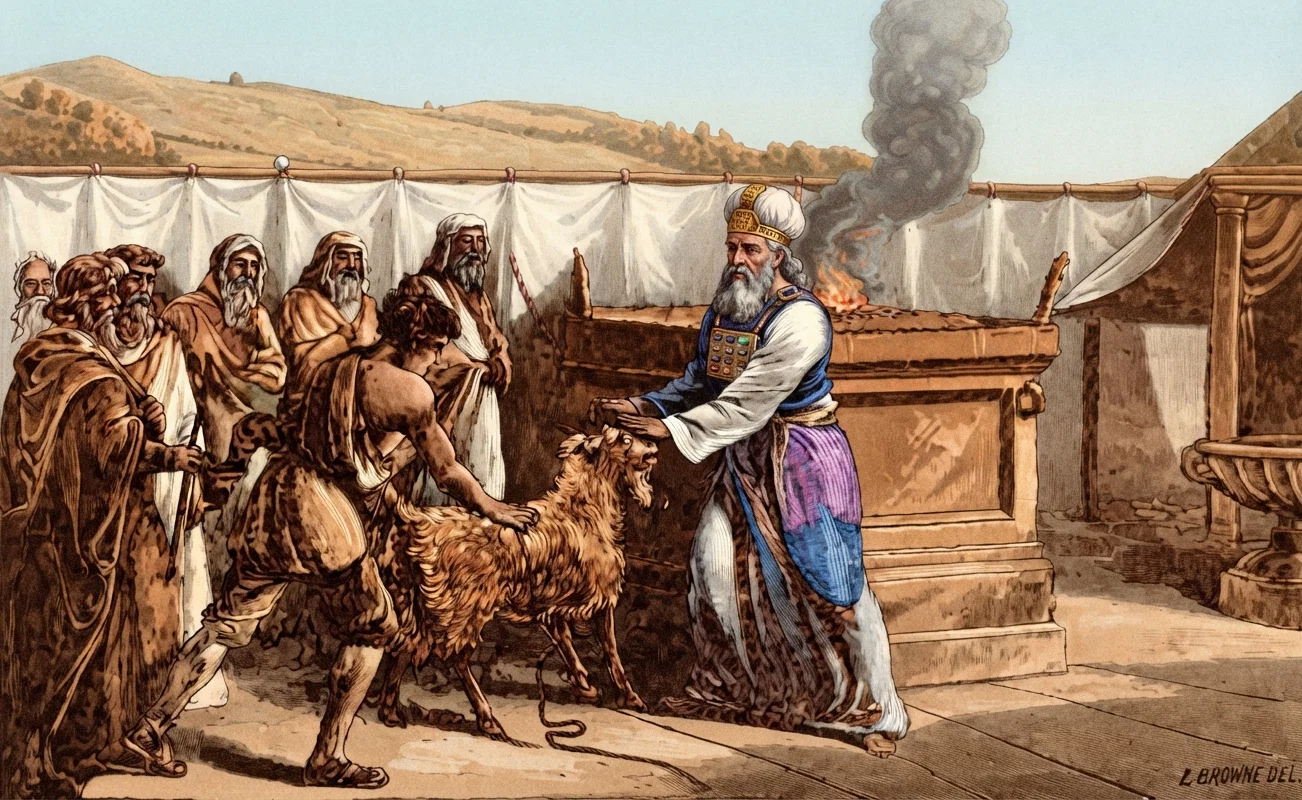
Of all the sacred days for devotions and meditations which God commanded Israel to observe, the day of atonement was the most important. The institution itself, with the manner of its observance, is recorded in Lev. 16, the substance of which is as follows: On the tenth day of the seventh month of the Jewish year, Tishri, all the congregation of the children of Israel were to refrain from their labor. The high priest was to take a young bullock for a sin-offering, and a ram for a burnt-offering, which he was to offer for himself before the Lord in the most holy place as an atonement for his sins. He was also to take of the congregation two kids of the goats for a sin-offering, and one ram for a burnt-offering. These two goats he was to bring to the door of the tabernacle of the congregation, and present them for acceptance to God. Then lots were cast upon the animals, one to be God’s lot, the other Azazel’s lot. Or, rather, one was to represent God, the other Azazel. Of this latter term more will be said later. When this was accomplished, the Lord’s goat was to be offered up for sins, or, as we generally express it, for a sin-offering. But the goat which was selected for Azazel, or the scapegoat, was to be presented alive to make an atonement upon, instead of with him, and let him go to Azazel in the wilderness.
The high priest was also to take a censer full of the hot coals from the altar, his hands filled with the sweet incense, and bring these into the most holy place. The incense was then placed upon the fire, and the clouded perfume laid upon the mercy-seat. He was then to take of the blood of the bullock for himself, and sprinkle the mercy-seat, and in front of the mercy-seat, seven times. After the Lord’s goat was killed, he was to take of its blood within the vail, and do with it to the mercy-seat as he did with the blood of the bullock. And in the doing of these things, he was making an atonement for himself, for all the congregation of the children of Israel, as well as for the sanctuary itself. Of course it was necessary that all the things in the sanctuary should be sprinkled with blood; for almost all things by the law were purged with blood; and without the shedding of blood there was no remission. Heb. 9:22.
When this work of cleansing the priest, people, and the holy places was accomplished, the scapegoat was brought alive, and the high priest then confessed all the sins of all the people of Israel, which were atoned for in the most holy place by the sprinkling of the blood taken from the Lord’s goat, and by an appointed man sent to the Azazel in a barren place. Verses 10, 21.
These sins of the people were confessed upon the head of this scapegoat, and it was to bear all these iniquities, in a separated land, not inhabited.
During this day all the people were to afflict their souls before the Lord; no work of any kind was done, neither were they allowed to partake of any food. Not only was this true of the Israelites, but any sojourner who dwelt among them was to observe the day in the same manner. And the soul who did not carry out the commands of God on this day as he had appointed was punished with death; for it was the day in which all their sins were blotted out before God, and they were cleansed and justified. Lev. 23:26-32; Num. 29:7. This was the institution ordered by the Lord,7and also the manner of its observance; the reasons for the ordinances therein are also described. Only such a day kept in such a manner could the Lord accept. But since the destruction of the temple at Jerusalem, under Titus, there has never been any place where Israel could offer her offerings before the Lord, nor have any high priest to perform the work. Yet the day has ever been observed, even to the present time. In fact, the day upon which this article was written was the day of atonement for the Jews this year. Of course, as Christians, we know by the Bible, since the Crucifixion, and the rending of the temple's vail between the holy places, Christ has become the High Priest, and earthly sacrifices are of no service. But the Jew says it was to be an everlasting statute, to be observed by all their generations. Therefore, as it can not be observed in the exact manner the Lord commanded, means have been substituted which are regarded as equally acceptable to the Lord.
In the Talmudic work Hilchoth T'shuva, or 'Laws of Repentance,' we find the following:—
At this time, when there is no temple, and we have no altar, there is no atonement but repentance.
Repentance atones for all transgressions; yea, tho a man be wicked all his days and repent at last, none of his wickedness is mentioned to him, for it is said, 'As for the wickedness of the wicked, he shall not fall thereby in the day that he turneth from his wickedness.' Eze. 33:12. The day of atonement itself also atones for them that repent, for it is said, 'For on that day he shall make an atonement for you.' Lev. 16:30.
It will here be noticed that repentance is substituted for the offering, and that repentance of course is by the good works of the individual. But right here we find a great inconsistency in the present manner of its observance. It says first that repentance alone is sufficient for atonement, independent of any day. If a person can only perform good works enough, the Lord will make it as acceptable as the offering. And the very next sentence says, 'The day of atonement itself atones for them that repent.' Now, if repentance alone is sufficient, why need the day? And if the day itself, by virtue of its name, be sufficient, then why need to repent?
But with this they were not satisfied, as they were well aware that some might sometime say that it was necessary to be provided with an offering. Hence the following was provided:—
Order of the atonements: On the eve of the day of atonement, the custom is to make atonements. A fowl (cock) is taken for a man, and a hen for a woman. . . . The father of the family first makes atonement for himself, for the high priest first atoned for himself, then for his family, afterwards for all Israel.
The order for these atonements is as follows: He takes the cock in his hand and says the following: 'The children of men that sit in darkness and the shadow of death, being bound in affliction and iron; he brought them out of darkness and the shadow of death, and brake their bands asunder. Fools because of their transgression and because of their iniquities are afflicted. Their soul abhorreth all manner of meat, and they draw near unto the gates of death. Then they cry unto the Lord in their trouble, and he saveth them from their distresses. He sendeth his word, and healeth them, and delivereth them from their destructions. O that men would praise the Lord for his goodness, and for his wonderful works to the children of men!' Ps. 107. 'If there be for him an angel, an intercessor, one among a thousand, to show unto man his uprightness, then he is gracious unto him, and saith, Deliver him from going down to the pit; I have found a ransom.' Job 33:23, 24. Whilst moving the atonement around his head he says: 'This is my substitute. This is my commutation. This cock goeth to death, but may I be gathered and enter into a long and happy life, and unto peace.'
This is performed three times in succession;
LAYING THE SINS ON THE HEAD OF THE SCAPEGOAT.
each time the prayers begin with the words, 'The children of men.'
As soon as one has performed the order of the atonement, he should lay his hands upon it as the hands used to be laid upon the sacrifices, and immediately after give it to be slaughtered.
These prayers will be found in any orthodox Jewish prayer-book on the day of atonement. Thus we see how God's plan is perverted, and man's ideas placed in its stead. The reason may be asked why the cock instead of any other. Because the Hebrew word for cock sometimes is used for man. If they could get a wholly righteous man, who never had sinned, to atone for them, they think he would be acceptable; but since that is impossible, they take the nearest thing bearing the name of a man, and believe it will answer.
How sad it is to see such blindness, when God has provided a Righteous Man, who has become the atonement for us all, and who is able to pardon all our sins. He was wounded for our transgressions, and was bruised for our iniquities; and the chastisement of our peace was upon him. He has healing for all those who will accept of his blood, even him whose name is 'Jehovah Our Righteousness.' Isaiah 53. Jer. 23:5. But to continue:—
Our God and the God of our ancestors; the burnt-offerings have ceased, and the sacrifices are discontinued. Wherewith shall we then approach him who dwelleth on high, for there is none amongst us that is fit to appease thee with supplications, to seek mercy for us that we may find grace. Did not our ancestors aforetime bring a certain sin and trespass-offering when they sinned, to make an atonement before thee? But now the sacrifices and meat-offerings are moved, and thy dwelling-place is destroyed. . . . Wherewith shall we wash away the filth of our shame, and make atonement for our transgression?
Then comes the reply:—
All those have failed, and we remain deprived of them. We fast this day to diminish our blood and fat, in lieu of the blood that was sprinkled on the altar; we bow ourselves with two supplications instead of the binding of the lamb morning and evening; we bow down the head and stretch out the neck, instead of the jugulation and wringing of the head, and the receiving of the blood in the bowels.—Prayers for the Day of Atonement.
Thus they fast, they pray, they afflict themselves and carry out their own ideas, and then think those traditions are accepted with the Lord. They serve him with their lips; but their hearts are far from him.
Much more might be adduced from their writings as to the manner of observance of this sacred day; but it is all man-made, and can only bring self-righteousness. If they only knew that there has a way been opened for them by which they can approach the Father, and there is One who is fit to make us accepted with the Lord, how different it would be with them! And how thankful we ought to be to the Lord that Jesus has shined into our hearts, to give unto us the light of himself! Let us then be light-bearers for him to those who are dead and buried beneath the rubbish of tradition.