The High Priest—the Priests

6%

Pacific Press Publishing Association · Mountain View, California · Dec 10, 1912

FromSigns of the Times, Vol. 39, No. 48.

Read the full edition

The High Priest—the Priests

Office and Work of the High Priest
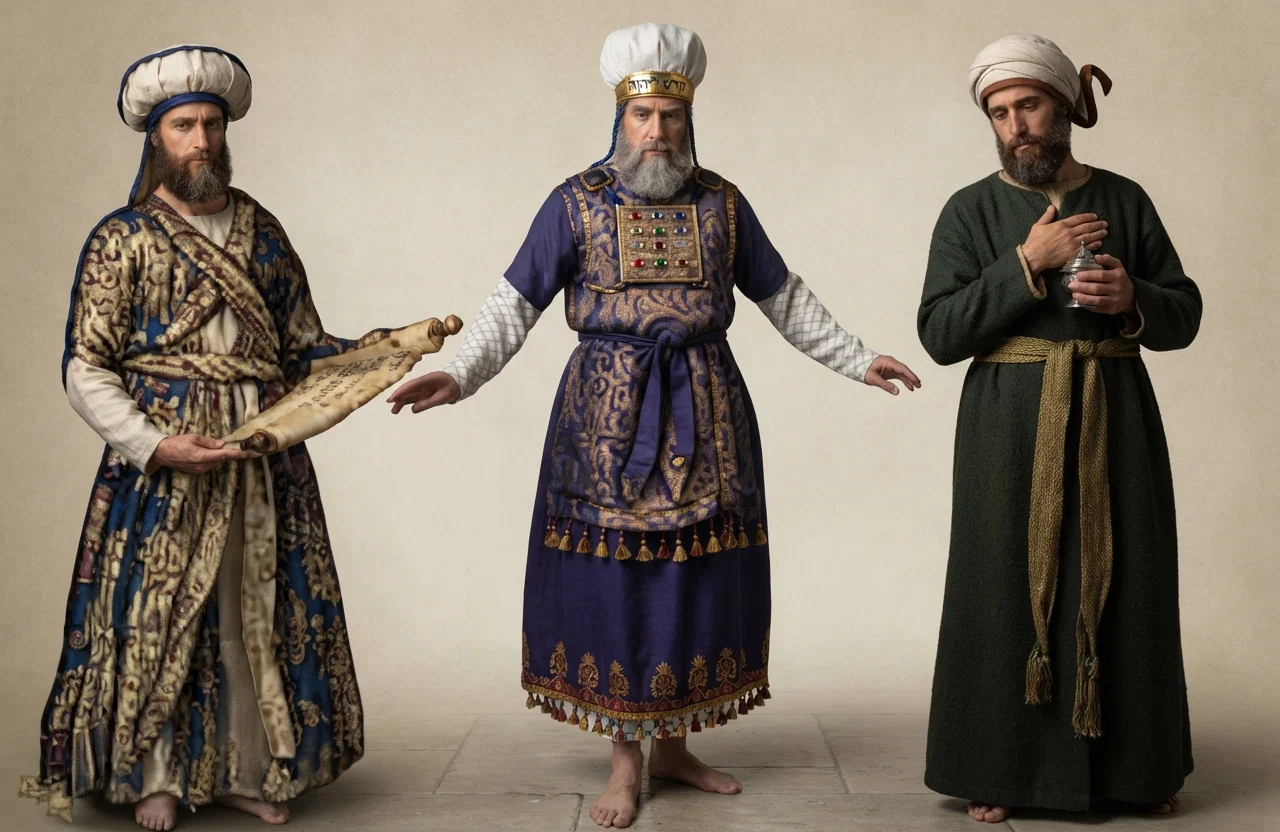
In early times, the patriarchs were priests over their own households, and God's original design was that the eldest son should take his father's place as priest of the family; but the plan of God was often thwarted by the sins of the eldest son. The Lord's words to Cain would indicate Cain was debarred from his inherited position on account of sin: "If thou doest well, shalt thou not have the excellency? and if thou doest not well, sin lieth at the door." Gen. 4:7, margin. Sin prevented Cain from having "the excellency."
Reuben, the first-born of Jacob, lost, on account of sin, "the excellency of dignity and the excellency of power" which was his inherited right. 1 Chron. 5:1. Joseph cultivated in his life, when but a youth, the traits of character that gave him "the excellency" above his brethren. It is very probable that the coat of many colors given him by his father, was interpreted by his brethren as indicating the headship, including the priesthood. God gave His First-born for the redemption of the world; and for that reason, in God's plan the first-born always inherited special privileges. To him came a double portion of his father's estate, the priesthood, and, to the first-born in the descent from Isaac, the honor of being the progenitor of the Messiah. If the first-born proved unworthy, his inheritance was given to others, as in the case of Reuben, where Judah became the progenitor of Christ, Joseph received the double portion, and Levi received the priesthood. 1 Chron. 5:1, 2; Num. 3:6. The first-born was so often unworthy on account of sin, that when the Lord brought Israel out of Egypt, He said, "I have taken the Levites from among the children of Israel instead of all the first-born . . . of Israel: therefore the Levites shall be Mine." Num. 3:12, 13.
Priest High Priest Levite of the Levitical Dispensation
It was on account of the tribe of Levi standing true to God in time of a crisis, that God chose Levi to serve before Him (Deut. 33:8-11); and when the service of the sanctuary was established, the priesthood was given to Aaron and his sons, and the remainder of the tribe of Levi were to do the work of the sanctuary under the direction of the priests. Ex. 28:1. Aaron was appointed to officiate as high priest, and his sons as common priests, the eldest son to take the office of high priest on Aaron's death. Ex. 29:29; Num. 20:25-28. The consecration to the priest's office was a most imposing ceremony. Aaron was clothed in the garments which were made for him under God's direction. Several sacrifices were slain, and the blood of the ram of consecration was touched to the tip of the right ear, the thumb of the right hand, and the great toe of the right foot, of both Aaron and his sons, signifying that their ears, hands, and feet were consecrated to the service of God. Unleavened bread, denoting "sincerity and truth" (1 Cor. 5:8), and the right shoulder of the sacrifice of consecration, were all put upon Aaron's hands and upon his sons' hands. The priests were to typify the One of whom Isaiah said, "The government shall be upon His shoulder." They were to bear the burdens of the people. The anointing oil and the blood were then sprinkled upon Aaron and his sons, typifying the blood of Christ and the Holy Spirit, which alone could fully qualify them to fill the holy office. Ex. 29:5-35.
The priesthood remained in Aaron's family unbroken until the sins of Eli and his sons made it necessary to change; and for a time Samuel, an Ephraithite, filled the office of leading priest in Israel. 1 Sam. 1:1, 19, 20. Abiathar was thrust out of the office of the priesthood in fulfilment of the prophecy given Eli. 1 Kings 2:26, 27. But Zadok, who filled the office of high priest in the time of David and Solomon, was thought by many to be a grandson of Eli. As the Israelites departed from the Lord, the priesthood became corrupt, until in the time of Christ it was bought and sold for money.
God designed that the high priest should more nearly represent Christ than any other priest. The work of every priest was a type of Christ's work; but the common priests only performed work in the court and first apartment of the sanctuary, while the high priest officiated in the court and first apartment as well as the common priests, and went alone into the holy of holies. Heb. 9:7. Aaron at times offered burnt offerings on the brazen altar in the court. 1 Chron. 6:49. It was impossible for one man to perform all the work of the sanctuary that typified the work of Christ, and for that reason there was a company of common priests to assist the high priest.
It is always a rule that a higher official can fill the offices below him. The high priest offered burnt offerings in the court and sin-offerings in the first apartment. Paul speaks of the high priest's offering the sin-offerings where the blood was taken into the sanctuary. Heb. 13:11. In the sin-offerings for the priests and the congregation, the blood was taken within the sanctuary. Lev. 4:3-7, 13, 14. It seems very fitting that the high priest should offer the sin-offerings for the common priests and the entire congregation. In most of the sin-offerings, the flesh was eaten in the holy place, and the blood not taken into the sanctuary. While the high priest could perform any work in the first apartment that other priests could perform, there was a daily service in the first apartment of the sanctuary that none but the high priest could perform. The high priest alone could burn incense upon the golden altar before the Lord, and trim andlight the lamps on the golden candlestick. Each morning and evening, twice every day throughout the entire year the high priest officiated in the first apartment of the sanctuary. Ex. 30:7, 8.
The crowning service of the whole year was on the tenth day of the seventh month, when the high priest, in his beautiful garments, entered the holy of holies alone to make the atonement for the sins of the people. Upon his breast, in the stones of the breastplate, were inscribed the names of the twelve tribes, typifying Christ our High Priest as He thinks upon us individually, and confesses our names as they come up in review before God.
TYPE ANTITYPE
Ex. 28:1, 2. Called of God. Heb. 3:1-3. Appointed by God.
Ex. 29:29. The priesthood passed from father to son. Heb. 7:23, 24. Our Priest lives forever.
Lev. 16:1-28. The high priest made the typical atonement in the end of the year's service. Heb. 9:14, 26. Christ atones, in the end of the world, for sin, by the sacrifice of Himself, made once for all.

The Priests

There were two orders of the priesthood, the Melchizedek and the Levitical. The Melchizedek order preceded the Levitical order. In Abraham's day, the priest Melchizedek was also king of Salem, as well as priest of the most high God. Altho there is not much said in the Bible of the Melchizedek order of the priesthood, it was superior to the Levitical order, for Christ was made a priest after the order of Melchizedek. The Levitical order extended from the time Israel came out of Egypt until the cross; and since that time we have the priesthood of Christ, of which all earthly priests were a type. Christ is made a priest after the order of Melchizedek; therefore we are now living under the Melchizedek order of the priesthood.
There are many particulars given in regard to the Levitical order; and as all the Levitical priests served "unto the example and shadow of heavenly things," when we study of the Levitical priesthood we are really studying of the priestly work of our Lord and Saviour Jesus Christ. The Levitical priesthood was divided into twenty-four courses. 1 Chron. 24:1-19; 2 Chron. 8:14. Each course had its chief or governor of the sanctuary. 1 Chron. 24:6, 31; 2 Chron. 36:14. This continued down to the time of Christ. Luke 1:8. When the Saviour ascended to heaven, He led a multitude of captives (Eph. 4:8, margin); and when to John in vision was shown the first apartment of the heavenly sanctuary, with its seven lamps of fire burning before the throne of God, he saw four and twenty elders seated upon four and twenty seats, and they worshipped the Lamb, saying, "Thou . . . hast redeemed us to God by Thy blood out of every kindred, and tongue, and people, and nation; and hast made us unto our God kings and priests." Rev. 4:4; 5:8-10. In this we see the antitype of the twenty-four courses of priests. These were our Lord's assistants. The remainder of the multitude Christ took into heaven are not mentioned, but it is reasonable to suppose they form the courses of which the four and twenty elders are the chiefs.
Only the descendants of Aaron were allowed to serve as priests. Num. 3:10. In the type, the priest who could not prove his direct genealogy from Aaron, the first high priest, was cast out of the priesthood. Ezra 2:62. So in the antitype, the Christian who can not prove his direct connection with Christ, the heavenly High Priest, will never become one of the "royal priesthood." 1 Peter 2:9.
God has provided for the support of all the different orders of the priesthood by the same method. "The earth is the Lord's, and the fulness thereof." Ps. 24:1. The silver and the gold, and the cattle upon a thousand hills, all belong to Him. Ps. 50:10-12. Man is placed as steward over the Lord's heritage, and the Lord claims one tenth of everything on the earth as His portion. "All the tithe of the land, whether of the seed of the land, or of the fruit of the tree, is the Lord's: it is holy unto the Lord." Lev. 27:30-33. Of the tithe, the Lord says, "I have given the children of Levi all the tenth in Israel for an inheritance, for their service which they serve, even the service of the tabernacle of the congregation." Num. 18:20-24. The individual who selfishly uses the entire ten portions for himself, not reserving one tenth for the Lord, is guilty of robbing the Lord. "Will a man rob God? Yet ye have robbed Me. But ye say, Wherein have we robbed Thee? In tithes and offerings." See Mal. 3:8-11. Abraham paid a faithful tithe to Melchizedek (Gen. 14:17-20), and Jacob promised to pay tithe of all, even if he only received food and raiment (Gen. 28:20-22). Those who belong to the great household of faith, and are children of Abraham, will "do the works of Abraham." John 8:39. They will pay a faithful tithe for the support of those who, like the Levitical priesthood, give their lives for the advancement of Christ's kingdom upon the earth. Just as the priest lived "of the things of the temple," "even so hath the Lord ordained that they which preach the gospel should live of the gospel." 1 Cor. 9:9-14; Matt. 23:23.
TYPE ANTITYPE
Heb. 8:5. The earthly priests served "unto the example and shadow of heavenly things." Heb. 10:10. "We are sanctified through the offering of the body of Jesus Christ once for all."
1 Chron. 24:1-19, 31. Priests divided into twenty-four courses, with a chief over each course. Rev. 4:4, 5; 5:8-10. John saw twenty-four elders in the first apartment of the heavenly sanctuary.
Ezra 2:61, 62. The records were examined to see if each one had a right to officiate in the priest's office. Rev. 20:15. None will be saved that are not found written in the Book of Life.