KUBBET ES-SAKHARA

9%

Pacific Press Publishing Company · OAKLAND, CALIFORNIA · Jun 13, 1900

FromSigns of the Times, Vol. 26, No. 24.

Read the full edition

"KUBBET ES-SAKHARA."

MOUNTAINS are always and everywhere of interest; how much more so the mountains of Sacred Story, connected as they are with the wonderful works of God among the children of men! Hermon and Gilboa, Ebal and Gerizim, Lebanon and Carmel, Nebo and Pisgah, Hor and Horeb, Sinai and Seir, Calvary and Olivet, and still others, what a multitude of thoughts and incidents surge into the mind! What curses and blessings, what defeats and victories, what suffering and triumph, what majesty and glory and love are revealed through the ministry of the mountains! It was in the mountains where God revealed Himself to His children. Sinai will ever stand as the symbol of the glory and majesty of law, and Calvary as the symbol of sacrifice and love.
AMONG the interesting highlands of Scripture is Mount Moriah. "Chosen of God" the name means. It was there that Abraham was about to offer Isaac, the very spot revealed to him of God, showing the great truth that the spirit of sacrifice has to do with the where and how as well as the what. We may not sacrifice some substitute of our own in the Lord's way, nor the sacrifice which the Lord demands in our way or in the place we shall choose. The true spirit of submission is anything, any way, anywhen, anywhere, as Infinite Wisdom and love may direct. And thus was the mountain chosen of God hallowed; and Abraham's faith was perfected. He yielded all to Him who gave all, and received all in return.
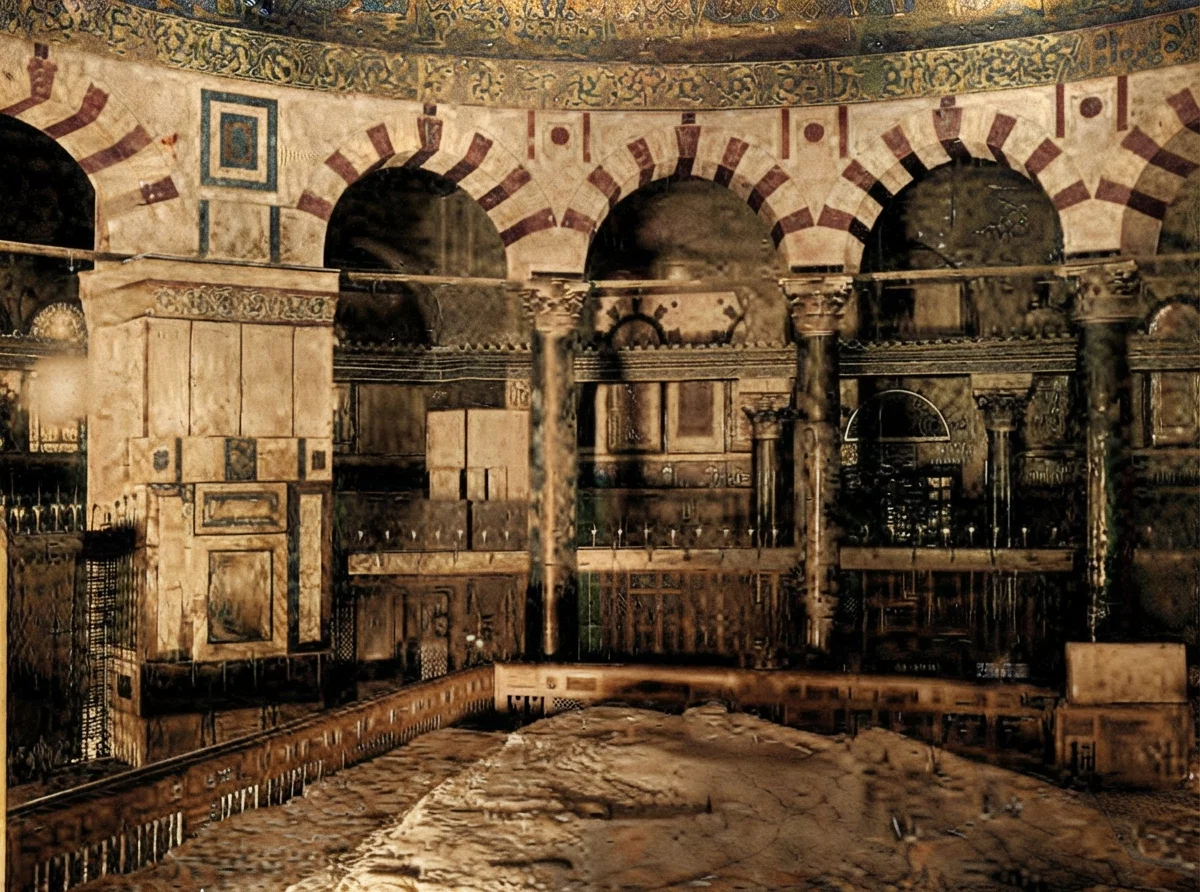
THE DOME OF THE ROCK—IN THE MOSQUE OF OMAR.
WHAT more fitting place could there be for the temple of the Most High than sacrifice-crowned Moriah? And so when the temple was builded it was not the highest mount within the city that was chosen, for Mount Zion—not the most elevated height in Jerusalem—towers above it one hundred and ten feet; but one of the lowlier ones, Mount Moriah, in the southeast part of the city, overlooking the Valley of Kedron and facing Olivet.
JERUSALEM of to-day is builded on her own heap, as the prophet declared. Jer. 30:18. Not less than seventeen times between the days of Joshua and Titus was the city besieged. Twice was she razed to the ground; twice were her walls destroyed; and now the ancient city of David and Solomon lies buried beneath twenty to eighty feet of the ruin and rubbish of centuries. The city is a fitting type of the truth committed to her people; they haveburied it yards deep under the traditions of men.
HOW LARGE Jerusalem was when Melchizedek reigned as king we do not know. From the time of the entrance into the promised land till the days of David, the Jebusites held it. On Mount Moriah "Araunah the Jebusite" had his threshing-floor. 2 Sam. 24:18. Here David built an altar and offered sacrifices, the expression of his own repentance, and the plague was stayed. And here was the temple builded. This was destroyed under Nebuchadnezzar, rebuilded under Zerubbabel, enlarged and beautified by Herod. When Rome conquered the city, the temple was destroyed, and on its site was erected Ælia Capitolina, a temple to Jupiter. In A.D. 614 the city was taken by Chosroes the Persian; in 637, by Caliph Omar; in 1099 it was captured by the Crusaders; the Mohammedans again obtained possession under Saladin in 1187; thence afterward it was in Christian possession; but 1517 found it in the hands of the Osmans, and it has been controlled by the Mohammedans ever since. Fitful indeed and unsatisfactory has been the history of the city which was not established in righteousness.
NOW ON MOUNT Moriah, the chosen of God, is an inclosure of between thirty and forty acres, called Haram ash-Sheref. Within this and on the very site of the temple is the Mosque of Omar, said to be "perhaps the very noblest specimen of building work in Asia." It is the most prominent and beautiful building in the whole city. It is the second mosque of Islam, inferior only to that of Mecca.
WITHIN THE MOSQUE IS Kubbet es-Sakhara, the "Dome of the Rock," the top of Moriah, fifty-seven feet long, forty-three feet wide, and from one to five feet above the mosaic marble pavement. It is inclosed by a strong fence, and the ground is considered sacred. It is here, the only place in the city, that the tourist feels that he is in direct contact with the things of old. It is well, perhaps, that the temple site is in Mohammedan hands; if the "Christians" were in control, as in other places, it would be a constant scene of strife and disgrace.
WHAT lies beneath the Dome of the Rock in its caverns, which we are told are there, we know not. This is the lesson: Only those places are truly holy where God's living presence abides. If His presence once possessed is lost, the curse is sure to follow. Mount Moriah is no longer the "Chosen of Jehovah." The High and Lofty One desires to dwell, nay, does dwell, in the heart of the humble and contrite (Isa. 57:15; Ps. 51:17), where in living fingers of light He writes His own holy law. "Know ye not that your body is the temple of the Holy Ghost." Blessed privilege of every soul! What matter, then, if our eyes never look upon the once hallowed spots of the past? We may say with the poet:—
"Henceforth my heart shall sigh no more For olden time and holier shore; God's love and blessing flow and there Are now and here and everywhere."