AROUND Egypt cluster many events of sacred as well as profane history. In the Scriptures it is called the land of Ham (Ps. 78:51; 105:23, 27; 106:22), because it was settled by the descendants of Ham. The Hebrews called it Mizraim. The early history of Egypt is involved in great obscurity. The Egyptologists of modern times differ greatly concerning the date of the accession of the first Egyptian king, Menes. The earliest date assigned to the beginning of his reign is over 3,000 years before the latest date. Böckh places it in B.C. 5702, Rawlinson in B.C. 2700, and Sir Gardner Wilkinson in B.C. 2691.
CONCERNING the cause of this wide divergence of dates, Rawlinson says: "A monarch might occupy the throne ten years in conjunction with his father, thirty-two years alone, and three years in conjunction with his son; in an Egyptian royal list he will be credited with forty-five years, altho his first ten years will be assigned also to his father, and his last three years to his son."-History of Ancient Egypt, chapter 12, par. 2. Another excellent authority, Lenormant, says: "The greatest of all the obstacles in the way of establishing a regular Egyptian chronology is the fact that the Egyptians never had any chronology at all. The use of a fixed era was unknown, and it has not yet been proved that they had any other reckoning than the years of the reigning monarch. Now these years themselves had no fixed starting-point; for sometimes they began from the commencement of the year in which the preceding king died, and sometimes from the day of the coronation of the king."-Manual of the Ancient History of the East, book 3, chapter 1, sec. 2, par. 6.
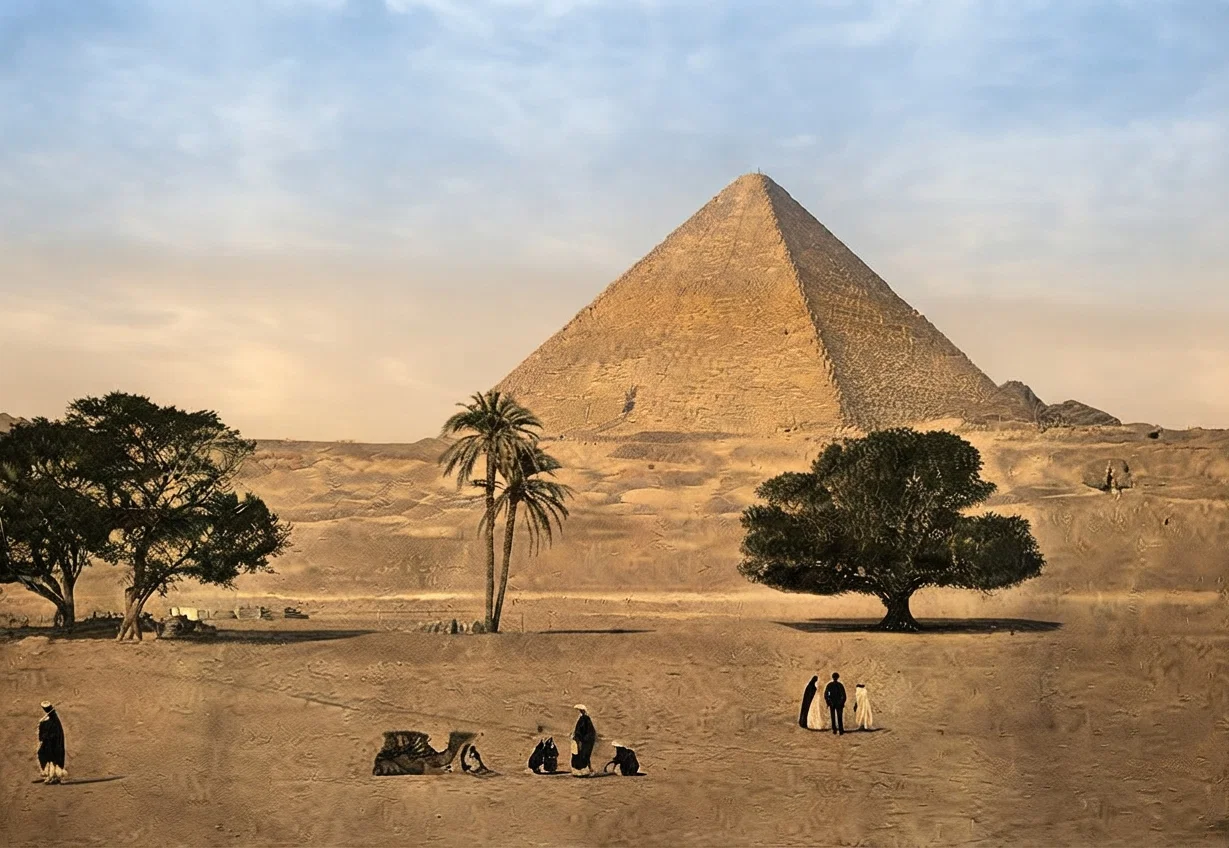
The Great Pyramid of Cheops, Egypt.
LITTLE'S "Cyclopedia of Classified Dates" gives a list of twenty-six dynasties, which ruled Egypt prior to 525 B.C., when it was conquered by Persia. Under the fourth dynasty Cheops distinguished his reign by building the great pyramid. This is called the pyramid dynasty, and Egyptian history "emerges from the mists of obscurity, and discloses a genuine and progressive civilization." The great pyramid covers an area of 13 acres, and is still 474 feet high. It was built by Cheops for his tomb. Herodotus says it required the labor of 100,000 men for 20 years in its construction; 10 years were previously spent in making a road of highly polished stone from the quarry to the selected site, a distance of 3,051 feet.
FROM the seventh to the eleventh dynasties Egypt "seems to have disappeared from the nations." This was a period of over 400 years. Near the close of the thirteenth dynasty the Hyksos, or "Shepherd Kings," invaded Egypt. They were wandering tribes of Semitic descent, which came from the northeast and dominated more or less of the country for several hundred years. "They wrought2such ruin of every kind everywhere, massacring the men, enslaving the women and children, burning the cities, and razing the temples, that they made forever the very idea of a shepherd 'an abomination unto the Egyptians.' Gen. 46 : 34."-Empires of the Bible, pp. 81, 82. They were finally expelled by Aahmes or Amasis I., under the eighteenth dynasty, about 1800 B.C.
THE oppression of the Hebrews occurred in the reign of Rameses II., under the nineteenth dynasty. He reigned from 1564 B.C. to 1497 B.C. He was the builder par excellence among the Pharaohs. "It is almost impossible to find in Egypt a ruin, or an ancient mound, without reading his name." He died six years before the Exodus, which took place 1491 B.C., in the reign of Meneptah II., the thirteenth son of Rameses II.
UNDER the twenty-seventh dynasty Cambyses defeated the Egyptians at the battle of Pelusium, and Egypt became a Persian province in 525 B.C. The Persians dominated Egypt to a greater or less extent till the thirty-second dynasty, when it was subdued by the Grecians under Alexander, in 332 B.C. He founded Alexandria, and was buried there in 322 B.C. The thirty-third dynasty was Ptolemaic, consisting of the reign of the Ptolemies from 323 B.C. to 31 B.C., when, by the battle of Actium on September 2, Egypt became a Roman province. In 284 B.C. Ptolemy Philadelphus founded the Alexandrian Library, and during his reign the Septuagint version of the Scriptures was completed, in 274 B.C. In 47 B.C. Julius Caesar besieged and burned Alexandria, and the great Alexandrian Library, consisting of 400,000 manuscript books, was destroyed by fire.
DURING the Christian era Egypt has suffered much from its varied but generally intolerant and cruel rulers. The Romans, the Saracens, and the Turks have been their principal masters. It is now tributary to Turkey, but under the control of England. It has an area of 10,698 square miles, and a population of about 7,000,000. The Lord said, "It shall be the basest of the kingdoms; neither shall it exalt itself any more above the nations; for I will diminish them, that they shall no more rule over the nations." Eze. 29 : 15. This is a prophecy which was made B.C. 589. How truly it has been fulfilled!
EGYPT was once the home of Abraham (Gen. 12 : 10), of Joseph (Gen. 39 : 1), of Jacob and his other sons (Gen. 46 : 6), of Moses (Ex. 2 : 1-10), of Jesus (Matt. 2 : 13-15). It was enveloped in heathen darkness and idolatry, and hence, like wicked Sodom, the Lord has used the name as a synonym or emblem of spiritual darkness and antagonism to Him. See Rev. 11 : 8. Because of her opposition to God and her great wickedness, and notwithstanding her great glory, her boasted civilization, and her great antiquity, she has become the basest of kingdoms. At one time she stood before the world without a peer in all that goes to make up human glory. In the arts, sciences, and wonderful structures, especially the pyramids, she stood unrivaled. Where now are her glory, her greatness, and her power?—Gone forever.
THE mighty men who once ruled that prosperous kingdom have long since passed away. Their monuments, as seen in the pyramids, the obelisks, and other structures, are more enduring by far than the minds that conceived and the hands that reared them.
What a lesson for the world's great men today! How brief, how fading, how unsatisfying is human glory! Surely "all flesh is as grass, and all the glory of man as the flower of grass. The grass withereth, and the flower thereof falleth away; but the word of the Lord endureth forever." 1 Peter 1 : 24, 25.
THE examples of Joseph and Moses, whose names are so closely associated in our minds with Egypt, are worthy of careful study. Joseph stands forth as a character whose faithfulness, integrity, and virtue could not be shaken, even under fierce temptations. Josephs are needed in this age of dishonesty, pleasure-seeking, and licentiousness. Moses is an example of meekness, devotion, and sacrifice. With all the glory, honor, wealth, and pleasures of Egypt within his reach, he "refused to be called the son of Pharaoh's daughter; choosing rather to suffer affliction with the people of God, than to enjoy the pleasures of sin for a season; esteeming the reproach of Christ greater riches than the treasures in Egypt; for he had respect unto the recompense of the reward." Heb. 11 : 24-26. The Lord gave Egypt a Joseph and a Moses, that she might learn righteousness, and become acquainted with God, but she chose the way of darkness, and her history reveals the sad consequences of her folly. M. H. BROWN.