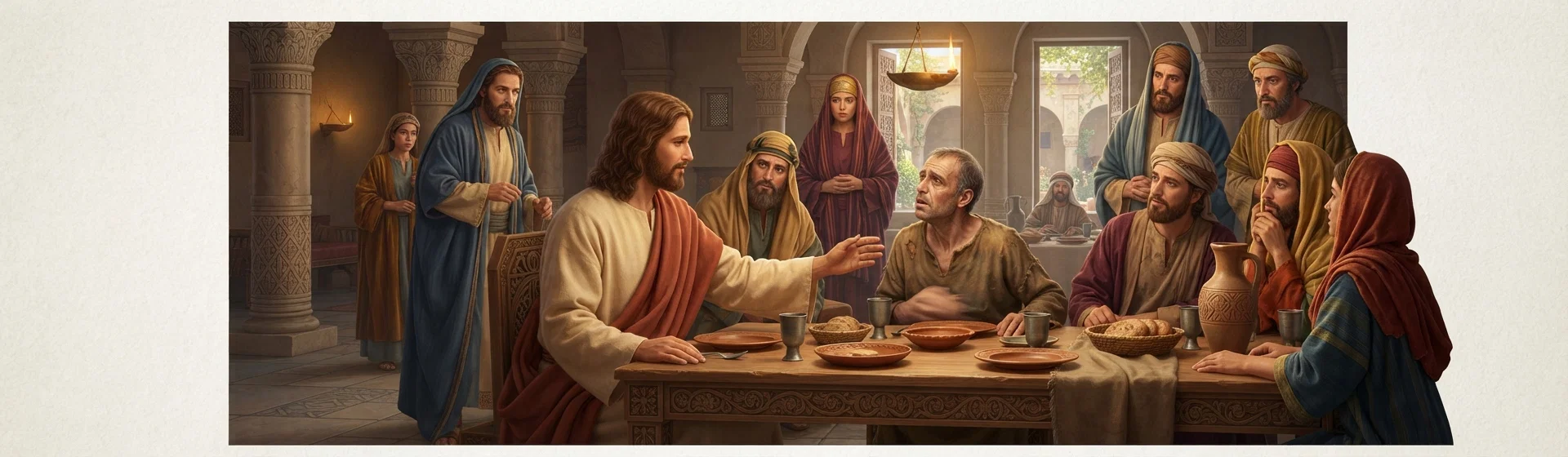
1 "And it came to pass, when He went into the house of one of the rulers of the Pharisees on a Sabbath to eat bread, that 2 they were watching Him. And behold, there was before Him 3 a certain man which had the dropsy. And Jesus answering spake unto the lawyers and Pharisees, saying, Is it lawful to 4 heal on the Sabbath, or not? But they held their peace. And 5 He took him, and healed him, and let him go. And He said unto them, Which of you shall have an ass or an ox fallen into a well, and will not straightway draw him up on a Sabbath 6 day? And they could not answer again unto these things.
7 "And He spake a parable unto those which were bidden, when He marked how they chose out the chief seats; saying 8 unto them, When thou art bidden of any man to a marriage feast, sit not down in the chief seat; lest haply a more honor9 able man than thou be bidden of him, and he that bade thee 10 and him shall come and say to thee, Give this man place; and then thou shalt begin with shame to take the lowest place. 11 But when thou art bidden, go and sit down in the lowest place; that when he that hath bidden thee cometh, he may say to thee, Friend, go up higher; then shalt thou have glory in the presence of all that sit at meat with thee. For every one that exalteth himself shall be humbled; and he that humbleth himself shall be exalted.
12 "And He said to him also that had bidden him, When thou makest a dinner or a supper, call not thy friends, nor thy 13 brethren, nor thy kinsmen, nor rich neighbors; lest haply they also bid thee again, and a recompense be made thee. 14 But when thou makest a feast, bid the poor, the maimed, the lame, the blind; and thou shalt be blessed; because they have not wherewith to recompense thee; for thou shalt be recompensed in the resurrection of the just."
NOTE.—At the time of this lesson Jesus was at Bethabara, beyond Jordan, near the fords, and this was in A.D. 30. In connection with this lesson, let both teacher and student learn the fourth commandment, not merely the words, "Remember the Sabbath day, to keep it holy," but the whole commandment. See Ex. 20:8-11. Study also Gen. 2:2, 3, and notice what entered into the Sabbath, what it took to make a Sabbath, and the particular day, and the one day only which has ever received what is enumerated therein. See also Isa. 58:13, 14; 56:2, 6, 7. It will be noted by reference to Acts 13:27, 42, 44 that the same Sabbath which the Jews had recognized, the same Sabbath referred to in the fourth commandment and in the references in Isaiah, was recognized as "the Sabbath day" long after the crucifixion of Christ.
Golden Text: "Whosoever exalteth himself shall be abased; and he that humbleth himself shall be exalted;" Luke 14:11.
SUGGESTIVE QUESTIONS.
(1) Into whose house did Jesus on this occasion enter? For what purpose? Upon what day was this? What were some of them doing? V. 1. Note 1. (2) Who is particularly mentioned as being present? V. 2. (3) What did Jesus say to the lawyers and Pharisees present? What in this verse shows that they had been questioning among themselves as to what Jesus would do with the diseased man? V. 3. (4) What reply did they make? What did Jesus do? V. 4. Note 2. (5) With what illustration did Jesus show them the reasonableness of healing disease on the Sabbath day? V. 5. (6) How did Jesus' illustration leave the Pharisees and lawyers? V. 6. (7) What action of those who were bidden led Jesus to speak a parable at this time? V. 7. (8) What instruction did He give them? Who might be present that would make it uncomfortable for those who chose the highest seats? V. 8. (9) In that case, what would the self-exalted man be asked to do? How would one naturally feel at such a time? V. 9. (10) What would be a better thing for them to do when invited to such a gathering? What would quite likely result when one had done this? How would the one be regarded who was thus given distinction? V. 10. Note 3. (11) What truth does Jesus draw from this parable? V. 11. (12) To whom does Jesus next address His teaching? What instruction did He give to this Pharisee? Where would one receive his reward if only his friends were benefited by his action? V. 12. (13) Among whom should one's liberality be dispensed? V. 13. Note 4. (14) What would be the result to one who did this? Why does Heaven recognize such deeds? When will the one who does such good acts receive his recompense? V. 14. Note 5.
NOTES.
1. They were watching Him.—As upon many other occasions the scribes, lawyers, and Pharisees were watching for an opportunity to accuse Jesus. The diseased man may have been brought there for the purpose of testing Jesus whether he would heal him on the Sabbath day. Jesus disarmed their accusation before healing the man, that they might see the righteousness of His course. Having read their thoughts, He asked them a question upon whose answer they expected to catch Him. They dared not permit themselves to reply. He replied to His own question by healing the man.
2. Took him, and healed him.—"Jesus neither here nor elsewhere abolishes or lessens the force of the fourth commandment. It is still in force as a day of rest and of worship. It is absurd to think that God would abolish from His Word what He has written on the nature of man and still keeps in force there. The Pharisees had covered up the Sabbath law by writing over it their human traditions. Jesus erased their writings and restored the original commandment. Jesus swept away the cobwebs; He did not tear down the house. He only removed the rubbish with which the Pharisees had encumbered the Sabbath. Jesus restored the Sabbath law by restoring its spirit."—Peloubet. It was prophesied of Jesus that when He should come, He would magnify the law and make it honorable. Isa. 42:21. He was doing it by just such teachings as recorded in to-day's lesson. Matt. 5:17-19. It is also absurd to hold that God would abolish the Sabbath which He created in Eden, blessed and sanctified, and then institute another sabbath, and all without giving a word of instruction in reference to the matter. He has told us which day His Sabbath is, and He has never taken it back.
3. Sit down in the lowest place.—Not out of feigned humility; not for the purpose of being exalted above men. Such a spirit is as unchristian as that of him who rushes into the highest place. If God exalts men, it is because they have been humble in spirit. The exaltation comes as a natural consequence of genuine humility. There is also true courtesy taught in this lesson of the Saviour's. The Christian and the true gentleman will prefer another before himself. Those who seek to exalt themselves have little of heaven's spirit. They would be out of place there.
4. Bid the poor.—Jesus had set the grandest example of the carrying out of this instruction. He had come to bid the poor of earth, the blind, the lame, the oppressed, to the banquet of heaven, and they have nothing with which to recompense Him. He, like those who follow His instruction in this thing, will receive a reward at the resurrection of the just, when His people, those for whom He died, are gathered around Him.
5. At the resurrection of the just.—This is the first resurrection, spoken of in Rev. 20:4-6. There are to be two resurrections, one of the just, and one of the unjust. Acts 24:15. Those to whom heaven will be opened will be those who arise in the first resurrection. 1 Thess. 4:16.
Jesus and the Resurrection
Important thoughts upon immortality and the resurrection are clearly presented in this tract, showing our dependence on the Saviour for both. A. G. L. No. 42. 50 cents per 100.
PACIFIC PRESS PUBLISHING CO.
New York City Oakland, Cal. Kansas City, Mo.
THE GREAT DAY OF THE LORD. By M. C. Wilcox. This tract of 40 pages sets forth in brief some of the more important events of the Great Day of God Almighty. It discusses the character of that day, shows when it begins, the coming of the Lord, the events in connection with that coming, the Millennium, the Saints in Judgment, when the Day of the Lord Ends, and the Eternal Home of the Redeemed. Bible Students' Library No. 65. Price, 5 cents.