ROMAN CATHOLICISM poses as the only Christian religion, and many Protestants recognize the Roman Church as a branch of the Christian church. It is clear, however, that, if Protestantism is Christianity, then Romanism is not. To recognize Romanism as Christianity is to admit that idolatry is Christianity. In the United States and in the British possessions, Romanism wears a modified cloak, because of her doctrine that "the end justifies the means." The enlightenment that is reflected upon Catholics in these countries, through the influence of generations of Bible circulation, compels a certain yielding to surrounding circumstances; but, underneath the surface, "Rome never changes." The fundamental errors are the same, whatever the appearances may be. Roman Catholicism is seen in its true light in those countries where Rome has had full religious sway for centuries. That there is crying need for missionary work among Catholics may be seen by noting the work of that system in countries where it finds but little counteracting influence. We append a few
Testimonies from Missionaries in Central America.
All consistent Roman Catholics serve and worship the creature more than the Creator. To them Mary is the sinner's hope, the door of refuge. Their confidence is in rites and ceremonies, images, saints, and men, and not in the only Saviour. If salvation is of faith, then it is not of works; if of works, then not of faith. "Being justified by faith, we have peace with God." "For by grace are ye saved through faith; and that not of yourselves; it is the gift of God; not of works, lest any man should boast." Among all the converts from Rome which I have met, I never have encountered a single one who had any conception of the finished work of Christ while he remained true to the teachings of Rome.—A. E. Bishop.
The devout Roman Catholics in Central America are idolaters, and we are told that no idolater shall inherit the kingdom of heaven. 1 Cor. 6:9, 10; Rev. 21:8. It is a well-known fact that in every community in this country the most religious or devout persons are those who have the greatest number of images in their houses, who most frequently bow down to these images, and who give the most toward the idolatrous processions which are so frequent. Salvation is secured only by faith in Jesus' atoning blood. Paul had lived in "all good conscience," but when the light of heaven shone into his heart, he saw himself as the "chief of sinners." Cornelius was a "devout" man, yet it was necessary for Peter to go to him, and tell him words whereby he should be saved. Acts 10:1, 2; 11:14. The Roman Catholic Church positively denies the sufficiency of the sacrifice of Jesus Christ for salvation, and constantly and persistently puts good works and human merits in place of faith and the merits of Jesus Christ as the means of salvation. I do not remember having ever met a Romanist who, as such, had any conception, whatever, of Christ's perfect work for the sinner.—J. G. Cassel.
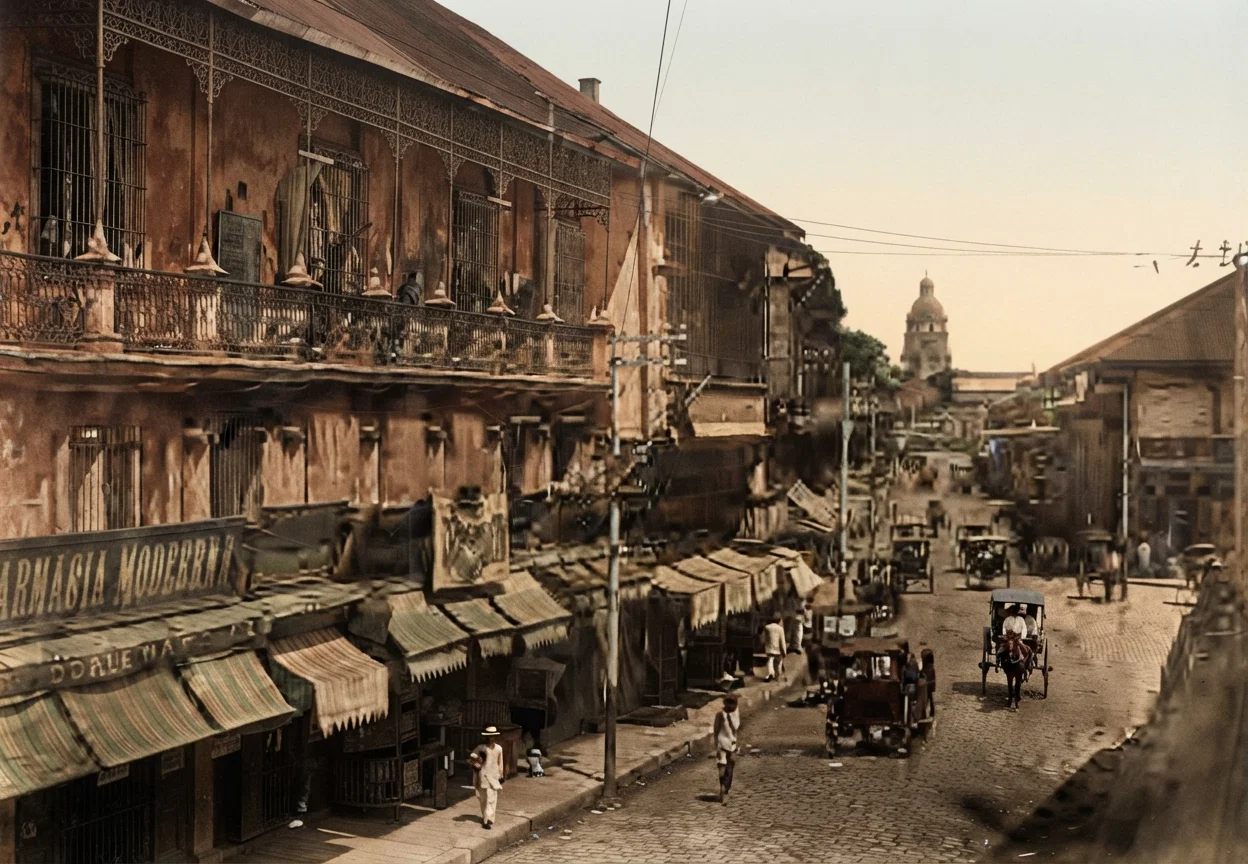
A Street Scene in Manila.
After having worked for six years among Romanists, I have never found one who even pretended to be saved, and as for trusting in the merits of the Son of God, it is always through the hands of Mary. Rome teaches that the priest brings Christ down from above by the mystery of the words, "This is My body." Rom. 10:6.—A. B. DeRoos.
Romanists are not taught the perfection of Christ's work; they are taught that they must supplement the work of Christ by their own meritorious works. The priests come between them and God, and God has said: "There is . . . one Mediator between God and men, the Man Christ Jesus."—R. H. Bender.
Roman Catholics put the creature before the Creator, giving to the Virgin the place of intercessor, which belongs to Christ. Rom. 1:25; 1 Tim. 2:5; Acts 4:12. They rob the sacrifice of Christ of its atoning merits and power to save, and save completely, all who believe. Heb. 9:15, 27, 28; 7:25. A lawyer expressed his belief in the following terms, and it is the faith of every true Roman Catholic: "The sacrifice of Christ atones for our original sin, but the actual sins of our lives need to be purged by good works, obedience to the church, and at last by the fires of purgatory, which are more or less severe and lengthy, according to the circumstances and actions of the person in this life, from which he is ultimately liberated by the intercession of Mary." They deny the possibility of any one asking for, and receiving, the assurance of pardon and eternal salvation in this life, which fact they declare can only be known when one stands in God's presence, when pardon will be given on merit, thus denying John 3:36; Eph. 5:9; Rom. 10:13.—Eva Ridge.
A Street Scene in Porto Rico.
Here in Nicaragua the great mass of people have no clear idea, whatever, of salvation. Those who understand a little more, invariably tell you that by good works, penances, and purgatory they pay the debt of sin, and thus buy salvation, coming in as auxiliaries, images, Mary, masses, baptism, etc. They thus place salvation on their own efforts as the foundation instead of the finished work of Christ. Salvation impossible; the foundation is false. I have never found a Romanist in Central America who had any conception of the perfection of Christ's work for the sinner.—Eta Aviles.
I asked the girl who lives with me, a native convert from Romanism, whether one can be saved in the Church of Rome, and she replied: "It is impossible, because God says that all idolaters shall have their part in the lake of fire; and in 2 Cor. 6:16, 17, that the Spirit of God can not have communion with idols, and God promises His Spirit to those who separate themselves from such things. And to live in the Church of Rome, it does not matter what other qualities one may possess, he is an idolater, and is occupied in everything under the sun but obedience to God's Word."—Callie Ham.
The doctrine held by Roman Catholics of transubstantiation is entirely antichristian, and substitutes the sacrificial work of the priest in the place of Christ's sacrificial work on the cross as the ground of pardon. Every Roman Catholic must believe that baptism is God's way of canceling sin, and that only those baptized will be saved. This destroys entirely the efficacy of Christ's work, and substitutes for it a mere ceremony. Confession to the priest, and believing that he has power to forgive sins, perverts the whole plan of salvation. This every Roman Catholic believes in. During my ten years in Costa Rica, I have not met one Roman Catholic who could give a clear and simple testimony of the plan of salvation,13as given in the Scriptures. I have met many thousands who believe that the saints, and especially Mary, can and will save them. One text describes Romanism as I know it: "They have taken away my Lord, and I know not where they have laid Him." Take away Christ, and what have we left but dry formalities and ceremonies which never did, and never can, take away sin? Christ says: "I am the way, the truth, and the life; no man cometh unto the Father, but by Me." This means, put Mary, good works, or some creature, in the place of Christ, and you can not come unto the Father.—James Hayler, Missionary of the Jamaica Baptist Missionary Society, Cartago, Costa Rica.
Romanism has not the slightest idea of the efficiency of Christ's redemptive work. As well ask heat of the moon as ask this of Rome. Neither priest nor people know or experience it. We have a proof of this in the sickness and death of Pope Leo XIII., invoking the Virgin, asking for the blessings of the priests, seeing shadows and phantoms, and having to be tranquilized by worldly men.—F. G. Penzotti, a converted Romanist, for many years a missionary and agent of the American Bible Society in South and Central America.
We were greatly impressed [in Italy], as never before, with the need of Protestant missions in Roman Catholic countries. Whatever truth the Romish Church conserves is buried under a mass of rubbish, both ecclesiastical and doctrinal. We saw, even in Dublin, on a Roman Catholic church, the blasphemous inscription, "Maria Peccatorum Refugio" (Mary is the refuge of sinners); and on many a church in Italy, the notice that in her name full indulgence for sin might there be procured.—Dr. A. T. Pierson.