THE first expression of faith in the saving power of God is the offering of a lamb without blemish and without spot. Gen. 4:4. That lamb was the type of the Lamb of God, slain in purpose before the foundation of the world, and meeting the climax of Love's sacrifice for guilty man on the cross of Calvary. 1 Peter 1:19; Phil. 2:5-8. When the sinner placed his hand on the head of the innocent victim, he confessed that he was a sinner, worthy of death, and that he took God's sacrifice for his substitute, of which the Lamb was a type.
In the patriarchal age we see this repeated over and over in object-lesson. In the Levitical dispensation the Infinite sacrifice and provision for human needs were greatly elaborated into numerous object-lessons that the people of Israel, and all the world through them, might be taught the exceeding sinfulness of sin, God's mighty power and infinite fulness to save, the conditions on which their full atonement was granted, and the grand culmination beyond the judgment of absolute oneness with God to all eternity.
These things are still left on record for "our learning," especially in the last four books of the Pentateuch, but now especially in Exodus, Leviticus, and Daniel in the Old Testament, and in Hebrews and the Revelation in the New Testament. Those who live in the last days are especially told to "remember ye the law of Moses My servant, which I commanded unto him in Horeb for all Israel, even statutes and judgments," that the things "written aforetime were written for our learning, that through patience and through comfort of the Scriptures we might have hope;" and that what happened unto Israel was left to us "by way of example; and they were written for our admonition, upon whom the ends of the ages are come." Mal. 4:4; Rom. 15:4; 1 Cor. 10:11.
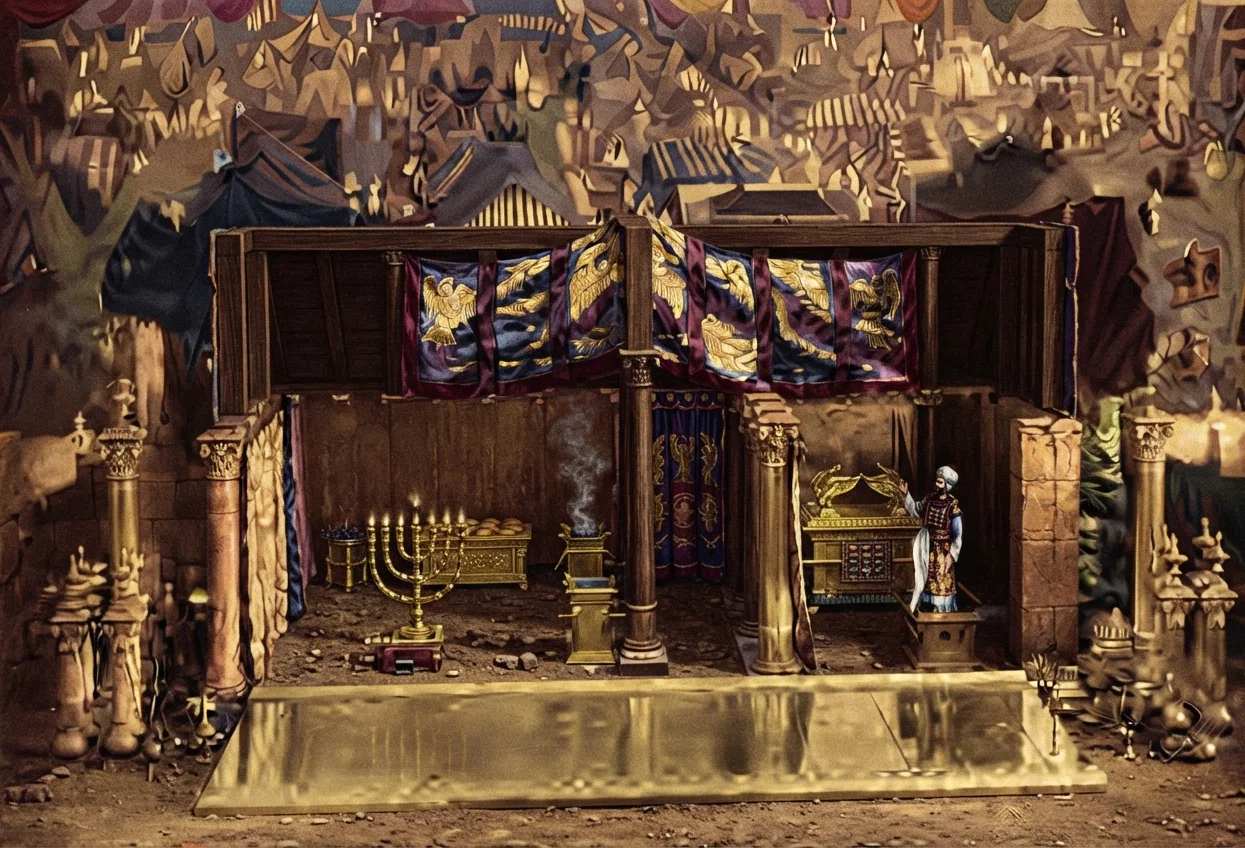
The Sanctuary, Open at Side.
Therefore it is important that we heed the Word of God; but this study can give only the barest outline of this vitally-important subject, and must refer the reader to books and pamphlets listed elsewhere in this issue.
Let us look at the work of Christ our Saviour from the view-point of the greatest object-lesson of the Bible, the center of all other object-lessons, the harmonizer of all seeming inconsistencies,—the ancient tabernacle, or sanctuary, in the wilderness, continued in the temple, and typical of the greater and "more perfect tabernacle, which the Lord pitched and not man."
When Israel stood at the base of Mount Sinai, from which the great Jehovah had thundered His unchangeable law in ten immutable precepts, He said to Moses for the people, "Let them make Me a sanctuary; that I may dwell among them." Ex. 25:8.
That sanctuary was built costly and beautiful in structure and material. It was perfectly proportioned, in feet, 45 x 15 x 15, consisting of two rooms separated by a heavy veil—the holy place 30 x 15, and the most holy place 15 x 15—built of boards overlaid with gold without and within, and covered with a curtain gloriously embroidered in cherubim.
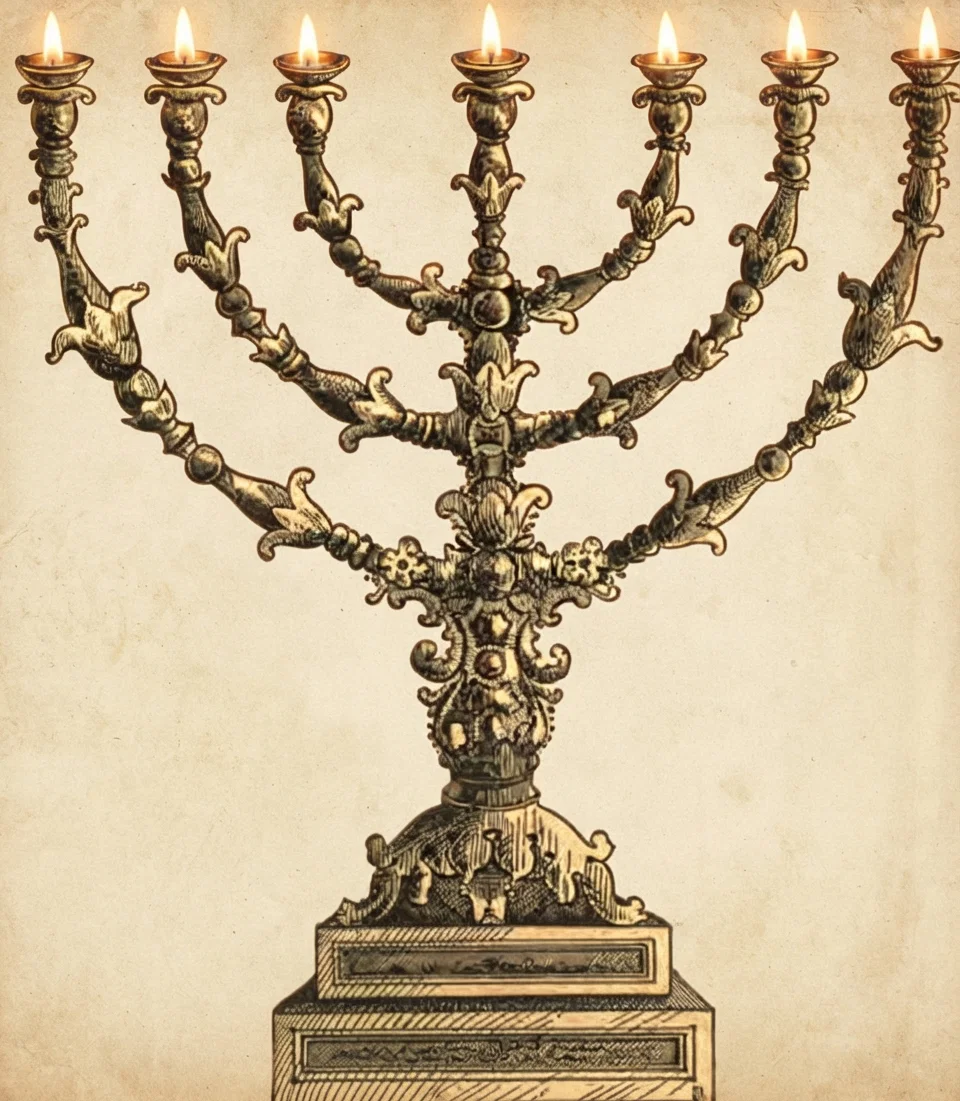
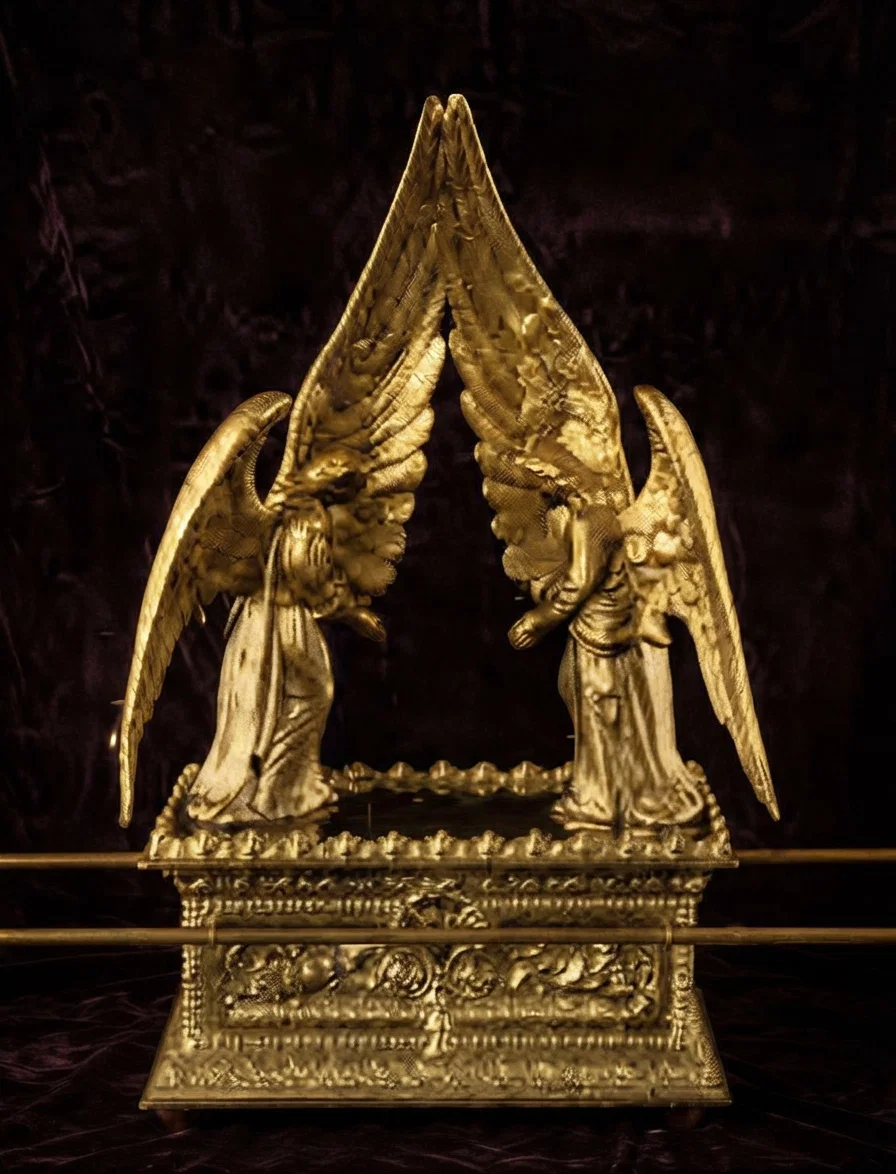
The outer apartment contained the seven-branched golden candlestick, representing the light of God's Spirit through His Word and church; the table of presence bread, eaten every Sabbath, representing the feeding upon the Bread of Life by His people, and so partaking of His life; and the altar of incense, where God's infinite grace mingles with the effectual prayers of His people. The most holy place contained the ark of the covenant, testimony, or testament, over which was the mercy-seat, and within which was the holy law of Ten Commandments, the doing of which embraced all duty, and the transgression of which included all sin. Eccl. 12:13, 14; 1 John 3:4; Rom. 7:7. Above the mercy-seat, between the cherubim, above the Holy Shekinah, the visible manifestation of the presence of God. Before the ark on the east was the altar of burnt-offering.
The Way of the Repentant Sinner.
When the sinner would be reconciled to God, he brought a firstling of the flock without blemish as in figure, laid his hand upon its head, confessing his sinfulness and worthiness to die instead of the beast; the offering was slain, and the priest took the blood—the life forfeited by sin—into the holy sanctuary, and sprinkled of it seven times before the veil, and placed of it upon the altar of incense. Thus the sin was transferred in figure by the priest to the sanctuary, and the sinner was forgiven. And this went on in various ways and forms for 364 days every year, the essential thing of which was the shedding of blood and the removal of sin by means of the blood, from the sinner to the sanctuary of God's presence. For without the shedding of blood, there is no remission of sin. Heb. 9:22. And we are washed from our sins by His blood (Rev. 1:5), or cleansed by His life.
In the end of the year, came the great day of atonement, described in Leviticus 16 and 23, the judgment day of the year. Two goats were brought, one goat for Jehovah, one for Azazel, "the strong one who revolted." The Lord's goat was slain, its blood brought into the most holy place and sprinkled upon the mercy-seat, underneath which was the law transgressed. All the transgressions of every repentant soul of the year are gathered up in the person of the priest, brought out by him to the door of the sanctuary, and confessed upon the head of the goat for Azazel—Satan—and the goat is sent away into a land of forgetfulness and destroyed. The penitent souls are free and clear from sin, at one with God.
The Antitype.
All these earthly rites and ceremonies were typical of the greater realities, the effectual things above and to come.
"Now of the things which we have spoken this is the sum: We have such an high priest, who is set on the right hand of the throne of the Majesty in the heavens; a minister of the sanctuary, and of the true tabernacle, which the Lord pitched, and not man." Heb. 8:1, 2.
The Ark of the Testament.
"Then verily the first covenant had also ordinances of divine service, and a worldly sanctuary. For there was a tabernacle made; the first, wherein was the candlestick, and the table, and the shewbread; which is called the sanctuary. And after the second veil, the tabernacle which is called the Holiest of all; which had the golden censer, and the ark of the covenant overlaid round about with gold, wherein was the golden pot that had manna, and Aaron's rod that budded, and the tables of the covenant; and over it the cherubims of glory shadowing the mercy-seat; of which we can not now speak particularly. Now when these things were thus ordained, the priests went always into the first tabernacle, accomplishing the service of God. But into the second went the high priest alone once every year, not without blood, which he offered for himself, and for the errors of the people; the Holy Ghost this signifying, that the way into the holiest of all was not yet made manifest, while as the first tabernacle was yet standing; which was a figure for the time then present, in which were offered both gifts and sacrifices, that could not make him that did the service perfect, as pertaining to the conscience; which stood only in meats and drinks, and divers washings, and carnal ordinances, imposed on them until the time of reformation. But Christ being come an High Priest of good things to come, by a greater and more perfect tabernacle, not made with hands, that is to say, not of this building; neither by the blood of goats and calves, but by His own blood He entered in once into the holy place, having obtained eternal redemption for us." Heb. 9:1-12.
The sanctuary of earth represented God's great sanctuary on high, the holy places were figures of the true. Heb. 9:23, 24; Rev. 4:4, 5; 8:3; 11:19.
The young bullock, the kid, the lamb without blemish, typified "the Lamb of God, that beareth the sin of the world." John 1:29, margin. The offering of that lamb symbolized the death of Christ Jesus upon the cross, once for all. Heb. 10:12, 14; 9:14, 26. The ministration of that blood by the priests each year, in holy and most holy places, was the type of the complete ministration of Jesus Christ by His own blood, for sin, once for all, in the holy places of the sanctuary on high. Heb. 8:4, 5; 9:12, 23, 24.
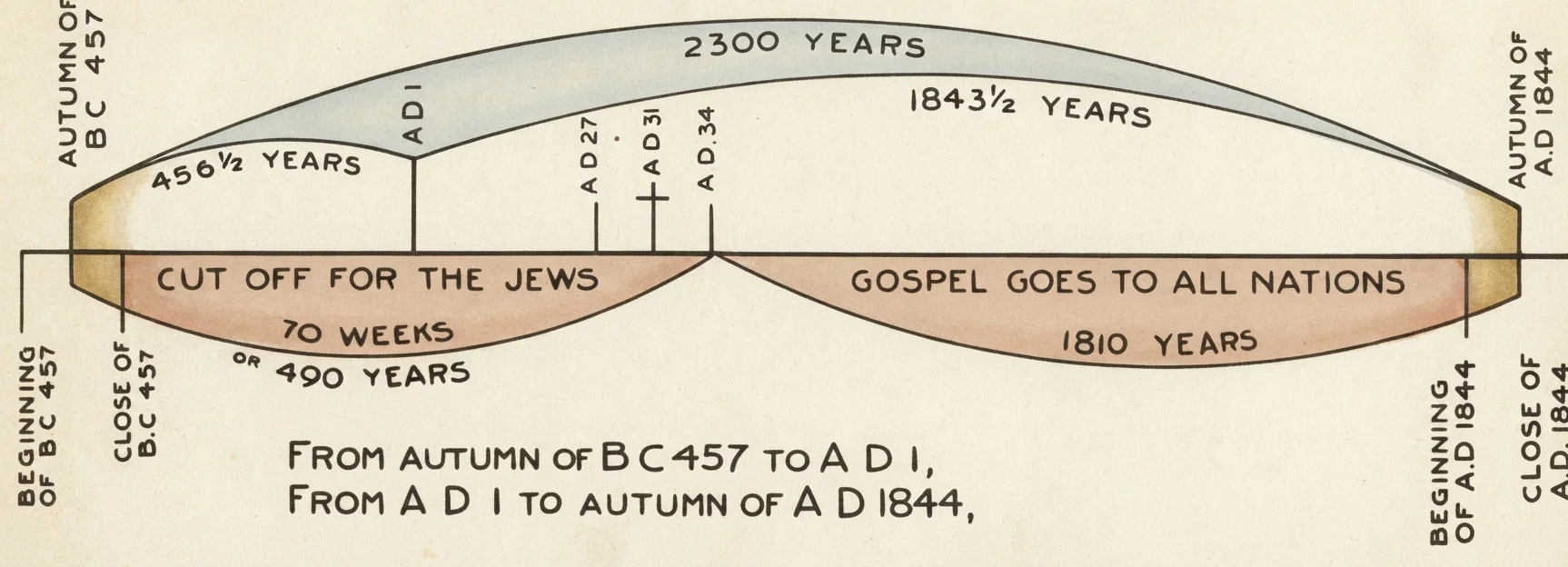
FROM AUTUMN OF B.C 457 TO A. D. 1, 456½ YEARS FROM A D 1 TO AUTUMN OF A D 1844, 1843½ YEARS TOTAL 2300 YEARS
In that holy place on high, our Lord has ministered since He took His seat on the right hand of the Majesty in the heavens, immediately after His sacrifice. Heb. 10:12-14.
But to every work of probation and trial, comes an end, a judgment, that it may be ascertained who have availed themselves of the opportunities offered, who have complied with the conditions, who have been successful candidates. Even so in God's work. Long ago He appointed a day in which He would judge the world in righteousness by Jesus Christ. Acts 17:31. Long ago His plan was devised, His purpose formed, the elect number of elect characters written in the books of heaven; and sometime, for the benefit of all the actors in the great drama6of eternal life, will be revealed in the judgment those who have yielded to God's infinite love, and through Christ are worthy to be called sons of God and heirs with Christ forever.
In that closing work the remembrance of all sin recorded against the children of God in the heavenly sanctuary shall be blotted out, because blotted out of their lives, and thrown back in right degree upon the head of him who instigated them, the senior partner in the firm of Sin, Satan. He is the antitypical scape-goat. Rev. 20:1-4.
The earthly sanctuary was justified from its remembrance of sin, represented by the sprinkled blood; the holy places of the heavenly temple must be cleansed, justified, also, by the Better Sacrifice. Heb. 9:23. Then the temple of God will be further opened in heaven, the most holy inner temple be revealed, and the ark of God's testament be seen, bringing again to view in the latter days His holy law, the rule of His judgment, and demanding the proclamation of that phase of His everlasting Gospel, "The hour of His judgment IS come." Rev. 14:6, 7.
The time of the beginning of the antitypical day of atonement (Lev. 23:26-30; Heb. 8:5), the cleansing of the heavenly sanctuary (Heb. 9:23), the finishing of the mystery, or Gospel, of God (Eph. 6:19; Rev. 10:7), the accounting worthy of the faithful (Luke 20:35), the blotting out of sins (Acts 3:19), the blotting out of the names of the unworthy (Rev. 3:5), the investigative judgment (Dan. 7:9, 10), is revealed in Dan. 8:14: "Unto two thousand and three hundred days; then shall the sanctuary be cleansed [literally, "justified"]." These days represent in symbolic prophecy so many literal years. Eze. 4:4-6. When they began, when parts of them end, is told in Dan. 9:24-26, a part of the prophecy of the eighth chapter. Seventy weeks of the 2,300 years—490 years—are marked off or decreed upon the Jewish people, during which time the everlasting righteousness of Christ is to come in, the vision sealed or made sure, the transgression of the Jewish nation to be filled up.
This period of 2,300 years began with the going forth of the commandment to restore and to build Jerusalem. This occurred in its fulness in B.C. 457, in the seventh year of King Artaxerxes Longimanus, as recorded in Ezra 7:7-26. Seven weeks of the time—49 years—reached to 408, the last work of Reformation under Nehemiah, according to Prideaux. Sixty-two weeks more—434 years—reached to "Messiah [the Anointed] the Prince," our Lord Jesus Christ, baptized and anointed of the Holy Spirit in A.D. 27. Luke 3:21, 22; 4:18-21; Acts 10:37, 38. In the midst of the seventieth week, after the sixty-nine weeks, the sacrifices were to cease by the cutting off of the Messiah. And this occurred at the Crucifixion, A.D. 31. Three and one-half years later the Jews rejected Jesus by stoning Stephen, and the Gospel was given to the world.
Four hundred and ninety years from 2,300 years leave 1,810 years. This period added to A.D. 34 brings us to 1844. Then began the closing work of Jesus Christ as high priest in the sanctuary on high. Then began that last-day proclamation of the Gospel, "The hour of His judgment is come" (Rev. 14:6, 7), resulting in the development of a company who keep "the commandments of God, and the faith of Jesus." Rev. 14:12. Man, therefore, is now in the solemn work of God's harvest-time, the judgment of His people, beginning at the house of God (1 Peter 4:17), the time when names will be blotted out of the book of life unless sin is blotted out of character. It is a fearfully-solemn time, however the scoffing world and the pleasure-loving religionist may regard it. As truly as God's sun rises and sets, there is coming God's great judgment day. Nay, it is already here. Each one of us will meet it, must meet it. God would have us by confession in Jesus Christ send our sins beforehand to judgment, and be acquitted in that day. Only so can we have boldness in the judgment. "Prepare to meet thy God."