A Great Dream of World-Wide Empire — It Seemed on the Verge of Fulfilment — Crushing Defeats Shatter the Dream
The Prophecy Stands a Mighty Gibraltar Monument
By JEAN VUILLEUMIER
THIS is the third and concluding study of Mr. Vuilleumier on the prophecy of the second chapter of the book of Daniel. In the previous articles, he has presented what the prophet foresaw. He has shown that the four great world empires of Babylon, Medo-Persia, Greece, and Rome were seen in the prophet's vision. The prophet furthermore saw that when Rome should arise, she would be the last of the world-wide kingdoms. She was to be broken into numerous smaller kingdoms, and these were to continue until Christ should come in person to overthrow all and establish His everlasting reign. Many mighty men have conspired and worked to unite Europe into one world-embracing empire. This article devotes itself to one of these colossal attempts — the one made by Napoleon Bonaparte. Without question, Satan has exerted all his rebellious powers to overthrow God's prophetic utterance; but for fourteen centuries and more, the divided state of Europe has stood as a mighty monument to God's foreknowledge.
Next week Mr. Vuilleumier will have the first of the two articles on the prophecy of the seventh chapter of Daniel.
THE most conspicuous and memorable example of the world empire dream is found in the history of Napoleon. He came as near reaching the goal of this ambition as could well be desired.
THE GIGANTIC PROJECTS OF NAPOLEON
"In the gigantic projects of Napoleon, Moscow was to be only one station. He planned to take up again, in colossal proportions, his expedition to India frustrated after Aboukir. A secret agent sent to all the countries between the Red Sea and the Indus, was seeking to unite all the Arab chiefs for a common undertaking against English India; Persia had been sounded and won; once beaten, the czar would furnish auxiliaries, and a Russian and French army would have left Tiflis, carrying along the nomads of those regions, rushing them as far as the shores of the Ganges!" — Duruy, "History of France," volume 2, page 62.
THE FINEST ARMY
Europe seemed to be at his feet. Five of his own brothers and sisters were sitting on thrones created or usurped by him. The reestablishment of the Roman Empire seemed an accomplished fact, when the whole structure came to naught under the second coalition.
In vain had Napoleon set on foot the finest and most disciplined army he had ever led. A divine fiat followed him, and turned every motion of his into a failure. Disaster followed upon disaster,— first the conflagration of Moscow, then the frightful retreat from Russia, and the crossing of the Beresina,— the most heartrending scenes in the history of war. Then comes the battle of Leipsic, which winds up in an irreparable defeat; France is invaded by the allies; Paris is blockaded, and a provisional government demands the abdication of Napoleon, who retires to the island of Elba as a private citizen.
ALL EUROPE RISES AGAINST HIM
But he is not satisfied with this experiment. He decides to try again the favor of his "star." He enters France, and a delirious army soon surrounds him. In order to crush the "French Attila," as his enemies call him, forces two and three times more numerous than his own army — 300,000 or 400,000 against less than 100,000 — hasten from all corners of Europe. A single battle must now decide the fate of the world, and settle once for all this question of sewing together the fragments of the old Roman Empire.
Napoleon is confident that once more he can defeat his enemies, in spite of numbers. According to his habit, he surprises them by the swiftness of his motions, and reaches Waterloo, in Belgium, before they expect him. The whole campaign lasted four days; but the battle, properly speaking, raged for ten hours.
CHARGED THE IRON DUKE ELEVEN TIMES
It was a giants' fray. Napoleon exhausted all the resources of his military genius. Twice the French came within reach of victory. Michel Ney, thinking he saw the allies beating a retreat, threw his whole cavalry against the English squares. Eleven times the charge was given, and eleven times they were repulsed. Wellington, in command of the English, unmindful of his terrible losses, remained motionless at his post, deserving the title of the "iron duke."
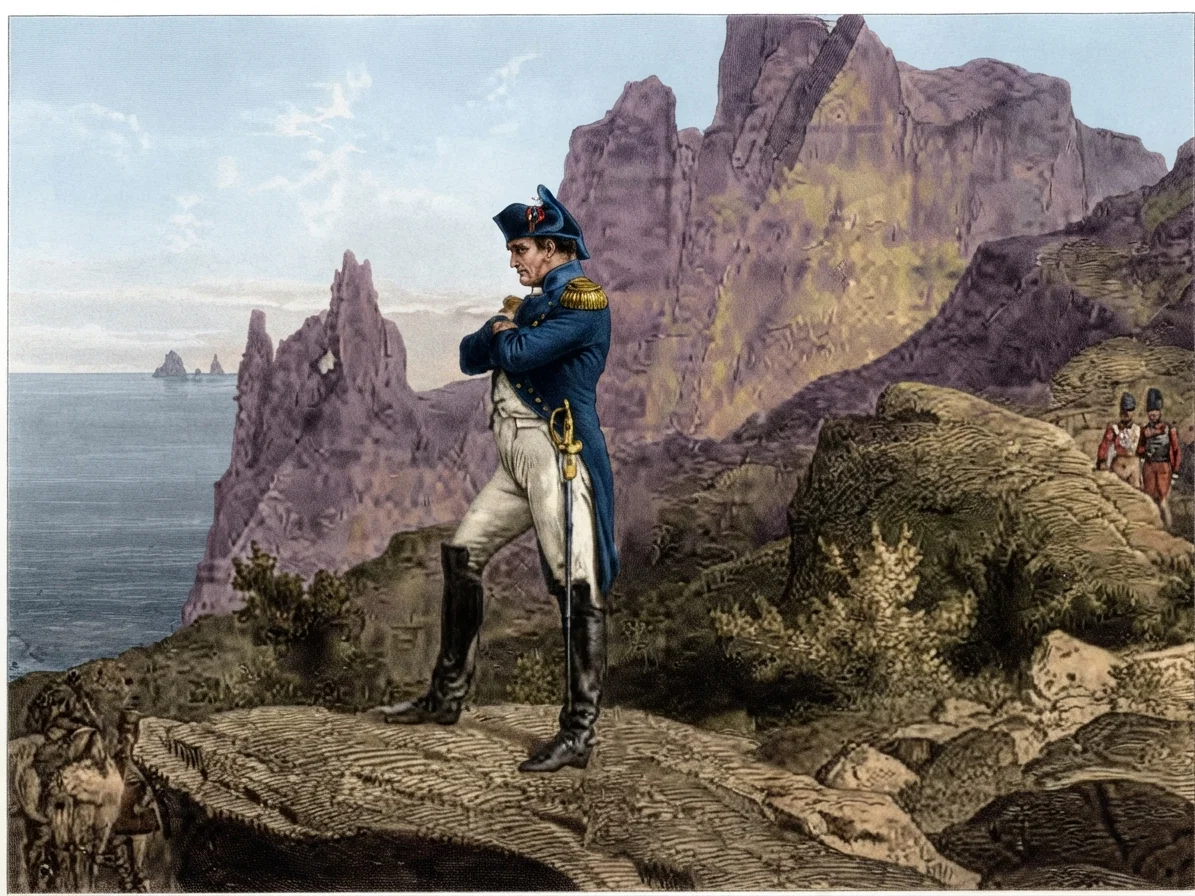
From Ridpath's "History of the World" NAPOLEON, WITH HIS DREAMS OF WORLD EMPIRE, BANISHED TO THE ISLAND OF ST. HELENA
But all was in vain. Unforeseen difficulties and reverses foiled the strategy of the emperor and the heroism of his soldiers. At eight o'clock at night, he exhausted his last resource by launching his reserve. The French army, reduced to one half, surrounded and crushed on two sides, whirled upon itself into a confused and horrible melee. Again France was invaded, its territory reduced, and it had to pay an enormous war indemnity.
AN UNRIVALED GENERAL, BUT SENT TO ST. HELENA
Rejected by his own countrymen, Napoleon — who had entered victoriously twice into Vienna, into Rome, Berlin, Madrid, and Moscow — saw himself forced, "like Themistocles, to ask England, as the mightiest, the most constant, and the most generous of his enemies, to give him a place at her fireside." But this request was not granted. He was treated as a prisoner of war, and carried in mid-ocean to the island of St. Helena.
After five years of captivity, he died at the age of fifty-two. One of the greatest generals the world ever produced, if not the greatest, a worthy successor of Cyrus, Alexander, and Caesar, he had seen his gigantic dreams vanish into smoke, and had madly dashed his head against a rock of adamant. The prophetic word written twenty-five centuries before had said, "They shall not cleave one to another."
Since Napoleon's failure, nothing has materially changed the aspect of Europe. The kings are there yet, waiting, as they have been for fourteen hundred years, for the next great change in the program of nations, for the last act in the human drama marked by prophecy:
"And in the days of those kings shall the God of heaven set up a kingdom which shall never be destroyed, nor shall the sovereignty thereof be left to another people; but it shall break in pieces and consume all these kingdoms, and it shall stand forever. Forasmuch as thou sawest that a stone was cut out of the mountain without hands, and that it brake in pieces the iron, the brass, the clay, the silver, and the gold; the great God hath made known to the king what shall come to pass hereafter: and the dream is certain, and the interpretation thereof sure."
TWO THOUSAND YEARS OF FULFILMENTS
Over two thousand years of striking fulfilments ought to be a sufficient warrant of the truthfulness of this final prediction, which contains a definite answer — and O, how consoling! — to the question of Nebuchadnezzar of so long ago, and which the present generation is repeating with breathless anxiety:375"What shall come to pass hereafter?" "What is this world coming to?"
THE STONE CUT OUT WITHOUT HANDS
The stone "cut out without hands," which strikes the image and dashes it to pieces, is Jesus Christ, the Saviour of the world, and the King of kings. David says of Him that He shall break the nations "with a rod of iron," and "dash them in pieces like a potter's vessel." Ps. 2:9. And the revelator saw in vision that when "the kingdom of the world is become the kingdom of our Lord, and of His Christ," who is to "reign forever and ever," then "there was a great earthquake, such as was not since there were men upon the earth," so that "the cities of the nations fell," "and every island fled away, and the mountains were not found." Rev. 11:15; 16:18-20.
A NEW EARTH IS OFFERED
But to His people, to the church of all ages, is offered in possession "new heavens and a new earth, wherein dwelleth righteousness." 2 Peter 3:13. "They shall inherit the earth," said Jesus of the meek, in His Sermon on the Mount. Matt. 5:5. And many years before, Isaiah described the "singing," the "gladness," and the "everlasting joy" of the "ransomed of Jehovah," when they see the desert "blossom as the rose," and "the glory of Lebanon" and "the excellency of Carmel and Sharon" adorn the earth made new. He tells us that "the wolf shall dwell with the lamb, and the leopard shall lie down with the kid"; "their young ones shall lie down together; and the lion shall eat straw like the ox."
BLIND AND DEAF TO SEE AND HEAR
But this is not all. "Then the eyes of the blind shall be opened, and the ears of the deaf shall be unstopped. Then shall the lame man leap as a hart, and the tongue of the dumb shall sing." "They shall not hurt nor destroy in all My holy mountain, saith Jehovah." Isa. 11:6, 7; 35:1-9; 65:17-25.
This is what the world is coming to. History in hand, we can, with Daniel, and even better than he, exclaim that "the dream is certain, and the interpretation thereof sure."
No longer doubt then, dear reader, seeing that God has given you such powerful reasons to believe. Accept with joy the good news herein proclaimed, thank God for such a beautiful prospect, and enlist without delay under the banner of the King of righteousness, who is also the Prince of peace and the Friend of sinners, the One who says to all, "Come unto Me, . . . and I will give you rest."