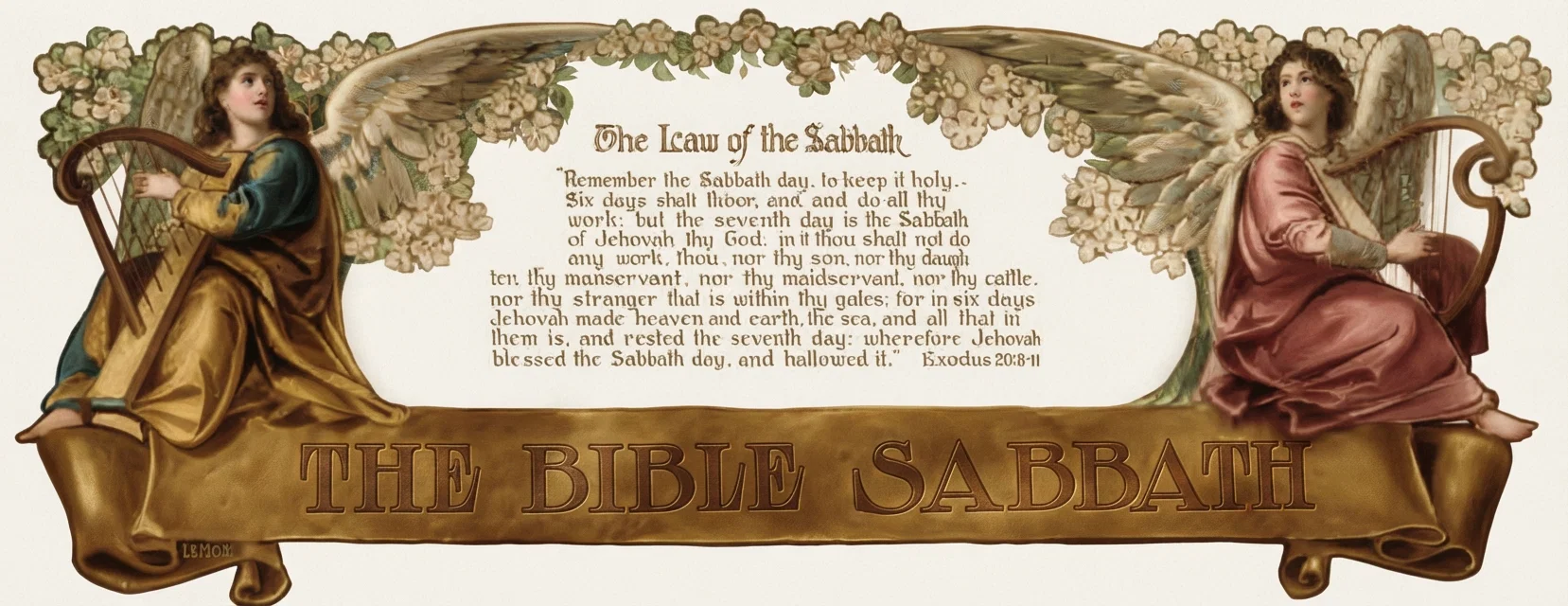
THE BIBLE SABBATH

3%

Pacific Press Publishing Company · Mountain View, California · Nov 8, 1905

FromSigns of the Times, Vol. 31, No. 45.

Read the full edition

THE BIBLE SABBATH

By A. T. Robinson

What Does the Bible Say?

The Foundation

JESUS declares, "The Sabbath was made for man," Mark 2:27.
Two facts are here clearly stated: (1) that the Sabbath was made. (2) For whom it was made.
To learn when, where, how, and by whom the Sabbath was made, we must turn to the record in Gen. 2:1-3, where we learn that the Sabbath was made by three specific acts performed by the Creator.
"Thus the heavens and the earth were finished, and all the host of them. And on the seventh day God ended His work which He had made; and He rested on the seventh day, from all His work which He had made. And God blessed the seventh day, and sanctified it, because that in it He had rested from all His work which God created and made."
The first of these three acts, the resting upon the day, was performed upon the first seventh day of time. He blessed and sanctified the seventh day, "because that in it He had rested." The two acts, of blessing and sanctifying the Sabbath, could not pertain to the first seventh day of time, as that day was already past. The blessing and sanctification of the Sabbath must therefore have pertained to the future seventh days, as they should occur at the close of each weekly cycle.

At the Exodus.

Thirty-three days before the giving of the law on Mount Sinai, the children of Israel were tested on the Sabbath question. After He had rained bread from heaven for them, the record states: "There went out some of the people on the seventh day for to gather, and they found none. And the Lord said unto Moses, How long refuse ye to keep My commandments and My laws? See, for that the Lord hath given you the Sabbath." Ex. 16:27-29. Here, be it carefully noted, the Sabbath is referred to by the Lord as a part of "My commandments and My laws," at least thirty-three days before the giving of the law from Sinai.
The good old patriarch, Abraham, faithfully observed these same commandments and laws. Of him the Lord says, "Because that Abraham obeyed My voice, and kept My charge, My commandments, My statutes, and My laws." Gen. 26:5. Thus the Sabbath, as an existing institution, spans the arch from Eden to Mount Sinai, when it was embosomed in the heart of the Decalogue.
No one questions the binding obligation of the Sabbath from Sinai to the Cross. We will therefore consider another great archway spanned by the Edenic Sabbath.

Christ's Regard for the Sabbath

Turning to the New Testament record, we find at the very beginning of His public ministry, the Lord Jesus declares that His mission was not to do away with any part of the law. His own words were:
"Think not that I am come to destroy the law, or the prophets; I am not come to destroy, but to fulfil. For verily I say unto you, Till heaven and earth pass, one jot [the smallest Hebrew letter] or one tittle [the smallest distinguishing corner of a letter] shall in nowise pass from the law, till all be fulfilled." Matt. 5:17, 18.
Concerning His public ministry, we read:
"And He came to Nazareth, where He had been brought up; and, as His custom was, He went into the synagogue on the Sabbath day, and stood up for to read." Luke 4:16. "And came down to Capernaum, a city of Galilee, and taught them on the Sabbath days." Luke 4:31.

The Apostles

Passing on to the record of the apostles, citing the chiefest of them as an example, we read:
"And Paul, as his manner was, went in unto them, and three Sabbath days reasoned with them out of the Scriptures." Acts 17:2. "After these things Paul departed from Athens, and came to Corinth. . . . And he reasoned in the synagogue every Sabbath, and persuaded the Jews and the Greeks." "And he continued there a year and six months, teaching the Word of God among them." Acts 18:1, 4, 11.
As late as A.D. 96 we find the "Lord's day" referred to as an existing institution. John says, "I was in the Spirit on the Lord's day." Rev. 1:10. There is only one day referred to in all the Bible, which the Lord claims as His own day. "If thou turn away thy foot from the Sabbath, from doing thy pleasure on My holy day; and call the Sabbath a delight, the holy of the Lord, honorable; and shalt honor Him, not doing thine own ways, nor finding thine own pleasure, nor speaking thine own words; then shalt thou delight thyself in the Lord." Isa. 58:13, 14. Here the Lord calls the Sabbath His holy day. We are not left in doubt as to which day is the Sabbath, for we read, "The seventh day is the Sabbath of the Lord thy God." Ex. 20:10. Therefore we know that a day referred to in A.D. 96, as "the Lord's Day," is none other than the Sabbath, which is the seventh day. Here again, we have another arch, from the Cross to the close of the New Testament record, spanned by the Edenic Sabbath.

The Remnant Church and the Sabbath

After an anti-Christian power, as predicted in Dan. 7:25, and other Scriptures, has thought to change the Sabbath from the day which God rested upon, blessed, and sanctified, we behold a world-wide movement, which is also a direct fulfilment of prophecy; calling the attention of God's people to the downtrodden Sabbath of Jehovah. The sun does not set upon those who have responded to this movement, by turning away their feet from the Bible Sabbath. The lonely seer of Patmos, looking through the telescope of prophetic vision, beheld the remnant church, and exclaims, "Here is the patience of the saints; here are they that keep the commandments of God, and the faith of Jesus." Rev. 14:12. He saw this commandment-keeping people in deadly conflict with the powers of darkness. "And the dragon was wroth with the woman, [the church], and went to make war with the remnant of her seed, which keep the commandments of God, and have the testimony of Jesus Christ." Rev. 12:17.
Describing the next scene, after beholding the remnant church, keeping the commandments of God, and the faith of Jesus, the prophet exclaims, "And I looked, and behold a white cloud, and upon the cloud one sat like unto the Son of Man, having on His head a golden crown, and in His hand a sharp sickle. . . . And He that sat on the cloud thrust in his sickle on the earth; and the earth was reaped." Rev. 14:14-16.
Turning to secular history, from the point where the inspired record closed, we find that during the first centuries of the Christian era the Bible Sabbath was observed by Christians; that gradually, as the church departed from the simplicity of the faith, it also departed more and more from the Sabbath, until it was nearly lost sight of. But traces of adherence to the Bible Sabbath are on record, showing that even throughout the Dark Ages that have intervened, God has not left Himself without witnesses for the Sabbath. And now, in these last days, we behold a people, true to the prophetic announcement, proclaiming to earth's remotest bounds, the message of the "everlasting Gospel" for this time. We behold thousands of honest people in every part of the earth, responding to the trumpet call, rallying around the standard, and holding aloft the banner of truth, inscribed with "the commandments of God, and the faith of Jesus." Thus we have the one remaining arch, from the close of New Testament history to the second coming of the Son of Man, spanned by the Sabbath of all the ages.

In the Earth Made New

The Lord has permitted us, through the spirit of prophecy, to get a glimpse of the Sabbath in the future eternal state. Speaking of the earth when it shall have been made new, the prophet of God declares: "For as the new heavens and the new earth, which I will make, shall remain before Me, saith the Lord, so shall your seed and your name remain. And it shall come to pass,that from one new moon to another, and from one Sabbath to another, shall all flesh come to worship before Me, saith the Lord." Isa. 66:22, 23.
The Sabbath of the Lord is an eternal institution, one pier, as we have found, rested in Eden, before the Fall. The other one is placed over in the earth made new. We have found the various arches between Eden lost and Eden restored spanned by the Sabbatical institution. This sacred memorial of Creation will endure forever. As the psalmist states it, "He hath made a memorial for His great creation. . . . The works of His hands are verity and judgment; all His commandments are sure. They stand fast forever and ever, and are done in truth and uprightness." Ps. 111:4, 7, 8. "Thy name, O Lord, endureth forever; and Thy memorial, O Lord, throughout all generations." Ps. 135:13.
THE BIBLE SABBATH By A. T. Robinson
The following diagram may serve to fix in the mind of the reader the fact that the Sabbath has been an existing institution during all the ages between eternity in the past and eternity in the future.