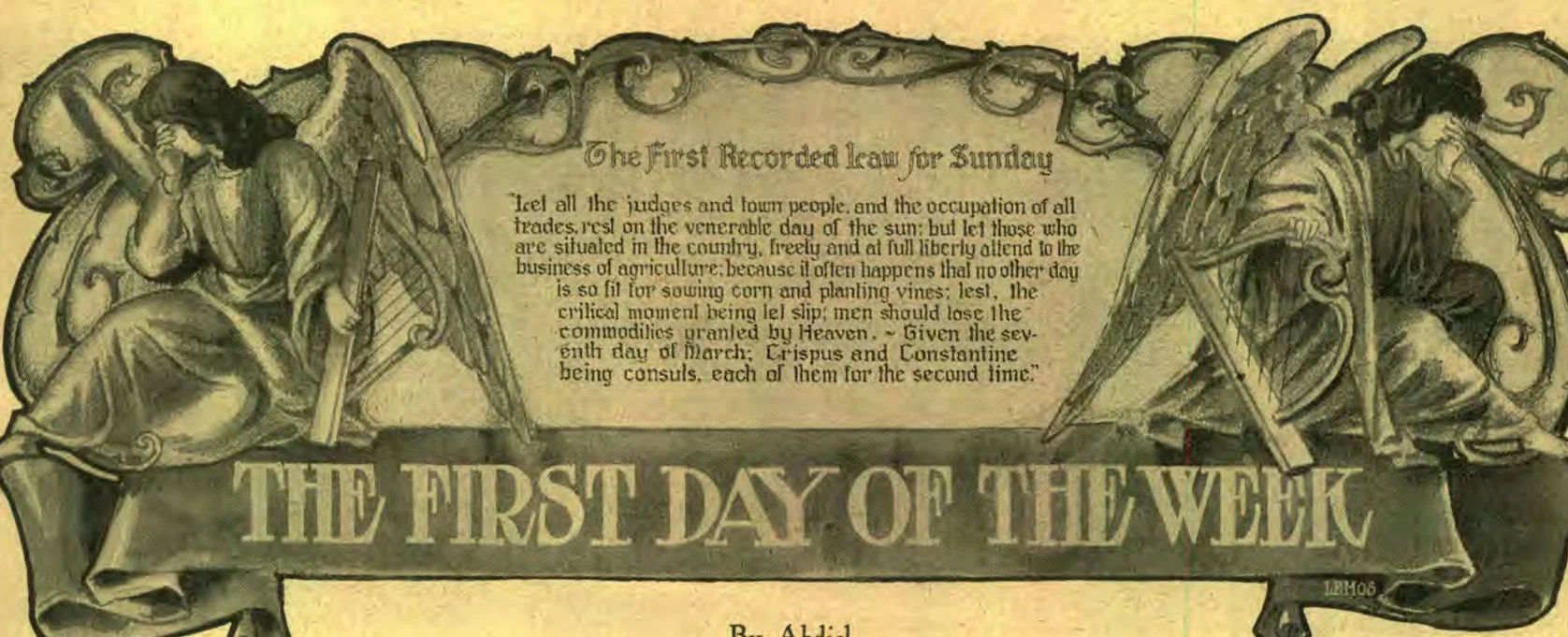
KEPT as the Sabbath by thousands of good Christians in the past. Kept by thousands of good Christians in the present. It is worthy of your consideration.
The Bible Christian says, "Prove all things [by the Word]; hold fast that which is good." Jesus said: "Every plant which My heavenly Father planted not, shall be rooted up." Matt. 15:13.
Every Mention of the "First Day of the Week."
What then do the Scriptures say in regard to a first-day sabbath?—Well, here is every text in the New Testament which speaks of the first day of the week:
1. "In the end of the Sabbath, as it began to dawn toward the first day of the week, came Mary Magdalene and the other Mary to see the sepulcher." Matt. 28:1.
2. "And when the Sabbath was passed, Mary Magdalene, and Mary the mother of James, and Salome, bought spices that they might come and anoint Him. And very early on the first day of the week, they come to the tomb when the sun was risen." Mark 16:1, 2.
3. "Now when He was risen early on the first day of the week, He appeared first to Mary Magdalene, from whom He had cast out seven demons." Mark 16:9.
4. "And on the Sabbath they rested according to the commandment. But on the first day of the week, at early dawn, they came unto the tomb, bringing the spices which they had prepared." Luke 23:56; 24:1.
5. "And behold, two of them were going that very day to a village named Emmaus, which was threescore furlongs from Jerusalem." Luke 24:13.
6. "Now on the first day of the week cometh Mary Magdalene early, while it was yet dark, unto the tomb." John 20:1.
7. "When therefore it was evening, on that day, the first day of the week, and when the doors were shut where the disciples were, for fear of the Jews, Jesus came and stood in the midst, and saith unto them, Peace be unto you." John 20:19.
8. "And upon the first day of the week, when we were gathered together to break bread, Paul discoursed with them, intending to depart on the morrow, and prolonged his speech until midnight." Acts 20:7.
9. "Upon the first day of the week let each one of you lay by him, in store, as he may prosper, that no collections be made when I come." 1 Cor. 16:2.
There they are, reader, every one of them. Read them over and over till every word is familiar. Take your Bible and read the context till you are familiar with the record. Know as you read that you have before you every instance in all God’s Word where the "first day of the week" is mentioned.
What Do They Mean?
The first seven of these passages, including Luke 24:13, refer to one and the self-same first day of the week, the day on which Jesus arose from the dead. They record this rising, and the events of that day. In that record there is not an intimation that the day was sacred or to be made sacred. When Christ the Creator founded the Sabbath in the beginning He did it by three specific steps; namely, resting upon that day, blessing it, setting it apart. But no such record is given of the first day. His resurrection upon that day was as it were in a moment, occurring before the day dawned, and some contend on the Sabbath day previous. The very uncertainty as regards the exact time shows clearly that the resurrection was not to be commemorated by a Christian day, but by a Christian life.
The day was one of uncertain suspense to the disciples. They disbelieved, they doubted, they hoped, they feared. The very meeting held at the close of the day, was in their own common abode (Acts 1:13), not to celebrate the day or the fact of the resurrection; for when Jesus appeared He upbraided them for their unbelief (Mark 16:10, 12, 14; Luke 24:38). Most certainly the fear and unbelief are not consonant with the claim that they met together to honor that day. The simple fact is that Jesus met with them as soon as they were all together, at the very close of the day.
The eighth passage merely records a night meeting at Troas by the apostle Paul on his way to Jerusalem, on what is our Saturday night (the Bible day began at sunset), and the apostle spent the light part of that day in journeying on foot to Assos. The great event of the meeting was the restoration of life to Eutychus. The day was one of activity both to Paul and his companions.
The ninth passage, quoted above, is simply an order from the apostle, to each member of the church to set apart as God prospered a certain amount on the first day of the week. The labors of the previous week were in the past, and the members could better calculate their store. Note also that this money was not to be taken to the church or placed in a contribution box, but was to be laid up "by him in store," in his own house, or home. The whole thing speaks of business, not a holy day.
The First Commandment for First-day Observance
There is a first-day observance commandment, the very first on record; but unfortunately not as old as the Bible, nor given by a holy man.
It is given on this page. Its author was the heathen emperor Constantine, a sun- and self-worshiper. All the Sunday observance of the early centuries crept into the church through half-converted heathen philosophers and teachers who corrupted the faith. Choose between these commandments in the headings of this and the previous page.
We are not, dear reader, condemning the good of past generations or of to-day. The old counterfeit of God’s Sabbath is well worn. Many have accepted it as genuine even as honest men accept counterfeit bills as genuine. But no honest man would continue to pass a counterfeit bill, knowing it to be such. He would pocket his loss if he could not collect from the man who passed it to him.
God’s plan is infinitely better. When He reveals by His great Detector, the Scriptures, the counterfeit, He gives us the eternal genuine.
"Every plant, which My heavenly Father hath not planted," says Jesus, "shall be rooted up." Will you take planting of error in the soon-to-perish tradition, or the plant of truth forever to grow and bloom and fruit in the evergreen garden of God?
CREATION VERSUS REDEMPTION
AMONG the claims for first-day sacredness frequently put forward is that redemption was finished on the first day of the week, that it is greater than creation, and therefore the day on which redemption is finished should be observed instead of the Sabbath, which is a memorial of creation. This is a large conclusion from very questionable premises; for (1) what authority have we that redemption is greater than creation? That is pure assumption on the part of poor, finite mortals, who know absolutely nothing of either; only the infinite God can create, only the infinite God can redeem. More than that, He tells us that redemption, regeneration in order to redemption, is creation; for "if any man be in Christ, he is a new creature," or as in the margin, "there is a new creation." 2 Cor. 5:17, A.R.V. "For we are His workmanship, created in Christ Jesus for good works." Eph. 2:10. Therefore the memorial of creation, the Sabbath, ought to be a day of double worth and joy to the recreated man. "Moreover also, I gave them My Sabbaths, to be a sign between Me and them, that they might know that I, Jehovah, do sanctify them." Eze. 20:12, margin, A.R.V.
2. It is not a wonderful thing that God should call from the dead His own righteous Son. It is a wonderful thing that He should die for a race of sinners, and it was on the cross that He said, "It is finished." Surely, if any day should be kept as a memorial of our redemption (for we are redeemed by His blood), it ought to be6the day on which He died, and not the day on which He arose.
3. While Christ paid the price of redemption on the cross for His children, that work of redemption is not completed until He shall come again; and so when that coming draws nigh, we are bidden to "look up, and lift up your heads; because your redemption draweth nigh." Luke 21:28.
4. It was a fitting thing to commemorate the work of creation by a day because God rested on that entire day and delighted Himself in the contemplation of His work; but the resurrection of Christ took place in a moment of time while the shades of night were yet tarrying, and the day following, the first day, passed without any divine acts which would in any way indicate that it was sacred.
5. God has given two things by which the believer shows forth to the world the power of Christ's redemption; one is the Lord's Supper, "an occasional emblem of a continual feast," the other is baptism, the beginning of a new life in Christ Jesus. And so the great memorial of Christ's resurrection is not a day, but a life. The newness of life to be manifested in the believer, the power over sin, is the greatest evidence to the world of a risen Saviour. The Lord's Supper and true baptism, or immersion, the failure to appreciate what these have meant by a church lost in the wilderness of tradition, led them to transgress the law of God, and put in the place of His memorial an institution for which there is no authority in the Scriptures. Truly has the Lord said of the wickedness that there is at the present time, "They have transgressed the laws, violated the statutes, broken the everlasting covenant." Isa. 24:5.