DANIEL VII will be divided into three lessons: (1) Babylon, the First of the Four Beasts; (2) Medo-Persia, Grecia, Rome; (3) The Little Horn. Read the first seven verses of the chapter as follows:
"In the first year of Belshazzar king of Babylon, Daniel had a dream and visions of his head upon his bed: then he wrote the dream, and told the sum of the matters. Daniel spake and said, I saw in my vision
by night, and, behold, the four winds of the heaven strove upon the great sea. And four great beasts came up from the sea, diverse one from another.
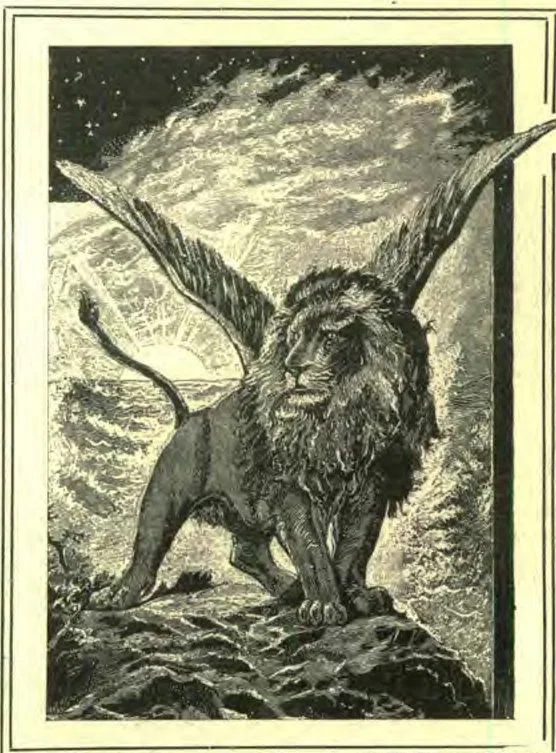
"The first was like a lion, and had eagle's wings: I beheld till the wings thereof were plucked, and it was lifted up from the earth, and made to stand upon the feet as a man, and a man's heart was given to it.
"And behold another beast, a second, like to a bear, and it raised up itself on one side, and it had three ribs in the mouth of it between the teeth of it: and they said thus unto it, Arise, devour much flesh.
"After this I beheld, and lo another, like a leopard, which had upon the back of it four wings of a fowl; the beast had also four heads; and dominion was given to it.
"After this I saw in the night visions, and behold a fourth beast, dreadful and terrible, and strong exceedingly; and it had great iron teeth: it devoured and brake in pieces, and stamped the residue with the feet of it: and it was diverse from all the beasts that were before it; and it had ten horns."
Let the vivid picture be stamped on the mind.
The vision is given in the first year of Belshazzar, three years before Babylon fell, or B.C. 541. Belshazzar had just been appointed joint ruler with his father Nabonidus. The father was engaged in building temples and shrines to the gods; the son seemed to be the active public ruler.
On this occasion the dream and vision came to Daniel. "If there be a prophet among you," the Lord declares to His people, "I Jehovah will make Myself known unto him in a vision, I will speak with him in a dream." Num 12:6. God was speaking in His regular appointed way thru Daniel, that the ages might know, that the people in "the latter days" might read, of God's foreknowledge and power, and, thus learning, believe His Gospel and be saved. "Remember the former things of old; for I am God, and there is none else; I am God, and there is none like Me; declaring the end from the beginning, and from ancient times things that are not yet done; saying, My counsel shall stand, and I will do all My pleasure." Isa. 46:9, 10. Blessed is the man who yields to God's holy purpose, that God may work in him His good pleasure, after the counsel of His own will, to the praise of the glory of His grace.
Read again the vision of the four beasts. Let the whole scene enter the mind. Put yourself in the prophet's place. See yourself the vision of God. You are standing upon the shore of the great sea, lashed into fury and made to boil in tumult by fierce and opposite winds. As you watch the raging waters, you see four wild beasts come up out of the sea, all alike fierce and cruel, yet totally different in form and kind. Each beast of the first three is unnatural, even of its kind, in form, in members, or in attitude.
By a great and magnificent image, God impressed the mind of the idolatrous king Nebuchadnezzar. By wild and cruel beasts, God revealed to His prophet and people the true nature of earthly empires.
What do these beasts symbolize? The angel of God answers the question: "These great beasts, which are four, are four kings, which shall arise out of the earth." (Read verses 15-17.) The Septuagint reads: "These four beasts are four kingdoms that shall rise up on the earth; which shall be8taken away." They represent the four great dynasties of earth; the same four that had been revealed to Nebuchadnezzar in the four parts of the great metallic image—the gold, the silver, the brass, the iron, and iron and clay. The great sea, the mighty, restless, surging water, is a fitting symbol of the restless, heaving, tossing tides of humanity's great sea, divided among the nations and tribes of the earth. Rev. 17:15; Isa. 8:7. The winds are fitting symbols of the strife and war among nations and governments. Jer. 25:32. As the result of the strife and war, four great kingdoms, or dynasties, appear.
The first of these beasts, the lion, represents Babylon, or Chaldea. So when Jeremiah saw in vision the army of Babylon marching upon Jerusalem, he declared: "The lion is come up from his thicket, and the destroyer of the Gentiles is on his way." Jer. 4:7. And as to the eagle's wings, the same prophet declares: "Behold, he shall fly as an eagle." Jer. 48:40; see also Hab. 1:6-8; Eze. 17:3. The lion with the eagle's wings represented Babylon, that "mighty nation," that "ancient nation," the beginning of kingdoms. Jer. 5:15. The word "ancient" means from time not known, whose antiquity is hidden. The record in Genesis clearly intimates that it was the very first city after the Flood, the beginning of the kingdom of Nimrod, the first of the rebel kingdoms against God. Gen. 10:10, 11. Erech (Ur) and Accad and Calneh and Assyria and Nineveh came later. The first of all, the mother of all the cities of pride, was Babylon, who by the wine of her lustful idolatry hath "made all the earth drunken." Jer. 51:7; Rev. 14:8; 17:2. "Their judgment and their dignity proceed from themselves." Hab. 1:7.
In all the ancient world it was the great seat of learning. Its universities surpassed all others. Wherever the mightier warriors might be, Babylon ruled. Assyria might be dominant in the martial field; Babylon reigned in character-molding power, in religious influence. The center of influence might sometimes change to some other great center for a few years or centuries, but in its origin it was Babylonian.
Until 1820, forgetting or not believing the Bible, men had supposed that Babylon was an empire which began at a late date in the world's history; founded, in fact, on the ruins of the old Assyrian empire. In this conception they had ignored the Bible, and the state archives of Babylon and Nineveh had not yet been unlocked to the world. Now it is clearly seen by the historical records of Babylon that she was among the most ancient of cities.
The archeologists tell us that its first inhabitants were not Semitic, but called by some scholars Sumerian (from Shinar, as given in the Bible), by others Accadian. One theory is that these were Mongols, others that they were a mixed people. Rogers tells us that "the solution of the question is not yet found." How much better it would be to go to the old Book, and find that the first builders of Babylon belonged to the Hamitic branch of Noah's family, and that among the first cities builded by them were Babel (Babylon), Erech (Ur), Accad, and Calneh, in the land of Shinar (hence Sumer, Sumerians). Gen. 10:10. Shinar was the name the land retained to Biblical times. Accadian, now considered a Sumerian dialect, was from the name of a tribal city.
From these Hamitic tribes came the cuneiform text, the perversion of true religion to nature-worship, and the inerasable scarlet of fornication,—unlawful union of religion with the state,—by which Babylon has stained all the nations of earth. Even the Assyrian kings in the time of Nineveh's greatest glory, honored Babylon, counting it one of the highest privileges to bow before the great god Marduk, and receive the kingdom from his hand. Rogers says:
"The origin of the city of Babylon is veiled in impenetrable obscurity. The first city founded upon the site must have been founded fully four thousand years before Christ, and it may have been much earlier. . . . From about 2300 B.C. the influence of the city extends without a break to the period of the Seleucides. No capital in the world has ever been the center of so much power for a period so vast."
Babylon, or her great ruler, Nebuchadnezzar, came to know God, as recorded in chapter 4. To the king who lived for this world only, as a beast lives, came the knowledge that the "Most High ruleth in the kingdom of men, and giveth it to whomsoever He will," and the acknowledgment of God. The man's heart came to the beast; but upon the death of that truly great ruler, Babylon sank to a lower level, till finally the empire succumbed under the weak and lust-loving king, Belshazzar.
[The next article will be the explanation of the other three symbols, the bear, the leopard, and the ten-horned beast.]
'The first was like a lion, and had eagle's wings.' Dan. 7:4.