THE fifth trumpet had come—the Mohammedan conquests foretold in prophecy. "And it was said unto them that they should not hurt the grass of the earth, neither any green thing, neither any tree, but only such men as have not the seal of God on their foreheads." Rev. 9: 4.
This prediction was literally fulfilled by the humane recommendation of Abu Bekr to his troops. Gathering the army around him in a circle, he said: "Warriors of Islam, stop a while and listen carefully to the precepts I am about to issue for times of war. Be brave. Be loyal. Use neither stratagem nor perfidy with your enemies. Let not your victory be stained with the blood of the aged, of women and children. Destroy no palm trees, do not burn harvests, cut down no fruit trees [italics ours], kill no cattle, only such as you need to eat."
The next order mentioned in the prophecy is also contained in Abu Bekr's instructions: "As you go on, you will find some religious persons who live retired in monasteries and propose to serve God in that way; let them alone, and neither kill them nor destroy their monasteries. And you will find another sort of people that belong to the synagogue of Satan, who have shaven crowns; be sure that you cleave their skulls, and give them no quarter till they either turn Mohammedans or pay tribute."
Severe on Idolaters
"He excepted," says the historian Lamartine, "from the protection thrown around the weak and the Christian hermits, only those who influenced the people against the doctrine of God's unity." The Koran was lenient to all except idolaters. The second surate (chapter), verse 59, says: "Certainly those who believe, and those who follow the Jews' religion, Christians, and Sabæans, that is, whoever believes in God and in a Judgment to come, and shall have done good, all those will be rewarded. They will be exempt from fear and torment." (Italics ours.)
The prophecy, however, does not say that these instructions would be followed to the very letter, but only that "it was said unto them." Led by fanaticism, greed, and human passions, it was only natural for the Arabs to plunder and exterminate; and this they often did.
"And it was given them that they should not kill them, but that they should be tormented five months: and their torment was as the torment of a scorpion, when it striketh a man." Verse 5.
A Merciless Dilemma
A scorpion's sting is very distressing, and sometimes mortal. This represents the condition of the Christian nations conquered by the dreadful Mussulman invaders. Mohammed's testament said: "Those nations which shall embrace our faith shall unite with you; they will enjoy the same advantages, and be subjected to the same duties. Let those who desire to keep their own belief become your subjects and pay you a tribute, and let them receive your protection in exchange. But fight even unto extermination those who shall refuse to accept Islam or the condition of tributaries." This tribute amounted to one fifth of the annual income from the land.
How painful it must have been for the Christian populations of the seventh and the eighth century to face this merciless dilemma—either give up their faith and become Mohammedans, or else lose a double tithe from the annual revenue! Here are the very words in which their fate was proposed to them: "If you refuse, I will send against you men who like death more than you like pork, and I will leave you no peace until, with God's help, I have defeated your armies and reduced your children to slavery."
Exchanged Sunday for Friday
This bitter sarcasm would have been resented by any but the weak-kneed, degenerate Christians of those days, of whom a historian says that "at the very first summons, the Christians welcomed the Mussulmans as liberators, and hastened to embrace the new religion, and to smother their own quarrels in a common apostasy." (La Jonquiere, page 98.) Thousands, perhaps millions, of nominal Christians bowed the knee before the god of Mohammed, destroyed their images, gave up their saints, and swore off on wine and pork. But this welcome to their new masters must have been more outward than real, more forced than willing; and to most of them, the following words of the prophecy must have applied:
"And in those days men shall seek death, and shall in no wise find it; and they shall desire to die, and death fleeth from them." Verse 6.
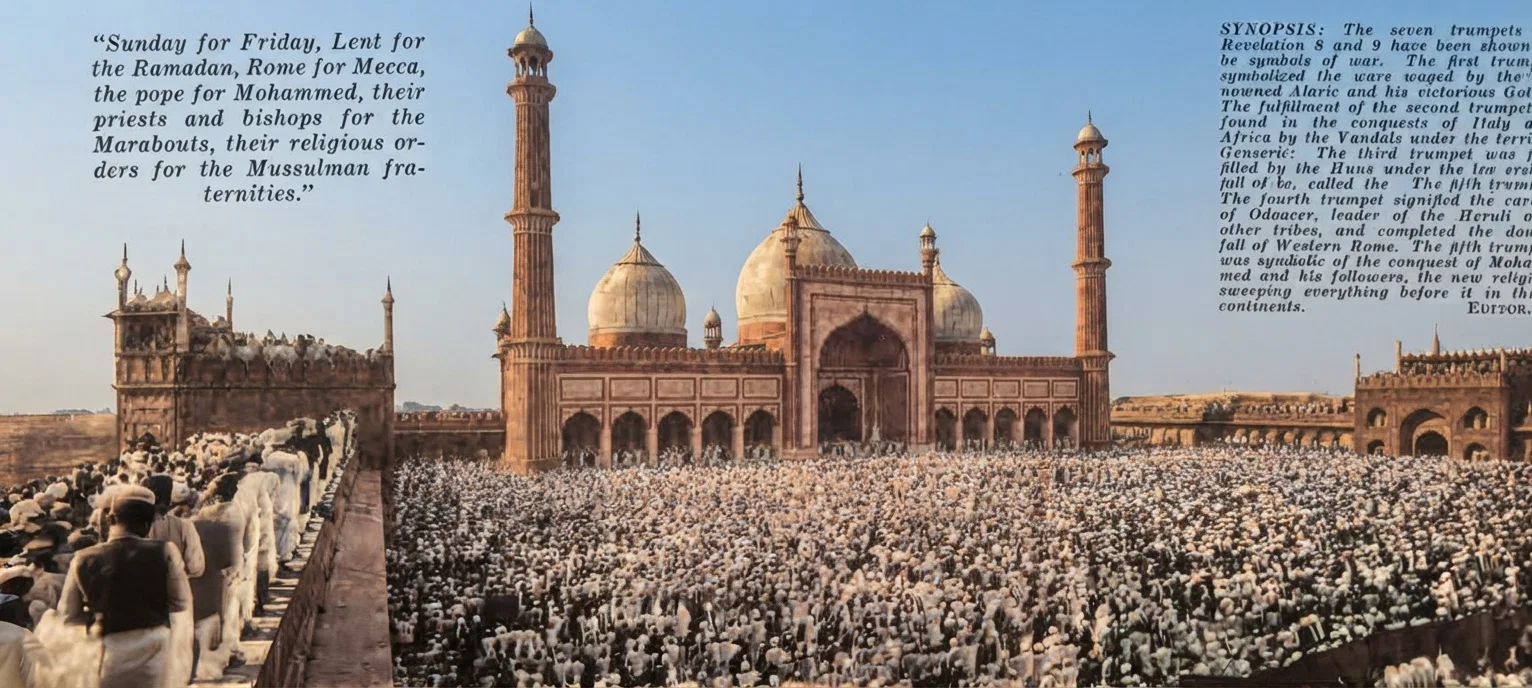
Too lukewarm to die for their faith, and too greedy to yield one fifth of their revenue for the privilege of retaining their religion, they soon decided to exchange their crosses for the crescent, their churches for the mosques, Sunday for Friday, Lent for the Ramadan, Rome for Mecca, the pope for Mohammed, their priests and bishops for the Marabouts, their religious orders for the Mussulman fraternities. Yet the change was galling, and almost unbearable, because there was no way out except at a sacrifice which they were unwilling to pay.
The result of the Mussulman invasion is an appalling revelation as to the low condition of the Christianity of that age. The historian states an almost incredible fact when he says, "In vain do we look, from that time onward, for the orthodox church in Syria, in Cilicia, in Phœnicia, in Palestine, in Mesopotamia, in Egypt, in Libya." (Chastel, volume 3, pages 16, 17.)
Venerable Symbol of Manhood
From this point, the prophecy deals almost exclusively (verses 7-10) with a minute and graphic description of the warriors that galloped under the banners of the caliphs.
"And the shapes [or likeness] of the locusts were like unto horses prepared for war; and upon their heads as it were crowns like unto gold, and their faces were as men's faces." Verse 7.
The Saracens fought almost wholly on horseback. It is a well-known fact that the Arabian horse takes the lead of the world, while the Arabs' skill in horsemanship is proverbial. Speaking of the invasion of Europe by the Saracens, Count A. De Gurowski, in "Russia as It Is," says: "All of them appeared, or entered Europe, on horseback, ravaging and pillaging, and producing hussars, or spahis [cavalry armed with sabers]; and on horseback, they successively disappear from the European arena." (Page 276.)
"The turbans of the Saracens," says Keith, "like unto a coronet, were their ornament and their boast. To assume the turban is, proverbially, to turn Mussulman." The expression "men's faces" is a clear reference to the dignified appearance and grave demeanor of the Arab, whose "only gesture is that of stroking his beard, the venerable symbol of manhood." (Idem.)8
"And they had hair as the hair of women, and their teeth were as the teeth of lions." Verse 8.
The Bedouins wore long hair and a long beard, according to ancient historians, like Pliny and Jerome; while the "pure whiteness of their teeth" suggests to Chateaubriand the comparison with those of wild beasts.
"And they had breastplates, as it were breastplates of iron; and the sound of their wings was as the sound of chariots, of many horses rushing to war." Verse 9.
The breastplate was in use among the Arabs as early as the days of Mohammed. He himself had seven of them for his personal use. Says Keith, quoted by U. Smith: "Their military force was chiefly formed of cavalry and archers. With a touch of the hand, the Arab horses darted away with the swiftness of the wind! . . . Their conquests were marvelous both in rapidity and extent, and their attack was instantaneous."
"And they have tails like unto scorpions, and stings; and in their tails is their power to hurt men five months." Verse 10.
"The prophet that teacheth lies, he is the tail!" (Isa. 9: 15); while the sting, as we have seen, is his false teaching (or sin, 1 Cor. 15: 56), enforced on cowardly Christians who had to submit to an abhorred religion for want of moral courage to retain their own.
150 Years of Torment
"They have over them as king the angel of the abyss: his name in Hebrew is Abaddon, and in the Greek tongue he hath the name Apollyon." Verse 11.
These two words, which mean destroyer, designate the "messenger" or "angel" of this new and false religion which emerges from the wild Arabian solitudes — from the abyss, or deep. (Gen. 1: 2.) Here the founder of Islam, called a star in verse 1, receives his true name: he is a destroyer as well as a false prophet, a political conqueror as well as the founder of a foul religion.
Like every other prophetic period in the Bible, this one of the five months must be interpreted according to the Bible rule of a "day for a year." Ezek. 4: 6. And as the Bible month has thirty days (compare Rev. 12: 6 with Rev. 13: 5), five months are one hundred fifty prophetic days, or literal years. (Compare the one hundred fifty days of Gen. 7: 24 with Gen. 7: 11 and Gen. 8: 3, 4.) Thus a definite period of one hundred fifty years was given during which to "torment" Christian nations.
Shamed "Christian" Europe
"The first woe [fifth trumpet] is past: behold, there come yet two woes hereafter," the sixth and the seventh trumpet. Verse 12.
The Mohammedans ceased to be, in God’s hands, a "torment" to the world. But they did not cease to be an example that might well have shamed Christian lands, along the lines of education and what we call civilization. At a time when so-called Christian Europe was groping in dense ignorance, when its princes hardly knew how to read and write, the caliphs, says Gibbon, "diffused the tastes and rewards of science from Samarkand and Bokhara to Fez and Cordova."
Their college in Bagdad had six thousand students, while the city of Cordova had two hundred thousand houses, six hundred mosques, and nine hundred public baths. There were in the Andalusian kingdom seventeen universities and seventy libraries. One of these contained six hundred thousand volumes, forty-four of which comprised the catalogue. A private physician, being called to the court by a caliph, refused this honorable position, saying that the carriage of his books would require four hundred camels.
At the same time, the Arabian courts and palaces offered scenes of luxury and magnificence that dazzle the imagination. "The age of Arabian learning," says Gibbon, "continued about five hundred years, . . . and was coeval with the darkest and most slothful period of European annals."