Nature's Series of Signals Precursing the Return of Jesus
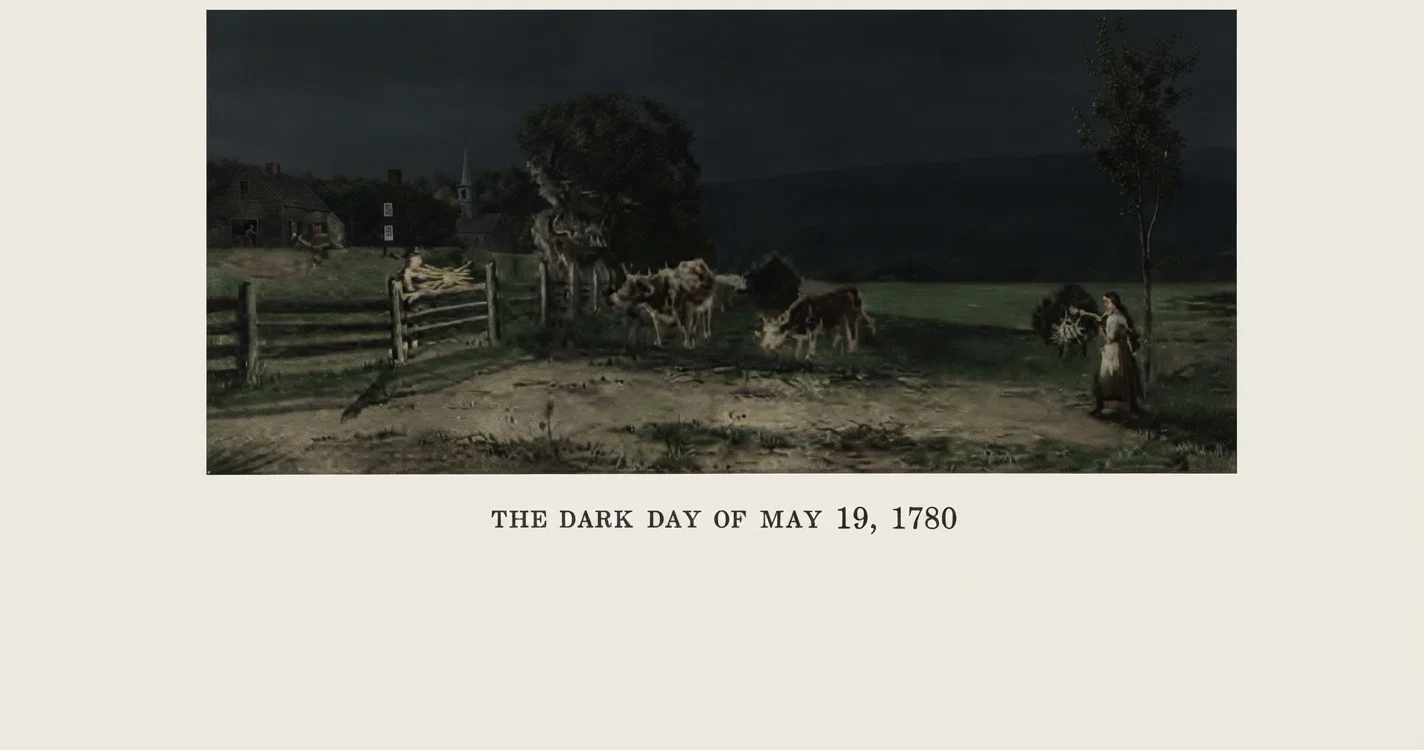
THE DARK DAY OF MAY 19, 1780
By Benjamin G. Wilkinson
This is Dr. Wilkinson's concluding article on the events of the seven seals recorded in Revelation 6 to 8. Spanning the time from Christ's first advent to His second coming, we have witnessed the remarkable response of historical events to God's advance history. In the preceding article, we saw the breaking of the sixth seal, and located in 1755, the great earthquake of Lisbon as the first of nature's series of signals heralding the time of the end. We are facing the last act in God's great drama of the ages.
THE great Lisbon earthquake of November 1, 1755, was followed by yet another sign pointing to the nearness of the end. "The sun," says the apostle, "became black as sackcloth of hair, and the moon became as blood." Rev. 6: 12. May 19, 1780, has gone down in the annals of American history as the famous dark day.
The unusual appearance of the sun on that day is still a theme in current literature. Thus we read in the Ladies' Home Journal, July, 1905:
"It is not easy now to produce a circumstantial account of a day which possibly has never been equaled anywhere in the United States for the fright which it excited; but here and there, there are still to be found some contemporaneous references to its singular effects. The day was the nineteenth of May, 1780. . . . It was generally pronounced to be the most extraordinary occurrence of that generation. . . . Where it was seen in its full effects, the darkness was appalling.
"At some places, all the light of day seemed as if it had been blotted out. . . . A thick cloudiness in the atmosphere seems to have been first observed about ten o'clock in the morning, gradually deepening into an oppressive gloom; and hour after hour, and long after the time for the setting of the sun, the blackness, with some intervals of light in the afternoon, continued to envelop a vast region. Dr. Samuel Penny, when, several years later, he wrote upon the cause of the phenomenon, declared that 'the darkness of the evening was probably as gross as it has ever been observed since the Almighty's fiat gave birth to light.'"
Four Advance Signals
THE phenomenal appearance of the moon the night following this dark day, fulfills precisely the words of the apostle that "the moon became as blood," and the words of our Saviour that "the moon shall not give her light." Matt. 24: 29. Thus says Samuel William Hallas, professor of mathematics and philosophy in the university of Cambridge, in the "Memoirs of the American Academy of Arts and Sciences," volume 50, pages 234-247: "It is probable that it [the darkness] extended much beyond the limits [New England]; but the exact boundaries cannot be ascertained by any observations that I have been able to collect. The sun and the moon appeared remarkably red in color, and divested of their brightness and lucid appearance."
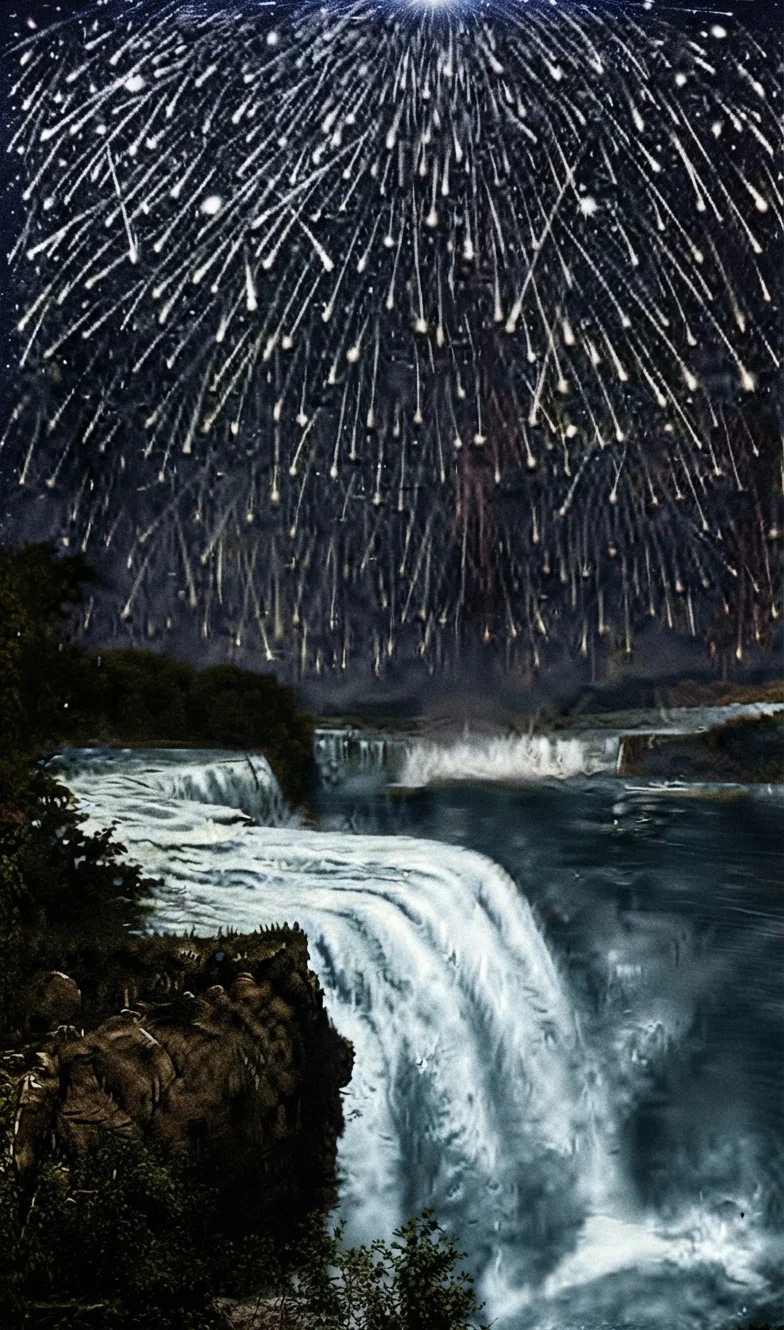
These two signs foretelling the second return of the Lord fully answer the word of our Saviour. But there is still a third sign, the falling of the stars to the earth "as a fig tree casteth her untimely figs, when she is shaken by a mighty wind." It would be a waste of time here to answer any objection that this language presents a scientific impossibility. Christ and John evidently did not mean fixed stars, but just what the expression means to-day, "shooting stars."
Did any such great phenomenon obtain a marked place in history? — Yes. Of the astonishing star shower of the night of November 12 to 13, 1833, Humboldt, the great scientist, says: "At the time of the appearance of the falling stars the night of November 12 to 13, epoch since become so celebrated, the falling stars appeared to depart from the same and identical point of the celestial vault. . . . An aurora borealis very intense accompanied the most magnificent appearance of falling stars that is known, that of the twelfth to the thirteenth of November, 1833."
Many other quotations might be given from numerous noted men and from standard magazines. It will not be necessary, however, to give such, as reference to these great events may be found in many well-known works.
Thus we have located the four signs preceding the Saviour's coming. It is true that the apostle saw other signs; but they were movements in the heavens which accompanied the return of the Saviour, rather than preceding Him as signals.
Cry Out for Death
How great will be the effect of this event upon the élite of society, upon capitalists and laborers, is indicated by the fact that all classes cry out in their anguish and fear for the rocks and the mountains to fall on them and hide them "from the face of Him that sitteth on the throne, and from the wrath of the Lamb: for the great day of His wrath is come; and who shall be able to stand?" We all know what would happen if a mountain fell on a man. Hence these transgressors cry out for death.
The return of Christ carries back the mind of those in all stations of life who rejected the grace offered to make them victors over sin. The terrors of a guilty conscience are upon them at the glorious event; or as says the revelator in another verse: "Behold, He cometh with clouds; and every eye shall see Him, and they also which pierced Him." Rev. 1: 7.
Have we not here enough to show us that the six seals do indeed reach from the first advent to the return of our Lord? And have not enough gone by to let us know that we are living under the sixth seal — nay, more, that we are living toward the very close of the sixth seal?
Reception Committee Called Out
THE sixth seal ended with the great question, "Who shall be able to stand?" Rev. 6: 17. In the seventh chapter of Revelation, nothing is said of the seventh seal. Only when we reach the eighth chapter do we find again the seventh seal. Why is this? — Evidently the seventh chapter is thrown in between the sixth and the seventh seal, to answer that great question, "Who shall be able to stand?" by saying, Those who are sealed with God's seal, they shall be able to stand. The seventh seal brings to view the seven trumpets. These cover chapters eight to eleven of the book of Revelation. They are retrospective. They go back over the ground of the seven seals, and bring it out in larger measure, with fuller detail, and presenting other events.
The great and glorious moment, however, has been reached under the seventh seal; and the sealing work in chapter seven brings forward the people called out to be a reception committee for the Lord's return. There is as it were but a moment of time left, and the seventh seal brings everything to its consummation. Is the hope of Christ's second coming burning bright in your heart? Are you responding to the conviction of His Spirit that you should become better? And have you put yourself in training to obtain the prize of eternal life?