Was There the Captivity Mentioned by Daniel?—Was There Such a Person as Belshazzar?—Who Was Darius the Mede?
Was Nebuchadnezzar Sick?
By A. EARL HALL, B. A.
This is the eighth and concluding article by Professor Hall on the reply of archæology to present-day Biblical criticism. We are sure that our thousands of readers have been following with intense interest this series of articles, which have shown how the higher critics have been successfully met by the records of the monuments and tablets of the ancient world. The critics had claimed that large portions of the Bible were myth and fable, that much of its history could not be depended upon. They had been very loud in their claims; they had been successful in getting their doctrines taught in the leading theological seminaries throughout the world; the most influential pulpits had accepted their teachings, which in reality were infidelity in disguise. But God by His providence had preserved on monument and tablet in Egypt, old Babylon, and elsewhere, records of unquestionable authenticity, which showed that the Bible account was true, and that the teaching of the critics was false. The evidence is overwhelming that God has been carefully guarding His sacred word, and that it stands the test of every adverse criticism, and remains the firm foundation for our faith and hope. EDITOR.
"IF these should hold their peace, the stones would immediately cry out."
We are now at a period at the close of which the monumental records cease. From the beginning of the fifth century B. C., there is an abundance of historical material from various writers. The science of historical writing was really born in that century, and writers could get at first hand, from the older generation, a great amount of information, which would go back even into the sixth century, the time of the historical events of the book of Daniel.
HOW THE CRITICS HAVE REGARDED DANIEL
Following the plan of previous articles, it will be told just how the book of Daniel is regarded by the critics, and some of their objections to it; and then appeal will be made to the monuments for a decision.
From one noted English critic, Dean Farrar, we copy these objections as "historical errors":
"There was no deportation in the third year of Jehoiakim," as given in Dan. 1: 1.
"There was no King Belshazzar," as found in Dan. 5: 1, etc.
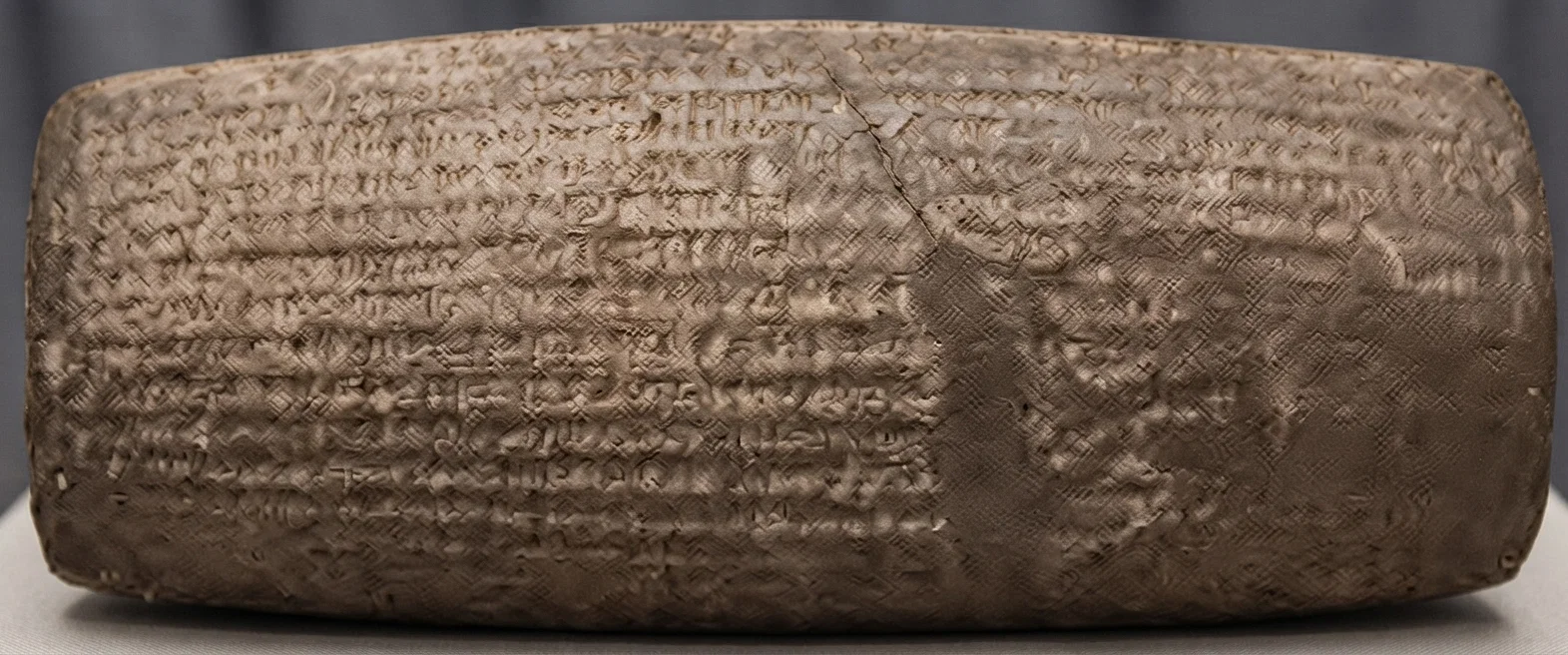
The cylinder of Cyrus, inscribed with an account of the capture of Babylon (British Museum).
"There was no Darius the Mede," mentioned in Dan. 5: 31.
"It is not true that there were only two Babylonian kings; there were five."
"Nor were there only four Persian kings; there were twelve."
"Xerxes seems to be confounded with the last king of Persia."
And "all correct accounts of the reign of Antiochus Epiphanes seemed to end about B. C. 164."
The following two objections are selected from nine arguments that are urged for a late writing of the book:
"The book of Kings does not mention the siege in Dan. 1: 1."
"That Belshazzar is spoken of as king and as son of Nebuchadnezzar."
From a third source, we select two more, which urge that the book of Daniel was written much later than Daniel's day,—the spelling of "Nebuchadnezzar" with an n after the letter d, and the Greek words in the book. (Quoted by Joseph D. Wilson, "Fundamentals," volume 8, chapter 6.)
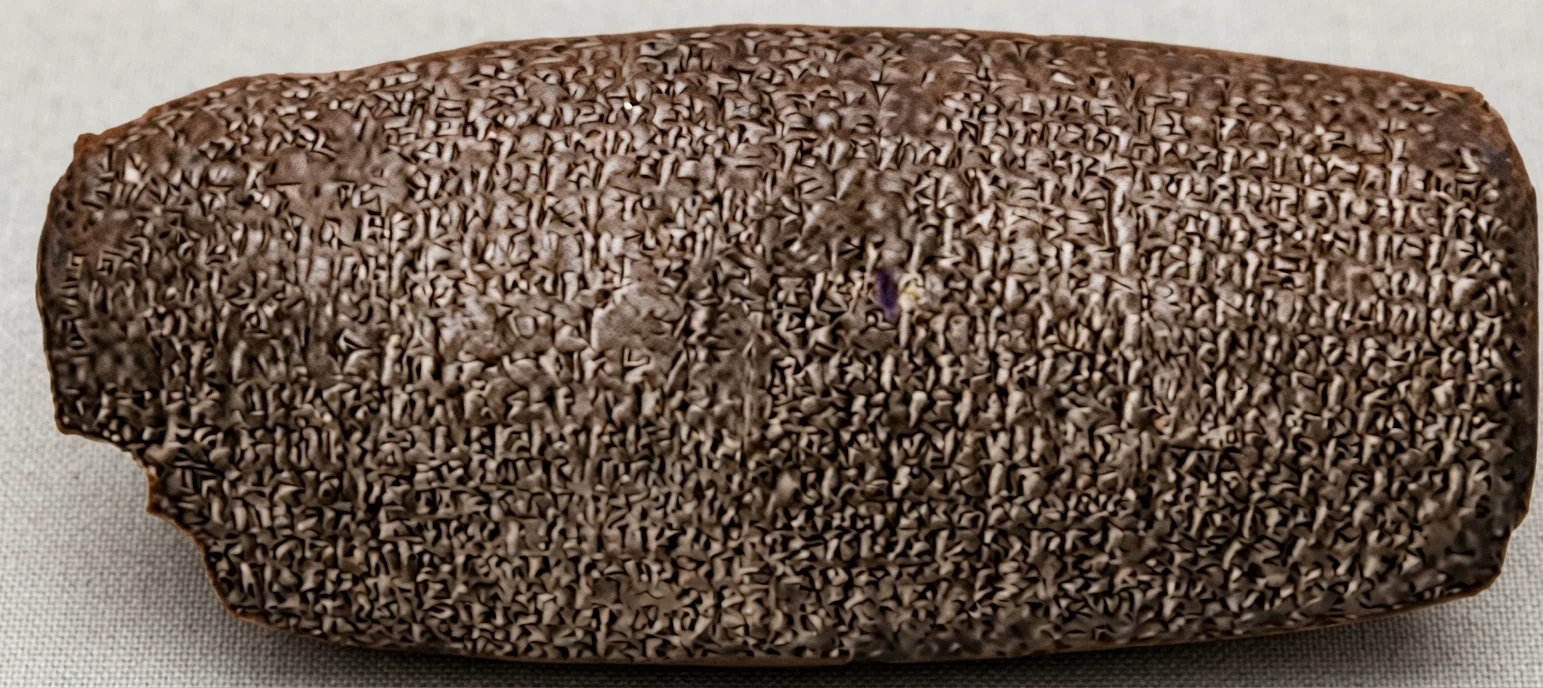
Baked clay cylinder of Nabonidus, king of Babylon, inscribed with a prayer on behalf of his son Belshazzar (British Museum).
THE REPLY TO THE CRITICS
Nos. 4, 5, 6, and 7 of the first list of objections given above have nothing to do with archæology, and can be cleared up in a few sentences. Daniel does not say there were only two kings of Babylon. Two only are mentioned by him, for obvious reasons. The accounts in the first four chapters could hardly be given without mentioning Nebuchadnezzar by name. The same point holds good concerning the last king mentioned, Belshazzar. Daniel was not writing a history of the Babylonian kingdom. That was not his purpose at all.
The same argument is proper to use in reference to No. 5, as the principle involved is the same. Only those kings of Medo-Persia are mentioned who were necessary for the narrative.
In No. 6, the "confounding" is surely not in Daniel. It is in the mind of those who wish to make Xerxes the last ruler of the kingdom. The record in Dan. 11: 2 does not even hint at anything of the kind.
For No. 7 we offer two statements: First, as one author suggests, "Where was the account of the reign of Antiochus to end, if not in the year of his death?" (Anderson, page 14.) Second, the "critics' den" is here opened to admit a large company who wish to make the "little horn" of Dan. 8: 9-12 apply to Antiochus Epiphanes. This question is purely a theological one, and lies outside the province of this article. We simply add that it has nothing to do with the question under consideration — the accuracy of Daniel.
WAS THERE A DEPORTATION?
Our first point is, Was there a deportation in Jehoiakim's third year? In the first sentence of his book, Daniel says there was; the critics think not. We have no monumental evidence, in the sense in which we have been using that term. Our material is gathered from ancient historians. From the canon of Ptolemy we learn that the first year of Nebuchadnezzar's sole reign was 604. Berossus says that when Nebuchadnezzar heard of his father's death, he arranged the affairs of the countries he was invading, turned over the captives from the Jews to his friends, and hurried over the desert to Babylon. The siege of Jerusalem is before the battle of Carchemish, when Necho came up to fight with him for entering what he claimed was his territory, according to the treaty made earlier.
Jer. 46: 2 says that this battle with Necho took place in the fourth year of Jehoiakim. The siege of Jerusalem was in the third year. Dan. 1: 1. In Jer. 25: 1 we read, "The word that came to Jeremiah . . . in the fourth22year of Jehoiakim, . . . that was the first year of Nebuchadnezzar." Here reference is made to the first year of his sole reign.
One more point: Daniel was in training three years; and in the second chapter, we read that Nebuchadnezzar's dream was in his second year. Daniel interpreted this dream after his three years' term in the palace school. Daniel speaks of Nebuchadnezzar's second year as sole monarch. Clinton, in his "Fasti Hellenici," confirms the statement that Nebuchadnezzar made his first expedition in the summer of 606 B. C. These facts must suffice for this section.
WAS THERE A BELSHAZZAR?
The second point of attack is, There was no King Belshazzar. Here are really two points to be proved — the existence of such a person, and that it was proper to speak of him as king. The ancient historians made no mention of Belshazzar at all, but of course spoke of Nabonidus as being the last king of Babylon. Some scholars who wish to vindicate Daniel tried to indentify Belshazzar with Evil-Merodach or Nabonidus. But these kindly efforts, as well as the claims of more radical scholars, may now be dispensed with; for archæology comes along, and the question is forever settled.
In 1854, Sir Henry Rawlinson found a cylinder in the ruins of Mukayyar, the Ur of Abraham's day, in the temple of the moon god, Sin, the translation of which appeared in 1861. Later one was found at each corner of the building. We here give the selections necessary to meet the argument:
Column I. "Nabonidus, the king of Babylon, the beautifier of Bit-Saggil and Bit-Zida, the worshiper of the great gods am I."
The remainder of this section tells of the kings of ancient Babylon, and their buildings, which he learned of from cylinders written by them.
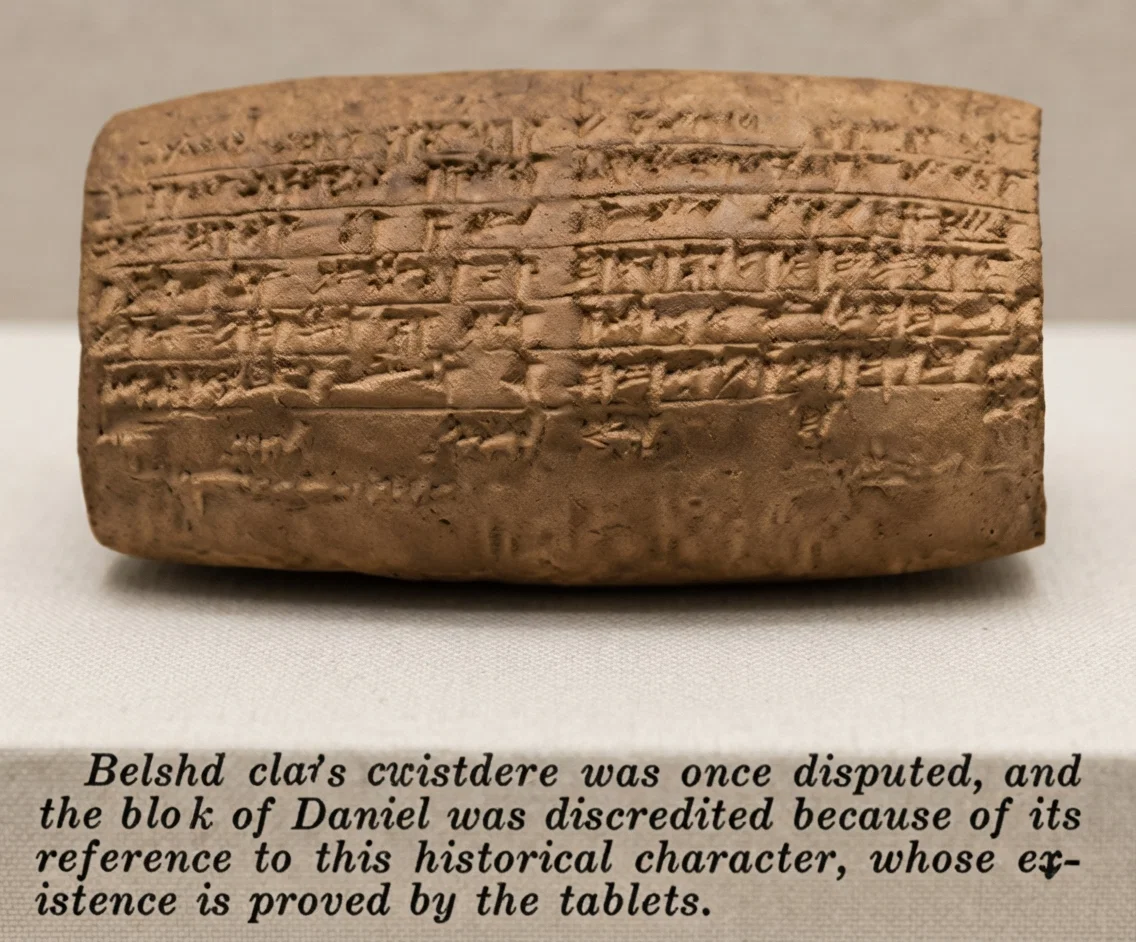
Column II. After addressing the god Sin, he says further: "As for me, Nabonidus, the king of Babylon, preserve me from sinning against thy great divinity, and grant me the gift of a life of long days; and plant in the heart of Bilu-sarra-utsur (Belshazzar), the eldest son, the offspring of my heart, reverence for thy great divinity, and never may he incline to sin; with fullness of life may he be satisfied."
It is thus shown that Nabonidus had more than one son, and the eldest is here mentioned by name. The latter point is now to be noticed. Why should Daniel call him king? From the "Annalistic Tablet," to be mentioned later, we know something of the affairs outside the city before and during the fatal night of the overthrow of Babylon. Nabonidus is outside the city, with the army. Ancient history shows that in other nations, some one was left at home when the ruler went on a campaign, or when old age made the selection of a successor necessary. Jehoahaphat and Jehoram, Uzziah and Jotham, are instances in Hebrew history. In medieval and modern history, we have cases of this kind. As will be shown in the discussion of Darius, there are a number of Assyrio-Babylonian words that in Aramaic mean king. For the time, Belshazzar was acting as king, or as we would say now, regent; and it was proper to address him at that time as king.
DARIUS THE MEDE
A number of quotations will be given on this point, with little comment. "That Cyrus would have subordinate rulers in the provinces is a certainty. Prof. R. D. Wilson has shown that there are five Assyrio-Babylonian [words] meaning, in the Aramaic, king. Three of these denote subordinate rulers. Any of these words might be rendered into the Hebrew by 'king.'" — Kyle, "Deciding Voice of the Monuments," page 289.
"Peace to the city did Cyrus establish, peace to all the provinces of Babylon did Gobryas his governor proclaim." — From the Annalistic Tablet.
"Not improbably also, the Gobryas of the inscriptions, whom, we are told, Cyrus made governor, and who 'appointed governors in Babylonia,' is the long-sought-for 'Darius the Mede,' who received the kingdom, and reigned for two years." — Orr, "Problems of the Old Testament," page 430.
"Many scholars maintain that 'Gabaru,' the original form of 'Gobryas,' is to be identified with 'Darius.' This is at least not impossible." — Price, "Monuments and the Old Testament," page 245.
"Darius the Mede was sixty years old at the time he became sovereign of Babylon, and reigned two years only, when he died, and was succeeded by Cyrus." — "Hales's Chronology," volume 2, page 508. Quoted in Bliss's "Sacred Chronology," page 149.
From “Light on the Old Testament,” by Clay
From Ezra 6: 2, we learn that the original copy of Cyrus's decree was not found in Babylon or Susa, but in Ebatana, a city of Media. Some one must have taken it there. Why not Gobryas, who was formerly governor in that section of the empire? It is not maintained that we have all the proof necessary, but all information thus far is in favor of Daniel. "Let those who have a more credible theory produce it."
THE JERUSALEM SIEGE AND THE BOOK OF KINGS
The next topic is the charge that the siege of Jerusalem is not mentioned in the book of Kings. If this charge were true — which it is not — the long record in 2 Chronicles 36 ought to be sufficient to satisfy any one desirous for the truth of the matter. In 2 Kings 24: 1 we read, "In his [Jehoiakim's] days Nebuchadnezzar king of Babylon came up, and Jehoiakim became his servant three years; then he turned and rebelled against him." It is true that the word "siege" is not found in this verse, but the event is plainly specified. In the section on the invasion of Shishak, the record in Chronicles has been proved true. Why not here, even if Kings did not mention it?
NEBUCHADNEZZAR AND BELSHAZZAR
The next point concerns calling Belshazzar the son of Nebuchadnezzar.
"By the well-known Oriental usage of those times, and of all times down to the present, the words 'father' and 'son' both may denote less immediate relationships among us, and may even be used of official precedence or succession. The Bedouins of the desert call young men of a party 'sons,' and an older man the 'father.' . . . There is much evidence which points to a daughter of Nebuchadnezzar as the wife of Nabonidus and mother of Belshazzar. There is here no impossibility or even improbability in Daniel's account of Belshazzar's descent." — Kyle, "Deciding Voice of the Monuments," pages 287 and 288.
In the inscription of Shalmaneser II, he calls Jehu the "son of Omri." This phrase "has no more significance than to designate
Jehu as Omri's successor on the throne of Israel." — Price, "Monuments," page 155.
As Daniel spells "Nebuchadnezzar" with an n, it is said that it must have been written about 370 years later than his time. Ezra spells it with an n, so do Kings and Chronicles. Jeremiah spells it that way seven times out of sixteen. Ezra was written before the time that the critics claim Daniel was written. But Jeremiah preceded Daniel, and his n's give the point away.
PRESENCE OF GREEK WORDS
Another reason assigned by the critics for the late writing of the book was the presence of Greek words. Under this topic we give Professor Driver's argument:
"The verdict of the language of Daniel is thus clear. The Persian words presuppose a period after the Persian empire had been well established; the Greek words demand, the Hebrew supports, and the Aramaic permits a date after the conquest of Palestine by Alexander the Great, B. C. 332." See his introduction, page 476, and "The Book of Daniel," page 63, quoted in Anderson's "Daniel in the Critics' Den," page 343.
These Greek words are names of musical instruments, mentioned in chapter 3. On this point, Dr. Pusey says, "It is now conceded that there are neither Greek words nor Grecisms, beyond the names of two or three musical instruments." He then explains how the mistake was made of the finding of other supposed Greek words, which he says was due to the lack of knowledge of philology. He also gives proof necessary for the dropping of those words. We quote again from him:
"There is nothing stranger in our finding Greek instruments of music in Nebuchadnezzar's time of Babylon than names of Indian animals and of an Indian tree reaching Jerusalem under Solomon." — "Lectures on Daniel the Prophet," pages 23-35, edition 1869.
There is an abundance of evidence from the monuments that Greek culture and traders were found in these countries in the days of Sargon and Sennacherib, in the eighth century before Christ.
NEBUCHADNEZZAR TELLS OF HIS ABSENCE
We here give Nebuchadnezzar's own account of his absence from attendance to royal affairs, as found in his Standard Inscription:
"Four years . . . the seat of my kingdom in the city . . . which . . . did not rejoice my heart. In all my dominions I did not build a high place of power; treasures I did not lay up. In Babylon buildings for myself I did not lay out. In the worship of Merodach, my lord, I did not sing praises. I did not furnish his altars nor clear canals." — "New Schaff-Herzog Encyclopedia," volume 3, article "Daniel."
What is known as the "Annalistic Tablet" of Cyrus was mentioned earlier in the article. It was found by Mr. Pinches in 1880. It gives a summary of the reign of Nabonidus and his defeat by Cyrus. Much useful and interesting information is derived from this source. Here we learn the month and even the day of the month that Gobryas entered Babylon, and also of the death of the king's son. Cyrus did not enter the city until a few months later.
In addition to this tablet, Cyrus wrote on a cylinder an account of the capture of the city, which record corresponds in a general way to the one written by Nabonidus, dealing with the same event.
HOPE TO AWAKEN INQUIRY
The monuments do not make every point of Daniel plain beyond the shadow of a7doubt. The remarkable thing is that there is as much evidence as there is. Many objections to the book have not been mentioned at all, and it is also true that there are facts not given from archæology that are in favor of Daniel.
These articles have dealt with archæological evidence that covers the period of Old Testament history from creation to the rise of the Medo-Persian empire, after which there is no need of such evidence. The claim is not made that all objections have been fully met, neither that all objections were mentioned, or all archæological evidence given. The field has been at least opened, and perhaps the interest has been aroused on the part of the reader to investigate the subject more fully for himself. The primary object of this series has been to increase our faith in the Bible as a revelation of God to man, an inspired record of all that is necessary for salvation.