Man's Sin and Saviour

5%

Pacific Press Publishing Association · Mountain View, California · Sep 6, 1910

FromSigns of the Times, Vol. 37, No. 35.

Read the full edition

Man's Sin and Saviour

IX. The Year's Service

THE ancient sanctuary service, which was the Gospel in type, completed a specific round every year. Morning and evening sacrifice, offered at a stated hour, was continual. Whatever happened, this service was never omitted. It was the atonement for sin committed by the whole congregation, tho that sin never came to their knowledge. No individual among the tribes of Israel was responsible for this offering, nor did any individual, save the priest, lay his hand upon the offering in confession of sin. Other offerings, as we noticed in a previous article, were of an individual nature and were brought to the priest by the person involved.
At the end of the sacred year, on the tenth day of the seventh month, was the Day of Atonement, the most important, most sacred, and most vital of all the days of the year, for on this day every man's destiny was determined. On this day every Israelite having reached the age of accountability, must make a final decision whether he would rid himself from sin, have atonement made for every transgression, and begin the new year with a clean record, or whether his name should be everlastingly cut off from the book of God's remembrance as one of His people. And to the present day, the Jew, tho he has wandered far from God's ancient teachings, unless he be entirely reprobate, will close his place of business before the setting of the sun on the evening of the ninth day of the seventh month, and will fast and pray and make confession until the sunset of the tenth, thus showing that there still remains in the mind of the Hebrew the solemn import of God's ancient teaching in regard to the Day of Atonement.

The Daily Service

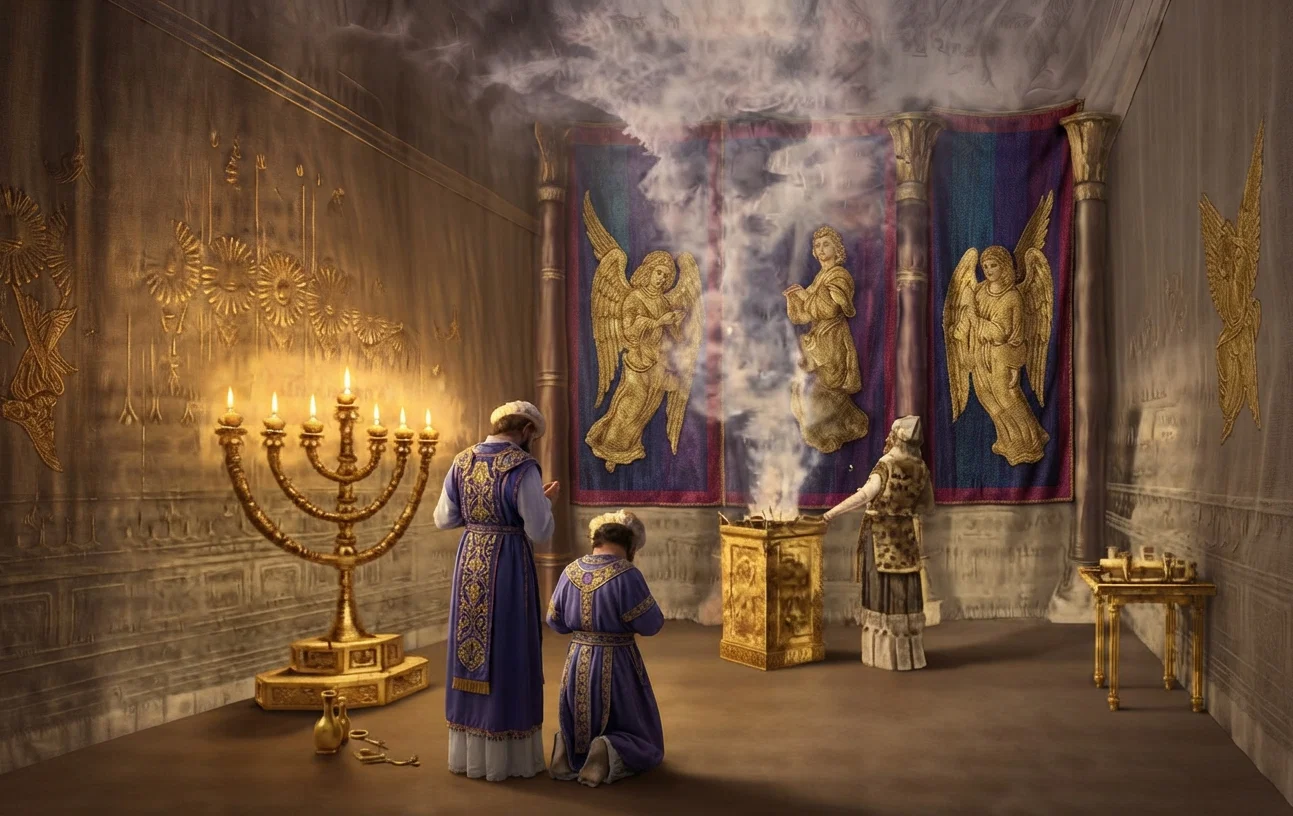
In chapters twenty-eight and twenty-nine of the book of Numbers, the morning and evening sacrifice, lately referred to, is called "a continual burnt offering." "It is a continual burnt offering, which was ordained in Mount Sinai for a sweet savor, a sacrifice made by fire unto the Lord." Num. 28:6. And tho numerous other offerings are mentioned in these two chapters, yet at the conclusion of any given offering, the Lord specifically declares that such and such an offering is to be made "besides the continual burnt offering and his drink-offering." Thus at least sixteen times in these two chapters the Lord makes clear the fact that this offering for all the tribes of Israel is, or was, continual.Not only were these offerings continual, but from Num. 4:7 we find that the showbread, or bread of the presence, is called "the continual bread." Likewise, the same expression is used in 2 Chron. 2:4. In Lev. 24:4, speaking of the golden candlestick and Aaron's command pertaining thereto, God says, "He shall order the lamps upon the pure candlestick before the Lord continually."
THE HOLY PLACE OF THE EARTHLY TABERNACLE
The incense is called, in Ex. 30:8, perpetual incense. "He shall burn incense upon it, a perpetual incense before the Lord throughout your generations." Thus we have continual burnt offerings, continual showbread, the lamps burning continually, and the incense perpetually rising with the prayers of Israel before the throne of God.
Now as a type of our great High Priest, Jesus Christ, who has ascended into the heavens, there to appear in the presence of God for us, sat Aaron the high priest, and upon Aaron's breast were borne the breastplate composed of twelve stones representing the twelve tribes of Israel. "And thou shalt put in the breastplate of judgment the Urim and the Thummim; and they shall be upon Aaron's heart, when he goeth in before the Lord: and Aaron shall bear the judgment of the children of Israel upon his heart before the Lord continually." Ex. 28:30. Thus Aaron in the type, and Christ in the antitype, bear the sins of all God's people upon the heart before the Lord continually. Says Jesus through His prophet Isaiah: "Can a woman forget her sucking child, that she should not have compassion on the son of her womb? yea, they may forget, yet will I not forget thee. Behold, I have graven thee upon the palms of My hands; thy walls are continually before Me."

An Abiding Saviour

Without this continual provision made for sin, without the abiding presence of Christ day and night continually before the throne of God, some poor sinner might, in a special time of need, find his Advocate off duty. Were Christ as feeble as man, or did He need the recuperation of sleep by night, and a summer vacation by the seaside, as many of His under-shepherds feel they do; did He have office hours, or times when He could be seen or not seen,— then might earth's sorrowful inhabitants be anxious concerning the possibility of their being heard before the courts above. But, thank Heaven, it is not so with Christ. "But this Man, because He continueth ever, hath an unchangeable priesthood. Wherefore He is able also to save them to the uttermost that come unto God by Him, seeing He ever liveth to make intercession for them." "Who needeth not daily, as those high priests, to offer up sacrifice, first for His own sins, and then for the people's: for this He did once, when He offered up Himself." Heb. 7:24, 25, 27.
But the continual service of Christ, our Advocate, in the courts above, and the type in the earthly sanctuary which pointed to that continual service, would be incomplete if our "continual" or "perpetual" service were omitted. God intends that when He makes continual provision for the forgiveness of sin, for the cleansing of iniquity, and for the upholding of sinful man against the power of Satan's temptations, our services should also be continual. The Bible records at least one man whose service was of this kind, and even the heathen among whom he lived recognized this fact. For did not Darius, king of the Medes, say to the prophet Daniel, "Thy God whom thou servest continually, He will deliver thee"? And also, "Is thy God, whom thou servest continually, able to deliver thee from the lions?" Dan. 6:16, 20. And every child remembers that Daniel's God, whom he served continually, was not only able to deliver him from the lions, but did deliver him grandly.
To serve God to-day and desert Him tomorrow, only to call upon His mercy the day following, to desert Him again, shows neither gratitude nor trust. To claim that forgiveness of sin carries with it no power to recover one from the snares of sin, to deliver one from its control, is in a word to make Christ the minister of sin. But He came to save His people from their sins. He caused it to be written, "Sin shall not have dominion over you." Rom. 6:14. And even of the weakest one God has spoken, saying, "Yea, he shall be holden up: for God is able to make him stand." Rom. 14:4.
"Now unto Him that is able to keep you from falling, and to present you faultless before the presence of His glory with exceeding joy, to the only wise God our Saviour, be glory and majesty, dominion and power, both now and ever. Amen." Jude 24, 25.

The Day of Atonement

As already mentioned, the Day of Atonement with ancient Israel was a final balancing of accounts with the most high God. Day after day, through the entire year, through the blood of the sacrifices, the record had been made, in the sanctuary, of sin and its remedy; but the final disposition of sin and its record was not made until the tenth day of the seventh month of the Jews' year. On this day a final atonement was made for the sins, first, of the priests, and then of the people. For Aaron and his sons a bullock was offered; and for the people, a goat.
On this day, and no other, the high priest went into the most holy place, the second apartment of the sanctuary, which contained the ark of God's covenant, and the Ten Commandments, which had been transgressed in every sin committed during the year. Seven times was the blood of the atonement sprinkled upon the mercy-seat covering the ark; and this indicated that complete satisfaction had been made for all the transgressions of every repentant sinner. Coming out of the sanctuary, Aaron bore upon himself, in figure, the sins of all the people; and approaching the scapegoat, he placed both his hands upon his head, and confessed over him all the iniquities of the children of Israel, and all their transgressions in all their sins, putting them upon the head of the goat, and then sent him away, by the hand of a fit man, into the wilderness. And the goat shall "bear upon him all their iniquities unto a land not inhabited: and he shall let go the goat in the wilderness." Concerning this latter work we shall have more to say in a future article.
This Day of Atonement was otherwise known as the day of cleansing the sanctuary. Aaron was to "cleanse it, and hallow it from the uncleanness of the children of Israel;" also, "on that day shall the priest make an atonement for you [said the Lord], to cleanse you, that ye may be clean from all your sins before the Lord." Hence it was, that both the sanctuary and the people were cleansed, the one from the record of sin, and the other from sin itself. This record of the cleansing of the sanctuary and people from sin on the tenth day of the seventh month is found complete in the sixteenth chapter of Leviticus, from which the above quotations are taken. This was final with every member of the congregation of Israel; and that no man might pass that day without making his record clear and having final atonement made for himself, is evident from the following words: "For whatsoever soul it be that shall not be afflicted in that same day, he shall be cut off from among his people." Lev. 23:29.
This service has also its antitype; and therefore the time must come, in the plan of Christ's redemption for sinners, when all the congregation of the Lord throughout the whole earth must finish their transgression and make an end of sins. But as in the type their cleansing and expiation from the guilt of sin was not due to any act of righteousness performed on their part, so with the antitype; when the time shall come for God to close the record of sin for this whole world, it will be only by the atonement of the blood of Christ that sins will be forgiven, the soul temple cleansed, and the sinner sealed for eternity.
[The next article in this series is entitled "Christ's Sacrifice and Priesthood."]