Evidence of Its Observance All Through the Patriarchal Age — Thousands of Individual Miracles Designated It in the Wilderness — Specifically Defined at Least Thirty Days Before Sinai
By GEORGE I. BUTLER
HAVING considered, in a previous article, the origin of the Sabbath, let us now notice its existence during the times of the patriarchs.
For convenience, man has divided human history into three great divisions, the patriarchal, the Mosaic, and the Christian dispensation. These terms are not directly used in the Scriptures. Yet, in God's dealing with the human family, there were special characteristics which distinguish one period from another. The patriarchal embraces the time from the creation to the giving of the law in the days of Moses; the Mosaic reaches to the crucifixion of Christ; and the Christian, from that time till Jesus comes again.
We are left largely in ignorance as to the existence of books previous to the time of Moses. There is a general agreement that Moses was inspired to write the book of Genesis. The value of that book, to the human family, is almost infinite, as it contains all we know of the beginning of this world, and of God's dealings with the human family up to the time of the Exodus. Every person who truly believes the Bible, will accept the Mosaic account of creation and the patriarchal history.
STEPS IN MAKING THE SABBATH
We saw last week that in the making of the Sabbath there were three steps or events:
1. God rested, on the seventh day of creation week, from all His labors of creation. That day became Jehovah's rest day, or Sabbath day.
2. At the close of that rest, He blessed the seventh day of the week for all future time, on its return in each weekly cycle. It became God's blessed rest or Sabbath day. It was a better day than the six "working-days" (Eze. 46: 1), because devoted to higher and holier uses.
3. He sanctified this day of His rest. To sanctify is to set apart for holy or religious use. The exact meaning of the term, the very essence of it, made known, to those who were to use this seventh day of the week, the fact that it was set apart, by God and Christ, to a sacred use, and their duty so to regard it.
When the Sabbath was thus made, Adam and Eve were the only persons living. They were the representatives of all who afterward derived existence from them.
IT WAS BEFORE MAN FELL
It is a fact never to be overlooked, that this act of setting apart the Sabbath in the Garden of Eden was before the fall of man — yea, before sin entered. The two institutions, the Sabbath and marriage, were both originated previous to the fall of man and the entrance of sin. Adam and Eve were therefore fully acquainted with the sacredness of the seventh-day Sabbath, as it was made immediately after their creation, and was made for them, as the representatives of our race in its innocence, before sin existed in our world.
To this holy pair God's instructions were given for the benefit of their descendants. We know not how soon sin entered Eden. We can not reasonably suppose it entered immediately after their creation and the prohibition of eating the fruit of the tree of knowledge. We could more easily believe that some time elapsed before they ventured to disobey their Creator. The sacredness of the Sabbath, made known to them by their [[FIGURE]] heavenly Father, must have been a prominent fact of their life in Eden before sin entered.
The principles of God's holy law of Ten Commandments existed in reality from creation, as the relation of Adam and Eve to God as their Creator existed, and their relation to each other would necessarily exist. Their first duty was to love with all their hearts the God who had given them existence, and also to love each other.
GREW OUT OF DEFINITE RELATIONS
These two great principles grew out of their relation to God and to each other. The ten precepts are embraced in those two principles of love to God and love to man. The Sabbath must have been made the most prominent of all the ten, as God must have told them of its existence and sacredness. Its sanctification really consisted in making known the facts of God's resting upon the seventh day, His blessing the day, and their duty in its observance. This institution stands out more prominently in their experience than the observance of any other precept of the ten.
In process of time, after sin entered, Cain and Abel were born, and grew up to manhood. One followed the occupation of raising fruits and other things that grew from the earth. The other was a shepherd and herdsman. How long a time elapsed previous to the events connected with Cain's murder of Abel, we have no means of knowing, but it must have been scores of years. After his murder of his brother, he became a wanderer in the earth. Then Seth was born, through whom came a race of patriarchs who loved and feared God. Seth's descendants called themselves sons of God, while Cain's descendants were called sons and daughters of men. Gen. 4: 26, margin; also Gen. 6: 1, 2, 4. The families of Cain and Seth seem to have lived apart until just before the Flood. In that period of extreme wickedness, they commingled more or less.
SETH AND HIS POSTERITY
Seth's posterity were servants of God for generations. Some of these patriarchs were remarkable for piety. Enoch, the seventh from Adam, was so devoted a servant of Jehovah that it is said of him he walked with God three hundred years, and was not, for God took him. Gen. 5: 22-24. He was the first man translated without seeing death. Heb. 11: 5. He was a believer in the second coming of Christ. Jude 14.
"Walking with God" must signify a complete harmony of being and practise between the great God and His loving, faithful servant. Every command of God must have been faithfully obeyed. Therefore Enoch kept that Sabbath which was "made for man."
Noah was another honored patriarch. It is said of him, "Noah was a just man and perfect in his generations, and Noah walked with God." Gen. 6: 9. This statement could not be true of Noah if he had not obeyed God in every particular. Noah therefore must have kept the Sabbath which God made for man.
Abraham, the father of the faithful, who was true to the God of heaven after his ancestors had gone into idolatry (Joshua 24: 2), must have been an observer of the seventh-day Sabbath; for it is said of him, "Abraham obeyed My voice, and kept My charge, My commandments, My statutes, and My laws." It follows, from this statement, that God had "commandments," "statutes," and "laws" in Abraham's time, and one of these was certainly that enjoining the observance of the seventh-day Sabbath. He had made this institution more prominent than any other, at the very creation of the world; and Abraham therefore had the Sabbath, and kept it. His descendants, Isaac, Jacob, and the twelve patriarchs, had the Sabbath, and kept it also, at least those who sought to serve God.
TIME RECKONED BY WEEKS
The custom of reckoning time by weeks was in existence in that age. Laban, Jacob's uncle, in giving his daughters to Jacob for wives, said, "Fulfil her week, and we will give thee this also." Gen. 29: 27, 28. The existence of the weekly reckoning of time necessarily demonstrates the existence of the Sabbath, the institution which gave the origin to the weekly reckoning of time. Though Laban was no saint, he knew of the Sabbath which God made for man, and no doubt he paid some degree of respect to it.
PHARAOH COMPLAINED OF THEIR RESTING
All are familiar with the fact of the children of Israel's going down into Egypt, and finally becoming bondsmen to the Egyptians, and that Moses was called of God to act as their leader in this deliverance.
The first complaint Pharaoh made to Moses and Aaron was that they hindered the people from their work.
We can not see that Moses and Aaron interfered with the work of the Israelites on ordinary days; but in counseling them to return to the Lord and serve Him better, no doubt they did advise them to refrain from work on the Sabbath. In their long, grievous bondage, probably they were required to work on the Sabbath. Their lot was perplexing and hard. Moses and Aaron doubtless pointed out their failures, and counseled them to cease their work on the Sabbath. So the king complained loudly.
They were finally permitted to take their departure for the promised land. Some4## The Sabbath Previous to Sinai
(Continued from page 3)
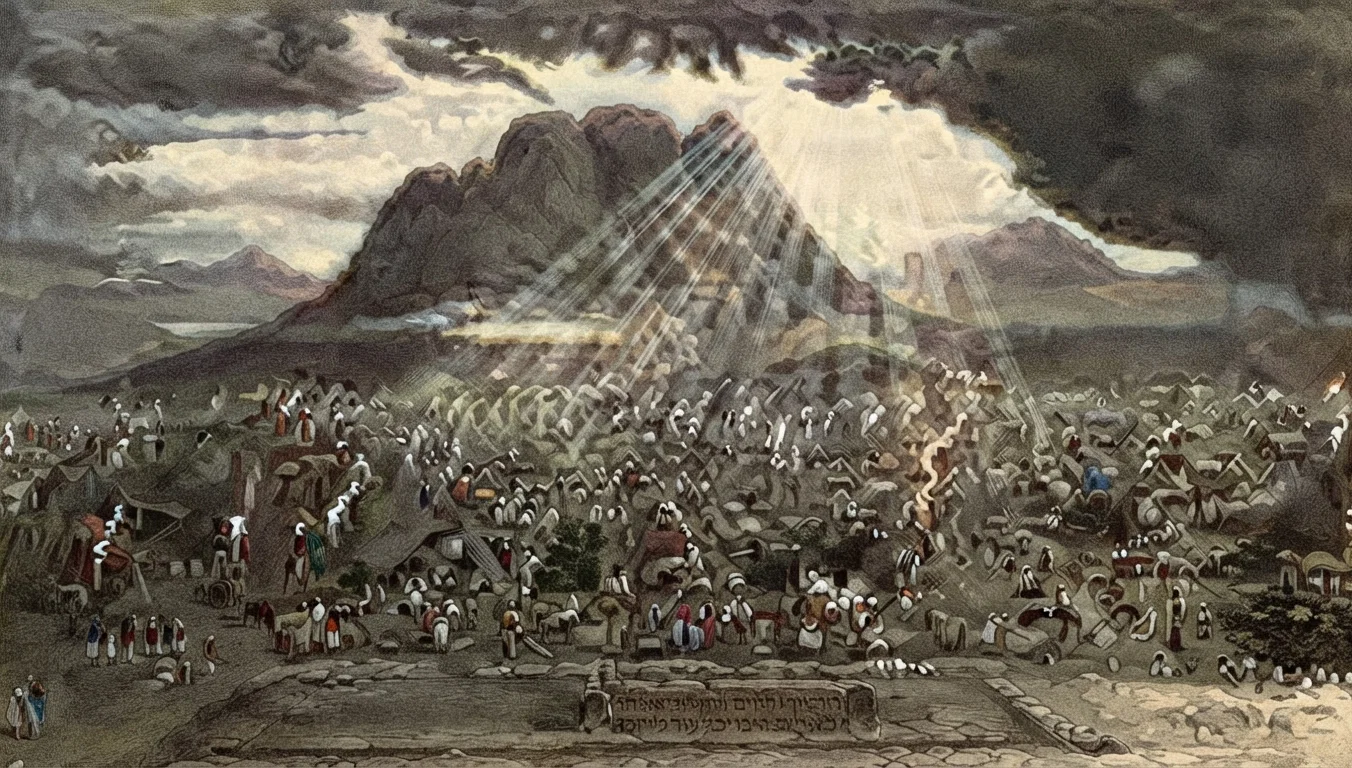
thirty days before they reached Mount Sinai, God gave them manna for their sustenance. In the giving of this food to them, God took occasion to impress upon them forcibly the importance of observing the Sabbath. On the six days of each week, the manna fell, and they were to gather it for their eating. On the sixth day, a double portion of it was given. None whatever fell on the Sabbath.
"Then said the Lord unto Moses, Behold, I will rain bread from heaven for you; and the people shall go out and gather a certain rate every day, that I may prove them, whether they will walk in My law, or no. And it shall come to pass, that on the sixth day they shall prepare that which they bring in; and it shall be twice as much as they gather daily. . . . And it came to pass, that on the sixth day they gathered twice as much bread, two omers for one man: and all the rulers of the congregation came and told Moses.
"And he said unto them, This is that which the Lord hath said, . . . Six days ye shall gather it; but on the seventh day, which is the Sabbath, in it there shall be none. And it came to pass, that there went out some of the people on the seventh day for to gather, and they found none. And the Lord said unto Moses, How long refuse ye to keep My commandments and My laws? See, for that the Lord hath given you the Sabbath, therefore He giveth you on the sixth day the bread of two days; abide ye every man in his place, let no man go out of his place on the seventh day. So the people rested on the seventh day." Ex. 16: 4, 5, 22, 23, 26-30.
BEFORE THE SABBATH LAW OF SINAI
Here we have the most emphatic evidence of the existence of the seventh-day Sabbath previous to the giving of the law on Mount Sinai. It was evidently well known to the whole Israelitish people; but because of their long bondage in Egypt, some had not kept it. The following facts demonstrate this:
1. God had a law previous to Sinai, and the Sabbath commandment was an important part of that law. "How long refuse ye to keep My commandments and My laws?"
2. The giving of the manna was to be a test to demonstrate whether they would keep the Sabbath or not.
3. The giving of the manna for their sustenance was one miracle. Giving twice as much on the sixth day was another. The preservation of it on the seventh day, while5it became corrupt on other days, was a third miracle. This continued for forty years, till they reached the promised land. Joshua 5: 12. Could God possibly give stronger evidence of His regard for the Sabbath, than these thousands of miracles spread over a period of forty years?
4. The giving of the manna was not the institution of the Sabbath. The language plainly states that God had laws before this. Abraham recognized the fact that God had laws. The Sabbath was a part of those laws. That Sabbath law was instituted in Paradise, just as soon as man was made. "The Sabbath was made for man."
The seventh-day Sabbath was well known to the Gentile nations, and was recognized by them as sacred time.
Thus we see that the Sabbath was well known and kept during the patriarchal dispensation.