Cause of the Egyptian Revolution

4%

Review and Herald Publishing Association · Takoma Park Station, Washington, D. C. · Feb 26, 1914

FromReview and Herald, Vol. 91, No. 9.

Read the full edition

Cause of the Egyptian Revolution

Does the History of Turkey and Egypt Since 1798 Fulfill the Prophecy of Daniel 11: 40-44?—No. 19
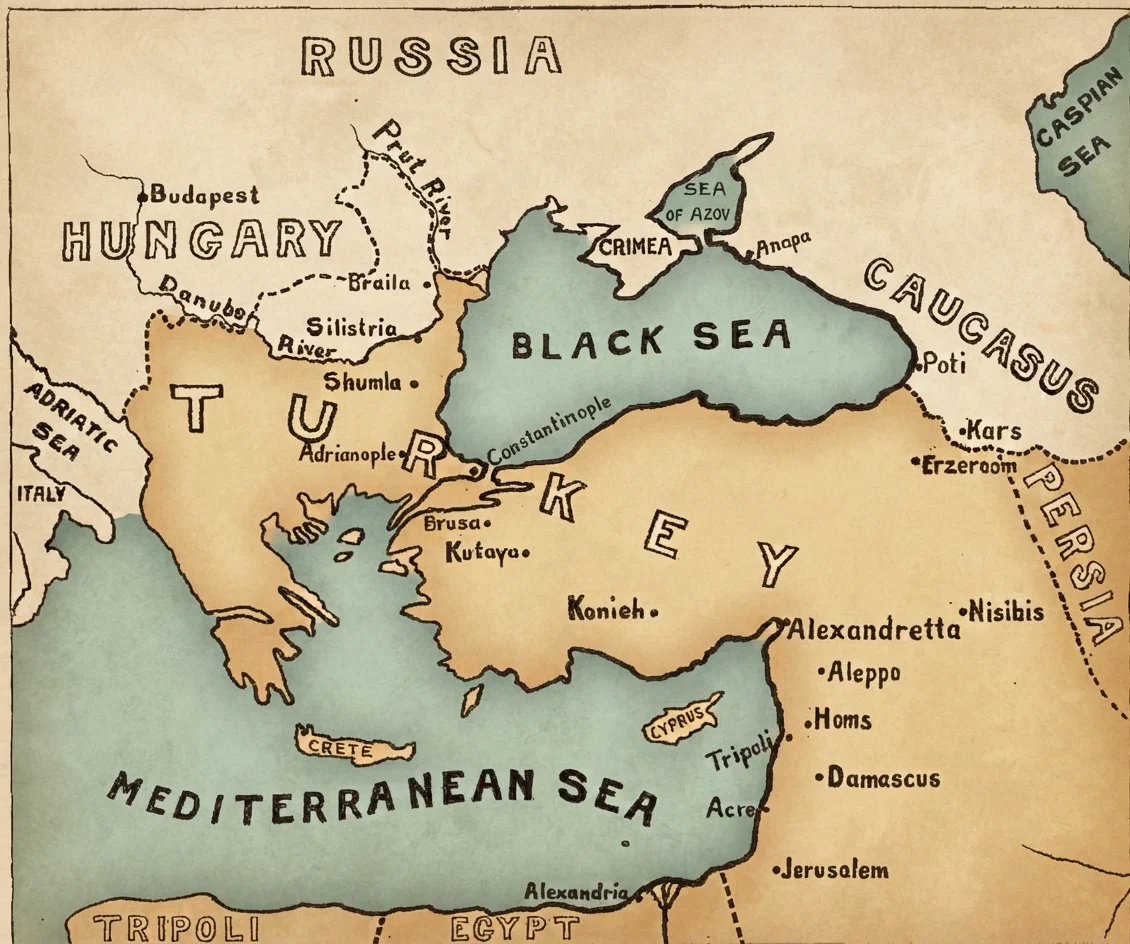
"Tidings out of the east and out of the north shall trouble him." Dan. 11:44. This was surely true of Turkey from the beginning to the close of the war with Russia in 1828-29. And when tidings came that two of her important cities, Adrianople, 125 miles northwest, and Erzerum, 600 miles east, with both in the possession of Russian generals, Turkey surrendered and signed the treaty of Adrianople.
But this did not end Turkey's troubles. While Russia was prosecuting this war against her, and wrestling territory from her northern and eastern dominions, a serious revolution was being set on foot by Mehmet Ali, governor of Egypt.
This revolution was not confined to Egypt; it was carried with success to the eastern part of the empire. It penetrated to the heart of Asia Minor, and but for the prompt and determined interference of European powers, Constantinople must surely have been taken and Mehmet Ali proclaimed sultan of Turkey. It resulted in the loss of Turkey's independence in 1840. This marked the close of the sixth trumpet of Rev. 9:13-21, which was to take place at the end of the prophetic period of "an hour, and a day, and a month, and a year." Verse 15.
DISTANCES FROM CONSTANTINOPLE
This is an event of great importance in the fulfillment of prophecy. It is full of meaning to the generation now living. The political events that resulted in the loss of Turkey's independence and marked the close of the prophetic period of the sixth seal in 1840 demand more than a brief, superficial statement. I shall, therefore, give as full an account of this part of Turkey's history as the limits of our space will permit.

Cause of the Egyptian Revolution

Of the purpose of this revolution Creasy says:—
"It was in Egypt that the most deadly storm was gathering. Mehmet Ali had resolved on founding an hereditary dominion on the ruins of the apparently doomed empire of the sultan. He had restored his navy after its destruction at Navarino; he possessed a veteran and admirably disciplined army, chiefly officered by Frenchmen; and, above all, he had a general of science, experience, prudence, and energy in his son, the celebrated Ibrahim Pasha."—"History of the Ottoman Turks," by Sir Edward Creasy, page 521.
"It was not in Europe alone that the reforming Sultan Mahmud had enemies to face. Scarcely had he ended the war with the Greeks and signed the treaty of Adrianople with the Russians than in 1830 his prestige was wounded in Africa by the French conquest of Algiers. . . .
"Far more serious than this moral defeat was the revolt of Mehmet Ali, viceroy of Egypt, in 1831, which threatened the very existence of the Ottoman throne. The ambitious Albanian was not satisfied with the reward which he had received for his services to his suzerain during the Greek war; Crete seemed to him an inadequate equivalent for the loss of the Morea; he in vain asked the sultan to compensate his son Ibrahim with the pashalic of Damascus; and refusal made him all the more eager to obtain it."
"Mehmet Ali could contemplate with self-complacency the condition of Egypt as compared with that of the rest of the Turkish Empire. A French officer had organized his army; a French constructor had rebuilt his fleet; a French doctor had taught his physicians; he was the sole landowner, the sole manufacturer, the sole contractor in the country, where human lives were reckoned of as little account as in the time of the Pharaohs. The one thing lacking was complete independence, and the moment seemed propitious for its attainment. An excuse was readily found in the refusal of Abdullah, pasha of Acre, to give up some Egyptian refugee victims of Mehmet Ali's state socialism, who had taken refuge in the old city of the crusaders. Ibrahim thereupon invaded Syria."—"The Ottoman Empire," 1801-1913, by William Miller, M. A., pages 144, 145.
"The Porte vindicated its dignity by pointing out that the governor of oneprovince could not make himself the censor and disciplinarian of a neighboring governor, without trenching on the prerogatives of sovereignty. But these reasonings had no effect on Mehmet Ali, who was bent on the conquest of Syria, for which the acts of Abdullah were merely the pretext."
"The number of men with which Ibrahim Pasha, who was named general in chief, undertook the conquest of Syria, was far larger than that which Bonaparte led across the desert to Acre; and equaled, if it did not surpass, those with which the whole French expedition to Egypt was attempted,—amounting to six regiments of infantry, four of cavalry, and a proportionate force of artillery,—in all, between thirty and forty thousand men."
"A large squadron effected a passage by sea, carrying the heavy artillery, ammunition, and supplies, and having on board Ibrahim Pasha and his staff, including Solyman Bey (the French officer of the empire, named Selves, already mentioned); while the cavalry and the bulk of the infantry, having started for El Araish in the first days of November, 1831, crossed the desert, and having taken Gaza and Jaffa without meeting with resistance, the squadron and the army effected a rally at the latter port. Ibrahim Pasha, disembarking with his staff, took the command in person, and marched northward to Acre, where Abdullah had concentrated his strength in the hope of turning back Ibrahim, as Djezzar had turned back a greater commander [Napoleon]."
"It must be admitted that the defense of Abdullah was a gallant one. His batteries replied to those of Ibrahim from the twenty-sixth of November, when the place was first invested, until February, 1832, when, a breach having been effected, two vigorous assaults were made, but without success."
"The last terrible assault was made on the twenty-seventh day of May, after daybreak. The battle continued through the whole heat of the day, and it was not until the afternoon, when many hundred men had been killed in the breach, that the place was surrendered."
"From Acre, Ibrahim marched to Damascus, which—situated in a luxuriant valley, without any considerable fortifications, and entirely commanded from the heights of Salahieh—was abandoned to him without firing a shot, the authorities having taken to flight. This city might have proved a new Capua to the general of the Egyptian troops; but Ibrahim, halting merely to replenish his commissariat stores, pushed on to Homs, where the pasha of Tripoli had under his orders thirty thousand men, forming the vanguard of the Ottoman armies."
"It was at Homs, the first city on the road from Damascus to Aleppo, that the two armies met on the eighth of July, 1832. Ibrahim did not make the first attack; but, placing his infantry in solid masses in the center, with the cavalry and artillery at the wings, he awaited the assault of Mohammed Pasha of Tripoli, who advanced in three columns. A well-directed, deadly fire of musketry and grape was opened on the Turks as soon as they were fairly within range, and, four battalions of the Egyptian guard vigorously charging the center with the bayonet before the Turks had recovered from their confusion while at the same time the cavalry acted on the wings, the Turkish army was put to utter rout."
"The victory was complete. The camp, the commissariat stores, the baggage, and the ammunition of the Turks, along with about two thousand prisoners and thirty-six guns, fell into the hands of the Egyptians, and the army of the Sublime Porte thus becoming an utter wreck, all Syria was placed at the feet of Ibrahim."—"History of the Egyptian Revolution," by Paton, Vol. II, pages 94-97.
"At Aleppo the Ottoman commander collected the scattered battalions and led them to Alexandretta, where the Turkish fleet lay at anchor. But Ibrahim, as usual, was swift to follow up his victory. On July 17, after a series of forced marches, he entered Aleppo; on July 29 he came up with Hussein himself, strongly posted in the Pass of Beilan near the sea. Once more the Egyptian arms were completely victorious; all Syria was lost to the sultan; and the vanguard of the Egyptian army, under Abbas, the future khedive, was free to pass the mountains and occupy Adana, in Asia Minor. The news of these crushing defeats struck the seraglio with consternation."—"Cambridge Modern History," Vol. X, pages 549-562.
"All Syria was lost to the sultan." Syria was a large and important division of the eastern part of the Turkish Empire. It extended from the borders of Egypt in the south almost to the Black Sea in the north, and from the Taurus mountain range in the west to the Euphrates River and Mesopotamia in the east. The revolt in Egypt, the southern part of the empire, had been a matter of regret and vexation at Constantinople, but not of serious alarm. But when this revolt was carried with uninterrupted success by the Egyptian pasha into upper Syria, the eastern division of Turkey, "the news [tidings] of these crushing defeats struck the seraglio [headquarters of the sultan] with consternation." Thus "tidings out of the east" continued to trouble him.