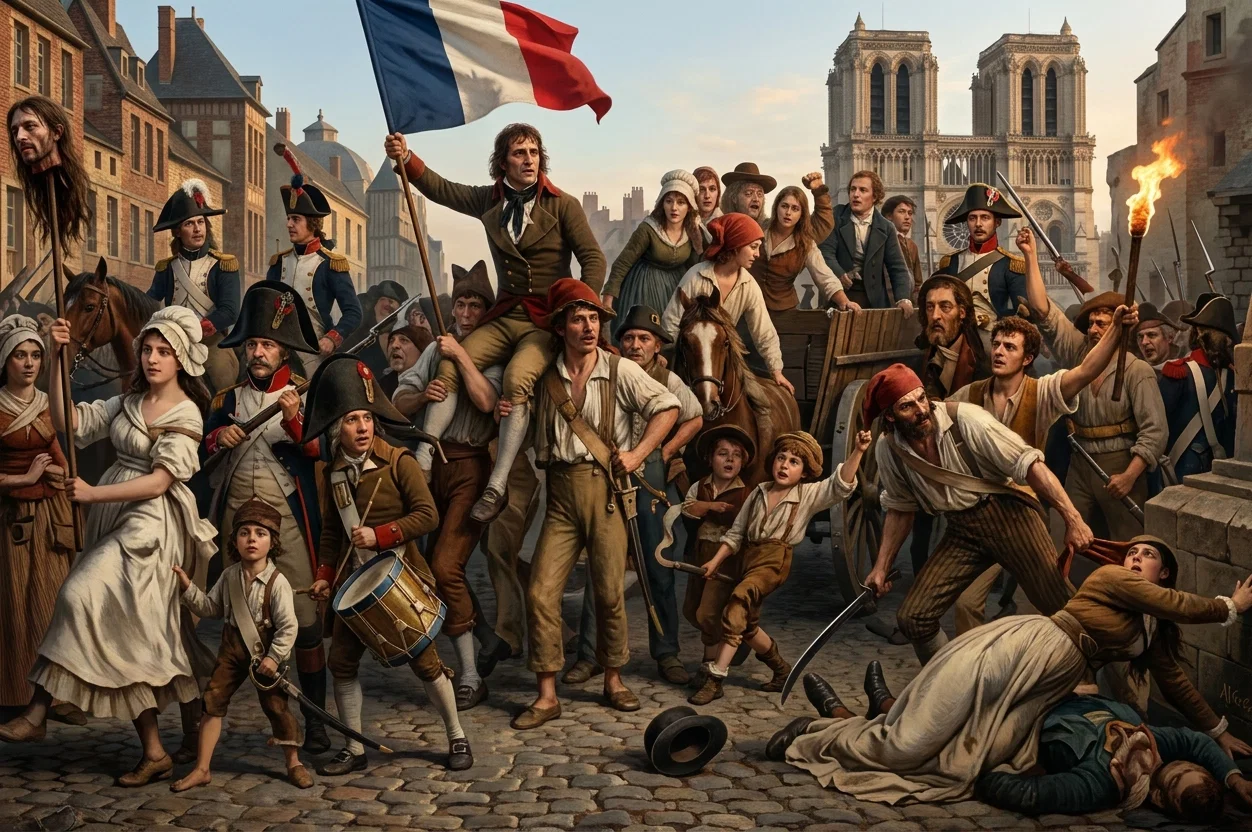
All too well the people had learned the lessons of cruelty and torture which Rome had so diligently taught. A day of retribution at last had come. It was not now the disciples of Jesus that were thrust into dungeons and dragged to the stake. Long ago these had perished or been driven into exile. Unsparing Rome now felt the deadly power of those whom she had trained to delight in deeds of blood. “The example of persecution which the clergy of France had exhibited for so many ages, was now retorted upon them with signal vigor. The scaffolds ran red with the blood of the priests. The galleys and the prisons, once crowded with Huguenots, were now filled with their persecutors. Chained to the bench and toiling at the oar, the Roman Catholic clergy experienced all those woes which their church had so freely inflicted on the gentle heretics.”
“Then came those days when the most barbarous of all codes was administered by the most barbarous of all tribunals; when no man could greet his neighbors, or say his prayers . . . without danger of committing a capital284crime; when spies lurked in every corner; when the guillotine was long and hard at work every morning; when the jails were filled as close as the holds of a slave-ship; when the gutters ran foaming with blood into the Seine. . . . While the daily wagon-loads of victims were carried to their doom through the streets of Paris, the proconsuls, whom the sovereign committee had sent forth to the departments, reveled in an extravagance of cruelty unknown even in the capital. The knife of the deadly machine rose and fell too slow for their work of slaughter. Long rows of captives were mowed down with grape-shot. Holes were made in the bottom of crowded barges. Lyons was turned into a desert. At Arras even the cruel mercy of a speedy death was denied to the prisoners. All down the Loire, from Saumur to the sea, great flocks of crows and kites feasted on naked corpses, twined together in hideous embraces. No mercy was shown to sex or age. The number of young lads and of girls of seventeen who were murdered by that execrable government is to be reckoned by hundreds. Babies torn from the breast were tossed from pike to pike along the Jacobin ranks.” In the short space of ten years, millions of human beings perished.
All this was as Satan would have it. This was what for ages he had been working to secure. His policy is deception from first to last, and his steadfast purpose is to bring woe and wretchedness upon men, to deface and defile the workmanship of God, to mar the divine purposes of benevolence and love, and thus cause grief in Heaven. Then by his deceptive arts he blinds the minds of men, and leads them to throw back the blame of his work upon God, as if all this misery were the result of the Creator’s plan. In like manner, when those who have been degraded and brutalized through his cruel power achieve their freedom, he urges them on to excesses and atrocities. Then this picture of unbridled license is pointed out by tyrants and oppressors as an illustration of the results of liberty.
When error in one garb has been detected, Satan only masks it in a different disguise, and multitudes receive it as eagerly as at the first. When the people found Romanism to be a deception, and he could not through this agency lead them to transgression of God’s law, he urged them to regard all religion as a cheat, and the Bible a fable; and casting aside the divine statutes, they gave themselves up to unbridled iniquity.
The fatal error which wrought such woe for the inhabitants of France was the ignoring of this one great truth: that true freedom lies within the proscriptions of the law of God. “O that thou hadst hearkened to my commandments! then had thy peace been as a river, and thy righteousness as the waves of the sea.” “There is no peace, saith the Lord, unto the wicked.” “But whoso hearkeneth unto me shall dwell safely, and shall be quiet from fear of evil.”
Atheists, infidels, and apostates oppose and denounce God’s law; but the results of their influence prove that the well-being of man is bound up with his obedience of the divine statutes. Those who will not read the lesson from the book of God, are bidden to read it in the history of nations.
When Satan wrought through the Romish Church to lead men away from obedience, his agency was concealed, and his work was so disguised that the degradation and misery which resulted were not seen to be the fruit of transgression. And his power was so far counteracted by the working of the Spirit of God, that his purposes were prevented from reaching their full fruition. The people did not trace the effect to its cause, and discover the source of their miseries. But in the Revolution, the law of God was openly set aside by the national council. And in the reign of terror which followed, the working of cause and effect could be seen by all.
When France publicly prohibited the Bible, wicked men and spirits of darkness exulted in their attainment of the object so long desired,—a kingdom free from the restraints286of the law of God. Because sentence against an evil work was not speedily executed, therefore the heart of the sons of men was “fully set in them to do evil.” But the transgression of a just and righteous law must inevitably result in misery and ruin. Though not visited at once with judgments, the wickedness of men was nevertheless surely working out their doom. Centuries of apostasy and crime had been treasuring up wrath against the day of retribution; and when their iniquity was full, the despisers of God learned too late that it is a fearful thing to have worn out the divine patience. The restraining Spirit of God, which imposes a check upon the cruel power of Satan, was in a great measure removed, and he whose only delight is the wretchedness of men, was permitted to work his will. Those who had chosen the service of rebellion, were left to reap its fruits, until the land was filled with crimes too horrible for pen to trace. From devastated provinces and ruined cities a terrible cry was heard,—a cry of bitterest anguish. France was shaken as if by an earthquake. Religion, law, social order, the family, the State, and the Church,—all were smitten down by the impious hand that had been lifted against the law of God. Truly spake the wise man: “The wicked shall fall by his own wickedness.” “Though a sinner do evil an hundred times, and his days be prolonged, yet surely I know that it shall be well with them that fear God, which fear before him; but it shall not be well with the wicked.” “They hated knowledge, and did not choose the fear of the Lord;” “therefore shall they eat of the fruit of their own way, and be filled with their own devices.”
God’s faithful witnesses, slain by the blasphemous power that “ascendeth out of the bottomless pit,” were not long to remain silent. “After three days and a half, the Spirit of life from God entered into them, and they stood upon their feet; and great fear fell upon them which saw them.” It was in 1793 that the decree which prohibited the Bible passed the287French Assembly. Three years and a half later a resolution rescinding the decree, and granting toleration to the Scriptures, was adopted by the same body. The world stood aghast at the enormity of guilt which had resulted from a rejection of the Sacred Oracles, and men recognized the necessity of faith in God and his Word as the foundation of virtue and morality. Saith the Lord, “Whom hast thou reproached and blasphemed? and against whom hast thou exalted thy voice, and lifted up thine eyes on high? even against the Holy One of Israel.” “Therefore, behold, I will this once cause them to know, I will cause them to know mine hand and my might; and they shall know that my name is Jehovah.”
Concerning the two witnesses the prophet declares further: “And they heard a great voice from heaven saying unto them, Come up hither. And they ascended up to heaven in a cloud; and their enemies beheld them.” Since France made war upon God’s two witnesses, they have been honored as never before. In 1804 the British and Foreign Bible Society was organized. This was followed by similar organizations, with numerous branches, upon the continent of Europe. In 1816, the American Bible Society was founded. When the British Society was formed, the Bible had been printed and circulated in fifty tongues. It has since been translated into more than two hundred languages and dialects. By the efforts of Bible societies, since 1804, more than 187,000,000 copies of the Bible have been circulated. For the fifty years preceding 1792, little attention was given to the work of foreign missions. No new societies were formed, and there were but few churches that made any effort for the spread of Christianity in heathen lands. But toward the close of the eighteenth century a great change took place. Men became dissatisfied with the results of rationalism, and realized the necessity of divine revelation and experimental religion. The devoted Carey, who288in 1793 became the first English missionary to India, kindled anew the flame of missionary effort in England. In America, twenty years later, the zeal of a society of students, among whom was Adoniram Judson, resulted in the formation of the American Board of Foreign Missions, under whose auspices Judson went as a missionary from the United States to Burmah. From this time the work of foreign missions attained an unprecedented growth.
The improvements in printing have given an impetus to the work of circulating the Bible. The increased facilities for communication between different countries, the breaking down of ancient barriers of prejudice and national exclusiveness, and the loss of secular power by the pontiff of Rome, have opened the way for the entrance of the Word of God. For some years the Bible has been sold without restraint in the streets of Rome, and it has now been carried to every part of the habitable globe.
The infidel Voltaire once boastingly said, “I am weary of hearing people repeat that twelve men established the Christian religion. I will prove that one man may suffice to overthrow it.” A century has passed since his death. Millions have joined in the war upon the Bible. But it is so far from being destroyed, that where there were a hundred in Voltaire’s time, there are now ten thousand, yes, a hundred thousand copies of the Book of God. In the words of an early reformer concerning the Christian church, “The Bible is an anvil that has worn out many hammers.” Saith the Lord, “No weapon that is formed against thee shall prosper; and every tongue that shall rise against thee in judgment thou shalt condemn.”
“The Word of our God shall stand forever.” “All his commandments are sure. They stand fast forever and ever, and are done in truth and uprightness.” Whatever is built upon the authority of man will be overthrown; but that which is founded upon the rock of God’s immutable Word shall stand forever.
CHAPTER XVI.
THE PILGRIM FATHERS.
The English reformers, while renouncing the doctrines of Romanism, had retained many of its forms. Thus though the authority and the creed of Rome were rejected, not a few of her customs and ceremonies were incorporated into the worship of the Church of England. It was claimed that these things were not matters of conscience; that though they were not commanded in Scripture, and hence were non-essential, yet not being forbidden, they were not intrinsically evil. Their observance tended to narrow the gulf which separated the reformed churches from Rome, and it was urged that they would promote the acceptance of the Protestant faith by Romanists.
To the conservative and compromising, these arguments seemed conclusive. But there was another class that did not so judge. The fact that these customs tended to bridge the chasm between Rome and the Reformation, was in their view a conclusive argument against retaining them. They looked upon them as badges of the slavery from which they had been delivered, and to which they had no disposition to return. They reasoned that God has in his Word established the regulations governing his worship, and that men are not at liberty to add to these or to detract from them. The very beginning of the great apostasy was in seeking to supplement the authority of God by that of the church. Rome began by enjoining what God had not forbidden, and she ended by forbidding what he had explicitly enjoined.
Many earnestly desired to return to the purity and simplicity which characterized the primitive church. They290regarded many of the established customs of the English church as monuments of idolatry, and they could not in conscience unite in her worship. But the church, being supported by the civil authority, would permit no dissent from her forms. Attendance upon her service was required by law, and unauthorized assemblies for religious worship were prohibited, under penalty of imprisonment, exile, and death.
At the opening of the seventeenth century the monarch who had just ascended the throne of England declared his determination to make the Puritans “conform, or harry them out of the land, or else worse.” Hunted, persecuted, and imprisoned, they could discern in the future no promise of better days, and many yielded to the conviction that for such as would serve God according to the dictates of their conscience, “England had ceased forever to be a habitable spot.” Some at last determined to seek refuge in Holland. Difficulties, losses, and imprisonment were encountered. Their purposes were thwarted, and they were betrayed into the hands of their enemies. But steadfast perseverance finally conquered, and they found shelter on the friendly shores of the Dutch Republic.
In their flight they had left their houses, their goods, and their means of livelihood. They were strangers in a strange land, among a people of different language and customs. They were forced to resort to new and untried occupations to earn their bread. Middle-aged men, who had spent their lives in tilling the soil, had now to learn mechanical trades. But they cheerfully accepted the situation, and lost no time in idleness or repining. Though often pinched with poverty, they thanked God for the blessings which were still granted them, and found their joy in unmolested spiritual communion. “They knew they were pilgrims, and looked not much on those things, but lifted up their eyes to Heaven, their dearest country, and quieted their spirits.”
In the midst of exile and hardship, their love and faith291waxed strong. They trusted the Lord’s promises, and he did not fail them in time of need. His angels were by their side, to encourage and support them. And when God’s hand seemed pointing them across the sea, to a land where they might found for themselves a State, and leave to their children the precious heritage of religious liberty, they went forward, without shrinking, in the path of Providence.
God had permitted trials to come upon his people to prepare them for the accomplishment of his gracious purpose toward them. The church had been brought low, that she might be exalted. God was about to display his power in her behalf, to give to the world another evidence that he will not forsake those who trust in him. He had overruled events to cause the wrath of Satan and the plots of evil men to advance his glory, and to bring his people to a place of security. Persecution and exile were opening the way to freedom.
When first constrained to separate from the English church, the Puritans had joined themselves together by a solemn covenant, as the Lord’s free people, “to walk in all his ways, made known or to be made known to them.” Here was the true spirit of reform, the vital principle of Protestantism. It was with this purpose that the Pilgrims departed from Holland to find a home in the New World. John Robinson, their pastor, who was providentially prevented from accompanying them, in his farewell address to the exiles said:—
“Brethren, we are now erelong to part asunder, and the Lord knoweth whether I shall live ever to see your faces more; but whether the Lord hath appointed that or not, I charge you before God and his blessed angels to follow me no farther than I have followed Christ. If God should reveal anything to you by any other instrument of his, be as ready to receive it as you ever were to receive any truth by my ministry; for I am very confident that the Lord hath more truth and light yet to break forth out of his Holy Word. For my part, I cannot sufficiently bewail the condition of the reformed churches,292who are come to a period in religion, and will go no farther than the instruments of their reformation. The Lutherans cannot be drawn to go any farther than what Luther saw, and the Calvinists, you see, stick fast where they were left by that great man of God, who yet saw not all things. This is a misery much to be lamented; for though they were burning and shining lights in their time, yet they penetrated not into the whole counsel of God, but were they now living, would be as willing to embrace further light as that which they first received.
“Remember your church covenant, in which you have agreed to walk in all the ways of the Lord, made known or to be made known unto you. Remember your promise and covenant with God and with one another, to receive whatever light and truth shall be made known to you from his written Word. But, withal, take heed, I beseech you, what you receive as truth. Examine it, consider it, compare it with other scriptures of truth before you receive it; for it is not possible that the Christian world should come so lately out of such thick antichristian darkness, and that perfection of knowledge should break forth at once.”
It was the desire for liberty of conscience that inspired the Pilgrims to brave the perils of the long journey across the sea, to endure the hardships and dangers of the wilderness, and with God’s blessing to lay, on the shores of America, the foundation of a mighty nation. Yet honest and God-fearing as they were, the Pilgrims did not yet comprehend the great principle of religious toleration. The freedom which they sacrificed so much to secure for themselves, they were not equally ready to grant to others. “Very few, even of the foremost thinkers and moralists of the seventeenth century, had any just conception of that grand principle, the outgrowth of the New Testament, which acknowledges God as the sole judge of human faith.” The doctrine that God has committed to the church the right to control the conscience, and to define and punish heresy, is one of the most deeply293rooted of papal errors. While the reformers rejected the creed of Rome, they were not entirely free from her spirit of intolerance. The dense darkness in which, through the long ages of her rule, popery had enveloped all Christendom, had not even yet been wholly dissipated. Said one of the leading ministers in the colony of Massachusetts Bay: “It was toleration that made the world antichristian; and the church never took harm by the punishment of heretics.” The regulation was adopted by the colonists, that only church-members should have a voice in the civil government. A kind of State church was formed, all the people being required to contribute to the support of the clergy, and the magistrates being authorized to suppress heresy. Thus the secular power was in the hands of the church. It was not long before these measures led to the inevitable result—persecution.
Eleven years after the planting of the first colony, Roger Williams came to the New World. Like the early Pilgrims, he came to enjoy religious freedom; but unlike them, he saw—what so few in his time had yet seen—that this freedom was the inalienable right of all, whatever might be their creed. He was an earnest seeker for truth, with Robinson holding it impossible that all the light from God’s Word had yet been received. Williams “was the first person in modern Christendom to assert, in its plenitude, the doctrine of the liberty of conscience, the equality of opinions before the law.” He declared it to be the duty of the magistrate to restrain crime, but never to control the conscience. “The public or the magistrates may decide,” he said, “what is due from men to men, but when they attempt to prescribe a man’s duty to God, they are out of place, and there can be no safety; for it is clear that if the magistrate has the power, he may decree one set of opinions or beliefs to-day and another to-morrow; as has been done in England by different kings and queens, and by the different popes and councils in the Roman Church; so that belief would become a heap of confusion.”
Attendance at the services of the established church was required under a penalty of fine or imprisonment. “Williams reprobated the law; the worst statute of the English code was that which did but enforce attendance upon the parish church. To compel men to unite with those of a different creed, he regarded as an open violation of their natural rights; to drag to public worship the irreligious and the unwilling, seemed like requiring hypocrisy. ‘No one,’ he said, ‘should be forced to worship, or to maintain a worship, against his own consent.’ ‘What!’ exclaimed his antagonist, amazed at his tenets, ‘is not the laborer worthy of his hire?’ ‘Yes,’ replied he, ‘from those who hire him.’”
Roger Williams was respected and beloved as a faithful minister, a man of rare gifts, of unbending integrity and true benevolence; yet his steadfast denial of the right of civil magistrates to authority over the church, and his demand for religious liberty, could not be tolerated. The application of this new doctrine, it was urged, would “subvert the fundamental state and government of the country.” He was sentenced to banishment from the colonies, and finally, to avoid arrest, he was forced to flee, amid the cold and storms of winter, into the unbroken forest.
“For fourteen weeks,” he says, “I was sorely tossed in a bitter season, not knowing what bread or bed did mean.” “But the ravens fed me in the wilderness;” and a hollow tree often served him for a shelter. Thus he continued his painful flight through the snow and the trackless forest, until he found refuge with an Indian tribe whose confidence and affection he had won while endeavoring to teach them the truths of the gospel.
Making his way at last, after months of change and wandering, to the shores of Narragansett Bay, he there laid the foundation of the first State of modern times that in the fullest sense recognized the right of religious freedom. The fundamental principle of Roger Williams’ colony, was “that every man should have the right to worship God according295to the light of his conscience.” His little State, Rhode Island, became the asylum of the oppressed, and it increased and prospered until its foundation principles—civil and religious liberty—became the corner-stones of the American Republic.
In that grand old document which our forefathers set forth as their bill of rights—the Declaration of Independence—they declared: “We hold these truths to be self-evident, that all men are created equal; that they are endowed by their Creator with certain unalienable rights; that among these are life, liberty, and the pursuit of happiness.” And the Constitution guarantees, in the most explicit terms, the inviolability of conscience: “No religious test shall ever be required as a qualification to any office of public trust under the United States.” “Congress shall make no law respecting an establishment of religion, or prohibiting the free exercise thereof.”
“The framers of the Constitution recognized the eternal principle that man’s relation to his God is above human legislation, and his right of conscience inalienable. Reasoning was not necessary to establish this truth; we are conscious of it in our own bosom. It is this consciousness, which, in defiance of human laws, has sustained so many martyrs in tortures and flames. They felt that their duty to God was superior to human enactments, and that man could exercise no authority over their consciences. It is an inborn principle which nothing can eradicate.”
As the tidings spread through the countries of Europe, of a land where every man might enjoy the fruit of his own labor, and obey the convictions of his conscience, thousands flocked to the shores of the New World. Colonies rapidly multiplied. “Massachusetts, by special law, offered free welcome and aid, at the public cost, to Christians of any nationality who might fly beyond the Atlantic ‘to escape from wars or famine, or the oppression of their persecutors.’ Thus the fugitive and the down-trodden were, by statute, made the296guests of the commonwealth.” In twenty years from the first landing at Plymouth, as many thousand Pilgrims were settled in New England.
To secure the object which they sought, “they were content to earn a bare subsistence by a life of frugality and toil. They asked nothing from the soil but the reasonable returns of their own labor. No golden vision threw a deceitful halo around their path. . . . They were content with the slow but steady progress of their social polity. They patiently endured the privations of the wilderness, watering the tree of liberty with their tears, and with the sweat of their brow, till it took deep root in the land.”
The Bible was held as the foundation of faith, the source of wisdom, and the charter of liberty. Its principles were diligently taught in the home, in the school, and in the church, and its fruits were manifest in thrift, intelligence, purity, and temperance. One might be for years a dweller in the Puritan settlements, and not “see a drunkard, nor hear an oath, nor meet a beggar.” It was demonstrated that the principles of the Bible are the surest safeguards of national greatness. The feeble and isolated colonies grew to a confederation of powerful States, and the world marked with wonder the peace and prosperity of “a church without a pope, and a State without a king.”
But continually increasing numbers were attracted to the shores of America, actuated by motives widely different from those of the first Pilgrims. Though the primitive faith and purity exerted a widespread and moulding power, yet its influence became less and less as the numbers increased of those who sought only worldly advantage.
The regulation adopted by the early colonists, of permitting only members of the church to vote or to hold office in the civil government, led to most pernicious results. This measure had been accepted as a means of preserving the purity of the State, but it resulted in the corruption of the church. A profession of religion being the297condition of suffrage and office-holding, many, actuated solely by motives of worldly policy, united with the church, without a change of heart. Thus the churches came to consist, to a considerable extent, of unconverted persons; and even in the ministry were those who not only held errors of doctrine, but who were ignorant of the renewing power of the Holy Spirit. Thus again was demonstrated the evil results, so often witnessed in the history of the church from the days of Constantine to the present, of attempting to build up the church by the aid of the State, of appealing to the secular power in support of the gospel of Him who declared, “My kingdom is not of this world.” The union of the church with the State, be the degree never so slight, while it may appear to bring the world nearer to the church, does in reality but bring the church nearer to the world.
The great principle so nobly advocated by Robinson and Roger Williams, that truth is progressive, that Christians should stand ready to accept all the light which may shine from God’s Holy Word, was lost sight of by their descendants. The Protestant churches of America—and those of Europe as well—so highly favored in receiving the blessings of the Reformation, failed to press forward in the path of reform. Though a few faithful men arose, from time to time, to proclaim new truth, and expose long-cherished error, the majority, like the Jews in Christ’s day, or the papists in the time of Luther, were content to believe as their fathers had believed, and to live as they had lived. Therefore religion again degenerated into formalism; and errors and superstitions which would have been cast aside had the church continued to walk in the light of God’s Word, were retained and cherished. Thus the spirit inspired by the Reformation gradually died out, until there was almost as great need of reform in the Protestant churches as in the Roman Church in the time of Luther. There was the same worldliness and spiritual stupor, a similar reverence for the298opinions of men, and substitution of human theories for the teachings of God’s Word.
The wide circulation of the Bible in the early part of the nineteenth century, and the great light thus shed upon the world, was not followed by a corresponding advance in knowledge of revealed truth, or in experimental religion. Satan could not, as in former ages, keep God’s Word from the people; it had been placed within the reach of all; but in order still to accomplish his object, he led many to value it but lightly. Men neglected to search the Scriptures, and thus they continued to accept false interpretations, and to cherish doctrines which had no foundation in the Bible.
Seeing the failure of his efforts to crush out the truth by persecution, Satan had again resorted to the plan of compromise which led to the great apostasy and the formation of the Church of Rome. He had induced Christians to ally themselves, not now with pagans, but with those who by their devotion to the things of this world had proved themselves to be as truly idolaters as were the worshipers of graven images. And the results of this union were no less pernicious now than in former ages; pride and extravagance were fostered under the guise of religion, and the churches became corrupted. Satan continued to pervert the doctrines of the Bible, and traditions that were to ruin millions were taking deep root. The church was upholding and defending these traditions, instead of contending for “the faith which was once delivered to the saints.” Thus were degraded the principles for which the reformers had done and suffered so much.