In November, 1850, the paper was issued at Paris, Maine. Here it was enlarged, and its name changed to that which it now bears, the Advent Review and Sabbath Herald. We boarded in Brother A.’s family. We were willing to live cheaply, that the paper might be sustained. The friends of the cause were few in numbers and poor in worldly wealth, and we were still compelled to struggle with poverty and great discouragement. We had much care, and often sat up as late as midnight, and sometimes until two or three in the morning, to read proof sheets.
Excessive labor, care, and anxiety, a lack of proper and nourishing food, and exposure to cold in our long winter journeys, were too much for my husband, and he sank under the burden. He became so weak that he could scarcely walk to the printing office. Our faith was tried to the utmost. We had willingly endured privation, toil, and suffering, yet our motives were misinterpreted, and we were regarded with distrust and jealousy. Few of those for whose good we had suffered, seemed to appreciate our efforts.
We were too much troubled to sleep or rest. The hours in which we should have been refreshed with sleep, were often spent in answering long communications occasioned by envy. Many hours, while others were sleeping, we spent in agonizing tears, and mourning before the Lord. At length my husband said:141“Wife, it is of no use to try to struggle on any longer. These things are crushing me, and will soon carry me to the grave. I cannot go any farther. I have written a note for the paper, stating that I shall publish no more.” As he stepped out of the door to carry the note to the printing office, I fainted. He came back and prayed for me. His prayer was answered, and I was relieved.
The next morning, while at family prayer, I was taken off in vision and was instructed concerning these matters. I saw that my husband must not give up the paper, for Satan was trying to drive him to take just such a step, and was working through agents to do this. I was shown that we must continue to publish, and the Lord would sustain us.
We soon received urgent invitations to hold conferences in different States, and decided to attend general gatherings at Boston, Massachusetts; Rocky Hill, Connecticut; Camden and West Milton, New York. These were all meetings of labor, but very profitable to our scattered brethren.
REMOVAL TO SARATOGA SPRINGS
We tarried at Ballston Spa a number of weeks, until we became settled in regard to publishing at Saratoga Springs. Then we rented a house and sent for Brother and Sister Stephen Belden and Sister Bonfoey, who was then in Maine taking care of little Edson, and with borrowed household stuff began housekeeping. Here my husband published the second volume of the Advent Review and Sabbath Herald.
Sister Annie Smith, who now sleeps in Jesus, came to live with us and assist in the work. Her help was needed. My husband expressed his feelings at this time in a letter to Brother Howland, dated February14220, 1852, as follows: "We are unusually well, all but myself. I cannot long endure the labors of traveling and the care of publishing. Wednesday night we worked until two o'clock in the morning, folding and wrapping No. 12 of the Review and Herald; then I retired and coughed till daylight. Pray for me. The cause is prospering gloriously. Perhaps the Lord will not have need of me longer, and will let me rest in the grave. I hope to be free from the paper. I have stood by it in extreme adversity; and now when its friends are many, I feel free to leave it, if some one can be found who will take it. I hope my way will be made clear. May the Lord direct."
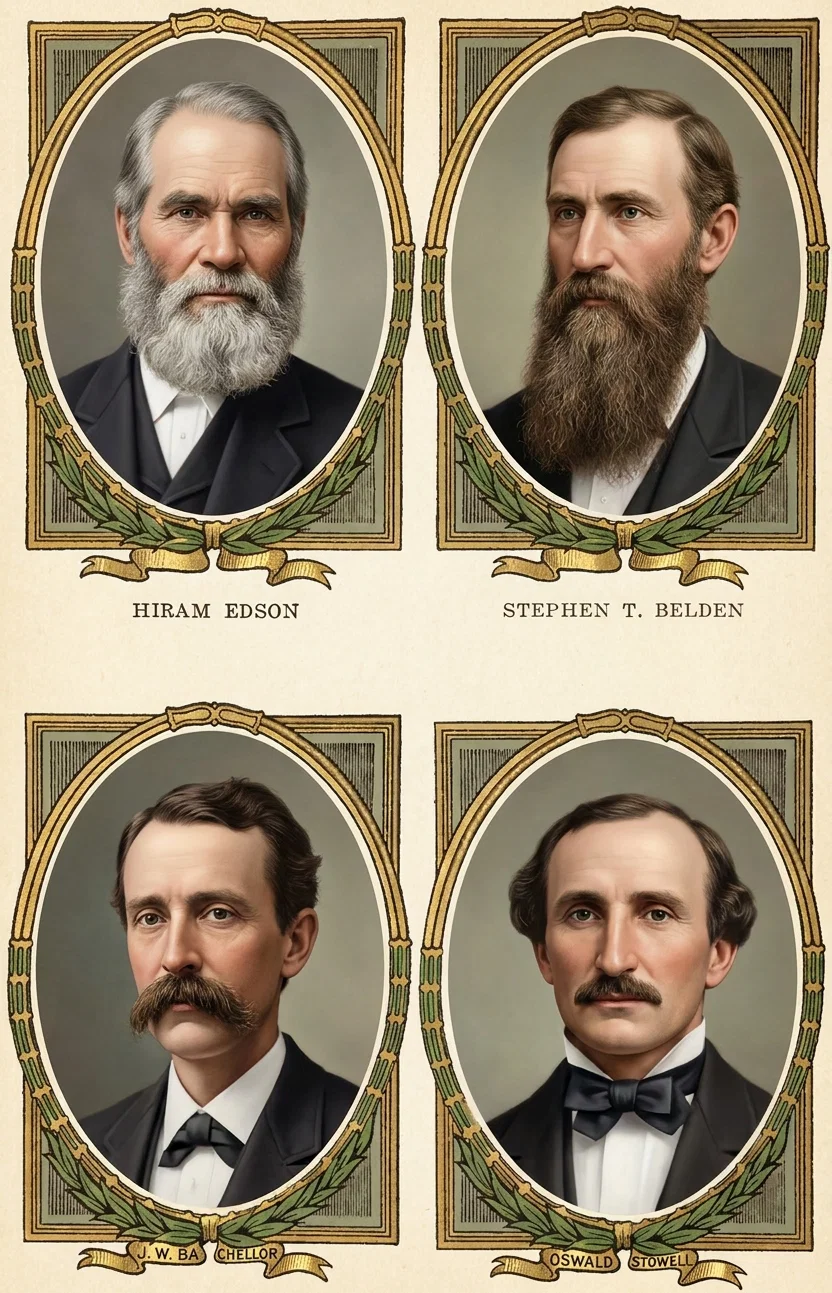
WORKERS CONNECTED WITH THE ROCHESTER PRINTING OFFICE
IN ROCHESTER, NEW YORK
In April, 1852, we moved to Rochester, New York, under most discouraging circumstances. At every step we were obliged to advance by faith. We were still crippled by poverty, and compelled to exercise the most rigid economy and self-denial. I will give a brief extract from a letter to Brother Howland's family, dated April 16, 1852:
"We are just getting settled in Rochester. We have rented an old house for one hundred and seventy-five dollars a year. We have the press in the house. Were it not for this, we should have to pay fifty dollars a year for office room. You would smile could you look in upon us and see our furniture. We have bought two old bedsteads for twenty-five cents each. My husband brought me home six old chairs, no two of them alike, for which he paid one dollar, and soon he presented me with four more old chairs without any seating, for which he paid sixty-two cents. The frames are strong, and I have been seating them with drilling. Butter is so high that we do not purchase144it, neither can we afford potatoes. We use sauce in the place of butter, and turnips for potatoes. Our first meals were taken on a fireboard placed upon two empty flour barrels. We are willing to endure privations if the work of God can be advanced. We believe the Lord's hand was in our coming to this place. There is a large field for labor, and but few laborers. Last Sabbath our meeting was excellent. The Lord refreshed us with His presence."
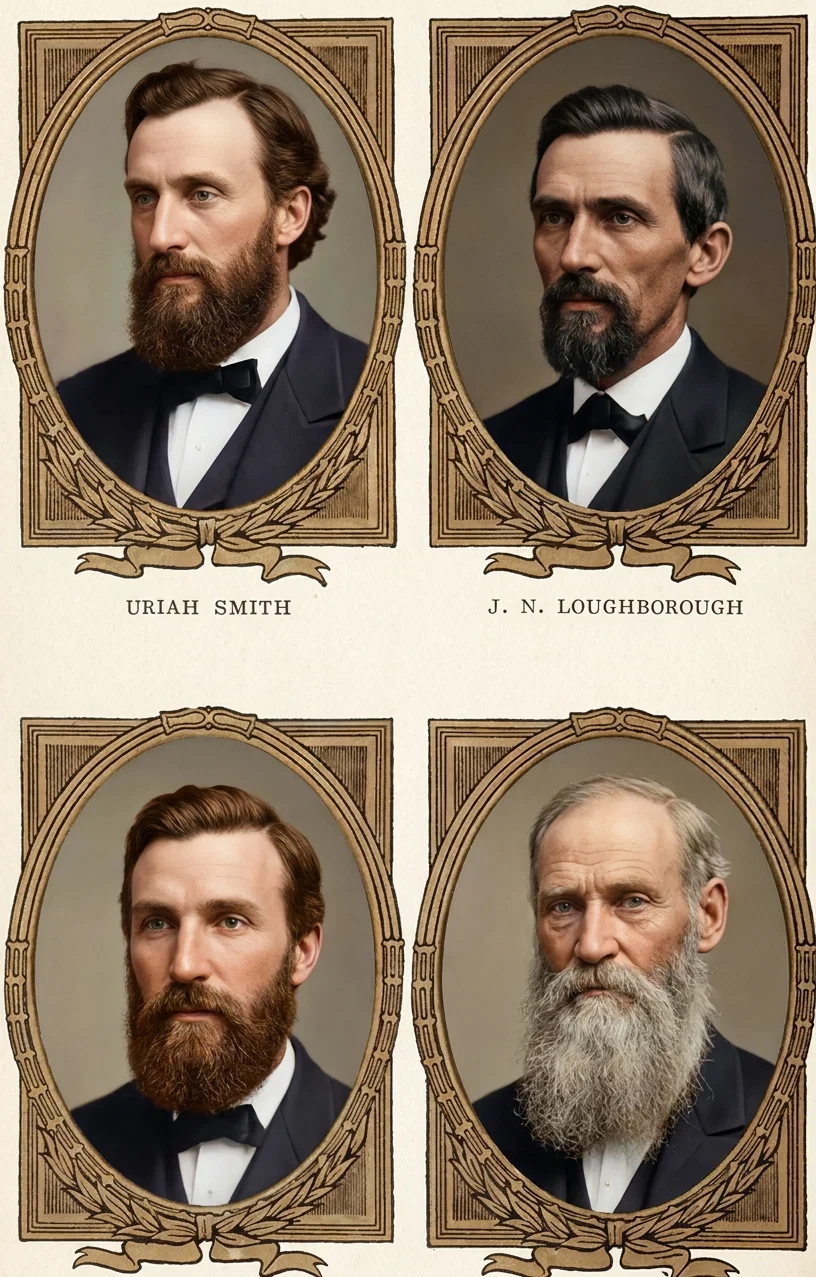
URIAH SMITH; J. N. LOUGHBOROUGH; HENRY NICHOLS; R. F. COTTRELL — WORKERS CONNECTED WITH THE ROCHESTER PRINTING OFFICE
PRESSING ON
We toiled on in Rochester through much perplexity and discouragement. The cholera visited the city, and while it raged, all night long the carriages bearing the dead were heard rumbling through the streets to Mount Hope Cemetery. This disease did not cut down merely the low, but took victims from every class of society. The most skillful physicians were laid low, and borne to Mount Hope. As we passed through the streets in Rochester, at almost every corner we would meet wagons with plain pine coffins in which to put the dead.
Our little Edson was attacked, and we carried him to the great Physician. I took him in my arms, and in the name of Jesus rebuked the disease. He felt relief at once, and as a sister commenced praying for the Lord to heal him, the little fellow of three years looked up in astonishment, and said, “They need not pray any more, for the Lord has healed me.” He was very weak, but the disease made no further progress. Yet he gained no strength. Our faith was still to be tried. For three days he ate nothing.
WRITING AND TRAVELING
We had appointments out for two months, reaching from Rochester, New York, to Bangor, Maine; and146this journey we were to perform with our covered carriage and our good horse Charlie, given to us by brethren in Vermont. We hardly dared to leave the child in so critical a state, but decided to go unless there was a change for the worse. In two days we must commence our journey in order to reach our first appointment. We presented the case before the Lord, taking it as an evidence that if the child had appetite to eat we would venture. The first day there was no change for the better. He could not take the least food. The next day about noon he called for broth, and it nourished him.
We began our journey that afternoon. About four o’clock I took my sick child upon a pillow, and we rode twenty miles. He seemed very nervous that night. He could not sleep, and I held him in my arms nearly the whole night.
The next morning we consulted together as to whether to return to Rochester or go on. The family who had entertained us said that if we went on, we would bury the child on the road; and to all appearance it would be so. But I dared not go back to Rochester. We believed the affliction of the child was the work of Satan, to hinder us from traveling; and we dared not yield to him. I said to my husband: “If we go back, I shall expect the child to die. He can but die if we go forward. Let us proceed on our journey, trusting in the Lord.”
We had before us a journey of about one hundred miles, to perform in two days, yet we believed that the Lord would work for us in this time of extremity. I was much exhausted, and feared I should fall asleep and let the child fall from my arms; so I laid him upon my lap, and tied him to my waist, and we both slept that day over much of the distance. The child147revived and continued to gain strength the whole journey, and we brought him home quite rugged.
The Lord greatly blessed us on our journey to Vermont. My husband had much care and labor. At the different conferences he did most of the preaching, sold books, and labored to extend the circulation of the paper. When one conference was over, we would hasten to the next. At noon we would feed the horse by the roadside, and eat our lunch. Then my husband, laying his writing paper on the cover of our dinner box or on the top of his hat, would write articles for the Review and Instructor.
In the summer of 1853 we made our first visit to Michigan. Soon after our return to Rochester, New York, my husband engaged in writing the book “Signs of the Times.” He was still feeble, and could sleep but little, but the Lord was his support. When his mind was in a confused, suffering state, we would bow before God, and in our distress cry unto Him. He heard our earnest prayers, and often blessed my husband so that with refreshed spirits he went on with the work. Many times in the day did we thus go before the Lord in earnest prayer. That book was not written in his own strength.
VISIT TO MICHIGAN AND WISCONSIN
In the spring of 1854 we visited Michigan again; and though we were obliged to ride over log ways and through mud sloughs, my strength failed not. We felt that the Lord would have us visit Wisconsin, and arranged to board the cars at Jackson late at night.
As we were preparing to take the train, we felt very solemn, and proposed a season of prayer; and as we there committed ourselves to God, we could not refrain from weeping. We went to the depot with148feelings of deep solemnity. On boarding the train, we went into a forward car, which had seats with high backs, hoping that we might sleep some that night. The car was full, and we passed back into the next, and there found seats. I did not, as usual when traveling in the night, lay off my bonnet, but held my carpetbag in my hand, as if waiting for something. We both spoke of our singular feelings.
The train had run about three miles from Jackson when its motion became very violent, jerking backward and forward, and finally stopping. I opened the window and saw one car raised nearly upon end. I heard agonizing groans, and there was great confusion. The engine had been thrown from the track, but the car we were in was on the track, and was separated about one hundred feet from those before it. The coupling had not been broken, but our car had been unfastened from the one before it, as if an angel had separated them. The baggage car was not much injured, and our large trunk of books was uninjured. The second-class car was crushed, and the pieces, with the passengers, were thrown on both sides of the track. The car in which we had tried to get a seat was much broken, and one end was raised upon the heap of ruins. Four were killed or mortally wounded, and many were much injured. We could but feel that God had sent an angel to preserve our lives.
We returned to the home of Brother Cyrenius Smith, near Jackson, and the next day took the train for Wisconsin. Our visit to that State was blessed of God. Souls were converted as the result of our efforts. The Lord strengthened me to endure the tedious journey.
RETURN TO ROCHESTER
We returned from Wisconsin much worn, desiring rest, but were distressed to find Sister Anna afflicted. Disease had fastened upon her, and she was brought very low. Trials thickened around us. We had much care. The office hands boarded with us, and our family numbered from fifteen to twenty. The large conferences and the Sabbath meetings were held at our house. We had no quiet Sabbaths; for some of the sisters usually tarried all day with their children. Our brethren and sisters generally did not consider the inconvenience and additional care and expense brought upon us. As one after another of the office hands would come home sick, needing extra attention, I was fearful that we should sink beneath the anxiety and care. I often thought that we could endure no more; yet trials increased, and with surprise I found that we were not overwhelmed. We learned the lesson that much more suffering and trial could be borne than we had once thought possible. The watchful eye of the Lord was upon us, to see that we were not destroyed.
August 29, 1854, another responsibility was added to our family in the birth of Willie. He took my mind somewhat from the troubles around me. About this time the first number of the paper falsely called the Messenger of Truth was received. Those who slandered us through that paper had been reproved for their faults and errors. They would not bear150reproof, and in a secret manner at first, afterward more openly, used their influence against us.
The Lord had shown me the character and final come-out of that party; that His frown was upon those connected with that paper, and His hand was against them, and although they might appear to prosper for a time, and some honest ones be deceived, yet truth would eventually triumph, and every honest soul would break away from the deception which had held them, and come out clear from the influence of these wicked men; as God's hand was against them, they must go down.
THE ADAMS PRESS
Removal to Michigan — 25
In 1855 the brethren in Michigan opened the way for the publishing work to be removed to Battle Creek. At that time my husband was owing between two and three thousand dollars; and all he had, besides a small lot of books, was accounts for books, and some of these were doubtful. The cause had apparently come to a standstill. Orders for publications were very few and small. My husband's health was very poor. He was troubled with cough and soreness of lungs, and his nervous system was prostrated. We feared that he would die while still in debt.
COMFORTING ASSURANCES
Those were days of sadness. I looked upon my three little boys, soon, as I feared, to be left fatherless, and thoughts like these forced themselves upon me: My husband will die of overwork in the cause of present truth; and who realizes what he has suffered? Who knows the burdens he has for years borne, the extreme care which has crushed his spirits and ruined his health, bringing him to an untimely grave, leaving his family destitute and dependent? I often asked myself the question: Does God have no care for these things? Does He pass them by unnoticed? I was comforted to know that there is One who judgeth righteously, and that every sacrifice, every self-denial, and every pang of anguish endured for His sake, is faithfully chronicled in heaven, and will bring its reward. The day of the Lord will declare and bring to light things that are not yet made manifest.
I was shown that God designed to raise my husband up gradually; that we must exercise strong faith, for152in every effort we should be fiercely buffeted by Satan; that we must look away from outward appearances, and believe. Three times a day we went alone before God, and engaged in earnest prayer for the recovery of his health. The Lord graciously heard our earnest cries, and my husband began to recover. I cannot better state my feelings at this time than they are expressed in the following extracts from a letter I wrote to Sister Howland:
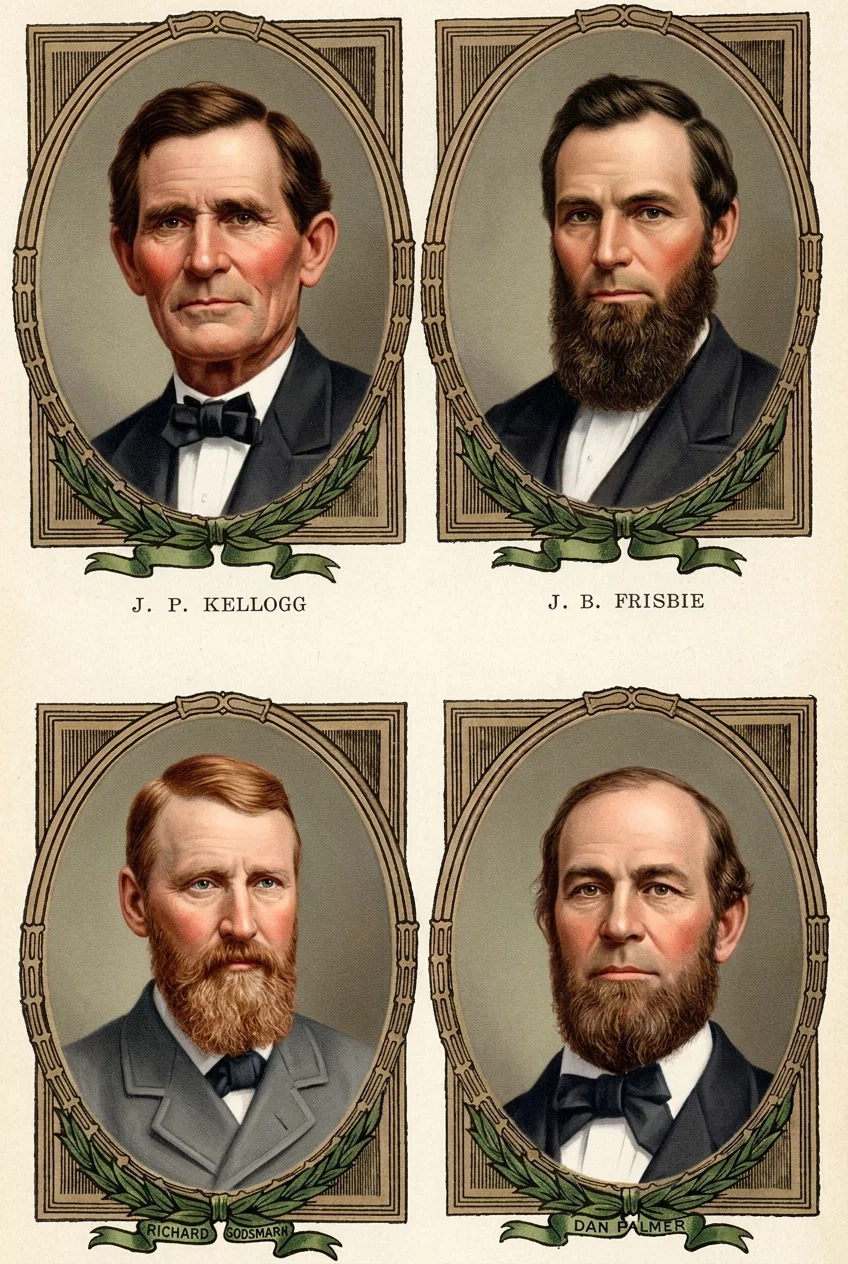
MICHIGAN MEN WHO AIDED IN THE ESTABLISHMENT OF THE PUBLISHING WORK AT BATTLE CREEK
“I feel thankful that I can now have my children with me, under my own watchcare. For weeks I have felt a hungering and thirsting for salvation, and we have enjoyed almost uninterrupted communion with God. Why do we stay away from the fountain, when we can come and drink? Why do we die for bread, when there is a storehouse full? It is rich and free. O my soul, feast upon it, and daily drink in heavenly joys! I will not hold my peace. The praise of God is in my heart and upon my lips. We can rejoice in the fullness of our Saviour's love. We can feast upon His excellent glory. My soul testifies to this. My gloom has been dispersed by this precious light, and I can never forget it. Lord, help me to keep it in lively remembrance. Awake, all the energies of my soul! Awake, and adore thy Redeemer for His wondrous love!
“Our enemies may triumph. They may speak bitter words, and their tongue frame slander, deceit, and falsehood; yet will we not be moved. We know in whom we have believed. We have not run in vain, neither labored in vain. A reckoning day is coming, when all will be judged according to the154deeds done in the body. It is true the world is dark. Opposition may wax strong. The trifler and the scorner may grow bold in their iniquity. Yet for all this we will not be moved, but lean upon the arm of the Mighty One for strength.”
Review and Herald Buildings, Showing the Growth of This Institution from 1855 to 1881
CAPTIVITY TURNED
From the time we moved to Battle Creek, the Lord began to turn our captivity. We found sympathizing friends in Michigan, who were ready to share our burdens and supply our wants. Old, tried friends in central New York and New England, especially in Vermont, sympathized with us in our afflictions, and were ready to assist us in time of distress. At the conference at Battle Creek in November, 1856, God wrought for us. New life was given to the cause, and success attended the labors of our preachers.
The publications were called for, and proved to be just what the cause demanded. The Messenger of Truth soon went down, and the discordant spirits who had spoken through it were scattered. My husband was enabled to pay all his debts. His cough ceased, the pain and soreness left his lungs and throat, and he was gradually restored to health, so that he could preach three times on the Sabbath and on first-day with ease. This wonderful work in his restoration was of God, and He should have all the glory.
The Two Ways—26
At the conference at Battle Creek, Michigan, May 27, 1856, I was shown in vision some things that concern the church generally. The glory and majesty of God were made to pass before me. Said the angel: “He is terrible in His majesty, yet ye realize it not; terrible in His anger, yet ye offend Him daily. Strive to enter in at the strait gate; for wide is the gate, and broad is the way, that leadeth to destruction, and many there be which go in thereat; because strait is the gate, and narrow is the way, that leadeth unto life, and few there be that find it.” These roads are distinct, separate, in opposite directions. One leads to eternal life, the other to eternal death. I saw the distinction between these roads, also the distinction between the companies traveling them. The roads are opposite; one is broad and smooth, the other narrow and rugged. So the parties that travel them are opposite in character, in life, in dress, and in conversation.
Those who travel in the narrow way are talking of the joy and happiness they will have at the end of the journey. Their countenances are often sad, yet often beam with holy, sacred joy. They do not dress like the company in the broad road, nor talk like them, nor act like them. A pattern has been given them. A Man of sorrows and acquainted with grief opened that road for them, and traveled it Himself. His followers see His footsteps, and are comforted and cheered. He went through safely; so can they, if they follow in His footsteps.
In the broad road all are occupied with their persons, their dress, and the pleasures in the way. They indulge freely in hilarity and glee, and think not of157their journey's end, of the certain destruction at the end of the path. Every day they approach nearer their destruction; yet they madly rush on faster and faster. Oh, how dreadful this looked to me!
AS JESUS OVERCAME, SO ALSO CAN WE OVERCOME
I saw many traveling in this broad road who had the words written upon them: "Dead to the world. The end of all things is at hand. Be ye also ready." They looked just like all the vain ones around them, except a shade of sadness which I noticed upon their countenances. Their conversation was just like that of the158gay, thoughtless ones around them; but they would occasionally point with great satisfaction to the letters on their garments, calling for the others to have the same upon theirs. They were in the broad way, yet they professed to be of the number who were traveling the narrow way. Those around them would say: "There is no distinction between us. We are alike; we dress, and talk, and act alike."
Then I was pointed back to the years 1843 and 1844. There was a spirit of consecration then that there is not now. What has come over the professed peculiar people of God? I saw the conformity to the world, the unwillingness to suffer for the truth’s sake. I saw a great lack of submission to the will of God. I was pointed back to the children of Israel after they left Egypt. God in mercy called them out from the Egyptians, that they might worship Him without hindrance or restraint. He wrought for them in the way by miracles, He proved and tried them by bringing them into strait places. After the wonderful dealings of God with them, and their deliverance so many times, they murmured when tried or proved by Him. Their language was, “Would to God we had died by the hand of the Lord in the land of Egypt.” They lusted for the leeks and onions there.
I saw that many who profess to believe the truth for these last days, think it strange that the children of Israel murmured as they journeyed; that after the wonderful dealings of God with them, they should be so ungrateful as to forget what He had done for them. Said the angel, “Ye have done worse than they.” I saw that God has given His servants the truth so clear, so plain, that it cannot be resisted. Wherever they go, they have certain victory. Their enemies cannot get round the convincing truth. Light has been shed159so clear that the servants of God can stand up anywhere and let truth, clear and connected, bear away the victory. This great blessing has not been prized, or even realized. If any trial arises, some begin to look back, and think they have a hard time. Some of the professed servants of God do not know what purifying trials are. They sometimes make trials for themselves, imagine trials, and are so easily discouraged, so easily hurt, self-dignity is so quick to feel, that they injure themselves, injure others, and injure the cause. Satan magnifies their trials, and puts thoughts into their minds that, if given way to, will destroy their influence and usefulness.
Some have felt tempted to take themselves from the work, to labor with their hands. I saw that if the hand of God should be taken from them, and they be left subject to disease and death, then they would know what trouble is. It is a fearful thing to murmur against God. They do not bear in mind that the way which they are traveling is a rugged, self-denying, self-crucifying way, and they must not expect everything to move on as smoothly as though they were traveling in the broad road.
I saw that some of the servants of God, even ministers, are so easily discouraged, self is so quickly hurt, that they imagine themselves slighted and injured when it is not so. They think their lot hard. Such realize not how they would feel should the sustaining hand of God be withdrawn, and they pass through anguish of soul. They would then find their lot tenfold harder than it was before, while they were employed in the work of God, suffering trials and privations, yet withal having the Lord's approbation.
Some that are laboring in the cause of God know not when they do have an easy time. They have had160so few privations, and know so little of want or wearing labor or burden of soul, that when they have an easy time, when they are favored of God and almost entirely free from anguish of spirit, they know it not, and think their trials great. I saw that unless such have a spirit of self-sacrifice, and are ready to labor cheerfully, not sparing themselves, God will release them. He will not acknowledge them as His self-sacrificing servants, but will raise up those who will labor, not slothfully, but in earnest, and will know when they have an easy time. God's servants must feel the burden of souls, and weep between the porch and the altar, crying, "Spare Thy people, Lord."
Some of the servants of God have given up their lives to spend and be spent for the cause of God, until their constitutions are broken down, and they are almost worn out with mental labor, incessant care, toil, and privations. Others have not had, and would not take, the burden upon them. Yet just such ones think they have a hard time, because they have never experienced hardships. They never have been baptized into the suffering part, and never will be as long as they manifest so much weakness and so little fortitude, and love their ease so well.
From what God has shown me, there needs to be a scourging among the ministers, that the slothful, dilatory, and self-caring ones may be scourged out, and there remain a pure, faithful, and self-sacrificing company who will not study their ease, but will minister faithfully in word and doctrine, willing to suffer and endure all things for Christ’s sake, and to save those for whom He died. Let these servants feel the woe upon them if they preach not the gospel, and it will be enough; but all do not feel this.