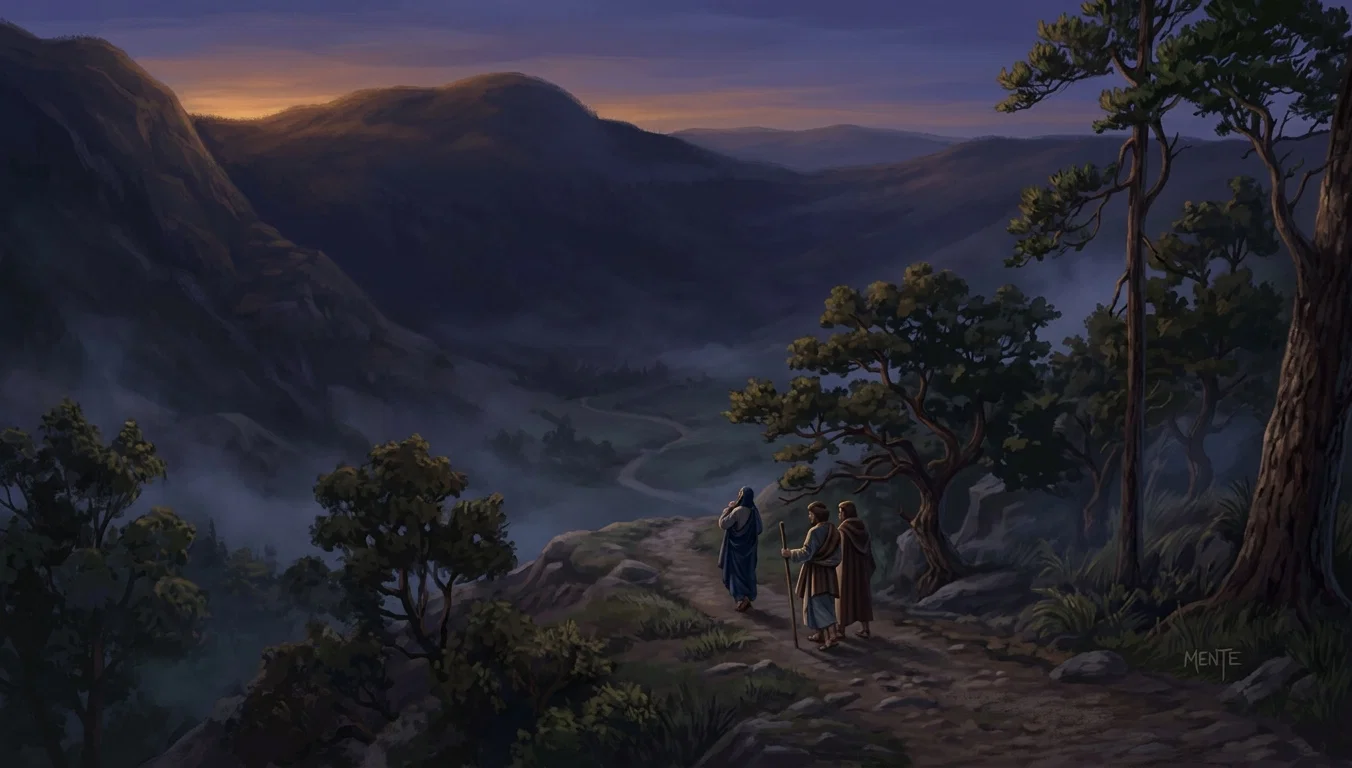
EVENING is drawing on as Jesus calls to His side three of His disciples, Peter, James, and John, and leads them across the fields, and far up a rugged path, to a lonely mountainside. The Saviour and His disciples have spent the day in traveling and teaching, and the mountain climb adds to their weariness. Christ has lifted burdens from mind and body of many sufferers; He has sent the thrill of life through their enfeebled frames; but He also is compassed with humanity, and with His disciples He is wearied with the ascent.
The light of the setting sun still lingers on the mountain top, and gilds with its fading glory the path they are traveling. But soon the light dies out from hill as well as valley, the sun disappears behind the western horizon, and the solitary travelers are wrapped in the darkness of night. The gloom of their surroundings seems in harmony with their sorrowful lives, around which the clouds are gathering and thickening.
The disciples do not venture to ask Christ whither He is going, or for what purpose. He has often spent entire nights in the mountains in prayer. He whose hand formed mountain and valley is at home with nature, and enjoys its quietude. The disciples follow where Christ leads the way; yet they wonder why their Master should lead them up this toilsome ascent when they are weary, and when He too is in need of rest.
Presently Christ tells them that they are now to go no farther. Stepping a little aside from them, the Man of sorrows pours out His420supplications with strong crying and tears. He prays for strength to endure the test in behalf of humanity. He must himself gain a fresh hold on Omnipotence, for only thus can He contemplate the future. And He pours out His heart-longings for His disciples, that in the hour of the power of darkness their faith may not fail. The dew is heavy upon His bowed form, but He heeds it not. The shadows of night gather thickly about Him, but He regards not their gloom. So the hours pass slowly by. At first the disciples unite their prayers with His in sincere devotion; but after a time they are overcome with weariness, and, even while trying to retain their interest in the scene, they fall asleep. Jesus has told them of His sufferings; He has taken them with Him that they might unite with Him in prayer; even now He is praying for them. The Saviour has seen the gloom of His disciples, and has longed to lighten their grief by an assurance that their faith has not been in vain. Not all, even of the twelve, can receive the revelation He desires to give. Only the three who are to witness His anguish in Gethsemane have been chosen to be with Him on the mount. Now the burden of His prayer is that they may be given a manifestation of the glory He had with the Father before the world was, that His kingdom may be revealed to human eyes, and that His disciples may be strengthened to behold it. He pleads that they may witness a manifestation of His divinity that will comfort them in the hour of His supreme agony with the knowledge that He is of a surety the421Son of God, and that His shameful death is a part of the plan of redemption.
“Soon the light dies out from hill as well as valley, . . . and the solitary travelers are wrapped in the darkness of night.” Page 419.
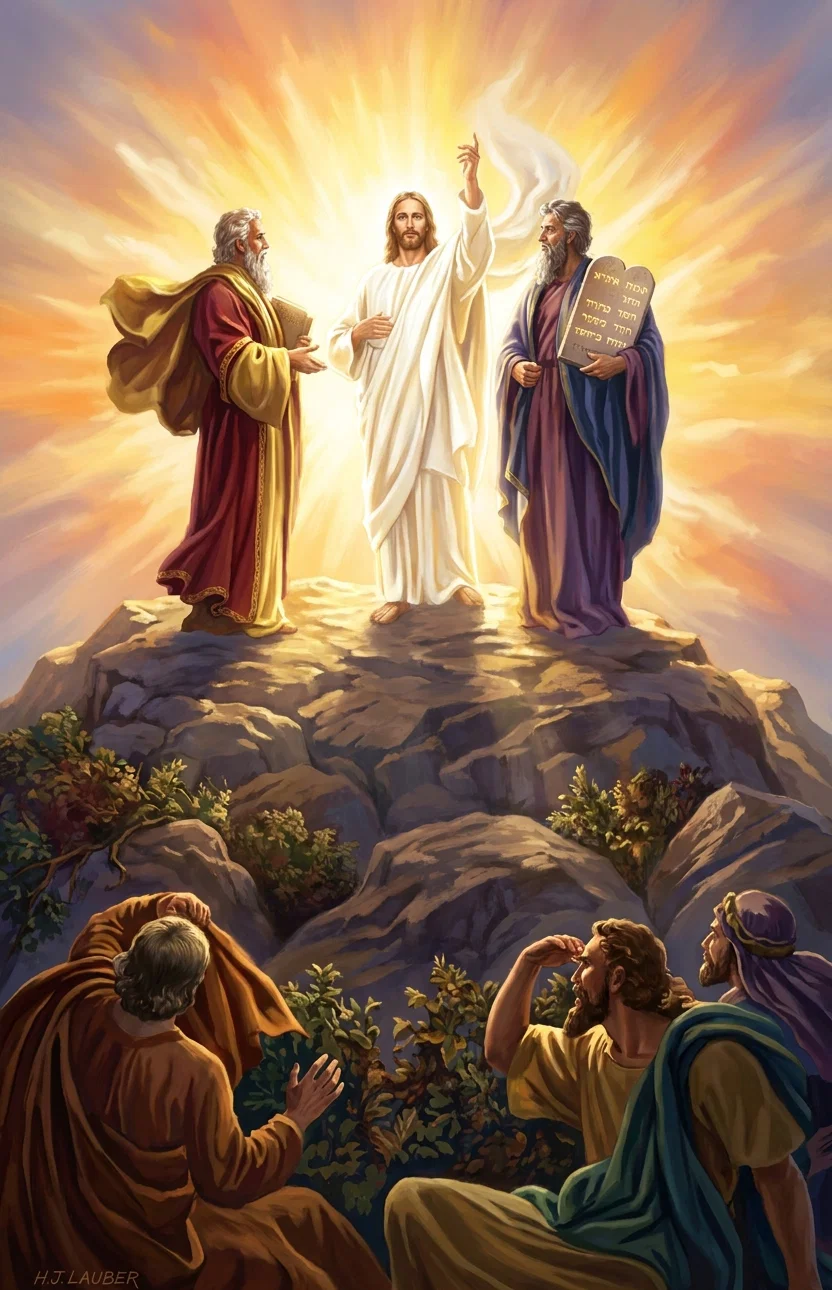
His prayer is heard. While He is bowed in lowliness upon the stony ground, suddenly the heavens open, the golden gates of the city of God are thrown wide, and holy radiance descends upon the mount, enshrouding the Saviour’s form. Divinity from within flashes through humanity, and meets the glory coming from above. Arising from His prostrate position, Christ stands in Godlike majesty. The soul-agony is gone. His countenance now shines “as the sun,” and His garments are “white as the light.”
The disciples, awaking, behold the flood of glory that illuminates the mount. In fear and amazement they gaze upon the radiant form of their Master. As they become able to endure the wondrous light, they see that Jesus is not alone. Beside Him are two heavenly beings, in close converse with Him. They are Moses, who upon Sinai had talked with God; and Elijah, to whom the high privilege was given—granted to but one other of the sons of Adam—never to come under the power of death.
Upon Mount Pisgah fifteen centuries before, Moses had stood gazing upon the land of promise. But because of his sin at Meribah, it was not for him to enter there. Not for him was the joy of leading the host of Israel into the inheritance of their fathers. His agonized entreaty, “I pray Thee, let me go over, and see the good land that is beyond Jordan, that goodly mountain, and Lebanon,” was refused. The hope that for forty years had lighted up the darkness of the desert wanderings must be denied. A wilderness grave was the goal of those years of toil and heart-burdening care. But He who is “able to do exceeding abundantly above all that we ask or think,” had in this measure answered His servant’s prayer. Moses passed under the dominion of death, but he was not to remain in the tomb. Christ Himself called him forth to life. Satan the tempter had claimed the body of Moses because of his sin; but Christ the Saviour brought him forth from the grave.
Moses upon the mount of transfiguration was a witness to Christ’s victory over sin and death. He represented those who shall come forth from the grave at the resurrection of the just. Elijah, who had been translated to heaven without seeing death, represented those who will be living upon the earth at Christ’s second coming, and who will be “changed in a moment, in the twinkling of an eye, at the last trump;” when “this mortal must put on immortality,” and “this corruptible must422put on incorruption.” Jesus was clothed with the light of heaven, as He will appear when He shall come “the second time without sin unto salvation.” For He will come “in the glory of His Father with the holy angels.” The Saviour’s promise to the disciples was now fulfilled. Upon the mount the future kingdom of glory was represented in miniature,—Christ the King, Moses a representative of the risen saints, and Elijah of the translated ones.
The disciples do not yet comprehend the scene; but they rejoice that the patient Teacher, the meek and lowly One, who has wandered to and fro a helpless stranger, is honored by the favored ones of heaven. They believe that Elijah has come to announce the Messiah’s reign, and that the kingdom of Christ is about to be set up on the earth. The memory of their fear and disappointment they would banish forever. Here, where the glory of God is revealed, they long to tarry. Peter exclaims, “Master, it is good for us to be here; and let us make three tabernacles; one for Thee, and one for Moses, and one for Elias.” The disciples are confident that Moses and Elijah have been sent to protect their Master, and to establish His authority as king.
But before the crown must come the cross. Not the inauguration of Christ as king, but the decease to be accomplished at Jerusalem, is the subject of their conference with Jesus. Bearing the weakness of humanity, and burdened with its sorrow and sin, Jesus walked alone in the midst of men. As the darkness of the coming trial pressed upon Him, He was in loneliness of spirit, in a world that knew Him not. Even His loved disciples, absorbed in their own doubt and sorrow and ambitious hopes, had not comprehended the mystery of His mission. He had dwelt amid the love and fellowship of heaven; but in the world that He had created, He was in solitude. Now heaven had sent its messengers to Jesus; not angels, but men who had endured suffering and sorrow, and who could sympathize with the Saviour in the trial of His earthly life. Moses and Elijah had been co-laborers with Christ. They had shared His longing for the salvation of men. Moses had pleaded for Israel: “Yet now, if Thou wilt forgive their sin;—and if not, blot me, I pray Thee, out of Thy book which Thou hast written.” Elijah had known loneliness of spirit, as for three years and a half of famine he had borne the burden of the nation’s hatred and its woe. Alone he had stood for God upon Mount Carmel. Alone he had fled to the desert in anguish and despair. These men, chosen above every angel around the throne, had come to commune with Jesus concerning423the scenes of His suffering, and to comfort Him with the assurance of the sympathy of heaven. The hope of the world, the salvation of every human being, was the burden of their interview.
THE TRANSFIGURATION.
“Jesus was clothed with the light of heaven, as He will appear when He shall come the second time without sin unto salvation.”
Through being overcome with sleep, the disciples heard little of what passed between Christ and the heavenly messengers. Failing to watch and pray, they had not received that which God desired to give them,—a knowledge of the sufferings of Christ, and the glory that should follow. They lost the blessing that might have been theirs through sharing His self-sacrifice. Slow of heart to believe were these disciples, little appreciative of the treasure with which Heaven sought to enrich them.
Yet they received great light. They were assured that all heaven knew of the sin of the Jewish nation in rejecting Christ. They were given a clearer insight into the work of the Redeemer. They saw with their eyes and heard with their ears things that were beyond the comprehension of man. They were “eye-witnesses of His majesty,” and they realized that Jesus was indeed the Messiah, to whom patriarchs and prophets had witnessed, and that He was recognized as such by the heavenly universe.
While they were still gazing on the scene upon the mount, “a bright cloud overshadowed them; and behold a voice out of the cloud, which said, This is My beloved Son, in whom I am well pleased; hear ye Him.” As they beheld the cloud of glory, brighter than that which went before the tribes of Israel in the wilderness; as they heard the voice of God speak in awful majesty that caused the mountain to tremble, the disciples fell smitten to the earth. They remained prostrate, their faces hidden, till Jesus came near, and touched them, dispelling their fears with His well-known voice, “Arise, and be not afraid.” Venturing to lift up their eyes, they saw that the heavenly glory had passed away, the forms of Moses and Elijah had disappeared. They were upon the mount, alone with Jesus.
MINISTRY
CHAPTER FORTY-SEVEN.
The entire night had been passed in the mountain; and as the sun arose, Jesus and His disciples descended to the plain. Absorbed in thought, the disciples were awed and silent. Even Peter had not a word to say. Gladly would they have lingered in that holy place which had been touched with the light of heaven, and where the Son of God had manifested His glory; but there was work to be done for the people, who were already searching far and near for Jesus.
At the foot of the mountain a large company had gathered, led hither by the disciples who had remained behind, but who knew whither Jesus had resorted. As the Saviour drew near, He charged His three companions to keep silence concerning what they had witnessed, saying, “Tell the vision to no man, until the Son of man be risen again from the dead.” The revelation made to the disciples was to be pondered in their own hearts, not to be published abroad. To relate it to the multitudes would excite only ridicule or idle wonder. And even the nine apostles would not understand the scene until after Christ had risen from the dead. How slow of comprehension even the three favored disciples were, is seen in the fact that notwithstanding all that Christ had said of what was before Him, they queried among themselves what the rising from the dead should mean. Yet they asked no explanation from Jesus. His words in regard to the future had filled them with sorrow; they sought no further revelation concerning that which they were fain to believe might never come to pass.
As the people on the plain caught sight of Jesus, they ran to meet Him, greeting Him with expressions of reverence and joy. Yet His427quick eye discerned that they were in great perplexity. The disciples appeared troubled. A circumstance had just occurred that had caused them bitter disappointment and humiliation.
While they were waiting at the foot of the mountain, a father had brought to them his son, to be delivered from a dumb spirit that tormented him. Authority over unclean spirits, to cast them out, had been conferred on the disciples when Jesus sent out the twelve to preach through Galilee. As they went forth strong in faith, the evil spirits had obeyed their word. Now in the name of Christ they commanded the torturing spirit to leave his victim; but the demon only mocked them by a fresh display of his power. The disciples, unable to account for their defeat, felt that they were bringing dishonor upon themselves and their Master. And in the crowd there were scribes who made the most of this opportunity to humiliate them. Pressing around the disciples, they plied them with questions, seeking to prove that they and their Master were deceivers. Here, the rabbis triumphantly declared, was an evil spirit that neither the disciples nor Christ Himself could conquer. The people were inclined to side with the scribes, and a feeling of contempt and scorn pervaded the crowd.
But suddenly the accusations ceased. Jesus and the three disciples were seen approaching, and with a quick revulsion of feeling the people turned to meet them. The night of communion with the heavenly glory had left its trace upon the Saviour and His companions. Upon their countenances was a light that awed the beholders. The scribes drew back in fear, while the people welcomed Jesus.
As if He had been a witness of all that had occurred, the Saviour came to the scene of conflict, and fixing His gaze on the scribes inquired, “What question ye with them?”
But the voices so bold and defiant before, were now silent. A hush had fallen upon the entire company. Now the afflicted father made his way through the crowd, and falling at the feet of Jesus, poured out the story of his trouble and disappointment.
“Master,” he said, “I have brought unto Thee my son, which hath a dumb spirit; and wheresoever he taketh him, he teareth him: . . . and I spake to Thy disciples that they should cast him out; and they could not.”
Jesus looked about Him upon the awe-stricken multitude, the caviling scribes, the perplexed disciples. He read the unbelief in every heart; and in a voice filled with sorrow He exclaimed, “O faithless generation, how long shall I be with you? how long shall I suffer you?” Then He bade the distressed father, “Bring thy son hither.”
The boy was brought, and as the Saviour’s eyes fell upon him, the evil spirit cast him to the ground in convulsions of agony. He lay wallowing and foaming, rending the air with unearthly shrieks.
Again the Prince of life and the prince of the powers of darkness had met on the field of battle,—Christ in fulfilment of His mission to “preach deliverance to the captives, . . . to set at liberty them that are bruised,” Satan seeking to hold his victim under his control. Angels of light and the hosts of evil angels, unseen, were pressing near to behold the conflict. For a moment, Jesus permitted the evil spirit to display his power, that the beholders might comprehend the deliverance about to be wrought.
The multitude looked on with bated breath, the father in an agony of hope and fear. Jesus asked, “How long is it ago since this came unto him?” The father told the story of long years of suffering, and then, as if he could endure no more, exclaimed, “If Thou canst do anything, have compassion on us, and help us.” “If Thou canst!” Even now the father questioned the power of Christ.
Jesus answers, “If thou canst believe, all things are possible to him that believeth.” There is no lack of power on the part of Christ; the healing of the son depends upon the father’s faith. With a burst of tears, realizing his own weakness, the father casts himself upon Christ’s mercy, with the cry, “Lord, I believe; help Thou mine unbelief.”
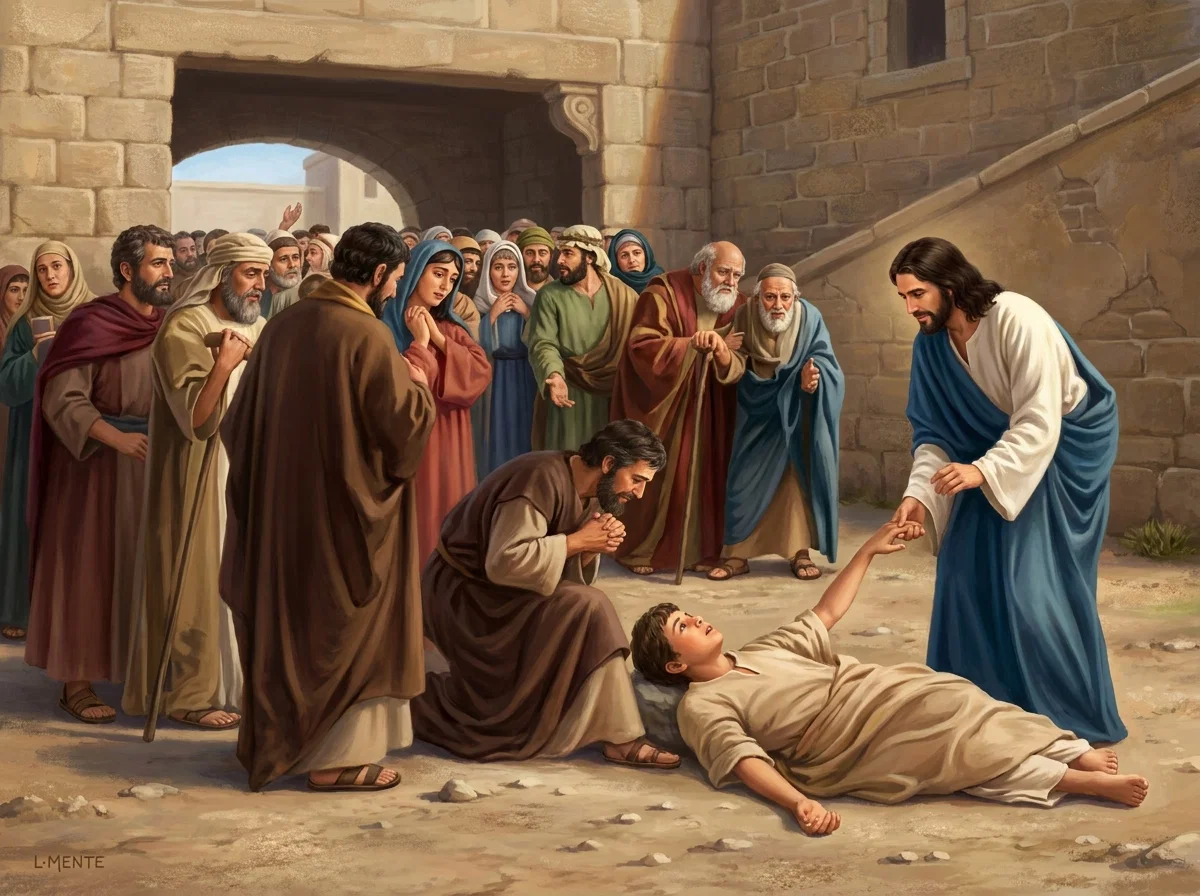
Jesus turns to the suffering one, and says, “Thou dumb and deaf spirit, I charge thee, come out of him, and enter no more into him.” There is a cry, an agonized struggle. The demon, in passing, seems about to rend the life from his victim. Then the boy lies motionless, and apparently lifeless. The multitude whisper, “He is dead.” But Jesus takes him by the hand, and lifting him up, presents him, in perfect soundness of mind and body, to his father. Father and son praise the name of their deliverer. The multitude are “amazed at the mighty power of God,” while the scribes, defeated and crestfallen, turn sullenly away.
“If Thou canst do anything, have compassion on us, and help us.” How many a sin-burdened soul has echoed that prayer. And to all, the pitying Saviour’s answer is, “If thou canst believe, all things are possible to him that believeth.” It is faith that connects us with heaven, and brings us strength for coping with the powers of darkness. In Christ, God has provided means for subduing every sinful trait, and resisting every temptation, however strong. But many feel that they429lack faith, and therefore they remain away from Christ. Let these souls, in their helpless unworthiness, cast themselves upon the mercy of their compassionate Saviour. Look not to self, but to Christ. He who healed the sick and cast out demons when He walked among men, is the same mighty Redeemer today. Faith comes by the word of God.
“Jesus takes him by the hand, and lifting him up, presents him in perfect soundness of mind and body, to his father.”
Then grasp His promise, “Him that cometh to Me I will in no wise cast out.” Cast yourself at His feet with the cry, “Lord, I believe; help Thou mine unbelief.” You can never perish while you do this—never.
In a brief space of time the favored disciples have beheld the extreme of glory and of humiliation. They have seen humanity as transfigured into the image of God, and as debased into the likeness of Satan. From the mountain where He has talked with the heavenly messengers, and has been proclaimed the Son of God by the voice from the radiant glory, they have seen Jesus descend to meet that most distressing and430revolting spectacle, the maniac boy, with distorted countenance, gnashing his teeth in spasms of agony that no human power could relieve. And this mighty Redeemer, who but a few hours before stood glorified before His wondering disciples, stoops to lift the victim of Satan from the earth where he is wallowing, and in health of mind and body restores him to his father and his home.
It was an object-lesson of redemption,—the Divine One from the Father’s glory stooping to save the lost. It represented also the disciples’ mission. Not alone upon the mountain top with Jesus, in hours of spiritual illumination, is the life of Christ’s servants to be spent. There is work for them down in the plain. Souls whom Satan has enslaved, are waiting for the word of faith and prayer to set them free.
The nine disciples were yet pondering upon the bitter fact of their own failure; and when Jesus was once more alone with them, they questioned, “Why could not we cast him out?” Jesus answered them, “Because of your unbelief; for verily I say unto you, If ye have faith as a grain of mustard seed, ye shall say unto this mountain, Remove hence to yonder place, and it shall remove; and nothing shall be impossible unto you. Howbeit this kind goeth not out but by prayer and fasting.” Their unbelief, that shut them out from deeper sympathy with Christ, and the carelessness with which they regarded the sacred work committed to them, had caused their failure in the conflict with the powers of darkness.
The words of Christ pointing to His death, had brought sadness and doubt. And the selection of the three disciples to accompany Jesus to the mountain had excited the jealousy of the nine. Instead of strengthening their faith by prayer and meditation on the words of Christ, they had been dwelling on their discouragements and personal grievances. In this state of darkness they had undertaken the conflict with Satan.
In order to succeed in such a conflict they must come to the work in a different spirit. Their faith must be strengthened by fervent prayer and fasting, and humiliation of heart. They must be emptied of self, and be filled with the Spirit and power of God. Earnest, persevering supplication to God in faith,—faith that leads to entire dependence upon God, and unreserved consecration to His work,—can alone avail to bring men the Holy Spirit’s aid in the battle against principalities and powers, the rulers of the darkness of this world, and wicked spirits in high places.
“If ye have faith as a grain of mustard seed,” said Jesus, “ye shall say unto this mountain, Remove hence to yonder place; and it shall remove.” Though the grain of mustard seed is so small, it431contains that same mysterious life-principle which produces growth in the loftiest tree. When the mustard seed is cast into the ground, the tiny germ lays hold of every element that God has provided for its nutriment, and it speedily develops a sturdy growth. If you have faith like this, you will lay hold upon God’s word, and upon all the helpful agencies He has appointed. Thus your faith will strengthen, and will bring to your aid the power of heaven. The obstacles that are piled by Satan across your path, though apparently as insurmountable as the eternal hills, shall disappear before the demand of faith. “Nothing shall be impossible unto you.”