Your ShelfYour Projects

Signs of the Times, Vol. 38, No. 35.

HARVEST

Signs of the Times

Sep 5, 1911

Pacific Press Publishing Association · Mountain View, California · Sep 5, 1911

HARVEST

Come, ye thankful people, come, Raise the song of harvest-home; All is safely gathered in, Ere the winter storms begin; God our Maker doth provide For our wants to be supplied. Come to God's own temple, come, Raise the song of harvest-home!
All the world is God's own field, Fruit unto His praise to yield; Wheat and tares together sown, Unto joy or sorrow grown; First the blade, and then the ear, Then the full corn shall appear. Lord of Harvest, grant that we Wholesome grain and pure may be!
For the Lord our God shall come, And shall take His harvest home; From His field shall in that day All offenses purge away; Give His angels charge at last In the fire the tares to cast, But the fruitful ears to store In His garner evermore.
Even so, Lord, quickly come To Thy final harvest-home! Gather Thou Thy people in, Free from sorrow, free from sin, There, forever purified, In Thy presence to abide. Come, with all Thine angels, come, Raise the glorious harvest-home! —Henry Alford.

"IF YE WILL INQUIRE, INQUIRE YE."

This Inquirers' Department is conducted for the purpose of helping those who are studying the Bible. The answers are oftentimes only suggestive. They are never to be considered infallible, only as they agree with the infallible Word. The writer who may answer them does not consider that his opinion is infallible. He will simply give the best that he has, and plead with the inquirer to search the Word. Such questions only will be answered as, to the editors, seem to minister to the good of the readers and to the mission of the paper. We can not answer repeatedly in the same volume questions upon the same scripture. The name and address must accompany question, not for publication, but as an evidence of good faith, and that answer may be made by letter if deemed advisable. No letters are answered which do not contain the name of the writer. It is well always to enclose stamp for reply.

3546 — The Wearing of Ornamental Jewelry

A young friend of mine recently bought a gold ring for his wife, and wants her to wear it, and she is glad of an excuse so to do. He says he didn't favor it until he read your answer in regard to wearing rings some time ago. Will you kindly state definitely the proper Christian principle in this matter?
The principle which should underlie wearing rings or jewelry of any kind is clearly stated in 1 Tim. 2:9: "In like manner, that women adorn themselves in modest apparel, with shamefastness and sobriety; not with braided hair, and gold or pearls or costly raiment; but (which becometh women professing godliness) through good works." And in 1 Peter 3:3: "Whose adorning, let it not be the outward adorning of braiding the hair, and of wearing jewels of gold, or of putting on apparel." The next verse tells us what the true adorning is: "Let it be the hidden man of the heart, in the incorruptible apparel of a meek and quiet spirit, which is in the sight of God of great price." The apostle is not speaking of necessary clothing. The clothing of every woman should be neat and tasty and fitted for herself—that which will rightly and at best advantage make her an acceptable, presentable representative of the Lord Jesus Christ. We do not understand that the text decries or condemns taste in dress, or such simple trimmings as will commend themselves to the best judgment of all. What it does condemn is the wearing of gaudy ornamentation, and classed with it are jewels of gold.
There are three things that should condemn these in the Christian: one is the unnecessary expense invested in these things; another is the setting of a wrong example, which would lead others less instructed and younger into extravagances of this sort; and the third is that they are not needed in any way to enhance the beauty or best appearance of any person. A ring, for instance, on a beautiful hand does not add to its beauty; a ring on a hand which is not beautiful only accentuates and emphasizes the unbeauty of the hand, by making the contrast appear more striking. In the early days of Methodism it is said that Mr. Wesley and another Methodist minister, overzealous and radical, were dining at the house of a wealthy member whose daughter, a beautiful young lady, was also a member of the church, but was still wearing jewelry, or rings. This zealous minister caught the young lady's hand at the table and held it up in the sight of the company and said, "Mr. Wesley, what do you think of that for a Methodist hand?" Mr. Wesley, in his quiet, wise way remarked, "It is a very beautiful hand," saying in a stronger way than so many words would, that it needed no ornamentation to beautify it. And the young lady needed no more; the jewels came off. So it would seem that Christians, if they have beautiful hands, need no jewels to enhance their beauty. If they have not beautiful hands, they certainly do not want jewels to reveal, by contrast, the ugliness of the hand.
There is but one excuse, so far as we know, for wearing rings, and that does not obtain in America. In some countries of the world the ring is a part of the marriage vow; it forms a part of the marriage ceremony. Women who accompany men and do not wear the wedding ring are thought to be women without husbands, or those who are of questionable character. But no such imputation rests upon women in America, because a good many sensible married women do not wear rings, and we see no reason whatever why any Christian American woman should do so. If she is in a country where that is demanded by society in general, for the sake of her reputation it might be well for her to accede to the custom. There is another appeal which ought to come home to every Christian woman's heart: it is possible to transmute the gold which would be worn as mere ornament in rings, and now coming to be the style again in earrings, into the gold of character in heathen lands. It seems as tho Christian women would be glad to make the exchange. We would not be understood as having reference, in this, to gold-bowed glasses. These are almost absolutely necessary, as others tarnish very quickly. These are not worn for adornment, but for necessity.

3548 — Simon and Simeon

Is it true that James' reference to Simeon in Acts 15:14 refers to Simon Peter, or does it not refer to Simeon of Luke 2:25? And is it true that "Simeon" is the Hebrew of Peter's name? L. H.
The Simeon of Acts 15:14 refers to the Peter of verse 7. Peter had just given his experience, and to this James himself refers. It is true that the Simeon of Acts 2:25 referred to the work of Christ among the Gentiles, but James' reference is evidently to Peter's speech made on that very occasion. The regular Hebrew term is "Simeon," the name of one of the twelve tribes, from the word "shama," "to hear." The Standard Bible Dictionary gives this as an alternate form of "Simon." This was the regular Hebrew name of Peter. The name "Peter" was given to him by our Lord. It would be very natural for James to speak of Peter as Simeon, a name doubtless by which he had known him from the time that he was a young man, or a child.

3545 — Everlasting Punishment

Please explain Matt. 25: 41, 46.
The first verse reads, "Then shall He say also unto them on the left hand, Depart from Me, ye cursed, into everlasting fire, prepared for the devil and his angels." Verse 46 reads, "And these shall go away into everlasting punishment; but the righteous into life eternal."
Both teach the same thing. Both teach absolute finality of punishment, both teach everlasting destruction. The everlasting fire is the same as the eternal fire of Jude 7 and 2 Peter 2:6, which show that the eternal fire is that which burned up the cities of Sodom and Gomorrah. The everlasting fire carries us back to Isaiah 30, in which the prophet predicts the punishment of the wicked, and the punishment of the leader of all the wicked, Satan. He tells us that "the name of the Lord cometh from far, burning with His anger, and the burden thereof is heavy; His lips are full of indignation, and His tongue is a devouring fire." Verse 27. Verses 28 and 29 declare that the nations shall be sifted, that His own children will sing with gladness of heart; but of the other class, "the Lord shall cause His glorious voice to be heard, and shall show the lighting down of His arm, with the indignation of His anger, and with the flame of a devouring fire, with scattering, and tempest, and hailstones." Verse 30. "For Tophet is ordained of old; yea, for the king [Satan] it is prepared; he hath made it deep and large: the pile thereof is fire and much wood; the breath of the Lord, like a stream of brimstone, doth kindle it." That is the fire prepared for the devil and his angels; and when God shall come in His insufferable glory, His indignation against sin, that glory shall set on fire the very foundations of the earth, and shall burn up, root and branch, the wicked. Then, according to the third chapter of 2 Peter, that earth which has thus been purified by fire from sin, shall be restored again to a new heavens and a new earth, where God's people shall forever dwell. That "devouring fire" is the everlasting punishment.
Note what Paul tells us that punishment is, in 2 Thess. 1:7-9: "And to you who are troubled rest with us, when the Lord Jesus shall be revealed from heaven with His mighty angels, in flaming fire taking vengeance on them that know not God, and that obey not the Gospel of our Lord Jesus Christ; who shall be punished with everlasting destruction from the presence of the Lord, and from the glory of His power." All of which brings us to the one thought so concisely expressed by the apostle in another place: "The wages of sin is death." Rom. 6:23.

3547 — Bible Proof for Easter

Please explain where the various sects get the Bible proof or instruction for what they call Easter, Easter services; also where in the Bible can we find the word "Easter" outside of Acts 12:4?
The word "Easter" is not found in the Bible at all save in Acts 12:4. It ought not to be there. The original word is "Passover," and so it ought to be rendered. All scholars admit this. See the Revised Version. There is no Scripture whatever for Easter services. The word "Easter" itself is from the old Saxon goddess Easter, or Eostre, a pagan goddess worshiped by our ancestors in the spring of the year. An apostate church endeavored to unite the heathen feast with the day which some were keeping in honor of Christ's resurrection; but our Lord never gave any day in honor of His resurrection to be observed either weekly or yearly. It is purely gratuitous on man's part, and must fall under the condemnation of these words of our Saviour, "Every plant, which My heavenly Father hath not planted, shall be rooted up." Will our correspondent take hold of these truths for himself, have all charity toward those who are doing wrong, and do all in his power to lead them to the better memorial of Christ's resurrection — the renewed, regenerated life in Christ Jesus?

3549 — Satan and Immortality

If Satan is mortal, why is he not subject to the first death? Will the angels be given immortality? C. G. P.
Satan will be subject to the first death, only his first death will be his last death. Spiritual beings have more vitality, more adaptability to circumstances and surroundings, than do children of men. That perhaps is the great reason. His vitality still keeps him alive—his superior organization. It was God's mercy that suffered men to die. It would have been a great calamity if man could have continued to live on and on a sinner. God permits Satan, however, that the whole universe may be tested to its fullest extent. Immortality is God's stamp of a tested, righteous character. The angels seem to have been tested at the first advent of our Lord, down to the very time of His death, when that song went forth as recorded in Revelation 12, "Therefore rejoice, ye heavens, and ye that dwell in them." But whether they were made immortal then, or will be made immortal when Christ comes the second time, we do not know. All those made immortal then will be those who are Christ's indeed, and have His own tested character placed upon them. Their incorruptibility of character demands their immortality of physical being.

3550 — "Dragon" or "I," Rev. 13:1

You say it was the dragon that stood on the sand of the sea. Don't other works say that "I" stood on the sand of the sea?
The Revised Version reads "he," and this is in harmony with the best Greek copies. He, the dragon, stood upon the sand of the sea. The sea represents multitudes, nations, peoples, kings. Satan stood in that position where he could look out upon all the great masses, in order that he might mold them at his will.
Schedule for Week Ending September 16, 1911

--- ★ ---

Schedule for Week Ending September 16, 1911 Sunday September 10 Isaiah 46-49 Monday " 11 " 50-53 Tuesday " 12 " 54-58 Wednesday " 13 " 59-62 Thursday " 14 " 63-66 Friday " 15 Matthew 1-4 Sabbath " 16 " 5, 6
--- ★ ---
Five days' reading in the wonderful evangelical prophet before we begin the Gospels. What a testimony to God is the contrast drawn in chapter 46! In the next chapter is pronounced the doom of literal and mystical Babylon. How filled with promises are all these prophecies! They foretell the very work and words of Christ. We see Him a sufferer in chapter 53, preaching His message to Nazareth in chapter 61. What promises are given to true Sabbath observers, Gentiles as well as Jews, chapters 56, 58! How the glorious new earth and its capital city are predicted, the destruction of sin and sinner, and the everlasting dominion of God's children!
Matthew ("faithful man") was one of the twelve apostles, called also Levi. He was a publican, or tax collector under the Romans, a class especially hated by the Jews. Often these publicans were dishonest and oppressive. His Gospel was written probably about A.D. 50 to 60, 19 to 29 years after the crucifixion, altho some place it earlier. Some think an earlier Aramaic or Hebrew Gospel was written much earlier. One of its great key words is the kingdom of heaven. He gives the royal genealogy of Christ, and records the Sermon on the Mount, and several other things not mentioned in other Gospels.

The Manner of Christ's Coming

By F. M. Wilcox
JESUS is coming again. Many inspired pens proclaim this glorious truth. He is coming to usher in the glad day of redemption. He is coming to break the power of sin and death, and set every captive free. He is coming to take His children home to Himself, to the everlasting mansions prepared for them.
As we contemplate the many important events growing out of His return, the questions naturally present themselves to every thoughtful mind: How are these things to be accomplished? How will Christ return to the earth? What will be the manner of His coming?
Regarding these inquiries, there are many diverse views entertained by His professed children to-day. Is this because the Bible is silent upon this point, and each one is left to conjecture for himself? God has revealed in His Word every essential to salvation, and upon this all-absorbing theme He has not left us in darkness. Hence, upon the authority of the Scriptures of truth, we are prepared to state that the second coming of Christ to this earth will be —

1. Personal

He says, "And if I go and prepare a place for you, I will come again, and receive you unto Myself; that where I am, there ye may be also."
The second coming of Christ will be —

2. Literal

He will not come through a representative. Since His departure, Christ has been with His people by His Holy Spirit, and thus in their need has more fully supplied their lack than could the personal presence of Christ; but when their warfare is over, the Lord Jesus Christ will come to receive them to Himself. Says the apostle Paul, "The Lord Himself shall descend from heaven with a shout;" and in the words of the angel as recorded in the first chapter of Acts, "This same Jesus, which is taken up from you into heaven," will come again. These words must have indeed imparted comfort to the sorrowing hearts of the disciples. It was to be the same Jesus who was to come; not another, but the One with whom they had been associated during His earthly ministry for three and one half years; the One who had raised the dead, who had opened the eyes of the blind, who had unstopped the ears of the deaf; the One who had broken for the hungry multitude the bread created by His power; the One who had stilled the tempest on the stormy Sea of Galilee, and saved them from a watery grave, and who, when their sorrows and perplexities and discouragements were ready to overwhelm, had stood as their ready friend and sympathizer. He was coming once again to receive them to Himself. His Spirit would sustain while He was absent; but His blessed Spirit could not make up or fill the place of His own blessed personal presence.
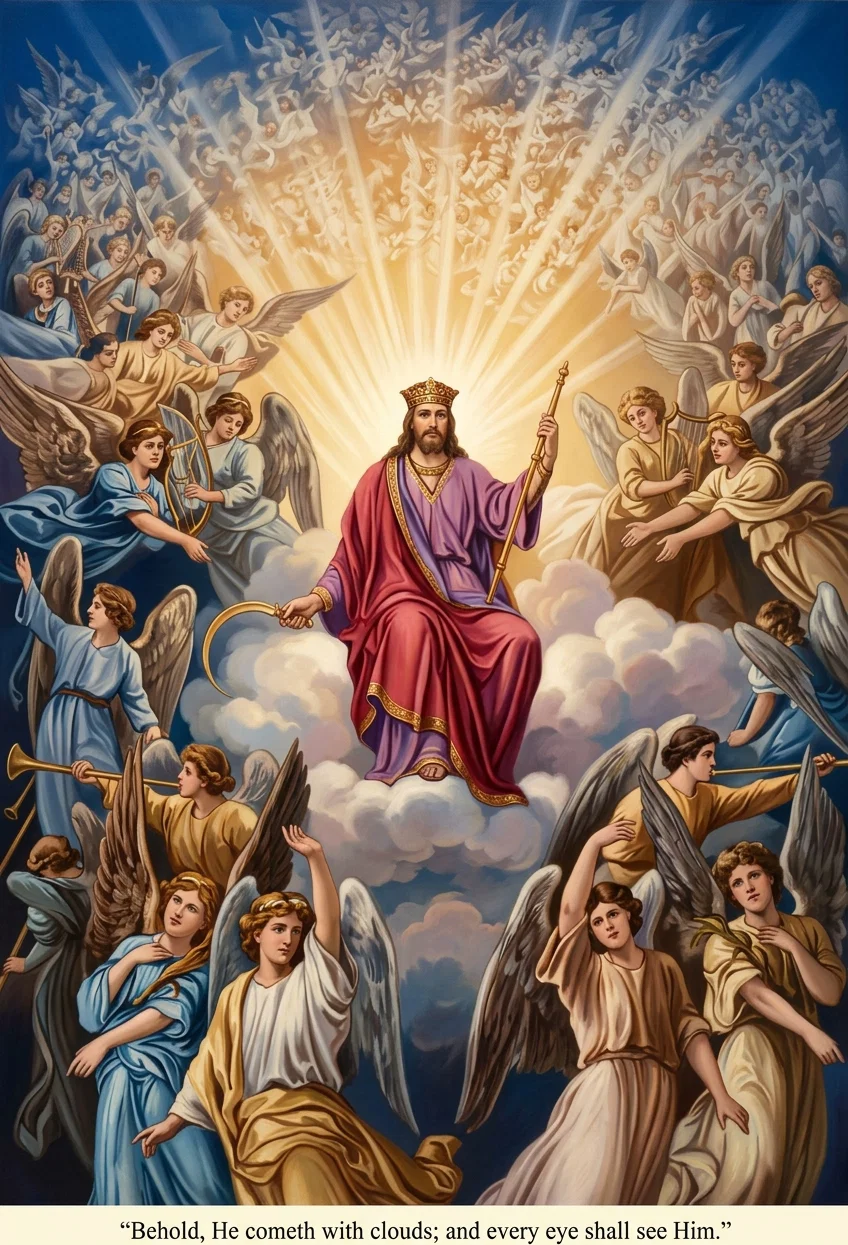
“Behold, He cometh with clouds; and every eye shall see Him.”
The coming of Christ will be —

3. Visible

In the hour of death, Jesus comes near by His blessed Spirit, to console and comfort. Many a weary warrior, as he has come down to the end of his pilgrimage, has had blessed experiences in the Lord as a crowning evidence and assurance of his acceptance by the Saviour. Some have even seen visions of the heavenly land, and their eyes have been opened so that they have seen the angels of God about their bedside; but this, altho so blessed, and a foretaste of the heavenly glories, was not the coming of Jesus. Says our Saviour, in speaking of that time: "Wherefore if they shall say unto you, Behold, He is in the desert; go not forth: behold, He is in the secret chambers; believe it not. For as the lightning cometh out of the east, and shineth even unto the west; so shall also the coming of the Son of Man be." The words of the angels at the ascension may again be quoted with special application to this point: "This same Jesus . . . shall so come in like manner as ye have seen Him go into heaven."
Then if we are to determine how Christ will come the second time, it is but necessary for us to determine how He went away; and that can readily be done by the ninth verse of the first chapter of Acts, where it says, "While they beheld, . . . a cloud received Him out of their sight." He went away with the clouds of heaven; He is to come in like manner. And this is confirmed by the words of the beloved disciple, "Behold, He cometh with clouds; and every eye shall see Him, and they also which pierced Him: and all kindreds of the earth shall wail because of Him." Rev. 1:7. It does not follow that the clouds spoken of in these scriptures are the misty, vapory clouds of our atmosphere, but doubtless the myriads of angels that surround the Son of God as He will descend to this earth — angels whose glories are veiled from mortal sight, appearing in the far distance as the clouds of our natural atmosphere. But as Christ nears the earth, the glory will become brighter and more resplendent, until it willbecome to the wicked a consuming fire, and to the righteous a transforming power, changing them into the glory of immortality.
Hence, in these days of peril, it is not for us to be deceived by the voice of pretenders. Says Christ of this time, "If any man shall say unto you, Lo, here is Christ, or there; believe it not." The second coming of Christ is not in the deserts of the West, not in the regions of the Sahara, nor will any land or nation or clime vie with another in claiming that honor. His return will be world-wide in knowledge and results. If we pay heed to the "sure word of prophecy," we shall not be deceived, and then ensnared and engulfed.
May the Lord anoint our eyes with the heavenly anointing, that we may be able to discern between the true and the false, the chaff and the wheat. To every humble, believing, trusting soul, God will reveal a knowledge of His will, and will show to him the salvation of our God.

Obedience the Fruit of Love

By Mrs. E. G. White
We should contemplate the love of Jesus, His mission and His work in reference to us as individuals. We are to say, Jesus so loved me that He gave His own life to save me. The Father loves me. "For God so loved the world, that He gave His only-begotten Son, that whosoever believeth in Him should not perish, but have everlasting life." It becomes us to ascertain upon what terms Christ promises the gift of eternal life. I answer, It is upon our faith. We must have faith in the promises. Jesus says: "Verily, verily, I say unto you, He that believeth on Me, the works that I do shall he do also; and greater works than these shall he do; because I go unto My Father. And whatsoever ye shall ask in My name, that will I do, that the Father may be glorified in the Son. If ye shall ask anything in My name, I will do it. If ye love Me, keep My commandments. And I will pray the Father, and He shall give you another Comforter, that He may abide with you forever; even the Spirit of truth; whom the world can not receive, because it seeth Him not, neither knoweth Him: but ye [who love Me] know Him; for He dwelleth with you, and shall be in you." "He that hath My commandments, and keepeth them, he it is that loveth Me: and he that loveth Me shall be loved of My Father, and I will love him, and will manifest Myself to him." John 14: 12-17, 21.
"He that hath My commandments" means he that has light upon what constitutes the commandments of God, and will not disobey His commandments, altho it might seem an advantage to do so. "If a man love Me, he will keep My words [commandments]: and My Father will love him, and We will come unto him, and make Our abode with him. He that loveth Me not keepeth not My sayings: and the word which ye hear is not Mine, but the Father's which sent Me." If it were not possible for us to keep the commandments of God, we should all be lost. But under the Abrahamic covenant, the covenant of grace, every provision for salvation has been made. "By grace ye are saved." For "as many as received Him, to them gave He power to become the sons of God."
John writes to the children of God, "My little children, these things write I unto you, that ye sin not." And what is sin?—"Whosoever committeth sin transgresseth also the law: for sin is the transgression of the law." And if any man sin, he need not give up his hope in Christ. He need not say it is of no use longer to attempt to keep the commandments of God; for this would be placing himself wholly on Satan's ground. Satan follows you with his temptations, in order that he may persuade you to yield and sin; and when you sin, then he tells you it is of no use for you to try, and you might just as well announce yourself an open transgressor of the law of God, for you can not keep His commandments. In the name and strength given of God we may be obedient to all His commandments, and His commandments are not grievous. We are happy in doing them.
"And if any man sin, we have an advocate with the Father, Jesus Christ the righteous: and He is the propitiation for our sins: and not for ours only, but also for the sins of the whole world. And hereby we do know that we know Him, if we keep His commandments. He that saith, I know Him, and keepeth not His commandments, is a liar, and the truth is not in him. But whoso keepeth His Word, in him verily is the love of God perfected: hereby know we that we are in Him. He that saith he abideth in Him ought himself also so to walk, even as He walked. Brethren, I write no new commandment unto you, but an old commandment which ye had from the beginning."
The Lord would not leave the enemy any opportunity to perplex the soul or to becloud the mind as to the commandments of which He is speaking. It is the commandments which He made when the foundations of the earth were laid, "when the morning stars sang together, and all the sons of God shouted for joy." Away back in the world's history, before there were any people distinguished as Jews, He laid the foundations of His law, when He laid the foundations of the world. "The old commandment is the Word which ye have heard from the beginning." John the beloved disciple, as mouthpiece for God, gives the inspired message; and it comes echoing down the lines, from age to age, to our time. Thank God, we are not left in mist and confusion in regard to the commandments.
We are required to keep the commandments of God, and to demonstrate before the heavenly worlds that we are obedient children, loyal and true to the government of God. We may not expect the world, which is under the power and dominion of Satan, to obey God and keep His commandments. There are but two classes in our world, the obedient and the disobedient, the holy and the unholy. When our transgressions were laid upon Jesus, He was numbered among the unholy on the sinner's account. He became our substitute, our surety, before the Father and all the heavenly angels. By imputing the sins of the world to Jesus, He became the sinner in our stead, and the curse due to our sins came upon Him. It becomes us to contemplate Christ's life of humiliation and His agonizing death; for He was treated as the sinner deserves to be treated. He came to our world, clothing His divinity with humanity, to bear the test and proving of God. By His example of perfect obedience in His human nature, He teaches us that men may be obedient.
And the apostle writes, "Grace and peace be multiplied unto you through the knowledge of God, and of Jesus our Lord, according as His divine power hath given unto us all things that pertain unto life and godliness, through the knowledge of Him that hath called us to glory and virtue: whereby are given unto us exceeding great and precious promises: that by these ye might be partakers of the divine nature, having escaped the corruption that is in the world through lust." It is here plainly revealed that whosoever believes in Jesus Christ becomes a partaker of the divine nature. Let divinity and humanity coöperate, and fallen man may be more than conqueror through Christ Jesus.

The Third Phase of Christ's Kingdom

The Kingdom of Christ—No. 3

The Third Phase of Christ's Kingdom

THE third phase of Christ's kingdom has a definite and glorious beginning, but no ending. It will stand forever. It can never be moved.
The second phase of His kingdom is generally known as the millennium. It is bounded at both ends by a resurrection. Blessed and holy are they that have part in the first resurrection. They shall not be hurt with the second death; on them it can have no power. The period of their millennial reign will be one of inexpressible joy and unalloyed bliss. Nevertheless, they will be ever looking forward with joyful anticipations to the coming of the third and last phase of Christ's kingdom, when their dominion will be greatly enlarged, and they will enter upon their eternal reign. As evidence of their hope in this regard, harken to one strain in their happy songs: "We shall reign on the earth." Rev. 5:10. Only six simple words of one syllable each; but O, how full of meaning!
At the end of the one thousand years' reign in the holy city in heaven, the New Jerusalem will come down and locate on a beautiful purified plain, made by the leveling of several mountains of sacred memory. Outside of this holy city, the redeemed of the Lord will behold all the works of Satan, completely and forever destroyed by that fire that shall burn as an oven. When the last flickering flame has consumed the originator of rebellion, when all the works of Satan, sin, and the curse are utterly consumed, when all the enemies and the last enemy of Christ's kingdom have forever perished, then will all His glorified subjects hear Him say: "Come, behold the works of the Lord, what desolations He hath made in the earth. He maketh wars to cease unto the end of the earth. . . . Be still, and know that I am God." Ps. 46:8-10.
The redeemed, in silence, will take one long look at the great battle-field where will have just closed the greatest, longest, and most bitter controversy of all the ages. What a scene of desolation! Then theywill hear the same musical voice, in tones loud and clear, saying, "Behold, I make all things new." Rev. 21:5. Then will the inexpressibly glorious new heavens and new earth be unfolded—in six successive days, for aught we know—in all their pristine beauty and loveliness. Then will the morning stars sing together, and all the sons of God will shout for joy. Then the saints of the Most High take and possess the kingdom under the whole heavens, and reign with Christ in this the third and last phase of His everlasting kingdom. Of this kingdom and peace there shall be no end. O, what will it be to be there!
H. A. ST. JOHN.

The Dying Thief

By G. W. White

And he said unto Jesus, Lord, remember me when Thou comest into Thy kingdom. And Jesus said unto him, Verily I say unto thee, To-day shalt thou be with Me in Paradise. Luke 23:42, 43.
E was a hardened wretch. Some people are known by their good deeds; this thief was known by his crimes.
He was nailed to the cross, suffering the last measure of wo that this life could give. A few more hours and he would be dead and his body cast out into the dread Valley of Hinnom. So far as this world was concerned, he had nothing to fear.
Death should have appalled him, but it did not. The sufferings of another should have touched his heart, but they did not. So thoroly reckless and abandoned had he become, that on the cross he joins the other robber in mocking and reviling Jesus in His dying agonies.

They Crucified Two Thieves

At first both of them mocked, the people mocked, the Pharisees and priests mocked, the robbers mocked. O, what a picture! Men created to show forth the glory and goodness of God, cursing and swearing and jeering and mocking another sufferer as they gaze into their own graves and as eternity stares them in the face! Humanity could not sink lower than this. O, what wreck and ruin sin has wrought in this world!
No man is ever, in a moment, made a votary of sin and vice. This man had not always been a jeering, mocking robber and murderer. Once he was a sweet and prattling babe. There was a time when a fond Hebrew mother bent tenderly over his sleeping form, parted those dark locks with fingers of love, and kissed those soft red lips as she fondly dreamed of her boy’s future. But sin, with its blighting, blasting, withering touch, got hold of him. Little by little, by slow gradations, he sank into the mire, until, hanging on the cross, suffering a death of deepest shame, he could spend his time in mocking and deriding the sinless Sufferer. What a thing to be dreaded is sin! Yet, “pride, covetousness, and love of the world have lived in our hearts without fear of banishment or condemnation,” and we seem to be so unconcerned about getting rid of it! At last,

A Great Change Comes Over This Robber

He is brought to see his condition as a lost sinner, and he cries for mercy. He acknowledges his guilt. There was no concealment, no blaming of others or of circumstances, no excusing of himself. He made a clean breast of it all. (See verse 41.) His marvelous faith lays hold of Jesus Christ; and then what?

He Tries to Save His Brother Robber

Hear those marvelous words of rebuke as there is a lull in the jeering and mocking of the multitude: “Dost not thou fear God, seeing thou art in the same condemnation?”
Ah, what a rebuke to the “indolence and slothfulness” of 1911! Here we are, on the verge of eternity, with the curtain about to be raised, comfortably installed in our homes, enjoying the innumerable blessings of God; and He calls upon us to warn our neighbors of the nearness of the end of all things. Have we done it? Are we doing it? Thousands must answer, No. And why not? — We have not the time. We are so deeply engrossed in the affairs of this life, that we haven’t the time. We have had a headache or some other indisposition. But here is a man suffering all the pangs of crucifixion, in the midst of a howling, jeering mob, that has the time and disposition to try at least to save his neighbor.

What Marvelous Faith He Had

Had he been converted at the tomb of Lazarus, or at the feeding of the five thousand, or on Galilee when Jesus stilled the storm-tossed waves with a word, or at the resurrection of Jesus, we would not marvel. But it was when the confidence of Christ’s disciples, who had witnessed wonders, was completely shattered; when all His followers had forsaken Him; when our Lord was actually dying, amid the curses of a world, betrayed, deserted, derided, and cursed — through all this he had faith. All hail, thou dying robber! Snatched from the very jaws of hell, washed from all sins, how bright the diadem that will glitter on thy brow when Jesus crowns His people! What wondrous, triumphant faith! Now note his prayer,

“Lord, Remember Me”

I tell you we would have hushed him at such a time as this. We would have said: You are too late. We are sorry for you, and wish we could help you; but you are too late. See the agony of the Saviour — see the blood trickling down over that blessed, sympathetic face, and dripping from those pierced hands and feet. See the agony that has settled upon His countenance. The earth itself is ready to shudder at the sight, and the skies to drape in mourning. O, no; trouble not the Master now. He can not pay attention to you when His soul is so full of trouble and wo.
But he, like blind Bartimeus, would not be hushed. If he must perish, he is resolved to perish pleading to be remembered by the Lord of heaven. Then, too,

His Prayer Was Brief

Like Peter sinking beneath the waves, he struck right at the heart of the Saviour.
Had some people whom I have heard pray, been in Peter’s place, they would have been many feet under the waves before they reached the words, “Lord, save me,” unless they dispensed with a lot of formal platitudes and vain repetitions; and had they been in the robber’s place, with “the whole head sick and the whole heart faint,” I fear they would have given up in despair. But his prayer was brief — humble; he asked only to be remembered. It was earnest, the cry of a lost soul on the verge of eternity: “Lord, remember me” — remember all my faults — all my swearing, jeering, mocking, and cursing — remember all my sins, if You will; but along with them all, Lord, remember ME.

Now, Note the Answer

During all that torture, Jesus had been silent. We read:
And the people stood beholding. And the rulers also with them derided Him, saying, He saved others; let Him save Himself, if He be Christ, the chosen of God. And the soldiers also mocked Him, coming to Him, and offering Him vinegar, and saying, If Thou be the King of the Jews, save Thyself. . . . And one of the malefactors which were hanged railed on Him, saying, If Thou be Christ, save Thyself and us. Luke 23:35-37, 39.
But through it all He was silent. All the taunts and insults possible for Satan and his hosts to heap upon Him could not part those lips with a word of retaliation.
He was oppressed, and He was afflicted, yet He opened not His mouth: He is brought as a lamb to the slaughter, and as a sheep before her shearers is dumb, so He openeth not His mouth. Isa. 53:7.
But now,

The Cry of a Penitent Soul Reaches His Ear

A gleam of joy passes through His soul. Renewed strength and courage seem to possess Him. His great heart, almost broken, melts into tenderness; and with a word the black, crime-stained past of the robber is swept away, and hope and the joy and peace of God flood his soul as these soul-stirring words of the Saviour fall upon his heavy ear:
“Verily I say unto thee to-day” — “to-day,” when the confidence of My disciples is completely shattered — “to-day,” when all My followers have forsaken Me — “to-day,” altho I am dying among the curses of a world, betrayed, deserted, derided, cursed — “to-day,” when all seems to be lost, and the powers of darkness seem to have gained a complete victory — yet, “to-day,” in spite of it all — “Verily I say unto thee to-day, Thou shalt be with Me in Paradise.” — Murdock’s Syriac Translation.

What a Wonderful Promise

to a sin-stained soul! Faith brought it. In that dark hour, faith brought the victory over every sin, and opened the flood-gates of heavenly assurance. It surmounted every obstacle, swept every barrier away, cleansed that soul from every stain, and clothed him with the righteousness of the Son of God.
This is the privilege of every soul to-day, and is the requirement which God makes of those who hope to share with Christ in the possession of the earth made new; for they are to be without “spot, or wrinkle, or any such thing” (Eph. 5:27); “without fault before the throne of God.” Rev. 14:5.

Needy

In future years, when dreams bring back to-day, With all its pleasures, sorrows, and its deeds Performed by me, my wish is that I may Be spared from feeling all my present needs.
C. H. Meiers.
Continue reading: God’s Bread Is Always Better Than Our Cake